Advertisement
Advertisement

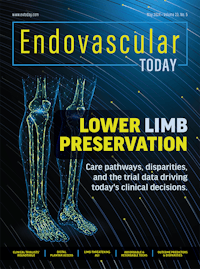
A regular fixture over the last decade has been the May issue of Endovascular Today focusing on critical limb ischemia/chronic limb-threatening ischemia (CLI/CLTI). This year’s issue will try to highlight recent developments, voids in the provision of care, and challenges in the treatment of CLI/CLTI. By inviting physicians from different specialty backgrounds, the importance of a multidisciplinary approach to CLI/CLTI is once more underlined.
Over the last 18 months, CLI/CLTI has been the subject of several randomized controlled trial publications, some comparing open surgery and endovascular treatment, others comparing new endovascular devices with what is considered standard of care in endovascular treatment of the below-the-knee segment. Last year’s issue briefly discussed the BEST-CLI and BASIL-2 trials (the latter published just before Endovascular Today’s May 2023 issue came out), and since then, the SAVAL and LIFE-BTK trials have been published. The outcomes of these four trials have sparked ongoing discussion and debate, and Brian DeRubertis, MD; Alik Farber, MD; Patrick Geraghty, MD; and Athanasios Saratzis, MBBS, shed some additional light on the interpretation of the data in a panel discussion.
In another panel, Eric Secemsky, MD; Lee Kirksey, MD; and Elina Quiroga, MD, reflect on the intensity of both pre- and postamputation care pathways and their influence on outcomes, sharing insights on how care should evolve to reduce amputation rates.
The first of two Literature Highlights articles focuses on a recently published article by Kim Smolderen, PhD, and Carlos Mena-Hurtado, MD, et al that discusses which socioeconomic factors are most predictive of 1-year health status in patients with peripheral artery disease (PAD).
An overview of the current standing of bioresorbable scaffold technologies, results of contemporary trials, and future developments is provided by Marianne Brodmann, MD.
A practical note on distal plantar access by Daniel A.F. van den Heuvel, MD, and myself provides a review of plantar circulation anatomy and some tips and tricks on puncture technique and access. This is followed by an interview with Frank R. Arko III, MD, on his approach to patients with acute limb ischemia, another well-established cause of lower limb amputation that merits attention.
The second Literature Highlights piece focuses on recent work by Pallavi Manvar-Singh, MD, and Elizabeth Genovese, MD, et al, featuring their publication on outcomes in female PAD patients undergoing endovascular intervention and their thoughts on the need for more sex-inclusive research to individualize and optimize treatment.
David Armstrong, DPM, and Caroline Fife, MD, offer their perspectives on the hallmarks of amputation prevention, the importance of multispecialty collaboration, and standards in wound care.
A recent CLI/CLTI-themed Vascular Leaders Forum hosted by The VIVA Foundation is also summarized in the News section of this edition.
Outside of our feature on CLI/CLTI, this issue shares highlights from the spring congresses and concludes with an interview with Iris Quasar Grunwald, MD, on the evolution of minimally invasive stroke treatment from the first experience and future prospects thereof.
I thank all the authors who contributed to this issue and hope you will enjoy this issue!
Jos C. van den Berg, MD, PhD
Guest Chief Medical Editor
Advertisement
Advertisement