Advertisement
Advertisement
November 2024 Supplement
Sponsored by Surmodics, Inc.
A Passion for the Radial-to-Peripheral Approach
A conversation with Matthew C. Hann, MD.
Throughout his career, interventional cardiologist Dr. Matthew C. Hann has demonstrated a strong commitment to medical education, receiving multiple teaching awards and serving as a clinical professor. His career also includes distinguished service in the United States Air Force, with deployment to Afghanistan during Operation Enduring Freedom.
Today, Dr. Hann serves patients at Singing River Cardiology on the Mississippi Gulf Coast. Board certified in cardiovascular disease as well as interventional cardiology, Dr. Hann has extensive experience treating complex coronary and peripheral artery disease from the radial approach. We spoke with Dr. Hann about his approach to radial-to-peripheral interventions and his experience with the Sublime™ Radial Access Platform (Surmodics, Inc.).
What inspired you to adopt radial access?
I trained at Duke University Medical Center with Dr. Sunil Rao as one of my mentors. He is a strong proponent of radial access for coronary procedures and emphasized an unwavering commitment to the approach to improve patient outcomes and satisfaction. I took that to heart and have been passionate about this approach ever since. Naturally, I was a very early adopter of the radial approach for peripheral interventions once the technology became available.
From a patient perspective, it’s absolutely the best approach. When I’m able to use radial instead of femoral access, patient flow and recovery is so much more efficient—patients can sit in a chair and eat a sandwich instead of lying flat in bed for hours after their procedures, often requiring more nursing support.1-4 I also sleep better at night knowing I don’t have to worry about a retroperitoneal bleed or groin complication for these patients.3,5,6 I get very frustrated when I hear femoral operators say they can’t do radial access for peripheral procedures because the tools are not available. The technology has gotten so much better; with current wire and crossing catheter technology, I rarely struggle to cross lesions the way I used to, even compared to a femoral approach. The current radial-to-peripheral sheaths provide remarkable support. Once you do a few cases, you see that radial-to-peripheral works very well for the vast majority of patients.
What types of radial-peripheral cases do you perform?
My bread-and-butter cases are superficial femoral artery (SFA) occlusions. I deal with a lot of those. I’ll also treat iliac arteries, and occasionally disease below the knee for limb salvage situations. Rarely, I run into equipment-length issues with below-the-knee cases, but I’ll at least start radial in a “radial-first approach,” given the very low complication risk with radial access.6 A working knowledge of balloon and shaft length along with sheath length is required to make “off-the-shelf supplies” work.
One thing I love about the radial-to-peripheral approach is being able to fix bilateral SFA occlusions at the same time. This often allows a patient to come in and get everything treated at once as opposed to having a staged procedure, which minimizes supply usage and further streamlines cath lab flow with only one preoperative visit, one moderate sedation period, and one recovery period. From the femoral approach, you’re typically obligated to work in stages for these types of procedures with at least two separate cath lab procedures, frequently requiring patients to take more time away from work. As physicians, we need to put ourselves in our patients’ shoes.
When do you still use femoral access for peripheral procedures?
After I take images from the radial approach, if I see that there is bilateral iliac disease, I’ll sometimes obtain femoral access to allow kissing stents. However, if one iliac artery is affected, I may use a hybrid approach with radial access and single femoral access. For example, if I only need to treat the right iliac, I will place my radial wire down the left iliac for protection and then obtain right femoral access. Unfortunately, the technology has not advanced to the point of allowing large stents to be placed via a 6 Fr system. Additionally, shaft length becomes a limiting factor. Simple math would dictate that minimizing femoral access to a single side instead of bilateral access reduces femoral complications by 50%.
One objection to radial-peripheral is a perceived lack of bailout options. What are your thoughts?
I’ve found the risk of having complications that require you to bailout and put in a stent are very low if you’re careful and have some patience.
For example, when I’m treating a SFA lesion, my practice is to perform atherectomy and then do very long balloon inflations to reduce the risk of dissection and the subsequent need for bailout stenting.7 I’ll frequently do a 5-minute inflation, and I usually just go up to whatever pressure expands the balloon. I’m not doing nominal pressure, going to 10 atm on every SFA lesion. If 4 atm expands the balloon and there is no waist in the balloon, I stop there. In any case, stents are not the ideal way of treating SFA disease. I think that’s clearly demonstrated now in the literature.8
Admittedly, unless the patient is a poor surgical candidate, I usually steer clear of treating common femoral stenoses via radial access, because that’s an area where I don’t ever want to have to bailout with a stent. Additionally, compromising the profunda can lead to severe complications. In any case, it is a fairly straightforward procedure for a vascular surgeon to make a small incision and perform an endarterectomy in the common femoral artery. A team approach and knowing technological limitations always lead to better outcomes.
What has been your experience with Sublime™ Radial Access devices?
I find the Sublime™ sheaths to be very deliverable and the support I get from them is outstanding. The Sublime™ RX PTA .014 and .018 catheters (250 and 220 cm working lengths, respectively) are very deliverable and track through lesions exceptionally well. Our facility recently gained access to the Sublime™ microcatheters (.014, .018, and .035 inch; ≤ 200 cm working lengths) and I have used them only a few times. My experience so far is that they are very pushable and cross very well, especially with the angled tip.
1. Busca E, Airoldi C, Bertoncini F, et al. Bed rest duration and complications after transfemoral cardiac catheterization: a network meta-analysis. Eur J Cardiovasc Nurs. 2023;22:454-462. doi: 10.1093/eurjcn/zvac098
2. Balaji NR, Shah PB. Radial artery catheterization. Circulation. 2011;124:e407-408. doi: 10.1161/CIRCULATIONAHA.111.019802
3. Alkagiet S, Petroglou D, Nikas DN, Kolettis TM. Access-site complications of the transradial approach: rare but still there. Curr Cardiol Rev. 2021;17:279-293. doi: 10.2174/1573403X16999200819101923
4. Amoroso G, Sarti M, Bellucci R, et al. Clinical and procedural predictors of nurse workload during and after invasive coronary procedures: the potential benefit of a systematic radial access. Eur J Cardiovasc Nurs. 2005;4:234-241. doi: 10.1016/j.ejcnurse.2005.03.005
5. Sajnani N, Bogart DB. Retroperitoneal hemorrhage as a complication of percutaneous intervention: report of 2 cases and review of the literature. Open J Cardiovasc Med. 2013;7:16-22. doi: 10.2174/1874192401307010016
6. Posham R, Biederman DM, Patel RS, et al. Transradial approach for noncoronary interventions: a single-center review of safety and feasibility in the first 1,500 cases. J Vasc Interv Radiol. 2016;27:159-166. doi: 10.1016/j.jvir.2015.10.026
7. Rockley M, Jetty P, Radonjic A, et al. Prolonged versus brief balloon inflation during arterial angioplasty for de novo atherosclerotic disease: A systematic review and meta-analysis. CVIR Endovasc. 2019;2:29. doi: 10.1186/s42155-019-0072-2
8. Chowdhury MM, McLain AD, Twine CP. Angioplasty versus bare metal stenting for superficial femoral artery lesions. Cochrane Database Syst Rev. 2014;6:CD006767. doi: 10.1002/14651858.CD006767.pub3
Caution: Federal (US) law restricts the Sublime™ Radial Access Guide Sheath, the Sublime™ Radial Access .014 and .018 RX PTA Dilatation Catheters, and the Sublime™ Radial Access .014, .018, and .035 Microcatheters to sale by or on the order of a physician. Please refer to each product’s Instructions for Use for indications, contraindications, warnings, and precautions. SURMODICS, SUBLIME, and SURMODICS and SUBLIME logos are trademarks of Surmodics, Inc. and/or its affiliates. Third-party trademarks are the property of their respective owners.

Case Report
Successful Revascularization of Near-Total Peroneal Artery Occlusion Via Radial Access
By Matthew C. Hann, MD
PATIENT PRESENTATION
A man in his mid 70s with a nonhealing ulcer on his right great toe (Figure 1) was referred by his podiatrist to interventional care for revascularization of his right leg. The patient had a history of hypertension, hyperlipidemia, chronic kidney disease, diastolic heart failure, coronary artery disease, and diabetes. He had been followed by wound care for his nonhealing toe ulcer for several months prior to presentation for interventional care. A previous Doppler study performed by the podiatrist suggested a distal superficial femoral artery (SFA) stenosis. A CT scan that had been performed several months prior had shown occlusion of all below-the-knee (BTK) vessels, but the patient had not had a nonhealing wound at that time and conservative treatment was recommended.
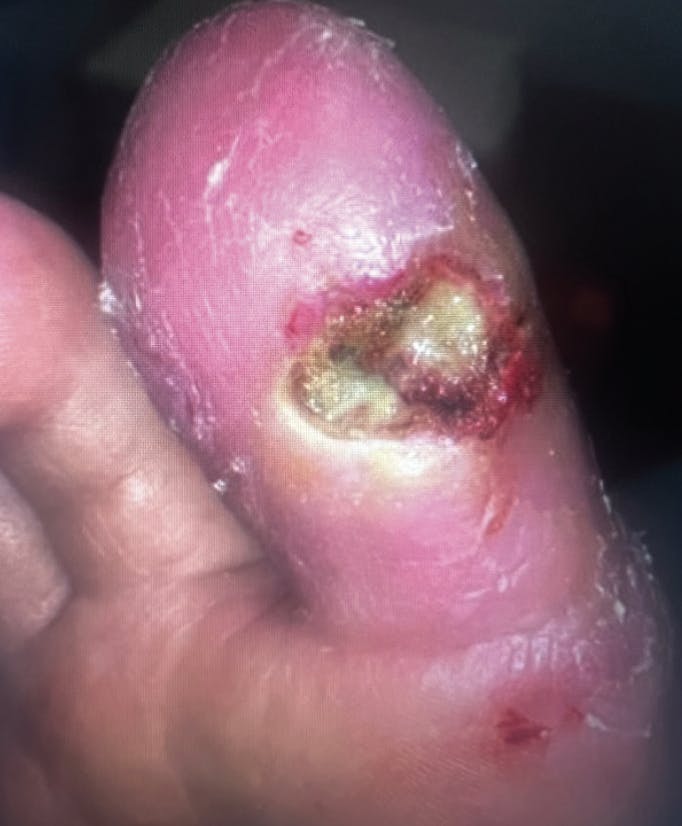
Figure 1. Nonhealing right great toe ulcer.
Courtesy of Dr. Matthew C Hann.
DIAGNOSTIC FINDINGS
Access was achieved in the left radial artery using a 6 Fr Slender™ sheath (Terumo Interventional Systems). The radial cocktail was administered, and a 400 cm Glidewire® Baby-J™ hydrophilic-coated guidewire (Terumo Interventional Systems) was used to place a 4 Fr pigtail catheter in the right common femoral artery. Angiography showed that the right distal SFA was not occluded, but rather that all three BTK vessels on the right side had occlusions (Figure 2). The anterior tibial (AT) and posterior tibial (PT) arteries had long, total occlusions, and the peroneal artery had a near-total occlusion in the proximal segment.
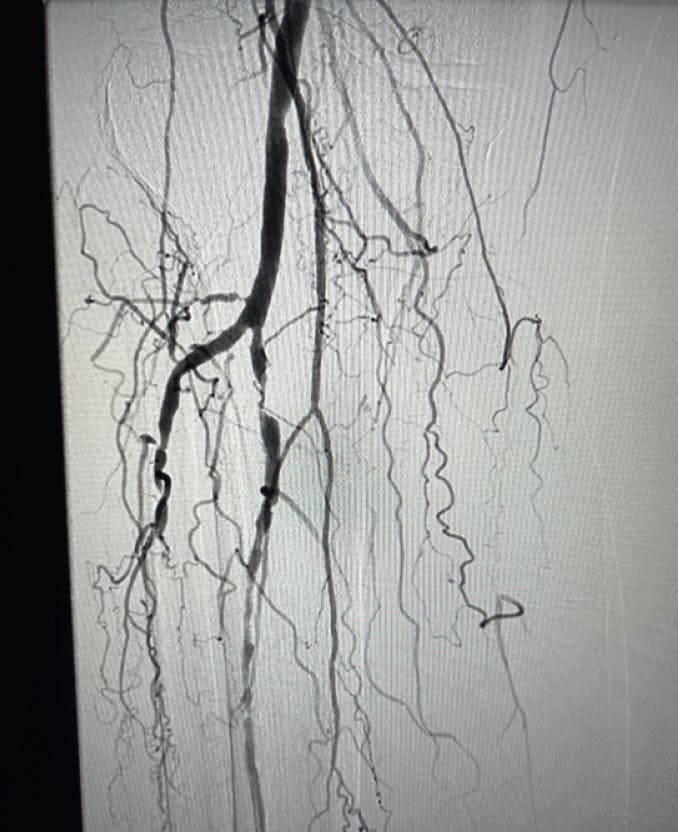
Figure 2. Near-total occlusion of the right peroneal artery.
TREATMENT
The 400 cm Glidewire® guidewire was placed in the SFA and the short sheath was exchanged for a 150 cm Sublime™ 6 Fr sheath (Surmodics, Inc.). The peroneal stenosis was crossed using the Glidewire® Baby-J™ guidewire and an angled, 200 cm, .035 Sublime™ microcatheter (Surmodics, Inc.). True lumen crossing was confirmed by injecting a small amount of contrast through the microcatheter. The guidewire was then exchanged for the 475 cm ViperWire Advance™ peripheral guidewire (Abbott) and four orbital atherectomy passes were performed. After atherectomy, balloon angioplasty was performed.
Final angiography showed single-vessel runoff to the foot (Figure 3). Revascularization of the AT and PT arteries was not attempted due to the patient complaining of persistent back pain. Nonetheless, given brisk, single-vessel runoff to the foot, the procedure was deemed successful. A TR Band® radial compression device (Terumo Interventional Systems) was used for hemostasis. Total procedure time from access to closure was 58 minutes.
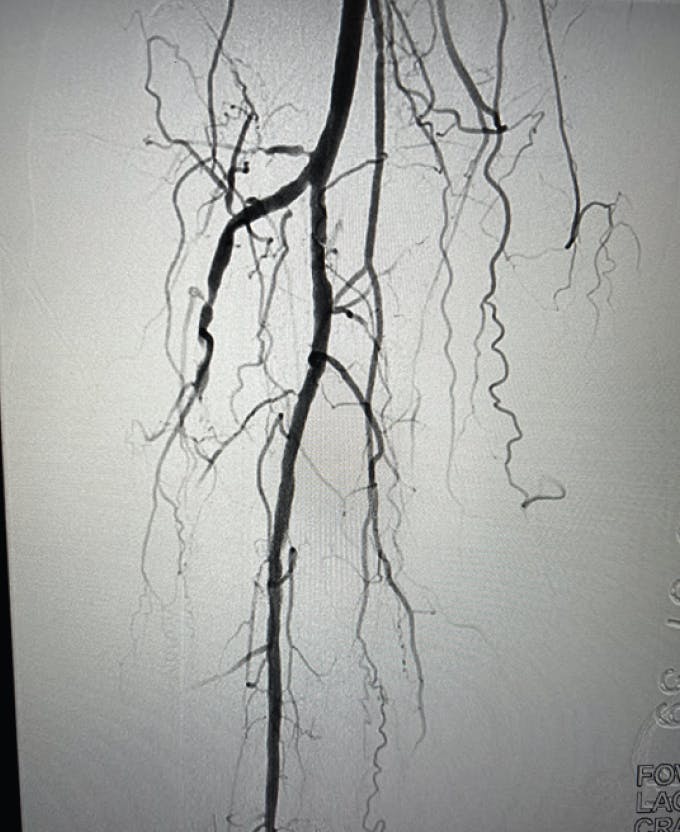
Figure 3. Patent peroneal artery with single-vessel runoff to the foot.
POSTPROCEDURE OUTCOME
The patient was discharged 4 hours after the intervention with a plan to continue his aspirin and clopidogrel therapy. This radial-first approach allowed for same-day patient discharge without the need for femoral access in a patient with chronic back pain and difficulty lying on his back for extended periods.
Caution: Federal (US) law restricts the Sublime™ Radial Access Guide Sheath, the Sublime™ Radial Access .014 and .018 RX PTA Dilatation Catheters, and the Sublime™ Radial Access .014, .018, and .035 Microcatheters to sale by or on the order of a physician. Please refer to each product’s Instructions for Use for indications, contraindications, warnings, and precautions. SURMODICS, SUBLIME, and SURMODICS and SUBLIME logos are trademarks of Surmodics, Inc. and/or its affiliates. Third-party trademarks are the property of their respective owners.
Advertisement
Advertisement