Advertisement
Advertisement
November 2024 Supplement
Sponsored by Surmodics, Inc.
Approaching 90% Radial-to-Peripheral for Complex CLI Interventions
A conversation with Ankit A. Patel, MD, FSCAI, FACC, RPVI.
Dr. Ankit A. Patel, an interventional cardiologist with the Northside Hospital health care system in greater Atlanta, Georgia, specializes in performing complex coronary and peripheral interventions from the radial approach. By his own account, he will do “anything to avoid femoral access”—including tackling long chronic total occlusions (CTOs)—to reduce patient risk with wrist access. Dr. Patel has participated as a site investigator for multiple clinical trials and has been actively involved in medical executive, credentialing, peer review, and technology steering committees. We spokewith Dr. Patel about the state of the art for radial-peripheral interventions.
What types of patients do you typically see?
Almost 80% of my peripheral interventions are Rutherford class 4 to 6. I like to treat rest pain, people we can help improve dramatically overnight. Many are no-option patients, people with very complex disease who have prohibitive surgical risks or very elderly patients with nonhealing wounds. These patients are in pain, they’re miserable, and their families don’t know what to do. It’s satisfying to be able to open their blood flow and see them get better.
How would you describe your transition to radial access for peripheral interventions?
During my early career, I was content with doing straightforward, less complex peripheral interventions. With time and experience, I became very comfortable doing transfemoral CTOs and atherectomy. These were 100% femoral access because of equipment limitations.
When radial-length sheaths and orbital atherectomy became available around 2019, I began doing about 20% of peripheral cases with radial access; most were less complex TASC (TransAtlantic Inter-Society Consensus) A or B lesions. I’m now very close to 90% radial-to-peripheral. About 60% of these cases are radial only, and 40% are radial and pedal for very complicated critical limb ischemia (CLI) with tight CTOs. We do a lot of CLI below-the-knee (BTK) work and CTOs of the iliacs or superficial femoral artery.
In a nutshell, why do you prefer the radial approach?
It’s much safer for the patient.1 Recovery is also faster, so you don’t hold up the bed—the patient can be out of the hospital in 2 hours.2 My staff has become very comfortable with radial access. For me, doing a radial-peripheral intervention is as fast as a femoral intervention.
When do you still select femoral access?
Lack of radial pulse, arteriovenous fistula, or a CTO case where I feel I need directional atherectomy. Of course, you also need to exclude patients with radial arteries too small for available equipment. The Sublime™ 5 Fr guide sheath (Surmodics, Inc.) helps with patients who have very small radial arteries—for example, elderly, petite female patients—that aren’t suitable for a 6 Fr system (see case on page 17). I would prefer to use the 5 Fr system for these patients to reduce the risk of losing their radial pulse for future interventions. To be successful as radialists, we need to maintain the option for radial access.
What other equipment limitations do you feel the Sublime™ Radial Access Platform has helped to address?
At times, I’ve had to bail out to femoral access because we couldn’t cross highly calcified distal CTOs—we’ve lacked support catheters longer than 150 cm. The only one we had was the ViperCath™ XC catheter (Abbott), which is .035 and, in my experience, will not cross a CTO segment. Surmodics has filled a big gap we faced in trying to go BTK. Since we’ve added Sublime™ PTA catheters and the Sublime™ 200 cm support catheters in the last few months, I have successfully opened three or four CTOs that I would not have been able to do transradial without using combined pedal access (see case on page 18). I don’t like to use pedal access unless it is absolutely necessary.
One of the drawbacks to radial-peripheral has been having to go left radial for interventions to get that extra 10 or 15 cm of length, which is precious for us. It’s prudent to use right radial access if possible—in my experience, it helps reduce radiation exposure for the patient, provider, and staff. I think the Sublime™ platform fills that void with the 220 cm (.018) and 250 cm (.014) PTA catheters. They have long rapid-exchange segments (45 and 50 cm for the .014 and .018 platforms, respectively), which gives you support, pushability, and crossability.
Do you have practical tips for new radialists for avoiding radial artery spasm?
The number one tip is to do an ultrasound of your radial artery, whether it’s left or right, and make sure you are not setting yourself up for failure. If you know the radial artery is big enough, then you know you can be comfortable doing the procedure. Number two is to heavily sedate these patients, numb them very well. You don’t want to have a wide-awake patient go into the procedure anxious—that can just kill your access. The third thing is that you can always test for radial spasm with smaller catheters. When you do your diagnostic angiogram with a 5 Fr multipurpose catheter or a pigtail, you can observe how the patient reacts. If that goes smoothly, the chance of them having spasm with a 6 Fr is very low.
In terms of spasm, your dilator is your best friend. They help reduce risk of radial spasm as the sheaths advance. Even if you’re new to radial access, avoiding spasm is not that difficult—you may have to do five cases to be comfortable. You just need someone like me you can call and say, “OK, I’m stuck in this situation, what do I do?”
What is the key to getting radial-peripheral adopted in hospitals?
You need experienced endovascular specialists in a program who can train new radial fellows, or even just talk to them, support them. I think endovascular specialists—whether they’re surgeons, radiologists, or cardiologists—owe it to colleagues to train them on how to do the right thing for the patient. When you have this, radial-peripheral will amplify very quickly, just as it did for coronary interventions after the trials came out that showed mortality benefit from using radial instead of femoral access.1 Radial access procedures result in less bleeding, less risk of retroperitoneal hematoma, and reduce the risk of patient death.
Caution: Federal (US) law restricts the Sublime™ Radial Access Guide Sheath, the Sublime™ Radial Access .014 and .018 RX PTA Dilatation Catheters, and the Sublime™ Radial Access .014, .018, and .035 Microcatheters to sale by or on the order of a physician. Please refer to each product’s Instructions for Use for indications, contraindications, warnings, and precautions. SURMODICS, SUBLIME, and SURMODICS and SUBLIME logos are trademarks of Surmodics, Inc. and/or its affiliates. Third-party trademarks are the property of their respective owners.
1. Ferrante G, Rao SV, Jüni P, et al. Radial versus femoral access for coronary interventions across the entire spectrum of patients with coronary artery disease: a meta-analysis of randomized trials. JACC Cardiovasc Interv. 2016;9:1419-1434. doi: 10.1016/j.jcin.2016.04.014
2. Mason PJ, Shah B, Tamis-Holland JE, et al. An update on radial artery access and best practices for transradial coronary angiography and intervention in acute coronary syndrome: a scientific statement from the American Heart Association. Circ Cardiovasc Interv. 2018;11:e000035. doi: 10.1161/HCV.0000000000000035

Case Report
Successful Below-the-Knee Revascularization Via Radial Access With Sublime™ Guide Sheath
By Ankit A. Patel, MD, FSCAI, FACC, RPVI
Patient Presentation
A woman in her early 60s with a history of diabetes, hypertension, hyperlipidemia, and peripheral artery disease presented with a nonhealing wound in her right lower leg.
Diagnostic Findings
An initial angiogram displayed severe runoff disease, a completely occluded anterior tibial (AT) artery, a 90% calcified stenosis in the tibioperoneal trunk (TPT) and posterior tibial (PT) artery, and a peroneal stenosis (Figure 1A). Overall flow was sluggish, and the patient complained of leg numbness.
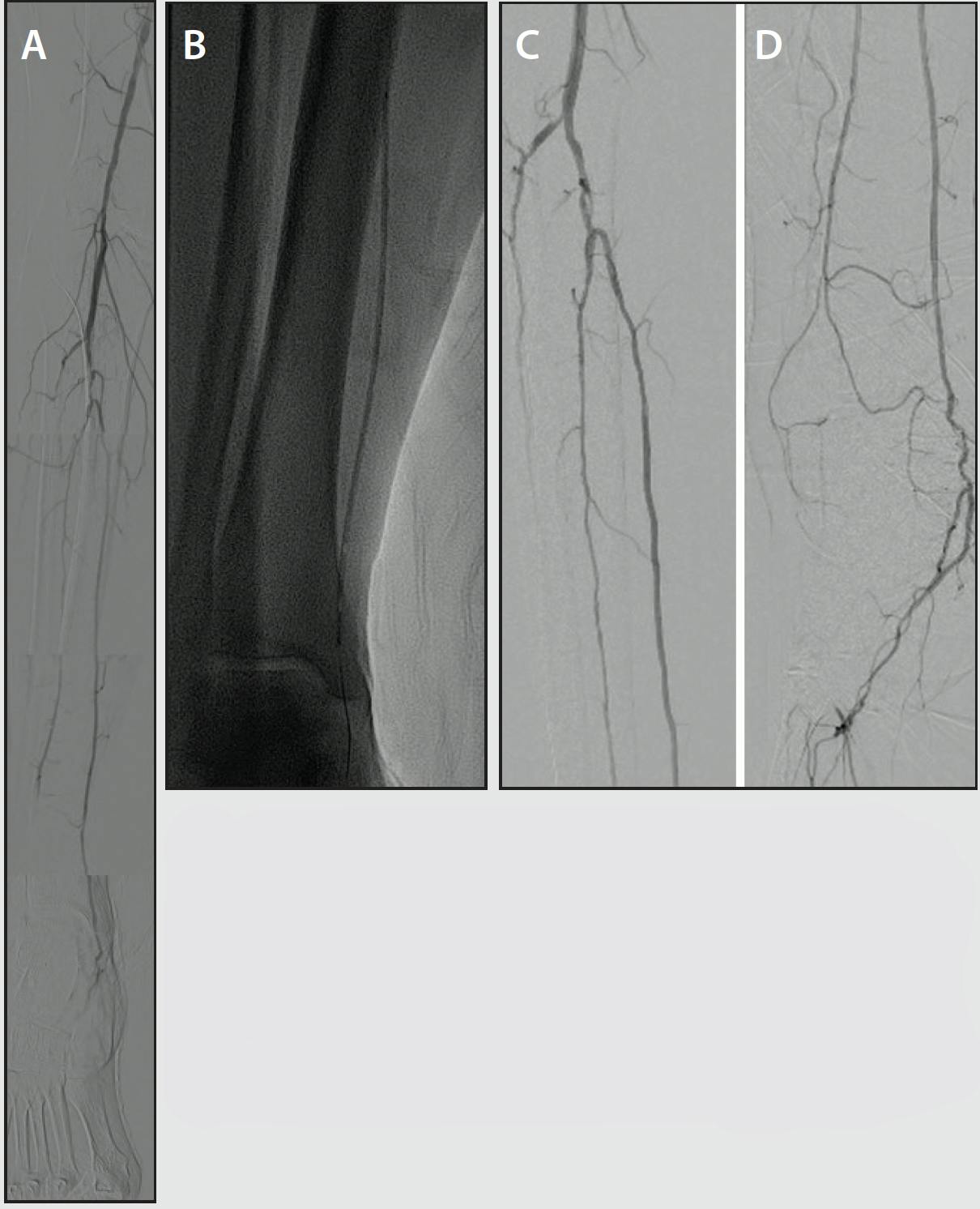
Figure 1. Initial angiogram displayed severe runoff disease, a completely occluded AT artery, a 90% calcified stenosis in the TPT and PT artery, and a peroneal stenosis (A). A 2.0 X 100 mm Sublime™ .014 RX PTA catheter was used to open flow to the AT artery (B). The final angiograms showed good two-vessel runoff, a blush foot, and no further disease to the distal foot (C, D).
The patient reported having a poor experience with a prior femoral access intervention due to bleeding and was pleased that a transradial procedure could be attempted.
Treatment
Left radial access was obtained using a 5 Fr, 150 cm Sublime™ guide sheath (Surmodics, Inc.). The guide sheath was advanced into the right superficial femoral artery. A guidewire was maneuvered into the AT artery, and a 2.0 X 100 mm Sublime™ .014 RX PTA catheter (Surmodics, Inc.) was used to open flow to the artery (Figure 1B). After the AT artery was revascularized, attention was given to the TPT. Due to the highly calcific nature of the TPT stenosis, the .014 guidewire and Sublime™ .014 RX PTA catheter would not cross. The Sublime™ PTA catheter was swapped out for a .018, 200 cm Sublime™ microcatheter (Surmodics, Inc.). With application of both push and torque, the microcatheter crossed the TPT stenosis.
Atherectomy was then used to debulk calcium in the TPT. After a few passes of the atherectomy system, the PT artery was wired and further atherectomy was conducted in the vessel to debulk more of the highly calcific stenosis. The atherectomy system was removed, and a 2.0 X 100 mm Sublime™ .014 RX PTA Catheter was dilated in the PT artery. After dilating the PT artery, a final angiogram showed good two-vessel runoff, a blush foot, and no further disease to the distal foot (Figure 1C and 1D). A TR Band® radial compression device (Terumo Interventional Systems) was placed on the patient’s left wrist.
Postprocedure Outcome
The patient was discharged 2 hours after the intervention on dual antiplatelet therapy.
Physician Observations
Due to the small stature of the female patient, a 5 Fr guide sheath was needed to maintain access and make the procedure as comfortable for her as possible. The .018, 200 cm Sublime™ microcatheter facilitated crossing of highly calcified below-the-knee stenoses, leading to same-day discharge without the need for femoral access.
Caution: Federal (US) law restricts the Sublime™ Radial Access Guide Sheath, the Sublime™ Radial Access .014 and .018 RX PTA Dilatation Catheters, and the Sublime™ Radial Access .014, .018, and .035 Microcatheters to sale by or on the order of a physician. Please refer to each product’s Instructions for Use for indications, contraindications, warnings, and precautions. SURMODICS, SUBLIME, and SURMODICS and SUBLIME logos are trademarks of Surmodics, Inc. and/or its affiliates. Third-party trademarks are the property of their respective owners.
Case Report
Successful Revascularization of Distal AT and DP Via the Radial Approach
By Ankit A. Patel, MD, FSCAI, FACC, RPVI
Patient Presentation
A woman in her mid 80s presented with a nonhealing wound on the lateral aspect of her left foot. Although she had been receiving wound care at an outside location, the wound resisted healing, and she reported pain in the foot. After ultrasound confirmation of diseased vessels in the foot, and with her TBI (toe-brachial index) in the range of 0.5 to 0.6, she was referred in for further diagnosis and potential treatment.
Diagnostic Findings
The patient was confirmed to have nonpalpable dorsalis pedis (DP) artery pulses, with palpable posterior tibial (PT) artery pulses. Right radial access was obtained, and a 5 Fr, 150 cm Sublime™ guide sheath (Surmodics, Inc.) was placed to facilitate diagnostics. An initial angiogram confirmed that the DP and distal AT arteries were 100% occluded, while the PT artery was patent (Figure 1A and 1B).
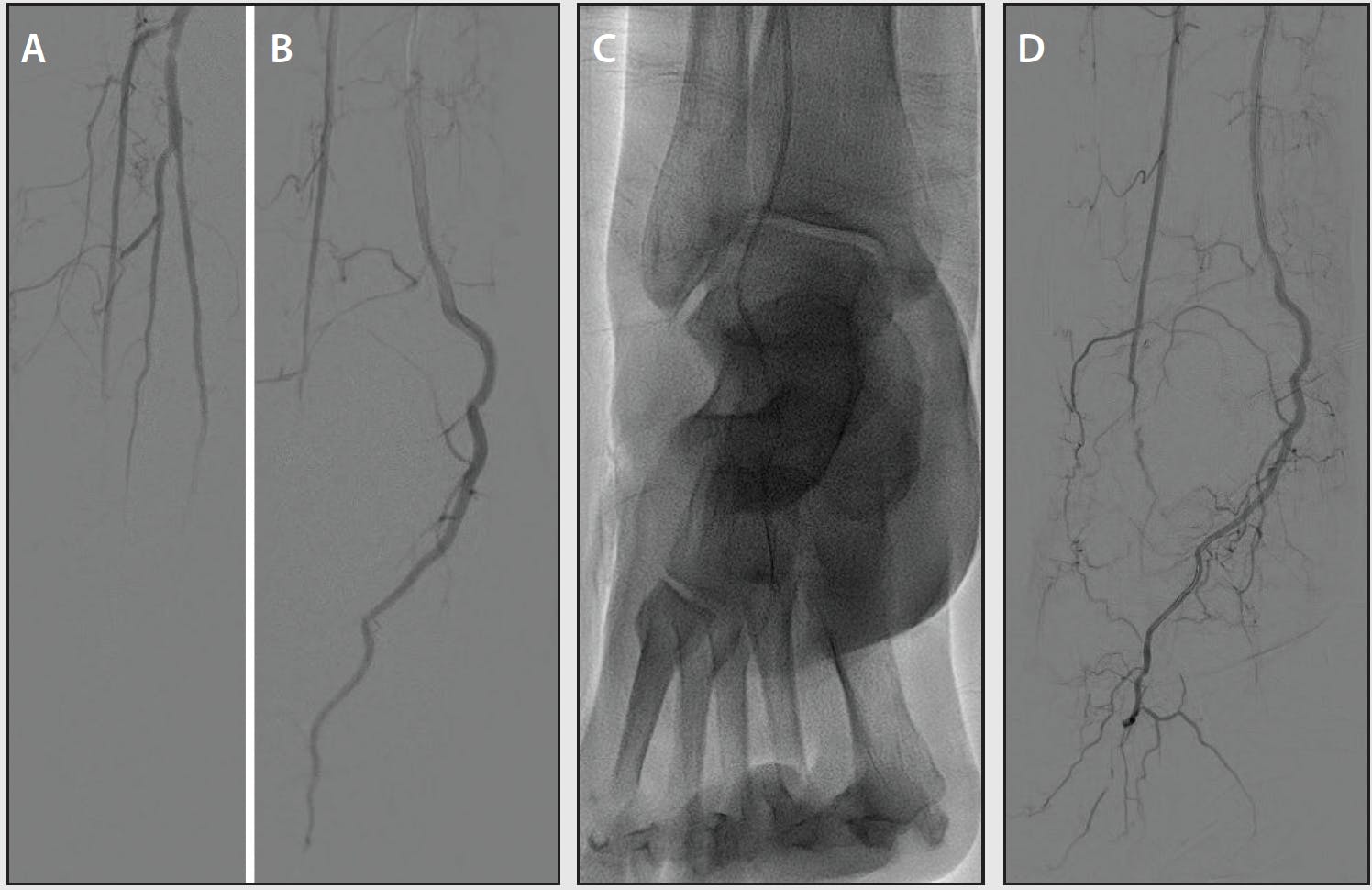
Figure 1. An initial angiogram confirmed that the DP and distal AT arteries were 100% occluded, while the PT artery was patent (A, B). The Hi-Torque Whisper™ MS guidewire was knuckled and used to cross into the DP and distal AT arteries. A further dilatation in the DP and distal AT arteries was conducted using the 2.0 X 100 mm Sublime™ .014 RX PTA catheter (C). Postintervention angiogram showing flow to the DP artery (D).
Treatment
A .014 Regalia® XS 1.0 (Asahi Intecc) guidewire and a 2.0 X 100 mm Sublime™ .014 RX PTA catheter (Surmodics, Inc.) were advanced through the 5 Fr Sublime™ guide sheath but were unable to cross the occlusion. The guidewire was swapped out for a Hi-Torque Whisper™ MS guidewire (Abbott). The occlusion still could not be crossed using an antegrade approach, so a retrograde approach was conducted via the PT artery around the pedal arch. The curvature of the pedal arch made crossing difficult. The Hi-Torque Whisper™ MS guidewire was then knuckled and used to cross into the DP and distal AT arteries. A further dilatation in the DP and distal AT arteries was conducted using the 2.0 X 100 mm Sublime™ .014 RX PTA catheter (Figure 1C). After the dilation, a Doppler pulse was observed in the DP artery. The final angiogram showed spasm in the distal tibial vessels, but after a brief period the spasm resolved, and the patient was observed to have bounding DP arterial pulses and patent flow (Figure 1D).
Postprocedure Outcome
The patient was discharged 2 hours after the intervention. At 1-week follow-up, her wound had observably improved.
Caution: Federal (US) law restricts the Sublime™ Radial Access Guide Sheath, the Sublime™ Radial Access .014 and .018 RX PTA Dilatation Catheters, and the Sublime™ Radial Access .014, .018, and .035 Microcatheters to sale by or on the order of a physician. Please refer to each product’s Instructions for Use for indications, contraindications, warnings, and precautions. SURMODICS, SUBLIME, and SURMODICS and SUBLIME logos are trademarks of Surmodics, Inc. and/or its affiliates. Third-party trademarks are the property of their respective owners.
Advertisement
Advertisement