Advertisement
Advertisement
September 2024
Drug Delivery From ATK to BTK: What Is on the Horizon?
Experts discuss differences in drug delivery between ATK and BTK, the future of sirolimus-coated balloons, device innovation in the infrapopliteal arteries, where drug-eluting bioresorbable scaffolds fit into the BTK algorithm, and the most significant unmet needs.
With moderator Ramon L. Varcoe, MBBS, MS, FRACS, PhD, MMed(ClinEpi), and panelists Marianne Brodmann, MD; Osamu Iida, MD, PhD; Sahil A. Parikh, MD; and Peter A. Schneider, MD





Prof. Varcoe: What do you see as the main differences between drug delivery above the knee (ATK) compared to below the knee (BTK)?
Prof. Brodmann: In the ATK space, we have learned a lot about adequate vessel preparation to guarantee adequate drug uptake. In BTK, we still have the challenge of achieving an optimal result after using some vessel preparation technologies. In addition, there is much more medial arterial sclerosis, which makes drug uptake or delivery to the right space difficult, especially in patients with diabetes.
Dr. Iida: The differences between ATK and BTK lesions in symptomatic peripheral artery disease (PAD) lie in vessel diameter and plaque characteristics. Notably, the vessel diameter in BTK lesions is smaller compared to ATK lesions. Previous reports indicate that assessments of vessel diameter using different modalities, such as angiography and intravascular ultrasound (IVUS), often result in underestimation when evaluated by angiography. This discrepancy is particularly pronounced in smaller vessels, suggesting that the rate of underestimation is higher in the infrapopliteal region. This difference is crucial when selecting balloon sizes. One reason for the suboptimal outcomes of drug-coated balloon (DCB) treatment in the BTK region may be that the DCB sizes are inadequately small relative to the vessel diameter, leading to insufficient drug delivery and, consequently, diminished therapeutic effects. Furthermore, existing clinical studies have reported differences in plaque characteristics, noting that infrapopliteal lesions often exhibit significant calcification, with thrombosis being a major contributing factor to occlusion. Understanding the plaque characteristics in BTK lesions is essential for optimizing drug delivery.
Dr. Schneider: The outstanding thing about ATK drug delivery is the efficacy of paclitaxel, which is readily delivered by either balloon or stent. Paclitaxel studies have set a high bar for patency, and competing drug delivery preparations must perform within a reasonable range of that level. It is striking that just centimeters more distal in the BTK vasculature, it’s not yet clear whether paclitaxel is efficacious. There are negative studies, but those failures appear to be a combination of the delivery device and study design. We know that sirolimus-based compounds are effective when delivered by balloon-expandable stent or drug-eluting resorbable scaffold in the BTK space. However, the delivery of sirolimus by balloon is quite inefficient, and there is no proof yet that we have success by balloon delivery, either ATK or BTK.
Dr. Parikh: Primarily, I believe that the pharmacokinetics and pharmacodynamics of drug delivery to inhibit neointimal hyperplasia differs between vascular beds. With respect to ATK versus BTK, the obvious issue is that the surface area needing uniform drug uptake is much greater in the larger-diameter ATK vessels. It is simply easier to have drug diffuse from stent struts around the artery and achieve therapeutic drug levels when eluting from a scaffold in the smaller-diameter BTK arteries than in the larger-diameter ATK arteries. Moreover, ATK vessels tend to be more elastic and less muscular than BTK arteries and frequently have less uniform medial calcinosis; these properties alter the ability for endoluminal drug delivery to affect steady-state drug concentrations within the arterial wall.
Prof. Varcoe: Sirolimus-coated balloons captured a lot of attention when there was a safety cloud over paclitaxel. What do you think their future holds now that the safety issues around paclitaxel have been disproven?
Dr. Iida: I believe that sirolimus-coated balloons will become the mainstream option. This belief stems from ongoing safety concerns regarding downstream effects and aneurysmal changes associated with the use of paclitaxel devices. Currently, the clinical evidence supporting the reduction of reintervention and restenosis rates with paclitaxel-coated balloons (PCBs) and drug-eluting stents (DESs) in the treatment of femoropopliteal lesions is substantial. Consequently, I routinely employ PCBs and DESs in my everyday practice.
However, I exercise caution in specific scenarios. During the treatment of chronic total occlusion (CTO) lesions, if IVUS evaluation reveals subintimal wire passage and IVUS findings postdilatation indicate medial dissection, I tend to limit the use of paclitaxel devices. Additionally, in cases of chronic limb-threatening ischemia (CLTI) with poor runoff, particularly when utilizing balloon angioplasty, I hesitate to use PCBs due to concerns about potential wound worsening from downstream effects. Although I have a thorough understanding of the safety and efficacy of paclitaxel devices to date, I cannot entirely dismiss my concerns as a clinician. If the efficacy of sirolimus devices proves to be comparable, I believe they could potentially replace paclitaxel devices. Of course, given the ample evidence supporting the use of paclitaxel devices in the PAD, I do not anticipate an immediate transition to sirolimus devices for all treatments. I am eagerly awaiting the results of the SIRONA study, which were presented at CIRSE 2024.
Dr. Parikh: I think that opportunities remain for improvement in clinical performance over “conventional” paclitaxel drug-eluting devices. These include efficacy and improved inhibition of intimal hyperplasia, as well as improved safety regarding embolic debris via avoiding crystalline drug formulations, which tend to have a higher burden of emboli. In the BTK arena in particular, we haven’t had too many successful drug-eluting devices save for Esprit BTK (Abbott), so I’m hopeful that we will see enhanced efficacy with sirolimus-coated devices (both balloons and scaffolds).
Dr. Schneider: Even though we are 20 years into the development of drug delivery to improve the results of lower extremity treatments, I believe we are still in an early phase. The regulatory pathway and the time required to enroll and follow study patients adds many hurdles to the iterative process. When the THUNDER trial was published in The New England Journal of Medicine in 2008,1 it really made me take notice of the potential opportunity to improve what we can offer patients. At that time, coronary intervention had already made the leap to sirolimus-based compounds; we know that there is less cytotoxicity, and we hypothesize that better vessel healing will ensue. In the next generations of drug delivery development, I suspect that we will figure out which compound is best in which location. It may be that we need different compounds for ATK and BTK.
Prof. Brodmann: For ATK, there are convincing data from studies evaluating many different generations of paclitaxel-coated devices (low dose and high dose). Thus, I think it will be difficult to gain the same ground for sirolimus-coated devices.
For BTK, where data are less convincing for paclitaxel-coated devices, efforts can focus on finding an adequate treatment option using sirolimus-coated devices, noting that it is important to have the right trial design and to apply key learnings from already-failed trials.
Prof. Varcoe: What are the most interesting drug delivery adjuncts and devices you’ve seen come through recently?
Dr. Schneider: In my opinion, the most important drug delivery adjunct is our developing focus on accurate vessel imaging and vessel preparation. Appropriate sizing of the vessels and analysis of lesions will likely improve the efficacy of drug delivery and long-term patency. This will drive vessel preparation, which is still in development but for which we have numerous tools and for which our goals are being further defined. Lumen gain, plaque modification, and improved vessel compliance should lead to greater success with all devices.
Prof. Brodmann: The most interesting are vessel preparation tools, which help especially BTK, such as the Serranator percutaneous transluminal angioplasty balloon catheter (Cagent Vascular) and Spur retrievable scaffold (Reflow Medical), as well as some new first-in-human technologies that “inject” drug into the arterial wall. From the point of scaffolding, I believe in drug-eluting resorbable scaffolds (DRS).
Dr. Parikh: There are numerous exciting formulations of drug-eluting devices in clinical development today, including:
- DRS: On the heels of Esprit BTK, there are several fast followers, with Motiv (Reva Medical) and Magnitude (R3 Medical) among them. In the ATK space, eFemoral has an interesting superficial femoral artery device in clinical trials.
- Drug-facilitating devices: The Spur retrievable scaffold fenestrates the artery and facilitates drug uptake, especially in BTK arteries.
- Alternate drug-delivery approaches: Dual drug approaches, such as those proposed by Advanced Nanotherapies, have emerged and include combinations of sirolimus and paclitaxel derivatives from a single DCB. These devices are aiming to achieve therapeutic drug levels at much lower concentrations.
Dr. Iida: The most intriguing drug delivery device is the sirolimus-coated balloon. Currently, its safety and efficacy have been established in several single-arm trials. In the Selution SFA Japan trial, the average lesion length was 127.4 ± 59.7 mm, with a concomitant rate of popliteal artery involvement of 47.8% and a CTO rate of 17.2% in patients with femoropopliteal lesions. The 12-month primary patency and freedom from target lesion revascularization rates were 87.9% and 97%, respectively. However, since this study was not a randomized controlled trial (RCT) and does not report comparative efficacy against PCBs, it is anticipated that future comparative trials will clarify the direction of paclitaxel versus sirolimus for clinical practice.
Prof. Varcoe: Infrapopliteal arteries have seen a series of failed DCB trials. What do you see as the future for drug delivery and mechanical properties of devices in the BTK space moving forward?
Dr. Parikh: Again, I think some of the new approaches listed above will yield benefits in the BTK circulation. With LIFE-BTK already showing promise with DRS, I think those devices as well as combination approaches with different DCB and adjunctive techniques (eg, intravascular lithotripsy and atherectomy) will potentially yield success in the treatment of BTK vessels.
Dr. Iida: The reasons for the failure of DCB trials for BTK are multifactorial; therefore, it is challenging to make definitive statements at this time. Clinical studies on DCB treatment for femoropopliteal lesions indicate that key factors for maximizing drug efficacy include successful vessel preparation and appropriate selection of DCB size. These factors are expected to enhance drug delivery to the target vessels, ultimately reducing restenosis and reintervention rates. However, this aspect has not been thoroughly investigated in the BTK region compared to the femoropopliteal area. If the use of paclitaxel adheres to these principles and improves drug delivery rates, there is a significant possibility that PCBs could yield favorable treatment outcomes. However, if downstream effects similar to those observed with femoropopliteal PCBs occur in BTK treatments, the applicability of these devices may be limited in CLTI patients with poor vascular bed reserve in inframalleolar lesions. In the future, I believe that either PCBs with minimal downstream effects or sirolimus-coated balloons will become central to BTK treatment strategies.
Prof. Brodmann: As previously mentioned, the trial designs need to be appropriate to show the efficacy of a drug in the target lesion. Further, vessel preparation needs to be performed adequately with the new technologies that have shown improved outcome. With these in place and a sufficient DCB available, this will be the standard of care in the BTK space in the future.
Dr. Schneider: Despite some failures, drug delivery BTK is much needed and has a bright future. This is an issue in which the unmet need is greatest and where the patient stories are most compelling. The complexity of the population and the tremendous number of variables that must be managed have made studies of any kind very challenging in the BTK vasculature. At least part of the solution is in trial design and in isolating the variables so that we can understand where improvements are being made. In the BTK arteries, not enough attention has been paid to lumen gain and eliminating recoil. Early tibial vessel thrombosis is not unusual, and no antineoplastic drug can treat that.
Prof. Varcoe: There has been a great deal of interest in DRS since the LIFE-BTK trial. How do these fit into your BTK algorithm?
Prof. Brodmann: This is a great hope and movement forward with use of DRS in the BTK space. Barriers to placing a scaffold in cases of recoil or dissections have been resolved based on results of LIFE-BTK. In recurrent obstructions, DRS could be a first-line therapeutic strategy. A suggested treatment algorithm is needed to delineate optimal use of DRS in BTK disease.
Dr. Schneider: We will need to see how DRS may be used to treat longer and heavily calcified lesions and how they perform when used for bailout.
Dr. Iida: The LIFE-BTK trial is an RCT with level 1 evidence and clearly demonstrated that DRS exhibit favorable patency rates when compared to conventional balloon angioplasty in the treatment of short and less calcified infrapopliteal lesions. Based on this result, a strategy of primary DRS should be considered for treating the short-segment lesions, particularly in the proximal tibial artery and the tibioperoneal trunk in real-world practice.
Dr. Parikh: My algorithm is very analogous to what we published in Journal of the Society for Cardiovascular Angiography & Interventions (Figure 1).2
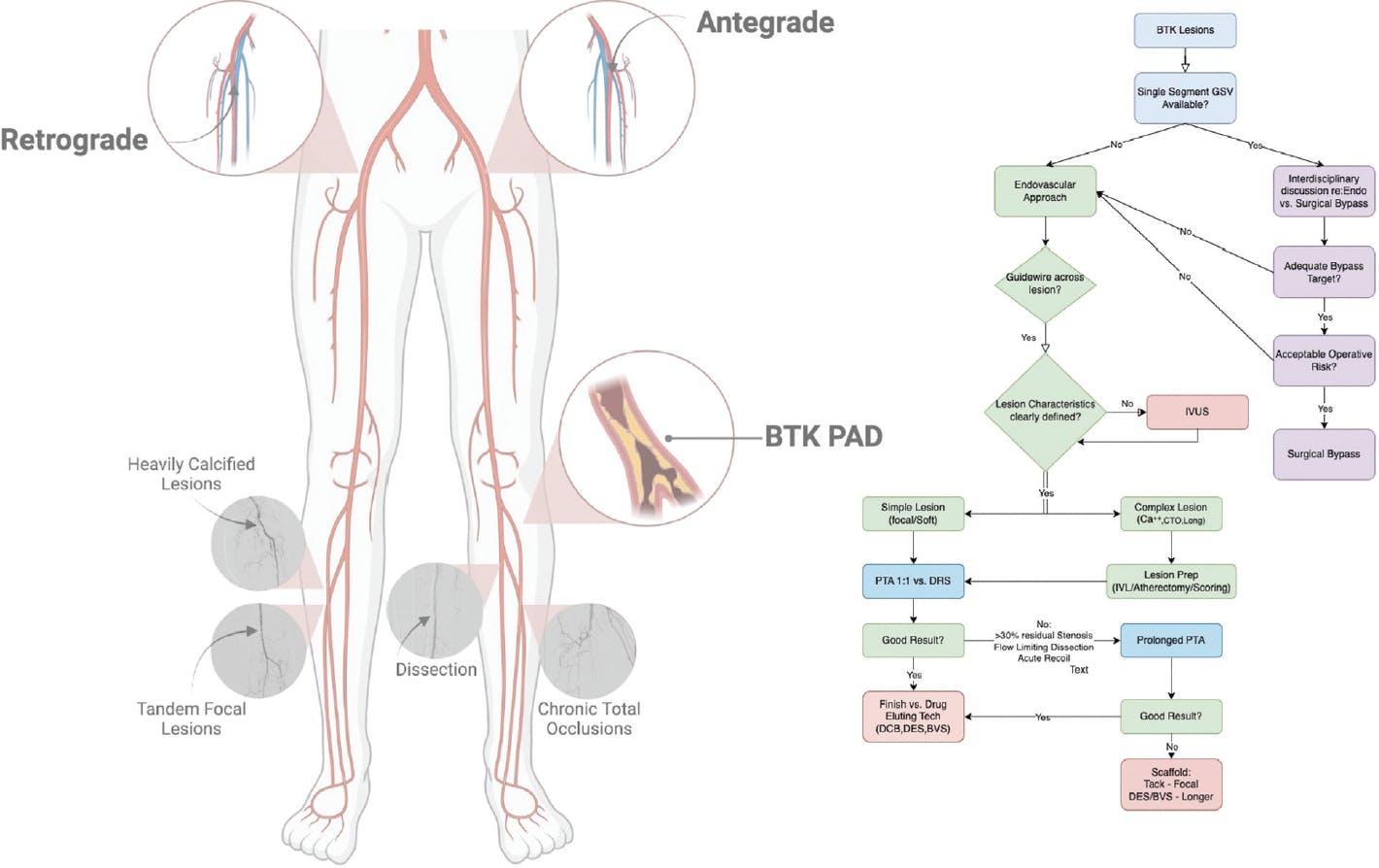
Figure 1. An algorithm for the management of BTK PAD. BVS, bioresorbable vascular scaffold; IVL, intravascular lithotripsy; PTA, percutaneous transluminal angioplasty. Reprinted with permission from JSCAI, Vol 3, Zilinyi RS, Alsaloum M, Snyder DJ, et al, Surgical and endovascular therapies for below-the-knee peripheral arterial disease: a contemporary review, Page 101268, Copyright Elsevier (2024).
Prof. Varcoe: What is the most significant unmet need in drug delivery right now?
Prof. Brodmann: What’s most important is finding a DCB for BTK lesions.
Dr. Parikh: I think there are numerous pharmacotherapeutic agents (systemic and locally delivered) that will have impact on restenosis in a positive way, and I think that combined therapies (both in-situ drug eluting and systemic) are likely to be synergistic in the treatment of these patients and will enable us to improve our limb and mortality outcomes.
Dr. Iida: The most significant clinical need for treating the infrainguinal lesions is the sirolimus-coated balloon.
Dr. Schneider: The most significant unmet need in drug delivery right now is the lack of available solutions for long BTK lesions. We have not also addressed “slow flow/no flow” after DCB, and we need to understand better which dissections must receive a scaffold after DCB. Optimal vessel protocols must also be sorted out before we can achieve best results.
1. Tepe G, Zeller T, Albrecht T, et al. Local delivery of paclitaxel to inhibit restenosis during angioplasty of the leg. N Engl J Med. 2008;358:689-699. doi: 10.1056/NEJMoa0706356
2. Zilinyi RS, Alsaloum M, Snyder DJ, et al. Surgical and endovascular therapies for below-the-knee peripheral arterial disease: a contemporary review. J Soc Cardiovasc Angiogr Interv. 2024;3:101268. doi: 10.1016/j.jscai.2023.101268
Disclosures
Prof. Brodmann: Consultant to Medtronic, Boston Scientific, Philips, Cook Medical, Biotronik, BD/Bard, and Cordis.
Dr. Iida: Consultant to Boston Scientific, Canon, NIPRO, and Terumo; honoraria from Cordis, Medtronic, Boston Scientific, Gore, Terumo, NIPRO, and Canon.
Dr. Parikh: Receives institutional research support from Abbott, Acotec, Boston Scientific, Concept Medical, Reflow Medical, Shockwave Medical, Surmodics, TriReme Medical, and Veryan Medical; advisor to Abbott, Boston Scientific, Cordis, Medtronic, and Philips; consultant to Abiomed, Inari, Penumbra, and Terumo; holds equity in Advanced NanoTherapies, eFemoral, and Encompass Vascular.
Dr. Schneider: Consultant to Silk Road, Surmodics, Endologix, Healthcare Inroads, Cagent, Medtronic, Boston Scientific, Philips, and Acotec.
Prof. Varcoe: Consultant to Medtronic, Abbott Vascular, BD Bard, InterVene, Surmodics, Philips Healthcare, Nectero Medical, Alucent Biomedical, W.L. Gore, R3 Vascular, Cook Medical, Boston Scientific, and Concept Medical; equity in EBR Systems, Provisio Medical, and Vesteck Inc.
Advertisement
Advertisement
