Advertisement
Advertisement
April 2025
Decision-Making for Type II Endoleaks: Choosing an Approach and Embolic Agent
An overview of current strategies for managing type II endoleaks illustrated by a case of persistent endoleak and sac enlargement after fenestrated endovascular aneurysm repair.
By Meghan Clark, MD; Alexandra Banathy, MD; and Nicole Keefe, MD
Aortic endografts are used in 80% of repairs for abdominal aortic aneurysms (AAAs) in the United States.1 Endoleaks are commonly seen in patients after endovascular aneurysm repair (EVAR), which can ultimately result in sac enlargement and rupture. Approximately 30% of patients who undergo infrarenal EVAR develop endoleaks, and the incidence is > 50% in patients who undergo fenestrated-branched EVAR (FB-EVAR).2,3 Type II endoleaks are the most common, representing over 50% of all endoleaks.4 The long-term significance of type II endoleaks is a topic of ongoing debate, as they commonly resolve spontaneously, but current guidelines advocate for the treatment of type II endoleaks in the setting of sac expansion (> 5 mm).5 These interventions are laborious, and the reintervention rate is quite high at almost 60% at 1 year, highlighting the need for effective and durable treatment strategies.6 Fenestrated and branched endografts often have multiple types of endoleaks simultaneously, making treatment more daunting.
Various embolic agents have been employed in the management of type II endoleaks, including coils, thrombin, gelfoam, and liquid embolics. Ethylene vinyl alcohol (EVOH) copolymer, commercially known as Onyx (Medtronic) or Lava (Sirtex Medical), is a nonadhesive, permanent liquid embolic agent that has been utilized in this context. Lava is the only commercially available EVOH embolic that is approved for use in the peripheral vasculature and has lower mass percentage of tantalum to decrease artifacts on subsequent CT.7 This article presents a challenging case of a patient with a history of FEVAR who developed sac enlargement due to a presumed type II and possibly type Ia endoleak treated via a transarterial approach. We also discuss alternative approaches, including transcaval, direct puncture, and perigraft techniques, to provide an overview of current strategies in the management of type II endoleaks.
CASE PRESENTATION
A male patient in his mid-80s with a history of a 6.7-cm pararenal/juxtarenal AAA who underwent a fenestrated aortobiliac endograft repair approximately 4 years prior presented with persistent endoleak and sac expansion. He had an aortic cuff extension for a suspected type III endoleak 1 year after the initial FEVAR and a translumbar direct stick glue embolization of a suspected type II endoleak 2 years later. Routine surveillance imaging demonstrated continued sac enlargement, now measuring 8.1 X 7.8 cm, with enhancement of the excluded aneurysm sac and findings of a type II endoleak involving the L4 lumbar arteries and inferior mesenteric artery (IMA). Although Yu et al determined there was no significant difference in treating the nidus versus treating the nidus and supplying branch vessels in the setting of persistent findings of type II endoleak and sac enlargement after prior embolization via translumbar approach,8 we elected to perform a repeat embolization of the patient’s type II endoleak from a transarterial approach.
Highlight Point
Transarterial lumbar artery embolization can be performed when there is iliolumbar branch communication with the lumbar artery supplying the endoleak. Preprocedure CTA is a useful tool in predicting procedural success. In a study by Contrella et al, preprocedure CTA was reviewed to determine if the path of the feeding vessel could be traced from the internal iliac artery (IIA). The path from the IIA to the lumbar arteries could only be traced in 32% of patients, but if it was possible, embolization was successful in 89% of procedures compared to 26% in patients where the path could not be traced.9 For this patient, the path of the left L4 lumbar artery was able to be traced on CTA and had similar findings on arteriography (Figure 1A).
CASE CONTINUED
Preprocedure transabdominal ultrasound with color Doppler demonstrated flow within the excluded aneurysm sac that appeared to be supplied by the IMA. Given this finding, we elected to interrogate the IMA first. The aortogram demonstrated retrograde flow through the IMA into the excluded aneurysm sac extending cranially toward the visceral segment via a patent arc of Riolan. A triaxial system of a 6.5-F TourGuide steerable sheath (Medtronic), a 4-F Glidecath (Terumo Interventional Systems), and a 2.1-F TruSelect microcatheter (Boston Scientific Corporation) was used to catheterize the IMA and exclude the aneurysm sac via the arc of Riolan. Digital subtraction angiography (DSA) confirmed the appropriate position of the microcatheter within the nidus and demonstrated outflow via the L3 lumbar arteries (Figure 1B). The microcatheter could not be advanced into the L3 lumbar artery. The nidus and L3 outflow lumbar arteries were embolized using Lava 34 (Figure 1C).

Figure 1. An ultrasound (A) and CTA (B) demonstrated the IMA inflow to the endoleak. A triaxial system was used to catheterize the IMA. Angiography from the distal IMA demonstrated supply to the excluded sac and communication with the L3 lumbar artery (C). Postembolization images demonstrating the Lava cast within the endoleak nidus (arrowhead), L3 lumbar artery, outflow (thin arrow), and IMA inflow (thick arrow) (D, E).
Highlight Point
Embolic agent choice is crucial in this case because multiple agents are available. A liquid embolic was employed so that it could flow into the lumbar artery for embolization. Lava 34 was specifically chosen because it is more viscous than Lava 18, allowing for more control during administration, and due to the decreased amount of artifact on follow-up imaging. The microcatheter must be removed promptly after embolization so it does not polymerize to the embolic agent.
Delivery of Onyx and Lava both must be preceded by dimethyl sulfoxide, which can be painful upon delivery. Knowledge of the dead space of the microcatheter should be used to minimize the amount delivered.
CASE CONTINUED
Completion angiography through the superior mesenteric artery demonstrated occlusion of the IMA with no residual enhancement of the excluded sac. The IIA was not interrogated due to the patient’s inability to tolerate the procedure any further. Postprocedure color Doppler of the excluded aneurysm sac demonstrated persistent flow despite occlusion of the IMA. Postprocedure multiphase CT confirmed persistent enhancement of the excluded aneurysm sac at the level of the L4 lumbar arteries (Figure 2A). The patient was scheduled for a repeat short-interval intervention.
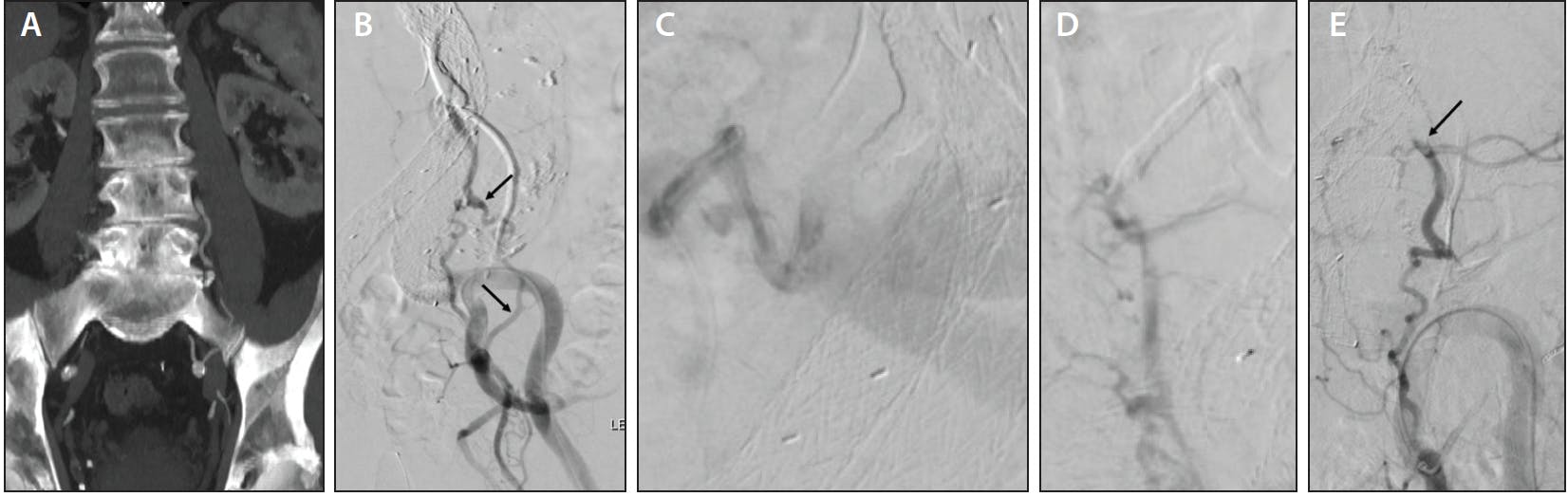
Figure 2. Preprocedure CTA demonstrating the left iliolumbar artery communicating with the L4 lumbar artery (A). Initial arteriogram demonstrating the same left iliolumbar branch communicating with the left L4 lumbar artery (arrows) (B). Selective obliqued arteriogram demonstrating the L4 lumbar artery involving the endoleak (C). Postembolization obliqued arteriogram with cessation of flow into the endoleak (D). Final anteroposterior arteriogram with cessation of flow in the ascending iliolumbar branch after postembolization (arrow) (E).
DSA from the left IIA demonstrated a hypertrophied iliolumbar artery collateralizing with the left L4 lumbar artery and robust enhancement of the excluded aneurysm sac, consistent with type II endoleak. A triaxial system of a 6-F, 45-cm Ansel 1 sheath (Cook Medical), a 4-F Glidecath, and a 2.1-F TruSelect microcatheter was used to select the left iliolumbar artery, left L4 lumbar artery, and the excluded aneurysm sac. DSA confirmed catheter position within the nidus (Figure 2B and 2C). The nidus and L4 lumbar arteries were then embolized using Lava 18 (Figure 2D and 2E). Lava 18 was used for this embolization, as there were no branches coursing toward the spinal canal.
Highlight Point
Use of EVOH (Onyx or Lava) requires an understanding of flow dynamics within the vessel being embolized. Delivery of a liquid embolic in this location requires finesse so as not to distally migrate and reach the spinal arteries, while still adequately embolizing the lumbar artery.
CASE CONCLUSION
Successful endoleak embolization was performed following two transarterial embolizations of different vessels. Routine endograft imaging follow-up at 12 months demonstrated no persistent endoleak with aneurysm sac size shrinkage.
CHOOSING AN ADVANCED APPROACH TO ENDOLEAK EMBOLIZATION: TRANSCAVAL, TRANSLUMBAR, OR PERIGRAFT?
Endoleak embolization requires a thoughtful approach when determining route of treatment and embolic agents.
Highlight Point
Multiple approaches for type II endoleak embolization can be employed based on the provider expertise and patient anatomy. Transarterial success rate is highest in cases where the vessel can be traced from its origin on arterial CT imaging. A transcaval approach requires the IVC and aneurysm wall to be apposed. The translumbar approach has a high technical success rate and can be used when multiple culprit vessels are identified or if the lumbar arteries are too high to reasonably reach via a transarterial approach.10 The perigraft approach is best suited when the endoleak involves the iliac vessels.
A transcaval approach can be considered in patients who have close contact between the inferior vena cava (IVC) and aneurysm sac. It is a useful approach in patients who cannot lay prone for translumbar access or as a contingency plan for unsuccessful transarterial embolization. In the case illustrated in Figure 3, a 10-F sheath was placed through right common femoral vein access. A transjugular liver biopsy set was manually shaped to direct the access medially, and a 21-gauge, 65-cm Chiba needle (Cook Medical) was used to puncture the sac. Pressure manometry was attached to the catheter, which demonstrated an arterial waveform with a lower pressure than systemic pressure. An 0.018-inch wire was advanced into the sac. Coaxial 0.035- and 0.018-inch NaviCross catheters (Terumo Interventional Systems) were advanced into the sac for support followed by catheterization with a microcatheter system. Embolization with Onyx liquid embolic was performed (Figure 3).
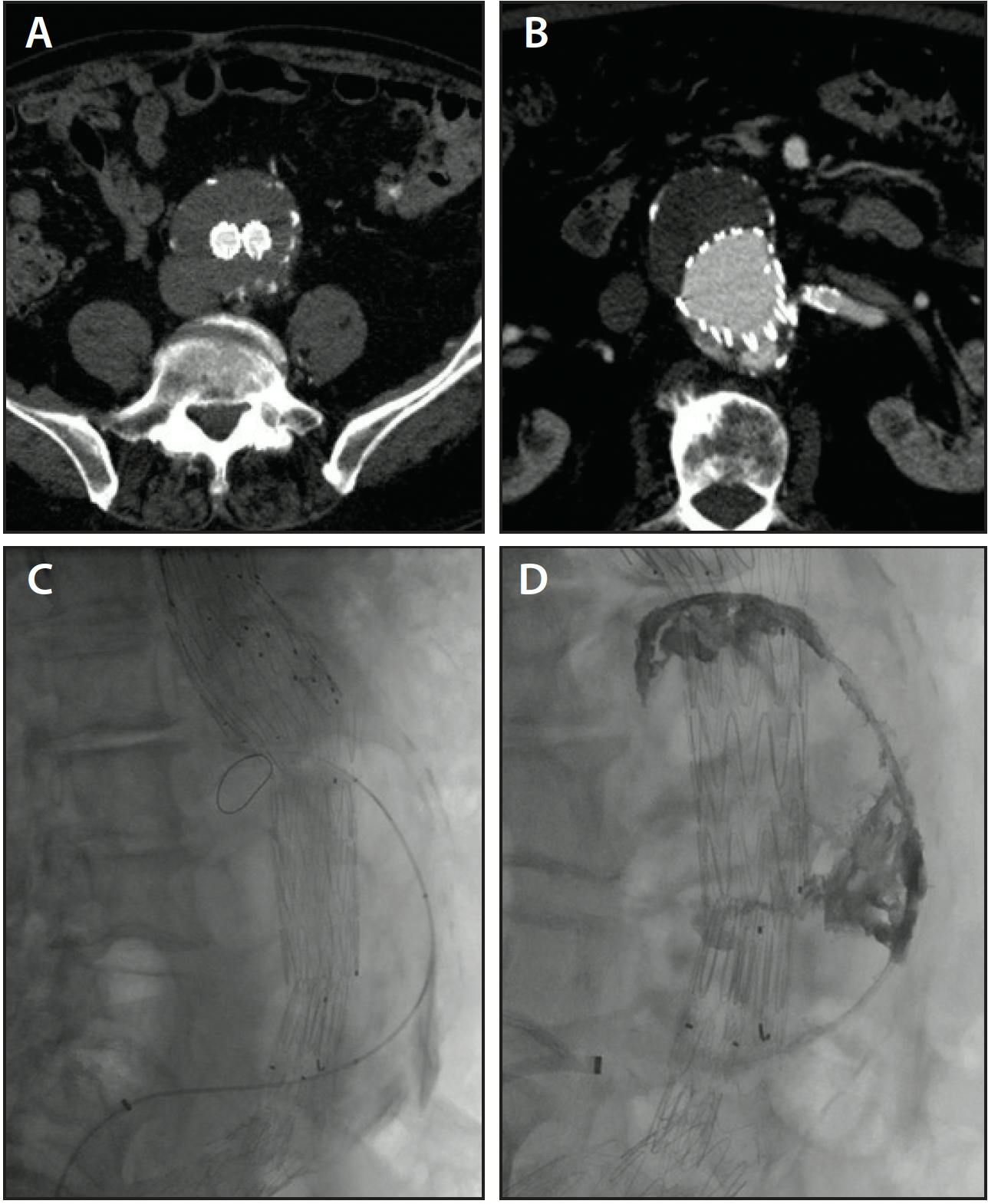
Figure 3. A male patient in his early 90s after FEVAR with type II endoleak and interval growth of aneurysm sac. CTA demonstrated the IVC in contact with the excluded aneurysm sac and adjacent to the L4 lumbar arteries involved in the endoleak (A). There was also a superior component involving the L1 lumbar arteries (B). Transcaval access was obtained with coaxial NaviCross catheters advanced into the sac (C). Postembolization imaging demonstrating Onyx liquid embolic in the endoleak nidus (D).
The translumbar approach is ideal for situations in which a transarterial approach is inaccessible or multiple culprit vessels are identified. In the case illustrated in Figure 4, translumbar access into the aneurysm sac was obtained with the patient positioned prone. A 21-gauge needle was advanced into the sac under fluoroscopic guidance via iGuide (Siemens Healthineers) or CT guidance. A transition dilator was advanced over an 0.018-inch wire to the margin of the aneurysm sac for stability. A microcatheter system was advanced into the sac for imaging, and embolization with a combination of pushable coils and a 4:1 ratio of N-butyl cyanoacrylate (NBCA) glue was performed (Figure 4).
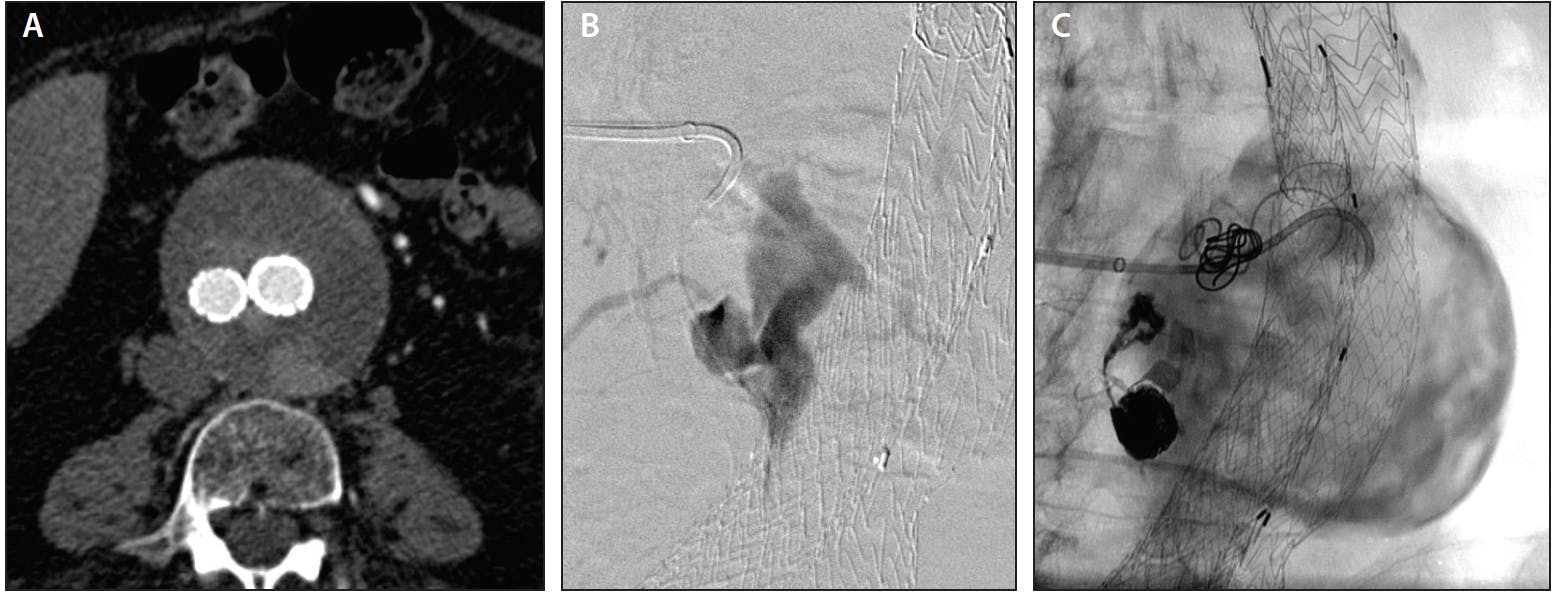
Figure 4. A male patient in his late 80s with type II endoleak on CTA via the L3 lumbar arteries (A). A transarterial approach was not amenable due to prior IIA aneurysm embolization and stent graft extension (A). Translumbar access was obtained with a 21-gauge Chiba needle and 0.018-inch microwire. This was then exchanged for a short sheath, RIM catheter, and Glidewire (Terumo Interventional Systems). DSA demonstrated nidus filling with contrast extending into the paired L3 lumbar arteries (B). A combination of pushable coils and 4:1 NCBA glue administration were used to embolize the nidus. The glue flowed into the proximal branch vessels of the lumbar arteries, providing appropriate embolization (C).
A perigraft approach requires advancing a catheter into the potential space between the iliac limb endograft and vessel wall to reach the aneurysm sac. This is best situated when other approaches have failed or when the endoleak is adjacent to or within an iliac vessel. For the case shown in Figure 5, a 6-F Ansel sheath was advanced into the ipsilateral common iliac artery for support. The perigraft space was accessed with a 4-F Glidecath and hydrophilic wire. Once access into the sac was obtained, the nidus was accessed with a microcatheter system. Embolization was performed with Onyx liquid embolic (Figure 5). Procedural complications can include a procedurally induced type Ib endoleak, which can be mitigated by embolization of the access tract and/or balloon angioplasty of the accessed limb stent graft.
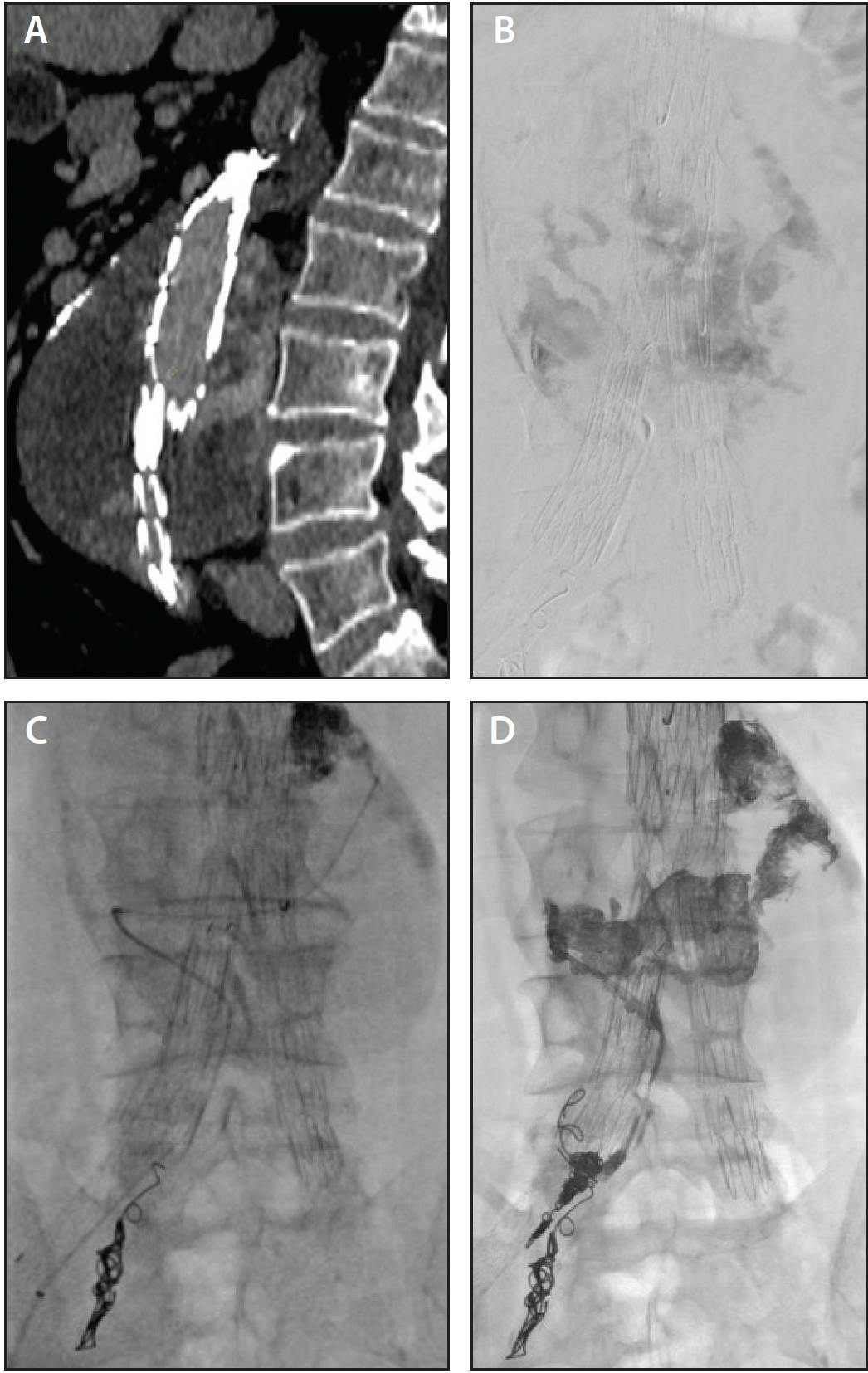
Figure 5. A male patient in his mid-70s with a 9.6-cm AAA after FEVAR with type II endoleak. Preprocedure delayed-phase CTA demonstrated endoleak evolving the L3 lumbar arteries (A). Endoleak arteriogram demonstrated the endoleak nidus (B). Perigraft embolization of the endoleak nidus with Onyx 34 (C). Completion imaging after Onyx 34 embolization of the nidus and coil embolization of the perigraft access site (D).
CONCLUSION
The literature on clinical success rates of type of approach for the treatment of endoleaks is limited by the lack of randomized controlled trials. There are multiple retrospective studies comparing two approaches or a single approach, reporting high clinical success rates of 84% to 98%, but the studies are heterogeneous cohorts.10,11 Based on the current data, the approach should be tailored to the individual patient’s anatomy. Endoleaks can be notoriously challenging to treat and require persistence and patience.
1. Schanzer A, Oderich GS. Management of abdominal aortic aneurysms. N Engl J Med. 2021;385:1690-1698. doi: 10.1056/NEJMcp2108504
2. Lal BK, Zhou W, Li Z, et al. Predictors and outcomes of endoleaks in the Veterans Affairs Open Versus Endovascular Repair (OVER) trial of abdominal aortic aneurysms. J Vasc Surg. 2015;62:1394-1404. doi: 10.1016/j.jvs.2015.02.003
3. Marecki HL, Finnesgard EJ, Nuvvula S, et al. Characterization and management of type II and complex endoleaks after fenestrated/branched endovascular aneurysm repair. J Vasc Surg. 2023;78:29-37. doi: 10.1016/j.jvs.2023.02.016
4. Wanhainen A, Van Herzeele I, Bastos Goncalves F, et al. Editor’s choice -- European Society for Vascular Surgery (ESVS) 2024 clinical practice guidelines on the management of abdominal aorto-iliac artery aneurysms. Eur J Vasc Endovasc Surg. 2024;67:192-331. doi: 10.1016/j.ejvs.2023.11.002
5. Rokosh RS, Wu WW, Dalman RL, Chaikof EL. Society for Vascular Surgery implementation of clinical practice guidelines for patients with an abdominal aortic aneurysm: endoleak management. J Vasc Surg. 2021;74:1792-1794. doi: 10.1016/j.jvs.2021.04.042
6. Wu WW, Swerdlow NJ, Dansey K, et al. Surgical treatment patterns and clinical outcomes of patients treated for expanding aneurysm sacs with type II endoleaks after endovascular aneurysm repair. J Vasc Surg. 2021;73:484-493. doi: 10.1016/j.jvs.2020.05.062
7. Arslan B, Razavi MK, Siskin G, et al. The LAVA study: a prospective, multicenter, single-arm study of a liquid embolic system for treatment of peripheral arterial hemorrhage. J Vasc Interv Radiol. Published online November 13, 2024. doi: 10.1016/j.jvir.2024.11.005
8. Yu H, Desai H, Isaacson AJ, et al. Comparison of type II endoleak embolizations: embolization of endoleak nidus only versus embolization of endoleak nidus and branch vessels. J Vasc Interv Radiol. 2017;28:176-184. doi: 10.1016/j.jvir.2016.10.002
9. Contrella BN, Wilkins LR, Sheeran DP, et al. Predictive value of preprocedural computed tomography angiography for the technical success of transarterial embolization of type II endoleaks arising from the lumbar arteries. J Vasc Interv Radiol. 2021 Jul;32:1016-1021. doi: 10.1016/j.jvir.2021.03.541
10. Guo Q, Zhao J, Ma Y, et al. A meta-analysis of translumbar embolization versus transarterial embolization for type II endoleak after endovascular repair of abdominal aortic aneurysm. J Vasc Surg. 2020;71:1029-1034.e1. doi: 10.1016/j.jvs.2019.05.074
11. Nana P, Spanos K, Heidemann F, et al. Systematic review on transcaval embolization for type II endoleak after endovascular aortic aneurysm repair. J Vasc Surg. 2022;76:282-291.e2. doi: 10.1016/j.jvs.2022.02.032
Advertisement
Advertisement