Advertisement
Advertisement

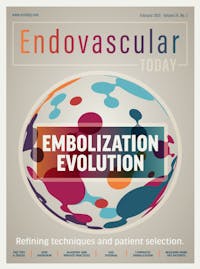
The world of embolization has come a long way. The meteoric growth of the field, which spans treatment of trauma and nuisance bleeding, men’s and women’s health, oncologic therapies, portal venous disease, musculoskeletal, and lymphatic interventions, is a far cry from the first reports of autologous clot delivered via catheter to stop bleeding. The growth of embolics (both in type and sophistication) and the expansion of their applications has developed a seemingly burgeoning field in and of itself. In this issue of Endovascular Today, we feature the embolization evolution, with expert operators sharing their technical tips and opinions and offering hints at what lies ahead.
Recent years have seen increased use of embolization for nonmalignant, pain-related disorders, particularly for symptom management in musculoskeletal conditions. Yuji Okuno, MD, takes on this topic in our first article, outlining the emerging evidence supporting genicular artery embolization (GAE) for knee osteoarthritis (OA), transarterial embolization for adhesive capsulitis and overuse sports injuries, and minimally invasive intra- arterial treatments for refractory hand OA.
Next, Tiago Bilhim, MD, and Joaquim Maurício da Motta-Leal-Filho, MD, share a retrospective take on how prostatic artery embolization (PAE) techniques and technology have evolved and ponder what the PAE operator of today needs to know about preprocedural vascular planning, intraprocedural imaging, medical devices and embolics, and more.
We dive further into GAE with an article by Bedros Taslakian, MD; Christiana Salami, MS; and Yan Epelboym, MD. This comprehensive, instructional guide offers tips on navigating patient selection, imaging, and procedural technique and presents strategies for optimizing patient outcomes.
Amgad M. Moussa, MD; Majid Maybody, MD; and Ernesto Santos, MD, then walk us through the current state and future directions of lymphatic embolization in oncology and pediatrics, as well as expanding indications elsewhere.
This is followed by a discussion with John C. Lipman, MD, and Jessica K. Stewart, MD, on uterine fibroid embolization awareness and access needs. They dive into why there are often barriers to this treatment option and propose solutions for bridging that gap.
Concluding our embolotherapy coverage is an interview with Jafar Golzarian, MD, on moving his embolization practice from an academic center to an office-based lab and the practical, procedural, and financial changes that come with that shift.
Closing this issue is an interview with Eric Ducasse, MD, who reflects on artificial intelligence for aortic aneurysms, the state of carotid intervention in France, current and upcoming research projects with CHU Bordeaux, keys to a collaborative vascular meeting, and more.
It has been a distinct pleasure to bring many trusted friends and colleagues around the world together for this edition of Endovascular Today. We hope you enjoy reading this issue and perhaps use this to further expand your knowledge in the field. One thing seems certain, the field of embolization will continue to grow.
Parag J. Patel, MD, MS, FSIR
Guest Chief Medical Editor
Advertisement
Advertisement