Advertisement
Advertisement
January 2025
Consensus Statement on Nonthrombotic Iliac Vein Lesion Management Published
Commentary by Kush R. Desai, MD, FSIR; Kathleen Gibson, MD; Raghu Kolluri, MD, MS, RVT, MSVM; and Saher Sabri, MD, FSIR
The VIVA Foundation, in collaboration with representatives from the American Venous Forum (AVF) and American Vein and Lymphatic Society (AVLS), published a consensus statement to provide guidance on the treatment of patients with nonthrombotic iliac vein lesions (NIVLs). The consensus statement was published in Circulation: Cardiovascular Interventions.1
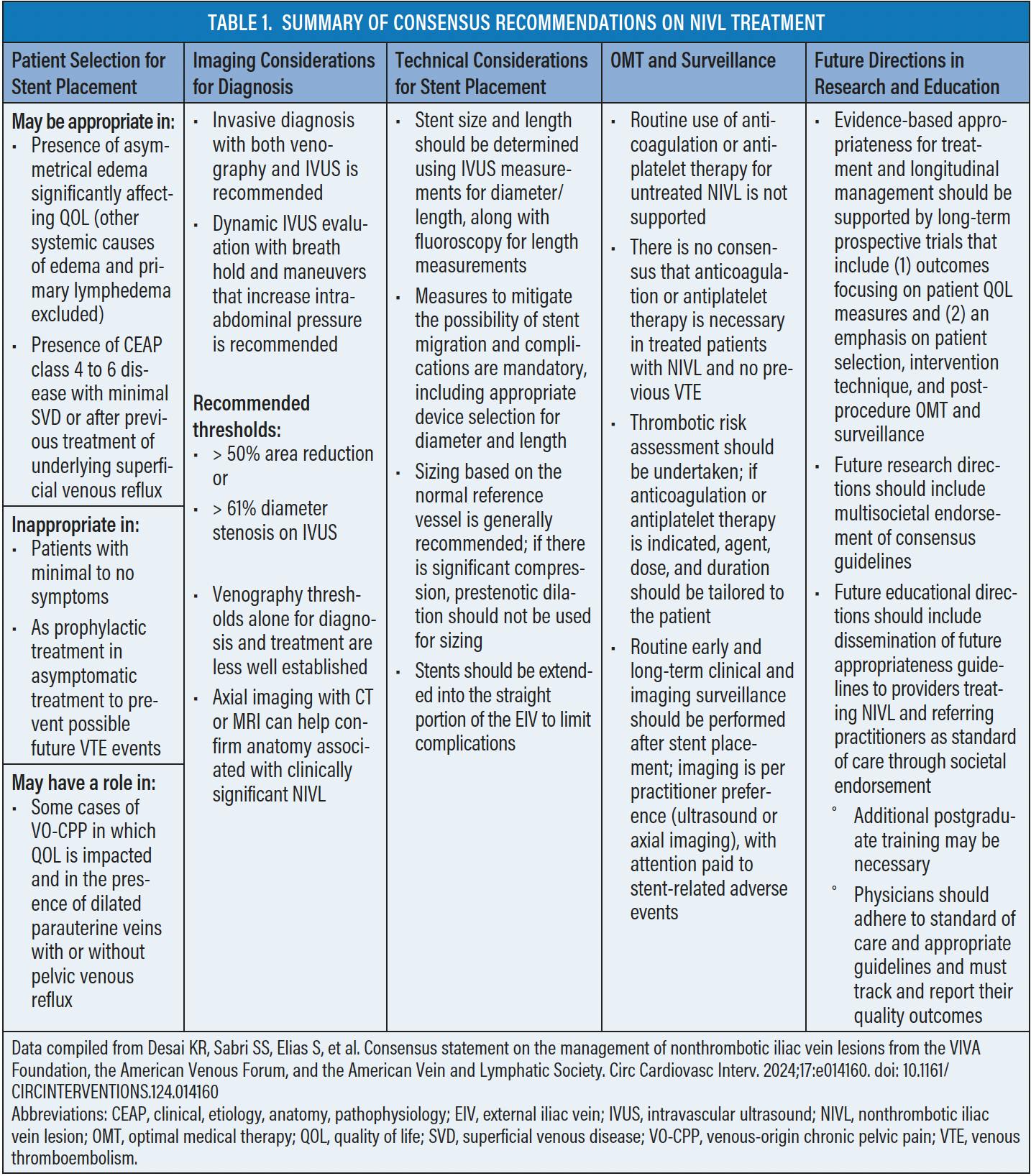
A group of multidisciplinary leaders in venous disease management convened and developed consensus statements regarding patient selection for treatment, imaging considerations for diagnosis, technical considerations for stent placement, optimal medical therapy and surveillance postprocedure, and future directions for research and education. The consensus statements reflect at least 80% agreement of the participants.
Table 1 summarizes the consensus recommendations. For more detailed discussion on the recommendations, please refer to the full article in Circulation: Cardiovascular Interventions.
ENDOVASCULAR TODAY ASKS…
We spoke with consensus guidance authors to discuss the process for developing the consensus statement, key challenges, and future directions for NIVL management.
What prompted the VIVA Foundation, AVF, and AVLS to come together to take a close look at NIVL management with an eye toward a consensus document?
Dr. Gibson: Patients with deep venous disease are managed by a variety of specialists, including interventional cardiologists, interventional radiologists, vascular medicine physicians, and vascular surgeons. However, the optimal approach to managing patients with NIVL remains unclear. To address this gap and enhance patient care, the VIVA Foundation, AVF, and AVLS convened a multidisciplinary panel to develop a consensus document. The goal of this initiative is to provide comprehensive guidance for treating physicians, covering key aspects such as diagnostic evaluation, therapeutic management (including conservative care and appropriate use of stents), and long-term care after intervention.
Dr. Sabri: The VIVA Foundation convenes a Vascular Leaders Forum (VLF) every year to discuss pertinent topics in the vascular field, with participation from stakeholders including vascular providers, industry, regulatory agencies, and patient advocates. In a recent VLF focused on venous interventions, the participants singled out NIVL and overutilization of stenting for this condition as a hot topic. Due to the paucity of evidence in NIVL, the group felt that a consensus statement document written by leading physicians in the field would be helpful to provide guidance to both providers and patients. The VIVA Foundation partnered with AVF and AVLS to provide a well-rounded representation in the authorship group.
Dr. Kolluri: We are at a unique crossroads in venous disease management. Several on-label venous stents have received FDA approval after undergoing the investigational device exemption process for use in patients with venous disease. A decade ago, awareness of NIVL was minimal, and it remains underdiagnosed. However, awareness has increased.
With the rise in endovascular interventions and thrombectomy, stenting iliac vein obstructions in appropriately selected patients has been shown to improve patient-reported outcomes and heal venous leg ulcers.
Complications related to technique, such as stent migration, fractures, or thrombosis, are concerning, especially because most NIVL patients are younger women. Poor patient selection can also result in a lack of symptom improvement. These issues led us at the VIVA Foundation to partner with AVF and AVLS to develop consensus statements aimed at standardizing NIVL care to improve outcomes and minimize complications.
Where did the group find the clearest paths to consensus?
Dr. Desai: Fortunately, there were several areas where consensus was clear and almost unanimous. Specifically, placement of stents when there are no clear attributable symptoms or for prophylactic reasons was deemed clearly inappropriate. Although this may seem obvious, there have been unfortunate instances where this practice occurs in the real world, such as for “reduction of deep vein thrombosis (DVT) risk.” There are no high-quality data that can help providers identify which compression lesions are at higher risk of for future DVT, and overtreatment is a concern. Thus, this was a clear area of agreement.
Other areas of agreement include the necessity for intravascular ultrasound (IVUS) in addition to venography prior to stent placement, as well as the lack of evidence for use of antithrombotic therapy when untreated NIVL is present. The panel agreed that IVUS is vital in confirming diagnosis and vessel sizing for stent selection, and that when no stent is present, there are no compelling data for use of anticoagulants or antiplatelets.
Dr. Kolluri: Interestingly, we anticipated some discordance going into the process, but all statements achieved the required 80% agreement.
Dr. Gibson: One of the clearest areas of consensus was patient selection. There was broad agreement that the most appropriate candidates for intervention are patients with venous ulceration or lifestyle-limiting venous claudication. Conversely, we agreed that patients with minimal or no symptoms, or those with CEAP (clinical, etiology, anatomy, pathophysiology) clinical class 2 disease without venous claudication, should not be offered a venous stent. Additionally, there was strong consensus on the importance of thorough preprocedure imaging and the use of IVUS for accurate stent placement.
Where does consensus remain elusive, and why?
Dr. Gibson: Consensus remains elusive on several key issues. One area of uncertainty is the IVUS thresholds for stent placement, both in the existing literature and in the practice patterns of the authors. Additionally, opinions differ regarding optimal medical management following venous stenting. There is no clear agreement on the need for antiplatelet or antithrombotic therapy, the choice of agent, or the appropriate duration of treatment after stent placement. Lastly, the role of stenting in patients with chronic pelvic pain remains somewhat undefined, highlighting the need for further research and discussion.
Dr. Desai: From the panel discussions and through the construction of the manuscript, it became clear that there are several areas where equipoise in the literature was conflicted with long-held clinical experience. For example, a definitive measurement threshold for what constitutes a NIVL in the setting of symptoms remains an active point of debate. Fifty percent area stenosis as a cutoff was originally described based on a large single-center patient cohort and has been the dominant cutoff used in clinical practice. However, a smaller, independently adjudicated, multicenter patient cohort found that area stenosis measurements had no correlation to subsequent clinical improvement; rather, 61% diameter stenosis at the NIVL was predictive of future improvement. Thus, we have disagreement on what the best path forward is, and we need to validate a rigorous criterion for lesion selection in a bias-limited way.
Another example where consensus remains elusive are in symptoms that can be attributed to a NIVL. Edema is probably the dominant symptom criterion that has been treated in both retrospective and prospective data sets, and yet rigorous quantification of edema (ie, below-knee, above-knee, both) as well as a clear demonstration of improvement in symptoms after stent placement for NIVL is glaringly absent. Again, the chorus of voices behind clear improvement in edema in their own practices is quite loud, but the actual data suggesting that it occurs remain mostly absent.
The authors note issues with improper patient selection, with a specific concern for “overstenting.” What are some of the specific selection errors? And, how could they be mitigated?
Dr. Desai: Put simply, the main concerns are placement of a stent that offers the patient no clinical benefit, or one that fails (ie, thrombosis, or worse, migration). Perhaps the first and most critical step occurs prior to selecting a patient for stent placement. Have all the other potential causes for their symptoms been excluded? And are you as the provider convinced that their symptoms would improve in some significant, quantifiable way after placement of a permanent prosthetic?
If the answers to those questions are yes, the next step is in the procedure itself. Most true NIVL lesions are not an “eye-test” on IVUS; the compression is significant and mostly obliterates the lumen. My view is, if you have to “squint” to see the lesion, it’s probably not there. Also, other signs such as collaterals on venography can be used to bolster confidence in the imaging diagnosis.
Dr. Sabri: Overstenting in NIVLs remains a major issue. Limiting interventions to patients who are truly symptomatic (CEAP class 4 and above) was one of the main recommendations of the consensus document. The document also provided technical recommendations regarding how to utilize IVUS with venography to identify true fixed lesions that may warrant an intervention versus a physiologic finding that is best managed conservatively. Disseminating these consensus statements amongst providers and endorsement by leading societies and physician groups can help mitigate some of the issues of overstenting.
Dr. Gibson: With the advent of dedicated venous stents in the past 5 years, enthusiasm for treating deep venous disease has grown, leading to a significant increase in stent placement. In particular, the use of stents for treating NIVLs has risen, driven by factors such as the ease of use of newer stents and a perception that interventions for nonthrombotic lesions are technically straightforward. However, “overstenting” has become a concern, stemming from a lack of consensus on patient selection and inconsistent interpretation of pre- and intraprocedural imaging for NIVLs.
The goal of this consensus document is to address these issues by offering clear guidance to prevent unnecessary stenting in patients unlikely to benefit, while also supporting appropriate interventions for those who stand to gain from treatment.
Stent sizing remains a concern. What are the consequences, and how can sizing be optimized?
Dr. Gibson: Both undersizing and oversizing of stents can cause substantial morbidity and even mortality. Oversized stents can lead to chronic pain, and improper placement can lead to stent erosion. Conversely, undersized stents risk migration to central locations such as the inferior vena cava, heart, or pulmonary artery, potentially requiring advanced interventional techniques or open cardiac surgery for retrieval. Tragically, some cases have resulted in fatalities. To mitigate these risks, two key strategies are essential: First, ensure appropriate evaluation for stent placement through proper patient selection and accurate interpretation of preprocedure imaging; and second, use dynamic IVUS imaging and multiplanar fluoroscopic imaging to precisely determine stent diameter and length.
What are the next steps for this group? The most important continuing areas of study?
Dr. Gibson: Our group agreed that significant work remains in establishing best practices for managing NIVL patients. Generating high-quality data is essential, with a particular emphasis on prospective trials that follow patients longitudinally and prioritize patient-centered outcomes, such as quality of life, rather than focusing solely on anatomic results. Additionally, the development of multisocietal guidelines based on robust evidence will be crucial. These guidelines should provide clear, evidence-based recommendations for patient evaluation and management, encompassing both conservative and interventional treatment options.
Dr. Kolluri: The VIVA Foundation will continue addressing areas requiring clarity to improve vascular patient care. For example, a similar initiative is underway for chronic limb-threatening ischemia (CLTI) care, led by Dr. Eric Secemsky, a fellow VIVA Board Member. We plan to use our annual VLF as a platform to unite multispecialty, patient-focused physicians and collaborate with regulators and payers. Together, we aim to produce high-impact papers that advance the field and enhance the care for vascular patients.
Dr. Sabri: The VIVA Foundation will continue to put together a VLF about pertinent vascular topics every year and produce literature than can be helpful to the vascular community. Out of this venous VLF, in addition to this document on NIVL, a second document was published on reporting standards in clinical studies for venous thrombosis and chronic venous obstruction.2 Recently, a VLF on care for a CLTI patient was completed with expectation of publishing two additional documents that include recommendations on the care of CLTI and ways to improve patient access and follow-up.
If you could reach patients with one message, what would that be?
Dr. Gibson: A venous stent is a permanent implant, so it’s important to carefully consider your decision. Before agreeing to have a stent placed, make sure the symptoms you’re experiencing are seriously affecting your quality of life and that you’re comfortable with the potential risks involved. Ask your doctor to clearly explain both the risks and benefits of the stent and the procedure. If you’re unsure or feel like you don’t have enough information, don’t hesitate to ask more questions. If you’re not given a thorough explanation, it’s okay to seek a second opinion from a specialist in venous care.
Dr. Desai: Patients need to be proactive in their care. Ask your provider to set expectations for what will most likely improve based on your symptoms. Ask questions about how they manage patients after the stent is placed, in terms of antithrombotic therapy, surveillance, and, in the case of females, through potential pregnancies. Patients should seek care from an engaged provider who is willing to care for them long term.
Dr. Sabri: If you are told you have NIVL or May-Thurner syndrome, please make sure to discuss with your provider the need for intervention versus conservative therapy. Unless you have significant leg swelling or pelvic pain, you can be treated conservatively with no interventions.
1. Desai KR, Sabri SS, Elias S, et al. Consensus statement on the management of nonthrombotic iliac vein lesions from the VIVA Foundation, the American Venous Forum, and the American Vein and Lymphatic Society. Circ Cardiovasc Interv. 2024;17:e014160. doi: 10.1161/CIRCINTERVENTIONS.124.014160
2. Vedantham S, Gloviczki P, Carman TL, et al. Delphi consensus on reporting standards in clinical studies for endovascular treatment of acute iliofemoral venous thrombosis and chronic iliofemoral venous obstruction. Circ Cardiovasc Interv. 2023;16:e012894. doi: 10.1161/CIRCINTERVENTIONS
Advertisement
Advertisement
Find more Literature Highlights.
Browse additional literature summaries, key findings, and investigator commentaries across the vascular interventional field.
Read More