Advertisement
Advertisement

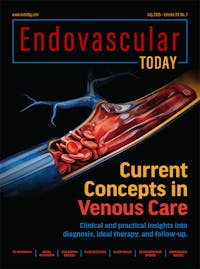
I’m honored to serve as Guest Chief Medical Editor for this venous-focused edition of Endovascular Today. The contributors in this issue represent a multidisciplinary group of leaders who are advancing the field of venous disease through clinical practice, research, and innovation. From pulmonary embolism (PE) care to device development for chronic venous occlusion, this edition explores some of the most dynamic and evolving areas in vascular medicine—highlighting both the exciting advances and persistent challenges that shape our work.
We begin with a panel discussion featuring Gregory Piazza, MD; Akhilesh Sista, MD; Brent Keeling, MD; Saher Sabri, MD; and Mona Ranade, MD, who share insights on the current state of PE care. Topics include the structure of high-performing PE response teams, emerging uses for artificial intelligence (AI), contemporary interventional pathways, and approaches to encouraging clinical trial enrollment.
Next, Edward Boyle, MD, addresses one of the most pressing issues in venous practice: reimbursement. He outlines the historical evolution of reimbursement models, the impact of budget neutrality in the landscape of inflation, and strategies for navigating these ongoing financial headwinds.
In the area of wound care, Misaki Kiguchi, MD, and Leigh Ann O’Banion, MD, review the current landscape of venous leg ulcer clinical trials. They highlight promising areas of investigation while emphasizing the need for improved trial design and more definitive evidence to guide best practices.
Kush R. Desai, MD, turns our attention to the challenges of caval occlusion. He provides an overview of disease burden, pathophysiology, gaps in data and disease-specific tools, and the importance of long-term follow-up—including definitions of durable outcomes.
In a point-counterpoint format, Gloria Salazar, MD, and Jake Hemingway, MD, debate treatment strategies for pelvic venous disease. Dr. Salazar takes an image-guided treatment approach, while Dr. Hemingway advocates for routine intervention of all four pelvic vessels, offering valuable perspectives on a topic where consensus is lacking.
Steve Elias, MD, reflects on the past, present, and future of endovenous valve development. Drawing parallels to his own professional journey, he explores innovations needed to realize a truly functional venous valve.
To conclude our clinical features, we ask experts to consider their dream device for managing chronic venous occlusion. Houman Jalaie, MD; Erin H. Murphy, MD; and Steven Abramowitz, MD, share their visions for an ideal device—from advanced mechanical designs, low-profile devices with built-in imaging and drug elution capabilities, and AI-guided navigation, their wish lists offer a look into the future of device design.
Wrapping up this issue of Endovascular Today, our featured interview with Lakshmi A. Ratnam, MBChB, covers the evolving technique of bleomycin electrosclerotherapy (BEST) for low-flow vascular malformations. She also shares guidance on the importance of a dedicated BEST team, tips for female interventional radiology trainees, guidelines for postpartum hemorrhage, and the importance of mentorship and collaboration.
Caring for patients with venous disease can be both complex and deeply rewarding. Whether your focus is PE, superficial, or deep venous disease, I hope the insights and perspectives shared in this edition will inform your practice and spark new ideas. It has been a privilege to edit this issue, and I hope you find it as engaging and valuable as I did.
Kathleen Gibson, MD
Guest Chief Medical Editor
Advertisement
Advertisement