Advertisement
Advertisement
July 2025
Endovenous Valves: From the Present to the Near Future
The journey for a functioning venous valve, where we are now, and where we are headed.
The search for a functioning venous valve is a long journey, dating back 45 to 50 years, but one that perhaps we are close to finishing. Names such as Drs. Bob Kistner, Seshadri Raju, and Syde “Abe” Taheri come up when looking back to the techniques of the 1970s and 1980s, including valvoplasty, valve transplant, and valve transposition. Although these procedures worked for a while, they weren’t durable. I was lucky enough to be a first-year resident in Buffalo, New York, working with Dr. Taheri when he performed one of the first axillary valve transplants in 1979. This is when the journey started, as well as the beginning of my personal vein journey. However, this is the past; this article details the present and the near future.
THE PRESENT
While we previously had two options, there is currently just one: the VenoValve (enVVeno Medical Corporation) (Figure 1).
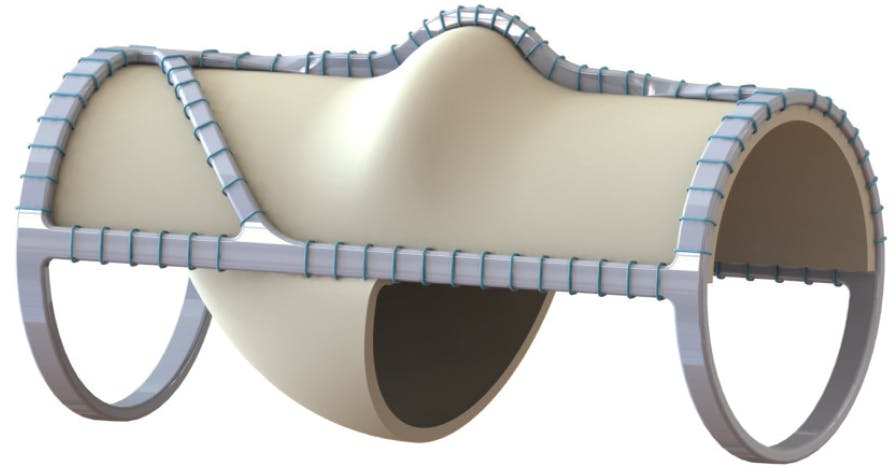
Figure 1. Side view of the VenoValve surgical venous valve.
(Courtesy of enVVeno Medical Corporation.)
Several platforms have been evaluated in early clinical studies, including those from Cook Medical, InterVene, and enVVeno Medical Corporation. In May 2024, Cook Medical announced it had discontinued its trial a year after its first patient was enrolled.1
In 2022, Marston et al reported their experience with BlueLeaf endovenous valve formation system (InterVene) in six patients in the United States.2 The BlueLeaf technique involved the creation of a monocuspid valve from the patient’s own venous tissue. No prosthetic was implanted. Conceptually, the technique was a percutaneous Maleti valve, and it worked fairly well; ulcers healed and Venous Clinical Severity Score (VCSS) improved, as did reflux times. Next phases for this technology are currently unknown.
The VenoValve is currently awaiting FDA approval, and 1-year results of the SAAVE trial were presented at the VEITH meeting in November 2024 and reported in Endovascular Today.3,4 The VenoValve consists of glutaraldehyde-treated porcine aortic valve leaflets sutured to a stainless-steel frame that is surgically inserted into the femoral vein. Results were quite good: 1-year valve patency was 97%, VCSS improved, and 85% of patients had a clinically meaningful benefit. In addition, pain improved and ulcer healing occurred. There were some adverse events noted in the trial, including hematoma, target vein thrombosis, and wound infection. Presently, this device is probably a good one.
To learn more about venous valve history and technical considerations, I recommend the article by Zong et al in Medicine in Novel Technology and Devices published in 2024.5
THE FUTURE
In the near future, a number of needs and concepts should be addressed. Ultimately, any venous valve option should be placed percutaneously, and a percutaneous version of the VenoValve is being tested. Percutaneous placement is better for patient recovery and would minimize some of the adverse events that occurred in the SAAVE trial, such as wound infection and hematoma. It also enables nonsurgeons to treat these patients. Although there are positives and negatives to this, if placement is easier and nonsurgeons can do it, many more patients will have access to this procedure.
We must address the following questions, from the start, once percutaneous or surgically placed valves are available:
- Who is qualified to place them?
- Which patients are appropriate?
- Where does valve placement fit in our algorithm of care?
- How do we minimize overuse and abuse?
- How do we monitor results in the real world, outside of a trial?
Physicians and industry both want to make money. Clearly, the more valves that are placed, the more money everyone makes. However, just because a procedure is relatively easy doesn’t mean that it always should be done. In 2025, there is minimal monitoring of any superficial or deep venous procedures, and unfortunately, abuse has occurred. One way to proactively prevent abuses in the valve space would be to require interventionalists to participate in a registry in order to use these devices. We all want the right patients being treated by the right doctor for the right reasons.
There is also a need to address what metrics are necessary to confirm a successful procedure. Some metrics have already been reported in the trials, including VCSS, reflux times, and patency. We also need general and specific patient-centered data to better understand the patient experience and whether patients feel better after treatment. Of course, this information is not unique to valve placement, and we are increasingly seeing patient-reported outcome measures in recent trials in the wider vein space.
Other technical considerations and questions include:
- How do we best visualize a valve once placed?
- What is the postoperative surveillance protocol?
- What is the ideal anticoagulation protocol?
- Do we use active or passive compression? During the day, night, or both?
- What is the best location for placement?
- Are multiple valves better than one?
CONCLUSION
In the realm of venous valves, we are getting there. We have at least one valve option that seems to be promising, and other options will emerge. We only need to look at the multiple devices available for endovenous ablation, stent placement, and thrombectomy to give us hope. Medicine always moves ahead. The history of the search for a durable, functioning, man-made valve has been too long. I was just starting out my venous career as a first-year resident when I was involved in one of the first reported axillary valve transplants. I never thought it would take this long to make progress.
Importantly, once a valve becomes available, we need to be sure we’re doing what is best for our patients. I am not yet sure how large or small the patient pool will be; we need to understand who benefits and who doesn’t, and we need to educate others so that we get good results while minimizing adverse events. It is about quality and not quantity.
The endovenous valve future is looking good. Time will tell if the future of valves is as good as the title of the Timbuk 3 song: “The Future’s So Bright, I Gotta Wear Shades.”
1. Cook Medical. What a medical device company learned from discontinuing a clinical trial. May 28, 2024. Accessed July 14, 2025. https://www.cookmedical.com/newsroom/what-a-medical-device-company-learned-from-discontinuing-a-clinical-trial/
2. Marston W, Muluk S, Sadek M, et al. Initial US experience with the BlueLeaf endovenous valve formation system. J Vasc Surg Venous Lymphat Disord. 2022;10:P566.
3. Ulloa J. Long-term results of the SAVVE trial: a bioprosthetic valve. Presented at: VEITHsymposium; November 19-23, 2024; New York, New York.
4. Endovascular Today. 1-Year data presented from enVVeno’s VenoValve pivotal trial. November 20, 2024. Accessed June 18, 2025. https://evtoday.com/news/1-year-data-presented-from-envvenos-venovalve-pivotal-trial
5. Zong Q, Liu J, Chen Y, et al. Prosthetic venous valves for chronic venous insufficiency: advancements and future design directions. Med Nov Technol Devices. 2024;21:100288. doi: 10.1016/j.medntd.2024.100288
Advertisement
Advertisement