Advertisement
Advertisement
March 2025
Sponsored by Medtronic
Hypersensitivity Reaction With Cyanoacrylate Glue: Patient Selection, Technical Considerations, and Management
Approach to hypersensitivity management after endovenous ablation.
By Eri Fukaya, MD, PhD; Leigh Ann O’Banion, MD, RPVI; Michael Y. Shao, MD, RPVI; Carl Fastabend, MD; Robert A. Edwards, DO; Misaki M. Kiguchi, MD, MBA, FACS, RPVI; Michael J. Cumming, MD, MBA, FRPC; and Kathleen Gibson, MD
The first use of cyanoacrylate glue as a nontumescent, nonthermal treatment for great saphenous vein reflux in humans was reported in 2012.1 After FDA approval in 2015, the VenaSeal Closure System™ (VenaSeal, Medtronic) became the most widely used form of cyanoacrylate ablation.1 VenaSeal offers several advantages, including avoiding the risk of thermal nerve injury, eliminating the need for tumescence, and removing the traditional requirement for compression postprocedure, while still having a high rate of long-term closure, comparable to surgical stripping and thermal ablation.2-4 However, cyanoacrylate polymerizes in the vein, acting as a foreign body and carrying the risks unique to this technique. These include foreign body granuloma (0.7%-1.6%; not discussed in this article)4,5 and hypersensitivity reactions (HSR; 5.6%-13.3%).4-7
HSRs after VenaSeal treatment may be categorized as either type I or type IV, or a combination of both. Type I hypersensitivity is a mast cell–activated reaction that occurs shortly after exposure (usually within minutes to days) due to excessive histamine release. Common symptoms include erythematous rash and itching. In contrast, type IV hypersensitivity is a T-cell–mediated, delayed immune reaction that can occur when the immune system is in prolonged contact with the allergen.8 The distinction between the two reactions is rarely made in the literature, and the reported hypersensitivity rates are likely a combination of the two.
Pre-procedure: Patient considerations
Patient selection†,1
If any of the following conditions exist, consider alternative treatment modalities:
- Significant autoimmune or systemic inflammatory disorder
- Prior adverse reaction to cyanoacrylate
- Known intolerance to adhesives (eg, skin glue, acrylic nails, eyelash glue, adhesive bandages, tape)
- History of numerous food and/or drug allergies
Patient education
Discuss hypersensitivity reaction, risk, and treatment options. Discuss different vein closure treatment options. Educate patients on symptom recognition and when to seek help.
†The authors of this document view these factors as being potentially related to, or predictive of, whether or not a patient develops a hypersensitivity reaction to VenaSeal.
1. Vasquez MA, et al. Phlebology. 2024;39:245-250.
O’Banion et al reported a 13.3% (n = 79/595) incidence of HSRs in their case series. Of these, 18 patients required oral steroid treatment. All cases resolved without further sequelae.7 Gibson et al reported that 6.3% (n = 18/286) of patients in their study developed a HSR, with 13 patients classified as mild, four classified as moderate, and one case requiring a vein excision due to a severe HSR.6 Despite multiple case reports describing HSRs requiring vein excision,9,10 the true incidence remains unknown, but it is likely rare. A nationwide survey done in Japan, which included 24,209 patients, found that glue resection was performed in only four patients due to HSR.5
Although widely regarded as a safe and effective procedure, the unique properties of VenaSeal that may trigger HSRs underscore the necessity for establishing clinical recommendations pertaining to patient selection, procedural techniques, and treatment options. In light of these considerations, this article’s authors convened for a 2-day meeting in December 2024 to address this issue in detail.
PATIENT SELECTION AND COUNSELING
Proper patient selection is a critical first step to minimize the risk of HSRs. Contraindications for VenaSeal are listed in the instructions for use.11
1. Patients with adhesive allergy. A prior adverse reaction to adhesives and cyanoacrylate is considered a contraindication to the use of VenaSeal.11 Although patients may not know if they have specifically reacted to cyanoacrylate, they can often recall past reactions to common adhesives. Therefore, it is necessary to ask about sensitivity to products such as skin glue (eg, Dermabond; Ethicon, a Johnson & Johnson company), acrylic nails, eyelash glue, adhesive bandages, and tape. Patch testing alone is inadequate to definitively exclude the possibility of developing a HSR.12 While individuals with a positive patch test should not be treated with VenaSeal, a negative result does not guarantee that a reaction will not occur.
2. Patients with significant autoimmune or systemic inflammatory disorders. These patients may be at a higher risk of developing a HSR; therefore, caution should be exercised when determining whether they are appropriate candidates for VenaSeal. Additionally, a history of multiple food, environmental, and/or medication allergies may be an indicator for a predisposition to allergic reactions, and this should be carefully considered when selecting the best ablation modality.
In general, shared decision-making (SDM) between the patient and treatment provider should be standard practice when discussing the potential risks, benefits, and alternative treatment options. The authors recommend that, when considering treatment with VenaSeal, an additional discussion should be held to inform patients about the nature of the product, including its role as a foreign-body implant and the associated risk of developing HSRs. Patients should receive clear instructions on symptom recognition and when to seek medical attention as a part of the informed consent process. Several studies and consensus documents have supported that SDM between patients and providers leads to improved patient outcomes and satisfaction.13
TECHNICAL CONSIDERATIONS
VenaSeal is a permanent implant, and therefore full sterile technique is a requirement. The triggers for the HSR are not completely known. However, it is critical to minimize risk through the use of the following procedural best practices.
1. Atraumatic catheter placement. Assessing the target vein’s diameter along the course of the targeted treatment pathway is essential for ensuring atraumatic catheter placement and determining the appropriate volume of adhesive for effective vein closure. Gentle manipulation of the wire and catheter is best to avoid any unintended trauma or perforation that may lead to adhesive extravasation beyond the vein wall.
2. Adequate compression. The instructions for use recommend applying sufficient pressure to collapse the vein during closure; however, it is important to avoid excessive pressure in order to prevent trauma to diseased, thin-walled veins leading to glue extravasation. The concomitant use of real-time ultrasound during the procedure allows the treating physician to confirm catheter position and immediate vein closure.
3. Avoiding subdermal glue exposure. Finally, recapturing the adhesive delivery catheter into the sheath prior to removing the sheath from the vein is a critical step. This prevents any adhesive from contacting with extravascular tissue, reducing the risk of developing inflammation and/or a granuloma at the exit site.
Procedural best practices
(Follow VenaSeal instructions for use)
Sterile technique
VenaSeal is an implanted device. Full sterile technique is mandatory.
Atraumatic wire and catheter placement
Assess target vein diameter to ensure atraumatic catheter placement. Gentle manipulation of wire and catheter is recommended to minimize tissue trauma.
Glue deployment
Modify adhesive volume based on vein diameter. Apply sufficient pressure to coapt the vein, avoiding excessive pressure.
Ultrasound
Use real-time ultrasound to confirm catheter position and immediate vein closure.
Exposure control
Recapture glue catheter into sheath prior to removing sheath from vein. Prevent adhesive contact with extravascular tissues to avoid inflammation and granulomatous reactions.
HYPERSENSITIVITY MANAGEMENT
Diagnosis
Type I hypersensitivity. This can present in a biphasic manner with the immediate stage occurring rapidly (within minutes of exposure) and the late phase developing 4 to 12 hours after exposure.8 Pruritus and erythema are required for diagnosis. The patient may also report burning, pain, or systemic symptoms.
Type IV hypersensitivity. This typically presents 1 to 3 days after exposure,8 but initial onset has been reported as late as 23 days after exposure.6 Pruritus and erythema are required for diagnosis. The patient may also report burning or pain.
Initial reports of safety outcomes from studies with VenaSeal likely combined the cases of phlebitis with HSR due to their similar clinical presentation.6 Classic phlebitis presents as a tenderness and painful erythema often with a hard or cord-like vein and can be hot to the touch, with an absence of any pruritus. In contrast, the most specific symptoms of HSRs are pruritus and erythema. It is important to understand that it is possible for patients to present with concomitant hypersensitivity and phlebitis, and appropriate diagnosis is critical to treat effectively.
Treatment
The treatment algorithm developed by the authors is detailed in Figure 1. Initial treatment options will depend on the severity of patient presentation. Most HSRs can be managed with oral and/or topical antihistamines with the option to prescribe nonsteroidal anti-inflammatory drugs and cold compress to alleviate any associated pain or swelling.
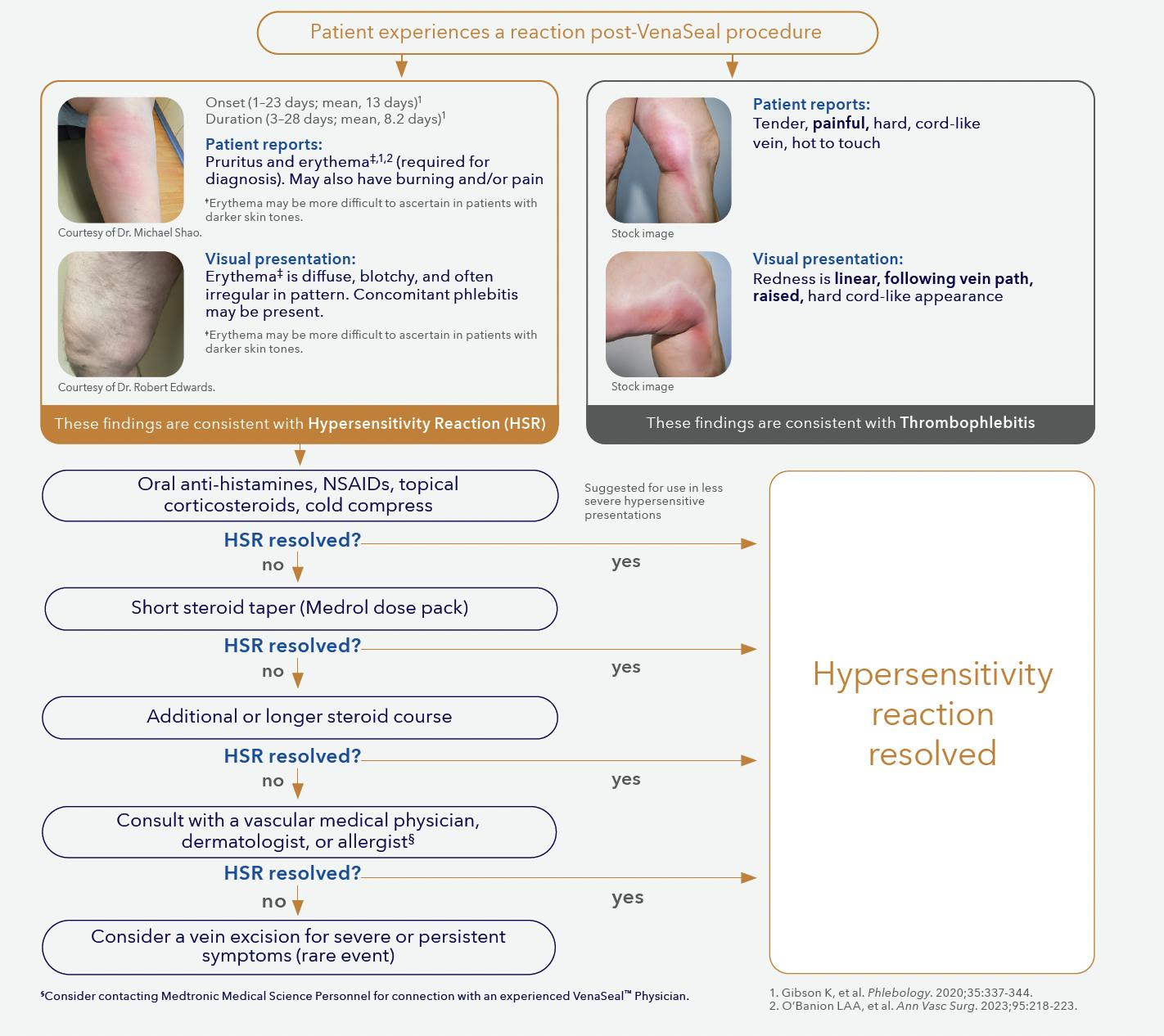
Figure 1. Differential diagnosis and treatment algorithm for HSR after VenaSeal treatment. NSAID, nonsteroidal anti-inflammatory drug.
In cases with prolonged or more severe symptoms including those with systemic manifestations, a short steroid taper (ie, Medrol Dosepak; Pfizer, Inc.) can be used either as a single treatment or in multiple rounds of treatment. Some patients may require higher-dose steroids or an extended course of steroids. If a HSR is persistent through multiple rounds of treatment, it may be beneficial to consult with a local physician with expertise in treating hypersensitivity cases (dermatologist, allergist, and/or vascular medicine specialist). In rare cases that are refractory to maximal medical therapy, where hypersensitivity persists despite steroid treatment and despite subspecialist consultation, complete excision of the treated vein may be required to fully alleviate symptoms; however, this option should be carefully considered in a multidisciplinary discussion and in conjunction with SDM.
Discussion and Conclusion
Various thermal and nonthermal modalities are available to treat axial venous reflux. The appropriate treatment plan for the patient should be guided by physician discretion and in collaboration with the patient through SDM. When VenaSeal is selected as the procedure of choice, consideration of unique complications should be discussed. While VenaSeal is a safe and effective treatment, there is a paucity of high-quality data on how to best prevent and manage HSRs. In 2022, the American Vein and Lymphatic Society published a report on the current practice of cyanoacrylate, including a potential screening tool to help determine which patients to treat with VenaSeal.12 The goal of this publication is to expand upon this foundation by providing additional considerations to mitigate HSRs and offer a treatment algorithm for managing cases when they do occur.
Overall, VenaSeal is a valuable option in the repertoire of available modalities for the treatment of superficial venous disease. High rates of long-term closure along with the ability to avoid surgical complications, nerve damage, tumescent anesthesia, and the requirement of compression postprocedure make it an attractive choice for patients and physicians alike. With proper technique and appropriate patient selection, the potential for development of a HSR is low and the vast majority of HSR cases after VenaSeal treatment are self-limited and resolve without further sequelae.
This article does not discuss foreign body granuloma, which is a unique complication from hypersensitivity but can occur either independently or concomitantly with HSR.
Acknowledgments
This work was fully supported by Medtronic Inc. The authors thank Amy Molan, PhD; Joseph Zygmunt; Alex Tarantino; Daniel Denmark, PhD; Azah Tabah, PhD; and Emily Anthony, all employed by Medtronic Inc., for their contributions to the publication of this article. The authors also thank Dr. Kazuyo Sujino for critical review.
1. Almeida JI, Javier JJ, Mackay E, et al. First human use of cyanoacrylate adhesive for treatment of saphenous vein incompetence. J Vasc Surg Venous Lymphat Disord. 2013;1:174-180. doi: 10.1016/j.jvsv.2012.09.010
2. Morrison N, Gibson K, Vasquez M, et al. Five-year extension study of patients from a randomized clinical trial (VeClose) comparing cyanoacrylate closure versus radiofrequency ablation for the treatment of incompetent great saphenous veins. J Vasc Surg Venous Lymphat Disord. 2020;8:978-989. doi: 10.1016/j.jvsv.2019.12.080
3. Proebstle T, Alm J, Dimitri S, et al. Three-year follow-up results of the prospective European Multicenter Cohort Study on Cyanoacrylate Embolization for treatment of refluxing great saphenous veins. J Vasc Surg Venous Lymphat Disord. 2021;9:329-334. doi: 10.1016/j.jvsv.2020.05.019
4. Gibson K. Primary Results from the VenaSeal Spectrum Program. Presented at: Charing Cross International Symposium; April 23-25, 2024; London, United Kingdom.
5. Umetsu M, Hirokawa M, Fukaya E, et al. Safety assessment of cyanoacrylate closure for treatment of varicose veins in a large-scale national survey in Japan. J Vasc Surg Venous Lymphat Disord. 2025;13:102160. doi: 10.1016/j.jvsv.2024.102160
6. Gibson K, Minjarez R, Rinehardt E, Ferris B. Frequency and severity of hypersensitivity reactions in patients after VenaSeal cyanoacrylate treatment of superficial venous insufficiency. J Vasc Surg Venous Lymphat Disord. 2020;35:337-344. doi: 10.1177/0268355519878618
7. O’Banion LA, Shao MY, Ali A, et al. Type IV hypersensitivity reaction after cyanoacrylate venous closure. Ann Vasc Surg. 2023;95:218-223. doi: 10.1016/j.avsg.2023.06.002
8. Athavale A, Thao M, Sassaki VS, et al. Cyanoacrylate glue reactions: A systematic review, cases, and proposed mechanisms. J Vasc Surg Venous Lymphat Disord. 2023;11:876-888.e1. doi: 10.1016/j.jvsv.2023.03.018
9. Louden CD, Clark J, Yanquez F, et al. Severe adverse reactions after cyanoacrylate endovenous ablation. J Vasc Surg Cases Innov Tech. 2023;9:101309. doi: 10.1016/j.jvscit.2023.101309
10. Jones AD, Boyle EM, Woltjer R, et al. Persistent type IV hypersensitivity after cyanoacrylate closure of the great saphenous vein. J Vasc Surg Cases Innov Tech. 2019;5:372-374. doi: 10.1016/j.jvscit.2019.05.004
11. VenaSeal Closure System [Instructions for Use]. Medtronic, Inc.: 2020. Accessed February 20, 2025.https://www.medtronic.com/en-us/l/patients/treatments-therapies/varicose-vein-treatments/important-safety-information.html
12. Vasquez MA, Iorio MD, Worthington-Kirsch RL, et al. Current practice of cyanoacrylate endovenous ablation: American vein and lymphatic society position statement. Phlebology. 2024;39:245-250. doi: 10.1177/02683555231221862
13. Davidson KW, Mangione CM, Barry MJ, et al. Collaboration and shared decision-making between patients and clinicians in preventive health care decisions and us preventive services task force recommendations. 2022;327:1171-1176. doi: 10.1001/jama.2022.3267








VenaSeal™ closure system
Brief Statement
Intended Use/Indications: The VenaSeal™ closure system (VenaSeal™ system) is indicated for use in the permanent closure of lower extremity superficial truncal veins, such as the great saphenous vein (GSV), through endovascular embolization with coaptation. The VenaSeal system is intended for use in adults with clinically symptomatic venous reflux as diagnosed by duplex ultrasound (DUS).
Contraindications: Separate use of the individual components of the VenaSeal closure system is contraindicated. These components must be used as a system. The use of the VenaSeal system is contraindicated when any of the following conditions exist: previous hypersensitivity reactions to the VenaSeal™ adhesive or cyanoacrylates, acute superficial thrombophlebitis, thrombophlebitis migrans, acute sepsis.
Potential Adverse Effects of the Device on Health: The potential adverse effects (e.g., complications) associated with the use of the VenaSeal system include, but are not limited to, adverse reactions to a foreign body (including, but not limited to, nonspecific mild inflammation of the cutaneous and subcutaneous tissue), arteriovenous fistula, bleeding from the access site, deep vein thrombosis (DVT), edema in the treated leg, embolization, including pulmonary embolism (PE), hematoma, hyperpigmentation, hypersensitivity or allergic reactions to cyanoacrylates, such as urticaria, shortness of breath, and anaphylactic shock, infection at the access site, pain, paresthesia, phlebitis, superficial thrombophlebitis, urticaria, erythema, or ulceration may occur at the injection site, vascular rupture and perforation, visible scarring.
Warnings, precautions, and instructions for use can be found in the product labeling at http://manuals.medtronic.com.
CAUTION: Federal (USA) law restricts this device to sale by or on the order of a physician.
501694 ©2025 Medtronic. Medtronic, Medtronic logo are trademarks of Medtronic. All other brands are trademarks of Medtronic. For global distribution. 03/2025
Advertisement
Advertisement