Advertisement
Advertisement
March 2025
Sac Management to Promote Regression in Infrarenal AAA Repair
Contemporary embolization strategies for active sac management during EVAR.
By Beatrix H. Choi, MD; Thomas FX O’Donnell, MD; and Virendra I. Patel, MD, MPH
Since the first successful endovascular aneurysm repair (EVAR) of abdominal aortic aneurysms (AAAs) 35 years ago, it has become widely adopted as an alternative to open repair for AAA.1 The advantages of EVAR are many: It is a less invasive and much less morbid procedure with shorter operative time, decreased blood loss, shorter hospital length of stay, and lower 30-day mortality.2-4 These benefits have made EVAR a popular repair alternative to open surgery, especially for frail patients.
However, medium- and long-term outcomes of EVAR have not been as favorable, with earlier studies showing no survival benefit or increased quality of life compared to open repair.4,5 More recent data show that there is increased aneurysm-related mortality, increased cancer mortality, and higher rates of reintervention approximately 8 years after EVAR. Most of the long-term aneurysm-related deaths in the EVAR group were due to secondary aneurysm sac rupture, highlighting the need for ongoing surveillance.6
In particular, the focus has shifted to aneurysmal sac behavior. Sac growth has been associated with worse long-term outcomes, including higher rates of reintervention to prevent aneurysm-related deaths, with type II endoleaks from branch vessels such as the inferior mesenteric artery (IMA) and lumbar arteries noted as a major contributor to sac enlargement.7-11 Even sac stability has been shown to be associated with worse outcomes.12,13 Conversely, sac regression has been shown to be associated with favorable outcomes and improved long-term survival and is now considered to be an important indicator of EVAR success.14-17
Therefore, there has been increasing interest in a more active approach to aneurysm sac management strategies to promote sac regression. Some predictive factors of sac regression include patent IMA, patent lumbar arteries (especially if > 3 mm), postimplantation syndrome, and thrombus density.15,18,19 As such, contemporary strategies for active sac management include embolization of the feeder vessels (most often the IMA or lumbar arteries) and coil or liquid embolization of the aneurysm sac itself.20,21
EMBOLIZATION STRATEGIES FOR ACTIVE SAC MANAGEMENT
Direct feeder vessel embolization has shown promising results, with a recent randomized controlled trial showing that preemptive embolization of the IMA during EVAR resulted in significantly greater rates of sac shrinkage ≥ 5 mm and lower rates of sac growth ≥ 10 mm.22 This is consistent with prior data showing decreased rates of sac progression and type II endoleak, as well as lower rates of reintervention postoperatively.21,23,24 However, embolization of feeder vessels has the distinct disadvantage of increased operative and fluoroscopy time, higher contrast load for the patient, and variability in technical success. Nonspecific embolization of the sac itself is less susceptible to technical failure and requires less operative time, but it can be imprecise, risks off-target embolization, and often leads to radiographic artifact on follow-up surveillance imaging.20
Coils, Liquid Agents, and Microvascular Plugs
Of agents for sac embolization, coils have been the most commonly used.25-27 Although detachable stainless steel or platinum coils can be used for direct sac embolization, they often lead to artifact on follow-up imaging and have varying degrees of success depending on tightness of the coils.28 Artifact from the coils can especially hinder detection of microleaks on CT, which may then require imaging with an additional modality such as ultrasound.25 Several liquid agents have been tried as well, including histoacryl glue and vinyl alcohol copolymer. Liquid agents have a higher risk of off-target embolization and have been associated with postoperative complications such as bowel ischemia and paraplegia.29 Plugs such as microvascular plugs (MVP, Medtronic) are used primarily for direct feeder vessel embolization and are not intended for use in embolization of the sac itself.
Shape Memory Polymer Plugs
Shape memory polymer (SMP) is a porous, bioabsorbable, polyurethane plug (Impede-FX, Shape Memory Medical Inc.) that was first used to promote sac thrombosis after EVAR in 2020.30-33 The plug self-expands into a porous scaffold upon contact with blood, which then supports thrombus formation and sac regression.30 SMP plugs are compatible with CT or MRI without producing streak artifact due to their radiolucent nature, making them an ideal device for aneurysms that require ongoing surveillance.
Each packaged SMP plug occupies up to 1.25 mL when fully expanded, with a small, proximal radiopaque marker to locate them throughout fluoroscopy. The most common method of aneurysm sac embolization has recently been described.24 On one or both access sides during EVAR, the ipsilateral and contralateral sheaths are chosen to be 2-F size larger than needed for graft and limb delivery. The main endograft and limbs are delivered in standard fashion. Prior to extension of the limbs to the common iliac artery on each side, a wire is advanced and coiled around in the aneurysm sac (Figure 1). The ipsilateral and contralateral limbs are then delivered and deployed. Balloon angioplasty of the proximal seal and proximal graft to limb overlap junctions is performed. Distal seal angioplasty is delayed until after aneurysm sac embolization. Using the wires left in the aneurysm sac, a 6-F sheath is introduced over the wire and along the iliac limbs into the sac for SMP plug delivery. Steerable sheaths or guiding catheters can be used for more precise SMP delivery, and the entire sac is sequentially filled in quadrants. After embolization and sac angiography, the unilateral sheath or bilateral sheaths is/are removed, and distal seal angioplasty is performed. The distribution of plugs is confirmed with fluoroscopy, with a goal of at least 150% to 200% fill based on volumetric measurements. Early results published by Holden et al demonstrated the safety of the device for aneurysmal sac exclusion, and follow-up results at 1 year showed 100% technical success, with almost 30% reduction in sac volume and 82% of patients achieving > 5 mm decrease in sac diameter.34
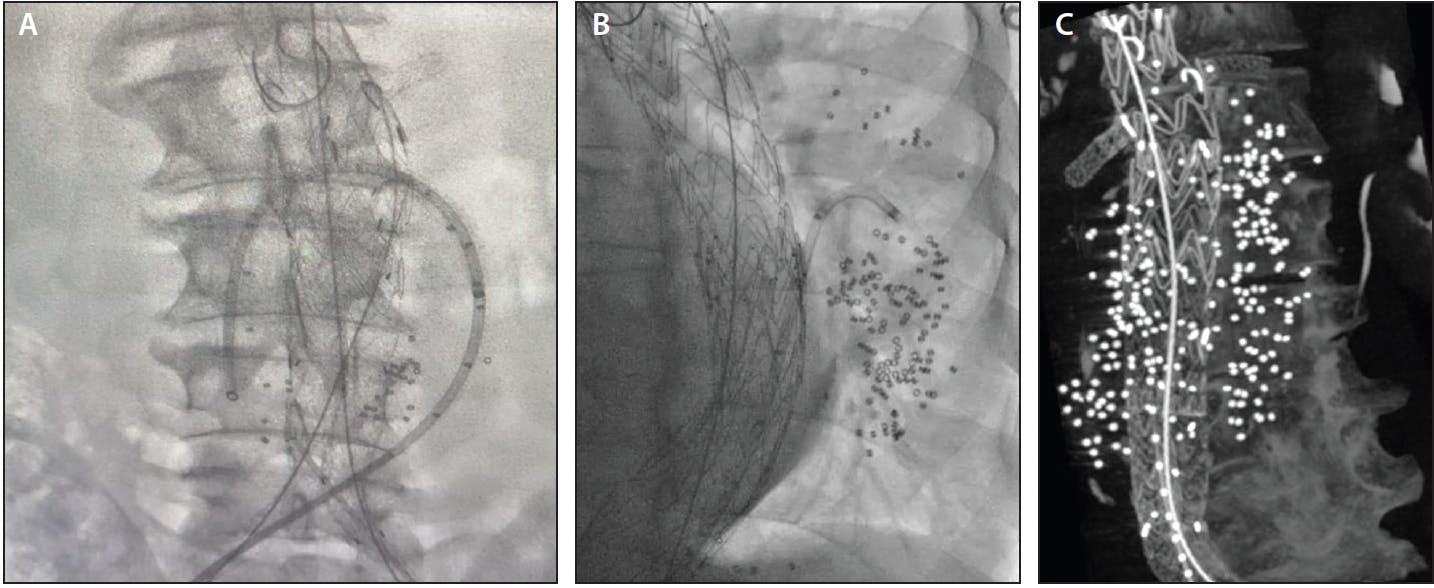
Figure 1. Intraoperative image of SMP deployment mid-fill (A). Intraoperative image of SMP deployment post-fill (B). Postoperative CTA (C).
Our group is currently evaluating our experience with sac embolization using SMP plugs in patients undergoing standard infrarenal AAA repair with EVAR. In our series of 30 patients, there were no off-target embolizations or inadvertent sac perforations. On completion angiography, four patients demonstrated endoleaks. By 1 month, three endoleaks had resolved, and by 6 months, all had resolved on surveillance imaging. Additionally, at 6-month follow-up, both median sac volume and aneurysm diameter had decreased—all patients showed reduction in sac volume, with 80% of sacs decreasing > 10% volumetrically. These data were presented at the 2025 Society of Clinical Vascular Surgery meeting.
Although these early results are promising, these studies are limited by small sample sizes, relatively short follow-up, and single-institution experience. The cost of SMP embolization may be prohibitive in some cases given the high number of plugs required to fill the aneurysmal sac space, and the long-term benefits from usage of SMP plugs may be limited in older or frail patients when considering the added operative time, radiation exposure to both operator and patient, and contrast burden. Many of these limitations will be addressed in the AAA-SHAPE trial (NCT06029660), which aims to enroll 180 patients in a prospective, multicenter study to compare the 1-year outcomes (sac regression of > 10% and need for reintervention) of EVAR with SMP plugs compared with standard EVAR.
CONCLUSION
SMP plugs are a safe and effective method of sac embolization to promote sac thrombosis and regression in EVAR. Although more data are needed to assess the long-term efficacy and effects of these plugs, the initial results are extremely promising.
1. Parodi JC, Palmaz JC, Barone HD. Transfemoral intraluminal graft implantation for abdominal aortic aneurysms. Ann Vasc Surg. 1991;5:491-499. doi: 10.1007/BF02015271
2. Chaikof EL, Dalman RL, Eskandari MK, et al. The Society for Vascular Surgery practice guidelines on the care of patients with an abdominal aortic aneurysm. J Vasc Surg. 2018;67:2-77.e72. doi: 10.1016/j.jvs.2017.10.044
3. Schermerhorn ML, O’Malley AJ, Jhaveri A, et al. Endovascular vs. open repair of abdominal aortic aneurysms in the Medicare population. N Engl J Med. 2008;358:464-474. doi: 10.1056/NEJMoa0707348
4. Chinsakchai K, Thorthititum D, Hongku K, et al. Endovascular versus open repair for asymptomatic abdominal aortic aneurysms: a 12-year retrospective cohort analysis. Ann Vasc Surg. 2025;112:363-372. doi: 10.1016/j.avsg.2024.12.052
5. EVAR trial participants. Endovascular aneurysm repair versus open repair in patients with abdominal aortic aneurysm (EVAR trial 1): randomised controlled trial. Lancet. 2005;365:2179-2186. doi: 10.1016/S0140-6736(05)66627-5
6. Patel R, Sweeting MJ, Powell JT, Greenhalgh RM. Endovascular versus open repair of abdominal aortic aneurysm in 15-years’ follow-up of the UK endovascular aneurysm repair trial 1 (EVAR trial 1): a randomised controlled trial. Lancet. 2016;388:2366-2374. doi: 10.1016/S0140-6736(16)31135-7
7. Hoshina K, Ishimaru S, Sasabuchi Y, et al. Outcomes of endovascular repair for abdominal aortic aneurysms: a nationwide survey in Japan. Ann Surg. 2019;269:564-573. doi: 10.1097/SLA.0000000000002508
8. Dijkstra ML, Zeebregts CJ, Verhagen HJM, et al. Incidence, natural course, and outcome of type II endoleaks in infrarenal endovascular aneurysm repair based on the ENGAGE registry data. J Vasc Surg. 2020;71:780-789. doi: 10.1016/j.jvs.2019.04.486
9. Seike Y, Matsuda H, Shimizu H, et al. Nationwide analysis of persistent type II endoleak and late outcomes of endovascular abdominal aortic aneurysm repair in Japan: a propensity-matched analysis. Circulation. 2022;145:1056-1066. doi: 10.1161/CIRCULATIONAHA.121.056581
10. Bruijn LE, Louhichi J, Veger HTC, et al. Identifying patients at high risk for post-EVAR aneurysm sac growth. J Endovasc Ther. 2024;31:1107-1120. doi: 10.1177/15266028231158302
11. Deery SE, Ergul EA, Schermerhorn ML, et al. Aneurysm sac expansion is independently associated with late mortality in patients treated with endovascular aneurysm repair. J Vasc Surg. 2018;67:157-164. doi: 10.1016/j.jvs.2017.06.075
12. Li C, Böckler D, Rastogi V, et al. The effect of one year aneurysm sac dynamics on five year mortality and continued aneurysm sac evolution. Eur J Vasc Endovasc Surg. 2024;68:469-477. doi: 10.1016/j.ejvs.2024.06.003
13. Vos CG, Fouad F, Dieleman IM, et al. Importance of sac regression after EVAR and the role of EndoAnchors. J Cardiovasc Surg (Torino). 2024;65:99-105. doi: 10.23736/S0021-9509.24.12992-8
14. Sugimoto M, Osawa T, Lee C, et al. Impact of significant sac shrinkage on endograft tortuosity at 5 years postendovascular aortic aneurysm repair: a retrospective analysis. Ann Vasc Surg. 2025;110:10-16. doi: 10.1016/j.avsg.2024.08.033
15. Jeong MJ, Kwon H, Ko GY, et al. New predictors of aneurysm sac behavior after endovascular aortic aneurysm repair. Eur Radiol. 2019;29:6591-6599. doi: 10.1007/s00330-019-06306-5
16. Tinelli G, D’Oria M, Sica S, et al. The sac evolution imaging follow-up after endovascular aortic repair: an international expert opinion-based Delphi consensus study. J Vasc Surg. 2024;80:937-945. doi: 10.1016/j.jvs.2024.03.007
17. Suzuki T, Mitsuoka H, Terai Y, Miyano Y. Remodeling of the proximal sealing zone and sac shrinkage after endovascular aortic repair or fenestrated endovascular aortic repair. Ann Vasc Surg. 2024;109:47-54. doi: 10.1016/j.avsg.2024.06.029
18. Skrebunas A, Lengvenis G, Builyte IU, et al. Aortic sac enlargement after endovascular aneurysm repair: volume-related changes and the impact of intraluminal thrombus. Pol J Radiol. 2019;84:e530-e536. doi: 10.5114/pjr.2019.91260
19. Chew DK, Dong S, Schroeder AC, et al. The role of the inferior mesenteric artery in predicting secondary intervention for type II endoleak following endovascular aneurysm repair. J Vasc Surg. 2019;70:1463-1468. doi: 10.1016/j.jvs.2019.01.090
20. Piazza M, Frigatti P, Scrivere P, et al. Role of aneurysm sac embolization during endovascular aneurysm repair in the prevention of type II endoleak-related complications. J Vasc Surg. 2013;57:934-941. doi: 10.1016/j.jvs.2012.10.078
21. Ward TJ, Cohen S, Fischman AM, et al. Preoperative inferior mesenteric artery embolization before endovascular aneurysm repair: decreased incidence of type II endoleak and aneurysm sac enlargement with 24-month follow-up. J Vasc Interv Radiol. 2013;24:49-55. doi: 10.1016/j.jvir.2012.09.022
22. Takeuchi Y, Morikage N, Samura M, et al. Five-year follow-up of randomized clinical trial for pre-emptive inferior mesenteric artery embolization during endovascular aneurysm repair. J Vasc Surg. 2024;80:693-701.e693. doi: 10.1016/j.jvs.2024.04.058
23. Manunga JM, Cragg A, Garberich R, et al. Preoperative inferior mesenteric artery embolization: a valid method to reduce the rate of type II endoleak after EVAR? Ann Vasc Surg. 2017;39:40-47. doi: 10.1016/j.avsg.2016.05.106
24. Aoki A, Maruta K, Omoto T, Masuda T. Midterm outcomes of endovascular abdominal aortic aneurysm repair with prevention of type 2 endoleak by intraoperative aortic side branch coil embolization. Ann Vasc Surg. 2022;78:180-189. doi: 10.1016/j.avsg.2021.06.037
25. Fabre D, Fadel E, Brenot P, et al. Type II endoleak prevention with coil embolization during endovascular aneurysm repair in high-risk patients. J Vasc Surg. 2015;62:1-7. doi:10.1016/j.jvs.2015.02.030
26. Mascoli C, Faggioli G, Gallitto E, et al. Tailored sac embolization during EVAR for preventing persistent type II endoleak. Ann Vasc Surg. 2021;76:293-301. doi: 10.1016/j.avsg.2021.01.118
27. Mascoli C, Faggioli G, Fenelli C, et al. Coil embolization of abdominal aortic aneurysm with a volume-tailored concentration in the prevention of persistent type II endoleak. Eur J Vasc Endovasc Surg. 2019;58:e541-e542. doi: 10.1016/j.ejvs.2019.06.1238
28. White SB, Stavropoulos SW. Management of endoleaks following endovascular aneurysm repair. Semin Intervent Radiol. 2009;26:33-38. doi:10.1055/s-0029-1208381
29. Buckenham T, McKewen M, Laing A, et al. Cyanoacrylate embolization of endoleaks after abdominal aortic aneurysm repair. ANZ J Surg. 2009;79:841-843. doi: 10.1111/j.1445-2197.2009.05113.x
30. Holden A, Hill AA, Khashram M, et al. Active aortic aneurysm sac treatment with shape memory polymer during endovascular aneurysm repair. J Vasc Surg Cases Innov Tech. 2023;9:101241. doi: 10.1016/j.jvscit.2023.101241
31. Echeverría D, Rivera R, Giacaman P, et al. A novel self-expanding shape memory polymer coil for intracranial aneurysm embolization: 1 year follow-up in Chile. J Neurointerv Surg. 2023;15:781-786. doi: 10.1136/jnis-2022-018996
32. Castellano D, Boghi A, Di Maggio L, et al. Shape memory polymer ovarian vein embolisation in a patient with nickel allergy. CVIR Endovasc. 2021;4:25. doi: 10.1186/s42155-021-00212-y
33. Morgan RA, Loftus I, Ratnam L, et al. Clinical experience with a shape memory polymer peripheral vascular embolisation plug: a case series. CVIR Endovasc. 2021;4:29. doi: 10.1186/s42155-021-00214-w
34. Holden A, Hill AA, Khashram M, et al. One-year follow-up after active aortic aneurysm sac treatment with shape memory polymer devices during endovascular aneurysm repair. J Vasc Surg. 2024;79:1090-1100.e1094
Advertisement
Advertisement