Advertisement
Advertisement
May 2025
An Interview With Efthymios “Makis” Avgerinos, MD, FACS, FEBVS
Dr. Avgerinos outlines differences between running a vascular practice in Greece versus the United States, the scope of his current deep venous research, priorities for chronic venous obstruction, the potential for AI-guided compression sonography, and more.
You've been back in Greece for full-time practice since 2021, starting in private practice as Co-Director of the Vascular and Endovascular Clinic of Athens Medical Center and more recently as Associate Professor of Vascular Surgery at the University of Athens. Can you tell us about how you've built and grown this practice? What do you wish you knew when embarking on this venture?
Returning to Athens, Greece, after an 11-year career in the United States was a difficult but conscious decision to serve (and live in) my homeland. Starting a new career and getting recognized by the wider European vascular community was a challenge I was willing to take, stepping on the foundation of my United States clinical and scientific practice. It wasn’t easy. Both physicians and patients need to confirm that you can deliver the service and quality of care you’ve promised; “word of mouth” is the strongest booster, and it takes time. Having a “niche” practice helps (in my case, deep venous and pulmonary embolism [PE] intervention), while extroversion and appropriate scientific collaborations at a local and European level are eventually key for professional growth.
I’m currently sharing my clinical practice between public and private, and I’m fortunate to retain my academic research and educational activities at the 2nd Department of Vascular Surgery of the University of Athens.
Prior to your return to Athens, Greece, your clinical practice and academic appointments had primarily been in Pittsburgh, Pennsylvania. What are the main similarities and differences between practicing in these locations?
The volume, resources, and productivity that a powerhouse like UPMC (University of Pittsburgh Medical Center) Vascular offered are impossible to match.
Vascular surgery practice in Greece—as I believe is the case in many other countries—lacks homogeneity between institutions and is largely dependent on local politics and leadership. I'm fortunate to work in a prime medical environment that, despite poor infrastructure and hospital facilities, there is full access to cutting-edge technologies, covering all aspects of vascular disease in high volumes (2nd Department of Vascular Surgery, University of Athens).
Resources are otherwise limitless in private practice, particularly in large health institutions with multiple facilities nationwide (Athens Medical Center).
Still, productivity is not as high and spontaneous as in the United States, mainly because the system is very much physician-oriented, lacking other health professionals (eg, physician assistants) and administrative staff to speed up in-hospital functions. Let’s keep in mind that Greece was amid a financial crisis 10 years ago; it is largely recovered now, but staff shortages still exist.
What is the scope of your current deep venous research?
I have long been working on the outcomes of deep venous intervention and appropriate patient selection in acute deep vein thrombosis (DVT) and postthrombotic syndrome (PTS). Although we now better recognize predictors of early failures (eg, technical, poor inflow), focusing on longer follow-up makes more sense in the younger population we are typically treating. What is the reintervention rate, and what happens when a venous stent terminally occludes? Does the patient go back to his baseline, or will his clinical condition deteriorate further?
My research team is also working on acute DVT diagnostics, seeking alternative and more efficient pathways using artificial intelligence (AI), portable plethysmography, or novel, more specific biomarkers. Given the rising numbers of acute DVT, alternative diagnostic tools that spare the need for standard ultrasound can be a game changer in busy emergency rooms or community hospitals lacking resources.
In 2024, you and colleagues published an article outlining the roles and principles for stenting in acute iliofemoral venous thrombosis.1 How would you summarize the main points you’d like your fellow physicians to take away from this article?
We have come a long way over the past decade in establishing the role and technique of venous stenting after acute DVT thrombectomy. We moved from very low stenting rates (< 30%) to very high rates (> 80%), with the reality likely being somewhere in between. We now better understand the role of inflammation and spasm that will likely go away, thus eliminating any need for stenting (consider deferring). We also better understand the role of an underlying culprit lesion that does need to be stented.
Some takeaways are: (1) pre- and postdilatation; (2) go big in size (typically 16 mm in the common iliac vein); (3) use a long stent to anchor in the external iliac vein; and (4) make sure you’ve covered any underlying disease to provide optimal inflow, even if it is below the inguinal ligament.
Regarding chronic venous obstruction (CVO), what concerns or questions are top of mind? How do you hope to see intervention and/or data for CVO improve and evolve in the coming years?
The more I get involved in deep venous disease, the more concerns and questions I have! What is the optimal inflow criterion to maintain patency of a venous stent? What is the role of crossing or debulking devices? Can/should we treat the femoropopliteal segment? When should we consider reintervention upon restenosis? What happens when the stent terminally occludes?
We have recently published a CVO classification system to better predict stenting outcomes but also as a reporting standard.2 I urge all practitioners to use it when publishing so that we can accurately compare populations and outcomes.
The STEVECO randomized controlled trial was the first to confirm the quality-of-life improvement in PTS patients who underwent stenting,3 but we’re all looking forward to the results of the National Institutes of Health–funded C-TRACT trial.4
You’ve been lead investigator for various studies related to AI-guided compression sonography for DVT diagnosis. What does the ability for nonexperts to acquire ultrasound images mean for overall DVT workflow and patient care?
I have been trialing AI-guided compression sonography for almost 5 years. The first clinical trials of the ThinkSono Guidance system (ThinkSono) were completed in Athens, Greece, and then later in the United Kingdom and Germany; a trial is now enrolling in the United States.
Leveraging the accessibility of point-of-care ultrasound and eliminating the need for an on-site expert sonographer, the ThinkSono Guidance system is an AI-based software that guides nonexperts in acquiring valid ultrasound images of venous compressions that can then be reviewed by remote, qualified clinicians.
Our trials have confirmed the safety and efficacy of ThinkSono in proximal DVT diagnosis, sparing the need for sonographer-performed venous duplex ultrasound in at least one-third of patients and potentially reducing patient waiting times and costs. Early diagnosis in those who really need it can be lifesaving.
While commercialization and FDA approval are underway, we’re investigating the system’s potential in remote communities, primary care facilities, intensive care units, and for following up varicose vein ablation procedures.
The technology has been constantly improving over a course of 9 years now, and the > 1,200 patients we have been scanning are making the software smarter and increasingly accurate. Don’t be surprised if in a few years we don’t even need an expert radiologist to review the images.
And, how has this experience opened your eyes to other potential uses of AI in vascular applications?
We’re not far from similar AI applications for identifying carotid plaque or aortic aneurysms at the hands of nonexperts. And, we can dive even deeper, such as identifying vulnerable carotid plaque and predicting an endovascular aneurysm repair failure or a failing arteriovenous fistula. There are endless opportunities that we’re going to experience soon!
Last year, the European Society for Vascular Surgery (ESVS) launched the EVeR registry, and you’re one of the registry’s founding key opinion leaders. Why was such a registry needed, and how is it intended to ultimately impact the understanding and treatment of venous diseases?
It’s an exciting time for the venous world, and it’s an exciting time for ESVS. The registry, which ESVS developed with the European Vascular Research Collaborative, is a collaboration of leading vascular specialists, researchers, and health care institutions across Europe.
Despite the prevalence of deep venous diseases, many aspects of these conditions remain poorly understood. The registry will address this knowledge gap by collecting comprehensive data, evaluating treatment effectiveness, and improving patient care.
What do you think has had the biggest impact on PE outcomes over the course of your career? What themes do you think define the current era of PE intervention?
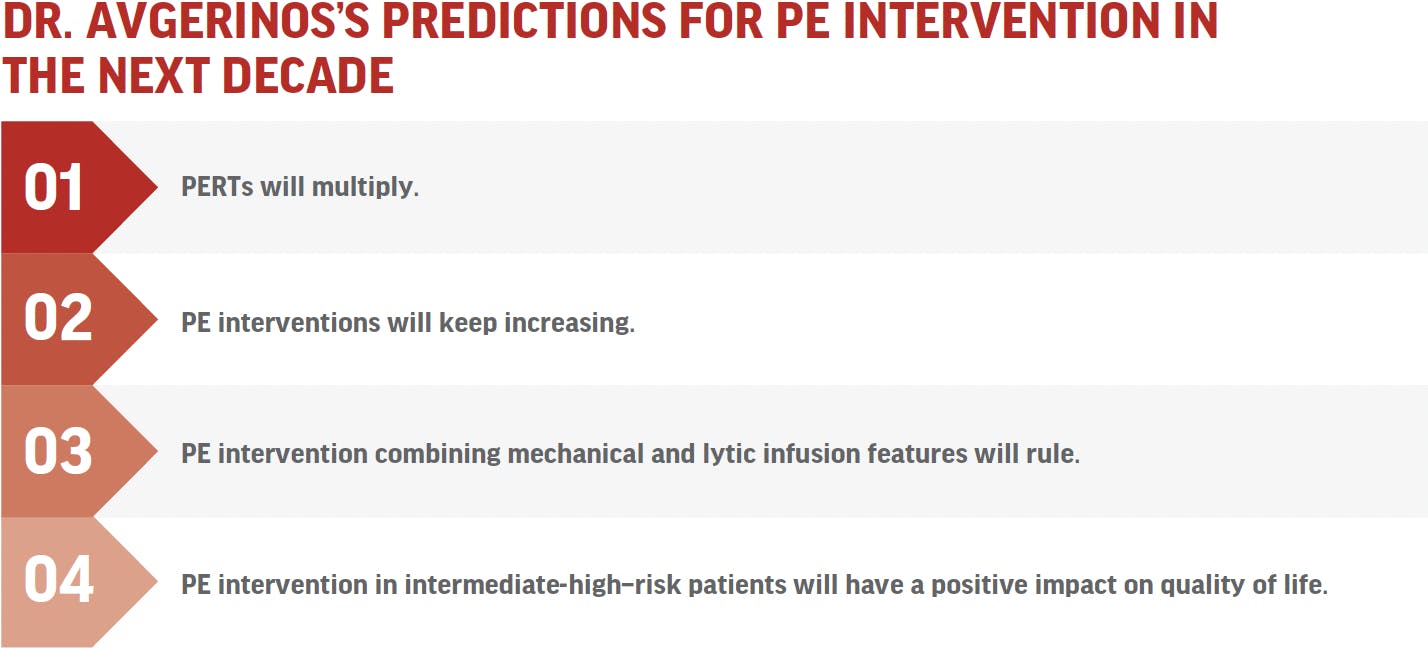
The development of PE response teams (PERTs) has been a catalyst for raising awareness, introducing patients to advanced therapies and eventually improving outcomes.
The main themes in today’s practice are patient selection and the shift to mechanical thrombectomy. While awaiting the PE-TRACT results, it is still unknown who the best candidates are for an endovascular intervention. It is likely the intermediate-high–risk patients, but the truth is that some of them might still do well on anticoagulation alone. Prevention of long-term PE syndrome may be key, but we lack appropriate evidence.
The shift to predominately mechanical aspiration techniques has simplified the logistics, and they will keep rising. However, combining on-table lytics remains a valid adjunct to clean up the distal arterial branches. A combination of techniques may be best.
You’ve studied and practiced in numerous countries and are also regularly traveling for meetings and symposia. What’s your favorite country or city you’ve visited, and what’s still on your bucket list?
Indeed, capturing the momentum and introducing deep venous and PE intervention outside of the United States has offered me the opportunity and privilege to travel around the world and meet other cultures in Latin America, South Africa, and the Middle East. Leaving aside the elegance of the big European metropolises and the breathtaking skylines of United States cities, my favorite places have been the smaller, picturesque cities of Maastricht, the Netherlands; Modena, Italy; and Porto, Portugal—all connected to major vascular events. My bucket list is still long, and I am now particularly looking to explore Asia.
1. Avgerinos ED, Black S, van Rijn MJ, Jalaie H. The role and principles of stenting in acute iliofemoral venous thrombosis. J Vasc Surg Venous Lymphat Disord. 2024;12:101868. doi: 10.1016/j.jvsv.2024.101868
2. Jalaie H, Barbati ME, Piao L, et al; International CVO Classification Study Group. Prognostic value of a classification system for iliofemoral stenting in patients with chronic venous obstruction. Eur J Vasc Endovasc Surg. 2025;69:315-322. doi: 10.1016/j.ejvs.2024.10.002
3. Shekarchian S, Van Laanen J, Esmaeil Barbati M, et al. Editor’s choice—quality of life after stenting for iliofemoral venous obstruction: a randomised controlled trial with one year follow up. Eur J Vasc Endovasc Surg. 2023;66:678-685. doi: 10.1016/j.ejvs.2023.07.044
4. Vedantham S. C-TRACT trial: coming together to tackle chronic DVT. Endovasc Today. 2019;18:77-78, 80-81.
Advertisement
Advertisement
Interested in reading more interviews?
To read more interviews with thought leaders in the vascular field, check out our Profiles & Perspectives hub.
Read More