Advertisement
Advertisement
November 2025 Supplement
Sponsored by Surmodics, Inc.
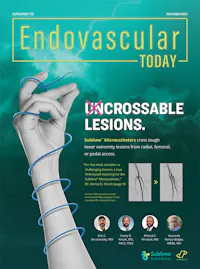
Reliable Crossing of Complex Arterial Lesions With the Sublime™ Microcatheter
A conversation with Dr. Henry D. Hirsch.
Henry D. Hirsch, MD, FACS, FSVS, is a fellowship-trained vascular and endovascular surgeon at Main Line Health in Philadelphia. He specializes in aortic aneurysm repair, transcarotid artery revascularization, and complex limb salvage and chronic limb-threatening ischemia (CLTI) interventions using both endovascular and open surgical approaches. Dr. Hirsch and his colleagues perform a high volume of advanced procedures while maintaining a commitment to educating surgical residents and cardiology fellows at multiple hospitals. Given the complexity of his peripheral artery disease (PAD) interventions, Dr. Hirsch uses high-performance, torqueable microcatheters in almost every PAD case. We spoke with Dr. Hirsch about his peripheral microcatheter tool kit and his experience with the Sublime™ Microcatheter (Surmodics, Inc.).
How would you describe your PAD patient population and your microcatheter requirements for these patients?
Most of my patients have CLTI with rest pain or wounds, and they usually have multilevel disease—iliac plus femoral, femoral plus tibial, or all three levels. There’s often a chronic total occlusion (CTO) with a tapered stenosis leading into it, followed by reconstitution beyond.
Sometimes I’m able to get through lesions with just a wire, but in most cases, I’ll need catheter support to cross. Beyond crossing the lesion itself, it’s very difficult to confirm proper reentry or verify that you’re truly in the vessel lumen beyond the lesion without advancing a catheter. Even if crossing the lesion seems simple, I will still place a catheter and take an angiogram distal to the lesion to confirm that I am exactly where I think I am and to avoid any surprises.
Navigating those tapered stenoses can create a lot of friction. That’s where microcatheters with good lubricious coatings, pushability, and torqueability become really valuable. For the most complex or challenging lesions, I now find myself reaching for the Sublime™ Microcatheter.
What is your current microcatheter tool kit?
I use various workhorse microcatheters for straightforward applications, such as aortic cannulations, where there isn’t really a lesion to cross and I just need the catheter for wire exchange or simple cannulation. For contralateral diagnostics, such as crossing over from the left to the right leg, I generally use a Soft-Vu® Omni™ Flush Angiographic Catheter (AngioDynamics, Inc.) because its shape is suited for that purpose.
For crossing challenging lesions, we have a broad selection available, including NaviCross® Support Catheters (Terumo Interventional Systems), Rubicon™ Control Support Catheters (Boston Scientific Corporation), Trailblazer™ Support Catheters (Medtronic), the CXI® Support Catheter (Cook Medical), the Quick-Cross™ Support Catheter (Philips), and now the Sublime™ Microcatheter platform, which I’ve been using with increased frequency.
What do you like about the Sublime™ Microcatheter?
With the Sublime™ Microcatheter, I’ve found excellent balance between push, flexibility, and torqueability. I find it handles well—it’s flexible yet it retains torqueability. It also has a very good crossing profile with its tapered tip.
In addition, I find it easy to use in the sense that when rotating the proximal end of the microcatheter, the distal end of the microcatheter rotates with the proximal end with minimal lag. The efficient transfer of rotation through the shaft prevents energy from being stored in the shaft during torquing, avoiding the unpredictable release of that energy. This makes the Sublime™ Microcatheter predictable and pleasant to work with.
Why is predictable rotation of the catheter beneficial?
Sometimes when you twist a catheter from the proximal end and the rotation of the distal end lags behind the proximal end, the stored energy in the catheter can be suddenly released, causing the distal tip to spin too fast or whip around. You might be turning quickly to get through something or carefully trying to finesse the wire angle. In my experience, the Sublime™ Microcatheter provides excellent torque control between the proximal end and the distal tip with minimal lag, so it doesn’t release that twisting energy in a “whipping” manner).
Revascularization of proximal SFA occlusion (Figure 1) and heavily diseased SFA with friable and heavily beaded plaque proximal to existing stents (Figure 2) aided by the Sublime™ Microcatheter.

Figure 1. Preprocedure angiogram (A), deployment of the Sublime™ Microcatheter (B), and postprocedure angiogram (C).

Figure 2. Preprocedure angiogram (A), deployment of the Sublime™ Microcatheter (B), and postprocedure angiogram (C).
I haven’t really seen the theoretical risk of artery injury or dissection from catheter twisting. It’s more an annoyance. When a catheter stores a lot of energy, you might start advancing the catheter and the unpredictable release of that energy causes the catheter to suddenly jump. If you’re using a floppy-tip wire and only have a short segment inside the vessel, stored energy can flip the wire tip out since there’s not much grip. That’s where the Sublime™ Microcatheter is great—I find it behaves predictably.
Can you determine your choice of tools with preprocedural imaging?
Almost everyone I take to the lab has a preprocedure ultrasound, so I usually have a sense of where and how much disease to expect and how long the affected segment might be. I start the case by crossing over and performing a complete runoff angiogram of the whole leg to map it out. Based on the angiogram and disease pattern, I decide on the sheath size—for example, whether I’ll need something different for atherectomy versus stenting. Then I pick the wires and sheaths from my stockroom based on that plan.
In terms of microcatheter selection, I usually start with tip shape, almost always reaching for an angled catheter as my general starting point. If I’m facing a CTO and want to cross straight through the lumen using a CTO wire, a straight catheter is more useful. But generally, I prefer the navigability of an angled catheter to start.
For lesions above the knee, like a superficial femoral artery (SFA) lesion with reconstitution in the popliteal artery, I usually start with a .035 wire system and see how it goes. If I have trouble, I may switch to a .018 system.
In delicate cases—such as arterial dissections after knee replacement—I start with a .014 wire and a .018 catheter. Below the knee, I almost always start with a .014 system or use a .018 catheter with a .014 wire. If I think I might need to deliver a larger device, I may start with a .018 catheter to allow for upsizing and easy wire exchanges.
Caution: Federal (US) law restricts the Sublime™ Radial Access Guide Sheath, the Sublime™ Radial Access .014 and .018 RX PTA Dilatation Catheters, and the Sublime™ Radial Access .014, .018, and .035 Microcatheters to sale by or on the order of a physician. Please refer to each product’s Instructions for Use for indications, contraindications, warnings, and precautions. SURMODICS, SUBLIME, and SURMODICS and SUBLIME logos are trademarks of Surmodics, Inc. and/or its affiliates. Third-party trademarks are the property of their respective owners.

Advertisement
Advertisement