Advertisement
Advertisement
November 2025 Supplement
Sponsored by Surmodics, Inc.
Transradial Crossing and Treatment of Complicated Peripheral Lesions With the Sublime™ Radial Access Platform
A conversation with Dr. Ahmad S. Khraisat.
Ahmad S. Khraisat, MD, an interventional cardiologist at Aurora Health Care in Milwaukee, Wisconsin, specializes in endovascular interventions for coronary and peripheral artery disease, with a strong preference for radial access in both scenarios. His radial-peripheral toolkit includes Sublime™ guide sheaths (5 and 6 Fr, 120 and 150 cm), RX PTA Dilatation Catheters (250 cm, .014 and 220 cm, .018), and Microcatheters (.014, .018, and .035; ≤ 200 cm) (Surmodics, Inc.). We spoke with Dr. Khraisat about his use of the Sublime™ Radial Access Platform for transradial peripheral interventions.
Why did you begin using Sublime™ Microcatheters?
The availability of the torqueable 200 cm Sublime™ Microcatheter made radial-peripheral cases much easier for me. Before I had these microcatheters, I was unable to reach some distal lesions, especially below the knee, from the radial access site using the shorter 150 cm support catheters available at the time. Instead, I relied on long chronic total occlusion (CTO) wires or percutaneous transluminal angioplasty (PTA) balloons for radial-peripheral crossing. But then I couldn’t infuse contrast to confirm the true lumen position of the distal wire or steer the wire.
Not only does the 200 cm Sublime™ Microcatheter reach these lesions, but it also provides better support and guidance of the wire than these old approaches, along with the ability to infuse contrast. You need to be able to steer the wire to stay in the lumen and in the true target vessel.
Still, there is a perception among some interventionalists that you can’t cross difficult lower extremity occlusions from the radial approach. In my opinion, the issue really comes down to the equipment available in your cath lab. Without a 200 cm torqueable peripheral microcatheter, you won’t be able to reach and cross many of these distal occlusions. With the right tools in place, I can only think of one time when I’ve failed to cross a lower extremity lesion in the past 2 or 3 years using radial access.
How often do you use a torqueable microcatheter for radial-peripheral cases?
Almost always, even with my claudicant patients. There will be a lot of switching wires, switching balloons, and you’ll still run into tight lesions. If you want to use a 200 cm over-the-wire drug-coated balloon in the lower extremity, you’ll need a microcatheter to switch to a 400 cm or longer guidewire.
Aside from length, what do you like about the Sublime™ Microcatheter?
The Sublime™ Microcatheter is flexible and has excellent torqueability. In terms of torque control, I find the Sublime™ Microcatheter to be highly responsive to my movements, particularly with the .018 catheter. This comes in handy when I need to redirect the wire to different angles; for example, when I’m dealing with a fractured stent. I also find the kink resistance and lubricity of Sublime™ Microcatheters to be very good.
Do you prefer to use the straight- or angled-tip Sublime™ Microcatheter?
I use an angled tip for nearly all my cases involving this device (Figure 1 and Figure 2). I find it better for directing the wire.
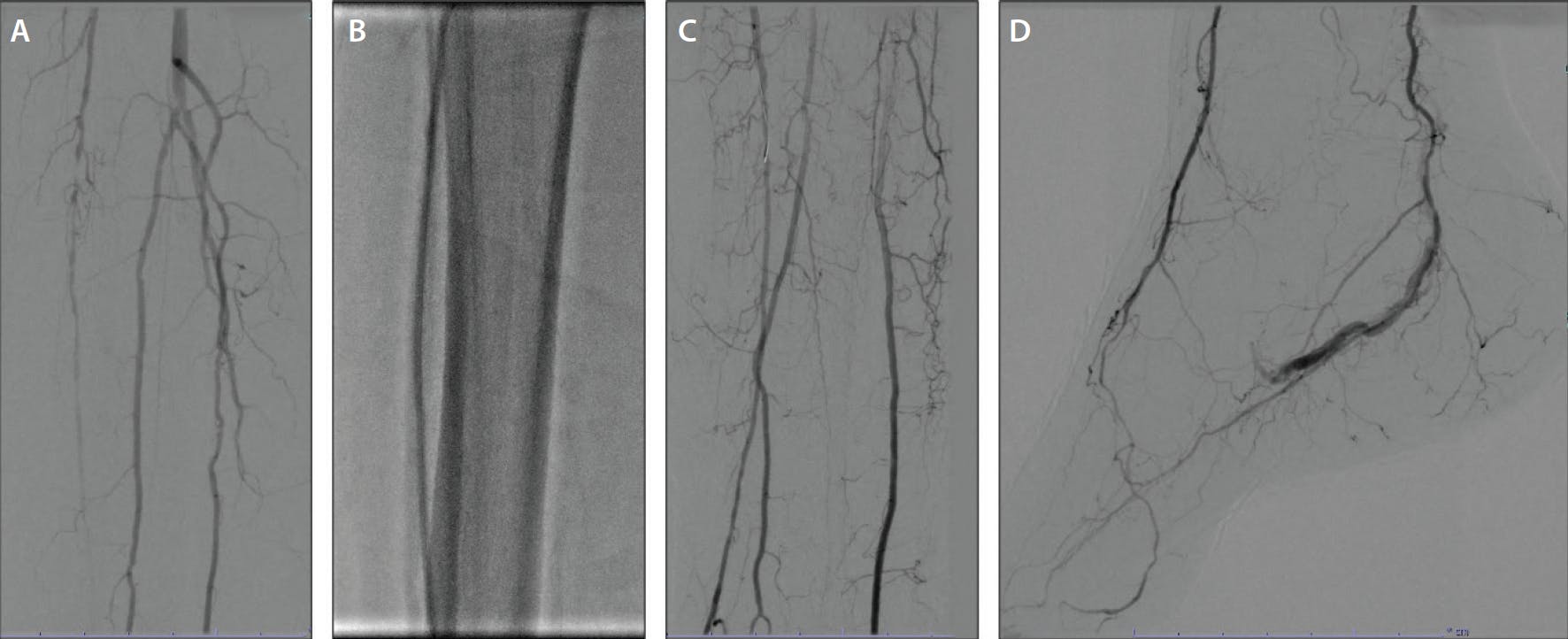
Figure 1. Transradial revascularization of anterior tibial artery aided by the Sublime™ Guide Sheath, Sublime™ Microcatheter, and Sublime™ RX PTA Catheter. A woman in her late 60s with a nonhealing ulcer on her right shin and a history of end-stage renal disease, hypertension, hyperlipidemia, and coronary artery bypass grafting presented for angiography and possible intervention. Initial angiography showed a CTO of the right anterior tibial artery (A). Right radial access was obtained. Following placement of a 5 Fr, 150 cm Sublime™ Guide Sheath, an angled 200 cm, .018 Sublime™ Microcatheter was used to facilitate guidewire crossing of the occlusion, with subsequent dilation with 250 cm, 2.5 X 150 mm Sublime™ .014 RX PTA Catheter (B) and subsequent flow in tibial (C) and pedal (D) vessels. Healed ulcer and no reported patient symptoms at 6-month follow-up.
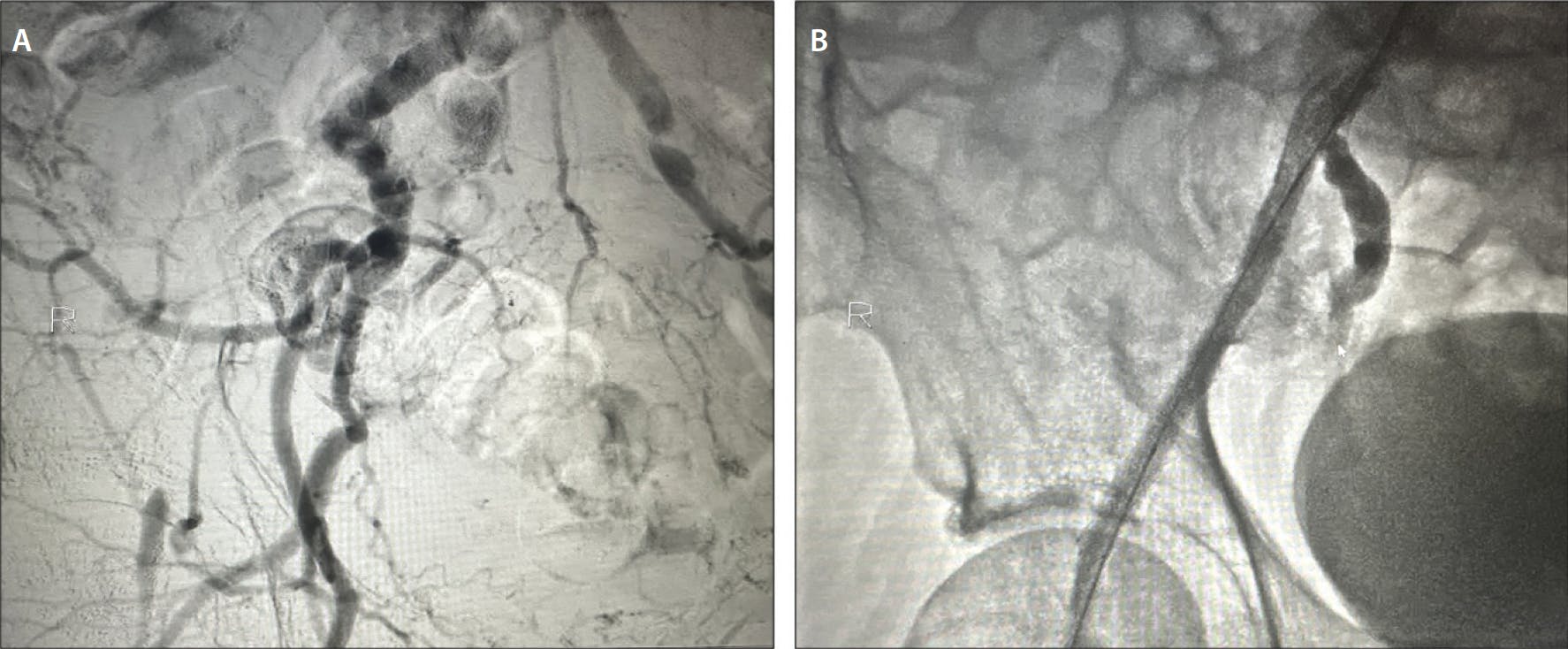
Figure 2. Transradial revascularization of an iliac artery CTO aided by the Sublime™ Guide Sheath and Sublime™ Microcatheter. A man in his early 70s with foot ulceration and history of peripheral artery disease and post right fourth toe amputation presented for bilateral lower extremity angiography and possible PTA and stenting. Initial angiography showed a CTO of the right iliac artery (A). Radial access was achieved. Following placement of a 6 Fr, 120 cm Sublime™ Guide Sheath, an angled 150 cm, .018 Sublime™ Microcatheter was used to facilitate guidewire crossing of the occlusion, with subsequent stenting (B). Healed ulceration and no reported patient symptoms at 2-year follow-up.
How would you describe the other tools you use from the Sublime™ Radial Access Platform?
Sublime™ Guide Sheaths provide very good support. In my opinion, they have better support than the sheaths I’ve used from other companies, more body to them. The availability of the 5 Fr Sublime™ Guide Sheath also adds value, especially for treating female patients with smaller arteries (Figure 1).1
The pushability and crossability of Sublime™ .014 RX PTA Catheters are excellent, and having a 250 cm, .014 balloon that can reach as far as the ankle from radial access is very useful (Figure 1). Whenever I work below the knee, I’m typically using a Sublime™ RX PTA Catheter.
Since 2022, when I began using these Sublime™ Sheaths and PTA Catheters, we’ve had excellent success with radial-peripheral interventions, and these tools have played a major role. I’d still like to see more options for dedicated radial-peripheral covered stents and longer intravascular ultrasound catheters, but the tools available today have afforded us excellent success. There are still a lot of interventionalists who prefer femoral access, but I honestly believe radial access is the future of peripheral vascular interventions.
Caution: Federal (US) law restricts the Sublime™ Radial Access Guide Sheath, the Sublime™ Radial Access .014 and .018 RX PTA Dilatation Catheters, and the Sublime™ Radial Access .014, .018, and .035 Microcatheters to sale by or on the order of a physician. Please refer to each product’s Instructions for Use for indications, contraindications, warnings, and precautions. SURMODICS, SUBLIME, and SURMODICS and SUBLIME logos are trademarks of Surmodics, Inc. and/or its affiliates. Third-party trademarks are the property of their respective owners.
1. Minor R. Radial to peripheral in women with small radial arteries: 5 French access for endovascular therapy in femoral, iliac, renal, subclavian and carotid artery disease. Cath Lab Digest. Accessed October 6, 2023. https://www.hmpgloballearningnetwork.com/site/cathlab/radial-access-technique/radial-peripheral-women-small-radial-arteries-5-french-access

Ahmad S. Khraisat, MD
Interventional Cardiologist
Aurora Health Care
Milwaukee, Wisconsin
Disclosures: Consultant to Terumo Medical.
Advertisement
Advertisement