Advertisement
Advertisement
November 2025 Supplement
Sponsored by Surmodics, Inc.
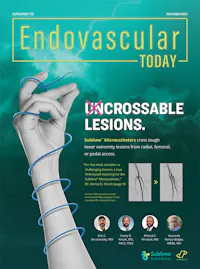
Treating From Wrist to Foot With the Sublime™ Radial Access Platform
A conversation with Dr. Aravinda Nanjundappa.
Interventional cardiologist Aravinda Nanjundappa, MBBS, MD, serves as the Director of Peripheral Interventions in the Cardiology Department at the Cleveland Clinic Main Campus. He is passionate about treating critical limb ischemia and is dedicated to advancing techniques that reduce vascular access complications. To this end, he favors radial artery access over the femoral approach for peripheral as well as coronary interventions.1 Dr. Nanjundappa credits distinguished mentors such as Dr. John Laird, Dr. Mark Bates, and Dr. Ali AbuRahma for shaping his multidisciplinary approach to vascular disease, which combines medical as well as interventional treatment and collaboration with vascular surgeons to best serve each patient’s needs.
We spoke with Dr. Nanjundappa about the benefits and limitations of the radial-peripheral approach and his use of guide sheaths, microcatheters, and RX PTA catheters from the Sublime™ Radial Access Platform (Surmodics. Inc.).
How do you select peripheral patients for radial access?
When evaluating a patient with peripheral artery disease for potential intervention via radial access, we begin with a comprehensive physical examination in the clinic. Peripheral pulses are assessed at the femoral, popliteal, dorsalis pedis, and tibial arteries, supplemented by handheld Doppler evaluation of arterial flow. Radial and brachial pulses are also examined to determine suitability of the upper extremity as an access site. Noninvasive vascular studies such as the ankle-brachial index and pulse volume recordings are obtained, but these are typically followed by advanced imaging to guide procedural planning. Mostly commonly we use CTA, unless contraindicated due to impaired renal function.
The CTA scan is crucial because it gives us a clear picture of any inflow disease, such as blockages in the aorta or iliac arteries. In cases where there’s serious disease in those large arteries, such as aortic or common iliac occlusions, the radial approach alone might not be safe or sufficient. That’s because large stents may be needed, and if a complication arises, it could be risky and difficult to manage solely through radial access. For those patients, even if we can use the radial artery, we still prefer to have femoral access available as a backup for safety.
However, if the patient does not have significant aortoiliac disease, or if the disease is isolated to areas such as the common or external iliac artery and we can work through a 6 or 7 Fr sheath, then we favor the radial approach. That said, most of the disease we treat typically involves the common femoral artery and vessels below it. Using the long microcatheters now available to us, we can navigate lower extremity lesions more easily using the top-down approach afforded by radial access compared with femoral access.
Do you treat below the knee via radial access?
Yes. In fact, we’ve treated tibial and peroneal artery lesions entirely from radial access without needing a separate pedal puncture. This was possible because of the Sublime™ Radial Access Platform. The long working lengths of Sublime™ RX PTA Catheters (.014/250 cm and .018/220 cm) make them very helpful for treating below the knee, either from left or even right radial access.* The lengths and performance of Sublime™ Radial Access Guide Sheaths (5-6 Fr/120-150 cm) and Sublime™ Microcatheters (.014/65-200 cm; .018/65-200 cm; .035/90-200 cm) are also excellent.
That said, in more complex interventions or very tall patients, additional access—usually pedal access—may still be required. We only use a small, 2.4 Fr micropuncture and don’t try to deliver much treatment through the pedal access.
How often do you use high-performance, torqueable microcatheters for radial-peripheral interventions?
I use them in almost every case. A torqueable peripheral microcatheter helps facilitate guidewire advancement and exchange and provides a conduit for contrast injection to help confirm the wire’s position within the vessel.
What qualities are you looking for in peripheral microcatheters?
Low profile, torqueability, and ability to cross lesions. If the catheter is too stiff, it won’t flex sufficiently to navigate through tortuous or curved vessel segments or lesions, but if it’s too flimsy, it will buckle. It should have intermediate stiffness and good braiding to prevent kinking or bending and be durable enough to resist fracturing in hard lesions. It should also have a good lubricious coating for deliverability.
I find that the Sublime™ Microcatheter has excellent torqueability for lesion crossing. At the same time, it has the flexibility required for navigating iliac angles and tortuous segments all the way down to the popliteal. At 200 cm, the microcatheter can reach as far as the tibial vessels in some patients. Notably, Sublime™ 200 cm Microcatheters are available in .018 as well as .035 guidewire compatibility. We can use the .018 microcatheter to support crossing with .018 or .014 wires in tibial or pedal vessels and then use Sublime™ RX PTA Catheters to treat those areas. These balloons track very well and have excellent pushability with their long rapid-exchange segments.
In addition to Sublime™ Microcatheters and RX PTA catheters, you also use Sublime™ Guide Sheaths. What has been your experience with these devices?
The long lengths of Sublime™ Radial Access Guide Sheaths (120 or 150 cm) are helpful. Based on the height of the patient, you can choose the 120 cm sheath to treat iliac, femoral, or proximal superficial femoral artery segments or the 150 cm to get down into the superficial femoral artery. These sheaths also have a good lubricous coating, allowing them to advance through small or tortuous radial arteries. Another advantage is the long, smoothly tapered dilator tip.
Once the sheath is positioned in the iliac artery, I find it has the advantage of staying in place. We have seen more flexible, softer sheaths move back into the aorta during balloon dilatations or catheter exchanges. A sheath should not move back and forth in the aortoiliac segment.
*The average working length from left and right radial access to the pedal loop ranges between 200-230 cm for left, 210-240 cm for right.2-4
Caution: Federal (US) law restricts the Sublime™ Radial Access Guide Sheath, the Sublime™ Radial Access .014 and .018 RX PTA Dilatation Catheters, and the Sublime™ Radial Access .014, .018, and .035 Microcatheters to sale by or on the order of a physician. Please refer to each product’s Instructions for Use for indications, contraindications, warnings, and precautions. SURMODICS, SUBLIME, and SURMODICS and SUBLIME logos are trademarks of Surmodics, Inc. and/or its affiliates. Third-party trademarks are the property of their respective owners.
1. Nanjundappa A, Dieter EG, Dieter RS. Transradial access for peripheral endovascular interventions: a leap toward improved patient safety and improved clinical outcomes. J Soc Cardiovasc Angiogr Interv. 2023;2(6 Part A):101179. doi: 10.1016/j.jscai.2023.101179
2. Fanaroff AC, Rao SV, Swaminathan RV. Radial access for peripheral interventions. Interv Cardiol Clin. 2019;9:53-61. doi: 10.1016/j.iccl.2019.08.005
3. Chowdhury M, Secemsky EA. Contemporary use of radial to peripheral access for management of peripheral artery disease. Curr Treat Options Cardio Med. 2021;23:17. https://doi.org/10.1007/s11936-020-00895-x
4. Mustapha JA. When do I spare the common femoral and access the radial artery? Presented at: Vascular InterVentional Advances (VIVA) annual conference; October 8-11, 2013; Las Vegas, Nevada.

Advertisement
Advertisement