Advertisement
Advertisement

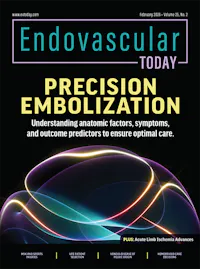
Embolization continues to be one of the most dynamic and rapidly evolving areas in endovascular care, with expanding indications, novel devices, and growing opportunities to address unmet clinical needs. For this issue, we set out to highlight what is new and emerging in the world of embolotherapy—where innovation is pushing boundaries, how evidence is shaping practice, and, most importantly, how these therapies can be leveraged to better serve patients and close persistent gaps in care. The contributions in these pages reflect both the maturity of established embolization techniques and the excitement surrounding their next frontiers, brought together by leaders who are actively defining the future of the field.
Opening our issue is a conversation with Yuji Okuno, MD, on the emergence of embolization as a promising option for sport-related and degenerative musculoskeletal pain. Dr. Okuno walks us through the mechanism behind it, who benefits most, and where it fits between conservative care and surgery.
Next, I moderate a discussion with Neil Khilnani, MD, and Gloria Salazar, MD, on venous-origin chronic pelvic pain, highlighting gaps in awareness and access to care, and the potential for multidisciplinary care and ongoing trials like EMBOLIZE to drive meaningful, lasting change.
Layth Alkhani, BS; Mikin V. Patel, MD; and Osman Ahmed, MD, then provide commentary on the emergence of hemorrhoid artery embolization as a safe and effective alternative for patients with symptomatic internal hemorrhoids, reviewing technique, clinical evidence, patient selection, and more.
Wrapping up our embolization coverage, Dominie Miyasato; Erica M. Knavel Koepsel, MD; Gretchen M. Foltz, MD; and Dania Daye, MD, contemplate where uterine fibroid embolization might fit in the era of precision medicine—asking how we might strengthen shared decision-making and equip physicians with imaging-, technique-, and artificial intelligence–informed tools to personalize care and optimize both outcomes and the patient experience.
Outside of our feature on embolization, the Endovascular Today team assembled a short series on trending themes in acute limb ischemia (ALI). First up, Dejah R. Judelson, MD; Britt H. Tonnessen, MD; and Alexander Ushinsky, MD, share their thought processes for decision-making in modern ALI. How do patient characteristics, anatomy, and technology drive their treatment choices, and what factors are most influential?
Then, Natalie Sridharan, MD, and Sahar Alimohamadi, MD, outline a practical, step-by-step workflow for ALI, from key considerations for initial evaluation and imaging to a comprehensive guide to therapeutic decision-making.
As in every issue, we conclude with an interview featuring an influential thought leader in the field. This month, Bella Hausen, MD, reflects on her work in research, innovation, and advocacy—from advancing artificial intelligence and robotics to championing radiation safety and physician well-being, while driving progress in stroke, aortic, and peripheral vascular research.
Together, the articles in this issue highlight the expanding scope of embolization—from musculoskeletal and pelvic venous disease to hemorrhoidal bleeding and uterine fibroids—while pointing toward a future shaped by personalization, multidisciplinary collaboration, and thoughtful innovation. I am grateful to the authors for their outstanding contributions and to the Endovascular Today editorial team for curating a collection that blends practical guidance with forward-looking perspective. I hope this issue leaves readers energized to consider how evolving embolotherapies can continue to improve outcomes, broaden access, and strengthen patient-centered care.
Jessica Stewart, MD
Guest Chief Medical Editor
Advertisement
Advertisement