Advertisement
Advertisement
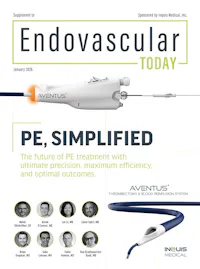
January 2026 Supplement
Sponsored by Inquis Medical, Inc.
Transforming the Future of PE Care: Expanding Mechanical Thrombectomy Through Innovation
Advancing PE intervention with the AVENTUS Thrombectomy System, a streamlined solution designed for procedural efficiency, seamless workflow, and safe, reliable outcomes.
Acute pulmonary embolism (PE) is responsible for an estimated 100,000 to 180,000 deaths annually in the United States, making it the third leading cause of cardiovascular mortality and the leading preventable cause of in-hospital death.1-3 In addition to mortality, PE is associated with significant morbidity, including the need for chronic anticoagulation (AC) therapy, oxygen therapy, rehabilitation, and development of chronic thromboembolic pulmonary hypertension. PE is also costly, requiring multiple days in the intensive care unit or hospital step-down unit for hemodynamic and respiratory stabilization. Further, these patients require multiple tests to diagnose and follow their progress, including extensive investigation to better identify the underlying cause of PE.4
Because of the significant morbidity and mortality associated with PE, there has been interest in improving its treatment, including improving patient quality of life and reducing overall health care costs associated with treatment. This has led to significant improvement in treatment options over the last 10 years with catheter-based interventions and the establishment of PE response team (PERT) programs.5 The ultimate goal has been to identify intermediate-high–risk patients early, treat proactively with catheter-directed devices, and discharge in a timely fashion, collectively reducing mortality, morbidity, length of stay, and cost.
Early research showed that catheter-directed thrombolysis (CDT) can reduce right ventricular (RV) dysfunction in intermediate- and high-risk PE.6 However, CDT does not provide an immediate therapeutic result, and contraindications to thrombolytic therapy can limit its applicability.7 This led to the introduction of mechanical thrombectomy (MT). Recent evidence has supported the use of MT as an adjunctive therapy to AC in acute intermediate-risk PE to safely reduce clot burden and RV/LV (right ventricular/left ventricular) ratio.8-10 A recently published randomized controlled trial showed lower hemodynamic deterioration in patients undergoing MT versus CDT but no difference in mortality or major bleeding.11
Although catheter-based interventions have helped treatment progress, they are not without drawbacks that have limited broad utilization. In fact, only 5% to 15% of PE patients are treated with catheter-based intervention, with a median of about 6% across all hospitals studied.12 Studies focusing on high- and intermediate-risk PE patients show slightly higher percentages of catheter-based intervention utilization, ranging from 11.4% to 20.6%.12 This heterogeneity of care has been shown to be highly influenced by people living in underserved or underprivileged areas of the United States, where access to catheter-based interventions or physicians experienced in these latest forms of treatment are not available.13 Furthermore, complication rates from PE range widely across treatment centers. Although differences in patient severity seen at institutions are a contributing factor, it should be our goal to improve standardization of care and reduce heterogeneity of patient outcomes.
A number of opportunities exist with the expanding role of PERT programs and growing data supporting the use of MT to treat intermediate-high–risk PE. The next generation of PE devices must be safe, provide reproducible outcomes, and reduce procedure time without increasing overall treatment costs. Furthermore, they must empower physicians during the procedure and lower the learning curve, which will ultimately expand this life-saving opportunity across the United States.
As we look to the future, devices that can complete the case with a single pass through the heart will have value. Removing guesswork around what is happening at the tip of the catheter in real time during clot extraction aspirations will reduce procedure time and make thrombectomy more precise. Reducing the need for operator-specific skill in catheter and wire manipulation will help broaden adoption while also reducing overall procedure time and complications. Finally, the focus should also be on improving patient outcomes and reducing procedural complications, such as bleeding risk and procedural blood loss. One simple, yet effective approach is the emergence of devices that enable clot extraction with less guidewire and catheter manipulation, and the ability to return patient blood that is lost during clot aspiration. Investigational Device Exemption (IDE) trials of new devices have already shown promise in limiting the need for postprocedure blood transfusions, which increases the complexity in providing patient care, increases hospitalization time, and increases treatment costs.
What do you see as the biggest value in broadening the adoption of MT?
Dr. Shishehbor: We want every patient with intermediate- and high-risk PE at any location in the world to have the option to be treated with MT. For these patients, MT provides faster hemodynamic and respiratory stabilization, reduces length of hospital stay and health care costs. If we can achieve that and reach zero device-related complications, the impact will be substantial. For example, in the AVENTUS IDE trial, there were zero device-related major adverse events in over 130 cases. For the right patient, MT can make treatment safer, more efficient, and more cost-effective.
How can new MT devices, such as the AVENTUS® Thrombectomy System, address challenges in PE treatment?
Dr. Shishehbor: The AVENTUS Thrombectomy System addresses key challenges in PE procedures by intelligent directional aspiration with streamlined blood reinfusion. The aspiration catheter requires less manipulation and allows treatment with a single aspiration catheter, minimizing multiple exchanges and the need for additional devices. Because of its directionality, it also can effectively aspirate clot without the need to navigate into side branches of the pulmonary arteries. In most cases, you can park the guidewire in the lower lobe and effectively aspirate clot without the need to continually manipulate the wire and catheter. Physicians are also empowered with the AVENTUS TrueClot™ Sensing technology to know what is happening at the tip of the catheter in real time, which eliminates guesswork during clot extraction aspirations. Finally, the AVENTUS System allows for simple and efficient blood return that can be done on the patient table without multiple support staff. These features improve the procedure and provide fast, efficient, and safe outcomes for patients.
INDICATIONS FOR USE
The Aventus Thrombectomy System is indicated for:
- The non-surgical removal of emboli and thrombi from blood vessels.
- Injection, infusion, and/or aspiration of contrast media and other fluids into or from a blood vessel.
The Aventus Thrombectomy System is intended for use in the peripheral vasculature and for the treatment of pulmonary embolism.
The Aventus Clot Management System is indicated for use with the Aventus Thrombectomy System for autologous blood transfusion.
AVENTUS® is a registered trademark of Inquis Medical, Inc.
©2025 Inquis Medical, Inc. All Rights Reserved.
1. Goldhaber SZ. Venous thromboembolism: epidemiology and magnitude of the problem. Best Pract Res Clin Haematol. 2012;25:235-242. doi: 10.1016/j.beha.2012.06.007
2. Centers for Disease Control and Prevention. Venous thromboembolism in adult hospitalizations–United States, 2007-2009. MMWR Morb Mortal Wkly Rep.2012;61:401-404.
3. Centers for Disease Control and Prevention. Data and statistics on venous thromboembolism. Accessed November 19, 2025. https://www.cdc.gov/blood-clots/data-research/facts-stats/index.html#:~:text=VTE%20is%20a%20leading%20cause,hip%20or%20knee%20joint%20replacement
4. Kearon C. Diagnosis of pulmonary embolism. CMAJ. 2003;168:183-194.
5. Provias T, Dudzinski DM, Jaff MR, et al. The Massachusetts General Hospital Pulmonary Embolism Response Team (MGH PERT): creation of a multidisciplinary program to improve care of patients with massive and submassive pulmonary embolism. Hosp Pract (1995). 2014;42:31-37. doi: 10.3810/hp.2014.02.1089
6. Kucher N, Boekstegers P, Müller OJ, et al. Randomized, controlled trial of ultrasound-assisted catheter-directed thrombolysis for acute intermediate-risk pulmonary embolism. Circulation. 2014;129:479-486. doi: 10.1161/CIRCULATIONAHA.113.005544
7. Giri J, Sista AK, Weinberg I, et al. Interventional therapies for acute pulmonary embolism: current status and principles for the development of novel evidence: a scientific statement from the American Heart Association. Circulation. 2019;140:e774-e801. doi: 10.1161/CIR.0000000000000707
8. Tu T, Toma C, Tapson VF, et al. A prospective, single-arm, multicenter trial of catheter-directed mechanical thrombectomy for intermediate-risk acute pulmonary embolism: the FLARE study. JACC Cardiovasc Interv. 2019;12:859-869. doi: 10.1016/j.jcin.2018.12.022
9. Ranade M, Foster MT 3rd, Brady PS, et al. Novel mechanical aspiration thrombectomy in patients with acute pulmonary embolism: results from the prospective APEX-AV trial. J Soc Cardiovasc Angiogr Interv. 2024;4:102463. doi: 10.1016/j.jscai.2024.102463
10. Sista AK, Horowitz JM, Tapson VF, et al. Indigo aspiration system for treatment of pulmonary embolism: results of the EXTRACT-PE trial. JACC Cardiovasc Interv. 2021;14:319-329. doi: 10.1016/j.jcin.2020.09.053
11. Jaber WA, Gonsalves CF, Stortecky S, et al. Large-bore mechanical thrombectomy versus catheter-directed thrombolysis in the management of intermediate-risk pulmonary embolism: primary results of the PEERLESS randomized controlled trial. Circulation. 2025;151:260-273. doi: 10.1161/CIRCULATIONAHA.124.072364
12. Watson NW, Jaff MR, Carroll BJ, et al. Temporal trends and practice patterns associated with utilization of catheter-based interventions for pulmonary embolism. J Soc Cardiovasc Angiogr Interv. 2025;4:103736. doi: 10.1016/j.jscai.2025.103736
13. Rush B, Ziegler J, Dyck S, et al. Disparities in access to and timing of interventional therapies for pulmonary embolism across the United States. J Thromb Haemost. 2024;22:1947-1955. doi: 10.1016/j.jtha.2024.03.013

Advertisement
Advertisement