Advertisement
Advertisement
July 2026 Supplement
Sponsored by The PERT Consortium®
The 2026 AHA/ACC Guideline for the Management of Acute Pulmonary Embolism
What’s new, what changed, and what the newest trials add.
By Geoffrey D. Barnes, MD, MSc; Allison Burnett, PharmD; Jay Giri, MD, MPH; and Soophia Naydenov, MD
Over the past 15 years, diagnostic, risk stratification, and therapeutic advances have transformed acute pulmonary embolism (PE) care. Yet, since the 2011 American Heart Association (AHA) scientific statement,1 no comprehensive update has been issued. In 2024, the AHA and American College of Cardiology (ACC) assembled a multidisciplinary committee of leaders from various societies to develop new guidelines on PE diagnosis, risk stratification, and treatment. Meeting weekly through April 2025, they reviewed evidence and formulated recommendations. This article highlights key updates from the 2026 AHA/ACC PE guideline.2,3
THE NEW CLINICAL CATEGORIES
For nearly 2 decades, clinicians in North America relied on a three-level risk stratification scheme that included “low risk,” “submassive,” and “massive” PE. In 2014, the European Society of Cardiology (ESC) proposed a four-level risk stratification scheme, which preserved the “low risk” group while renaming “massive” PE as “high risk.”4 This change helped differentiate the volume of thrombus seen on imaging, often reported by radiologists, from clinical risk as determined by cardiac-specific imaging and biomarkers. The ESC scheme also incorporated established risk scores (eg, Pulmonary Embolism Severity Index [PESI]) and more specific markers of right ventricular (RV) dysfunction (biomarkers, imaging size) into “intermediate-low” and “intermediate-high” risk groups.
However, over the past decade, two key advances in acute PE diagnosis and treatment have highlighted limitations of this four-level classification scheme. First, the rapid expansion of CT imaging has greatly increased detection of asymptomatic, incidentally found acute PE (eg, on cancer staging CT). These patients are inherently different from those presenting with acute PE-related symptoms but without risk factors for PE-related deterioration. Second, therapeutic interventions beyond anticoagulation (AC) have evolved following the PEITHO trial5 and the introduction of several catheter-based interventional techniques. These therapies primarily target patients at high risk for hemodynamic decompensation, a subset of those previously classified as submassive or intermediate-high risk.
Building on the three- and four-level schemes previously recommended by the AHA and ESC, the 2026 AHA/ACC acute PE guideline writing committee proposed a new five-level risk classification (Table 11-4 and Figure 1). At the lower end of this scheme are categories A and B. Category A includes patients with asymptomatic, incidentally detected acute PE. Ongoing research is examining the risk of recurrence and the relative benefit of AC in this population. Category B includes patients with symptoms consistent with acute PE but with a low clinical severity score (eg, PESI ≤ 85, simplified PESI [sPESI] = 0, Bova ≤ 4). Many of these patients do not require hospitalization and can be safely treated with oral AC alone.
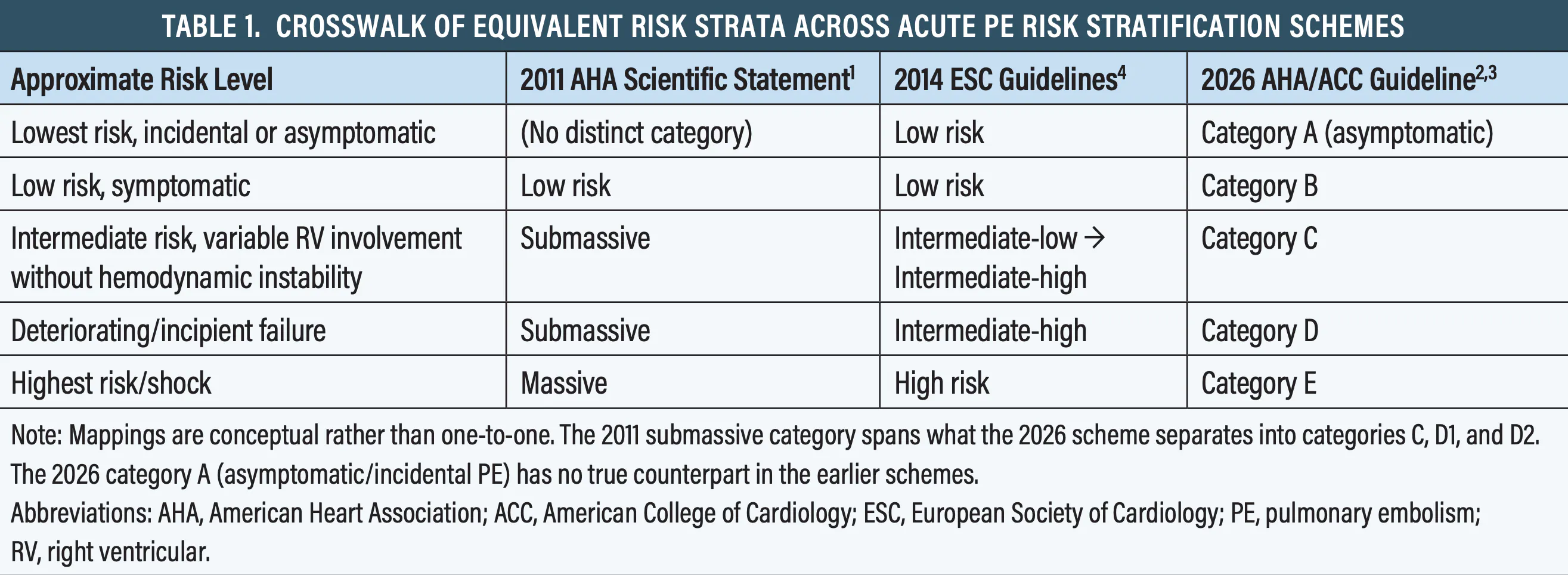
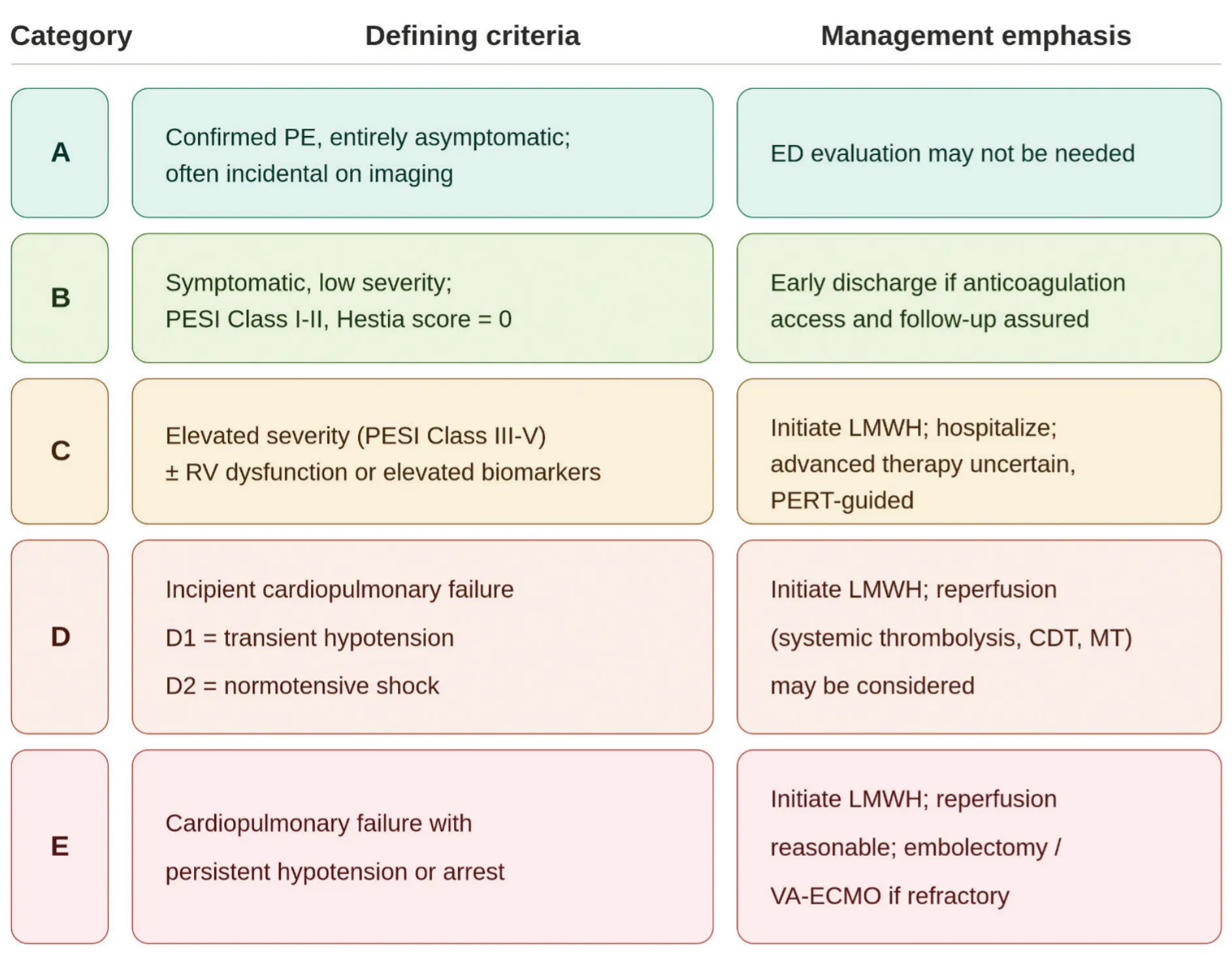
Figure 1. 2026 AHA/ACC acute PE clinical categories and initial management considerations. CDT, catheter-directed thrombolysis; ED, emergency department; LMWH, low-molecular-weight heparin; VA-ECMO, venoarterial extracorporeal membrane oxygenation. Adapted from Creager MA, Barnes GD, Giri J, et al. 2026 AHA/ACC/ACCP/ACEP/CHEST/SCAI/SHM/SIR/SVM/SVN guideline for the evaluation and management of acute pulmonary embolism in adults: a report of the American College of Cardiology/American Heart Association Joint Committee on Clinical Practice Guidelines. Circulation. 2026;153:e977-e1051. doi: 10.1161/CIR.0000000000001415
In the middle of this risk scheme are patients previously categorized as submassive or intermediate risk. They are divided into two groups to better identify patients for whom advanced intervention may be considered. Category C includes patients with symptomatic acute PE and an elevated clinical severity score (eg, PESI > 85, sPESI ≥ 1, Bova > 4). These patients have a higher risk of PE-related adverse events than those in category B and are typically hospitalized for close monitoring. However, current evidence suggests they rarely benefit from therapies beyond AC. By contrast, patients in category D represent those with incipient cardiopulmonary failure. This includes patients with transient hypotension (eg, syncope) as well as those with normotensive blood pressure despite presenting with shock physiology (eg, elevated lactate, acute kidney injury). Patients in category D are the primary focus of several recently completed and ongoing clinical trials exploring the relative benefits and risks of catheter-based interventions compared with AC and close hemodynamic monitoring. Finally, category E includes patients previously deemed to have massive or high-risk acute PE, as determined by persistent hypotension and/or cardiopulmonary failure. These patients require urgent intervention and are at the highest risk of PE-related mortality.
Although the five-level categories are likely sufficient for most clinicians, PE experts and researchers will benefit from further subdividing patients based on clinical presentation and PE-related risk. For example, patients with category C acute PE can be further subcategorized by the number of imaging and biomarker abnormalities of the right ventricle. Some category C3 patients in particular are included in many randomized studies of advanced therapies that also include category D patients. Patients with category D acute PE can be further subcategorized into those with transient hypotension (category D1) and those with normotensive shock (category D2). Patients with category E acute PE can be further subcategorized into those with recurrent or persistent hypotension and cardiogenic shock (category E1) or those with refractory cardiogenic shock, often leading to cardiac arrest (category E2). The latter category has sometimes been referred to as catastrophic PE.
Finally, the 2026 AHA/ACC acute PE clinical categories also acknowledge that some patients with acute PE experience more respiratory and oxygenation limitations than RV strain. As such, patients in categories C through E can be further described with the respiratory modifier if they exhibit significant oxygenation or respiratory limitation. In cases where respiratory symptoms are discordant with their associated hemodynamic category, the writing committee intended that the patient be stratified into the “higher” of the two clinical categories.
Clinicians might feel overwhelmed by the many categories used to describe patients with acute PE. We believe that it's best for most clinicians to focus on the five main categories (A-E) to guide initial decisions (Figure 1). Subcategories and respiratory modifiers are better suited for PE response teams (PERTs) and researchers to discuss nuanced patient scenarios.
ADVANCED THERAPY AND PERT RECOMMENDATIONS
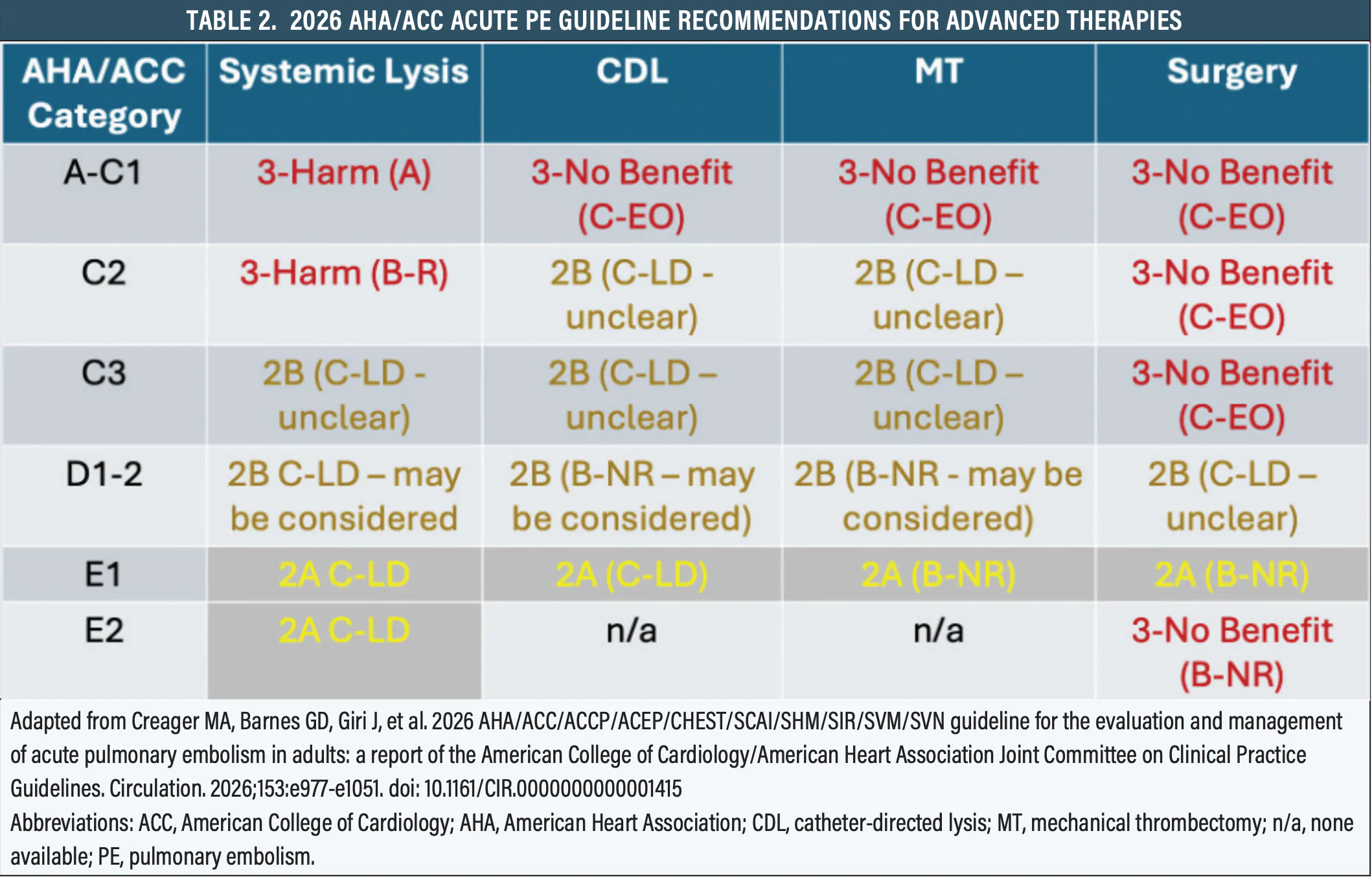
Another key advance in the 2026 AHA/ACC acute PE guideline is its comprehensive approach to recommendations on the use of systemic thrombolysis, catheter-directed thrombolysis (CDL), mechanical thrombectomy (MT), and surgical embolectomy (Table 2).1 For the first time, a North American–based guideline document provides a class 2A recommendation for systemic thrombolysis, CDL, and MT in patients with category E acute PE (cardiopulmonary failure). Importantly, the assessment of the writing committee was that available evidence and clinical experience no longer supported systemic thrombolysis as holding primacy in this population, with its associated recommendation at the same level as catheter-based therapies. This is a meaningful upgrade from prior North American guideline recommendations and largely mirrors those of the ESC.6 However, the guideline writing committee was unable to provide strong recommendations in favor of any advanced therapy elsewhere due to the lack of prospective randomized data with patient-centered outcomes (eg, mortality, hemodynamic collapse, bleeding, symptom improvement). Nonetheless, the 2026 AHA/ACC acute PE guideline provides a class 2B recommendation for the use of systemic thrombolysis, CDL, MT, and surgical embolectomy in patients with class D acute PE (incipient cardiopulmonary failure), noting that these therapies either “may be considered” or have “unclear” benefit. In patients with more advanced forms of class C acute PE (class C3), the guidelines provide a class 2B recommendation for systemic thrombolysis, CDL, and MT, noting that the benefit is “unclear.”
Given the complexity of selecting the most appropriate treatment for individual patients, the 2026 AHA/ACC acute PE guideline provides a class 1 recommendation in favor of multidisciplinary PERT assessment for patients with category C to E acute PE. The guideline recognizes that each hospital and health system will have access to different experts and resources, so the makeup and delivery of PERT-based care will be individualized. However, the guideline strongly favors a structured approach to coordinated care for patients hospitalized with acute PE to ensure timely, evidence-based acute treatment and follow-up care.
INITIAL PHARMACOTHERAPY UPDATES
A key update in the 2026 AHA/ACC PE guideline is a class 1 recommendation favoring low-molecular-weight heparin (LMWH) over unfractionated heparin (UFH) for hospitalized patients with category C to E1 acute PE needing parenteral AC. This is based on a meta-analysis showing lower recurrent venous thromboembolism (VTE) rates with LMWH, without increased bleeding, and offers more predictable pharmacokinetics, enabling rapid AC without overshoot risk.7 LMWH also reduces patient and nurse burden, as no intravenous lines, pumps, or routine monitoring and adjustment are needed. The guidelines note that patients undergoing catheter-based therapies or thrombolysis may also safely use LMWH.
For patients with category A and B acute PE considering outpatient treatment, guidelines recommend a direct oral anticoagulant over a vitamin K antagonist in most cases, including obesity. The committee could not include COBRRA-VTE trial results comparing apixaban to rivaroxaban,8 as it was published after data evaluation. However, this trial suggests apixaban may be preferred due to lower bleeding rates without affecting recurrent VTE during the first 3 months. Vitamin K antagonists are still recommended for specific groups, such as those with antiphospholipid syndrome and advanced liver disease.
FOLLOW-UP AND LONGER-TERM THERAPY
While the 2026 AHA/ACC acute PE guideline primarily focuses on the diagnosis, risk stratification, and acute treatment of patients with acute PE, the guideline writing committee felt it was critical to address several important clinical decisions that occur after a patient is discharged from the hospital. These include recommendations for follow-up clinical encounters, decisions regarding the duration of AC therapy, and recommended approaches to evaluating for chronic thromboembolic pulmonary disease (CTEPD).
Given that most patients with acute PE will be newly initiated on AC therapy, the guideline provides a class 1 recommendation for a clinical follow-up touchpoint approximately 1 week after hospital discharge for all patients. This touchpoint, which could occur as a clinic visit or a phone call from a nurse, pharmacist, or advanced practice provider, is intended to assess for anticoagulant access barriers and bleeding complications and to provide additional education about acute PE and the importance of AC therapy. This visit can also address many patient-centered questions about travel, use of hormone-based therapies (ie, contraception), and exercise.
The guideline provides a class 1 recommendation for a follow-up visit within 3 months of acute PE diagnosis. This visit should screen for AC complications, determine the need for additional tests (eg, thrombophilia evaluation), and assess persistent PE symptoms. For patients with ongoing PE symptoms despite 3 months of AC, the guidelines suggest using cardiopulmonary exercise testing or combining an echocardiogram with a ventilation-perfusion scan to evaluate for CTEPD. Patients with abnormal findings on these tests should be referred to specialized centers for evaluation and management, including chronic thromboembolic pulmonary hypertension.
After 3 months of AC for acute PE, the 2026 AHA/ACC guidelines recommend continuing or stopping therapy based on risk factors. For patients with first-time, strongly provoked PE and no reversible or persistent risk factors, stopping after 3 to 6 months is advised (class 1). Otherwise, ongoing AC is generally preferred, with a class 1 recommendation for half-dose apixaban or rivaroxaban to reduce bleeding risk.
ONGOING CLINICAL TRIALS
Despite a robust literature search for the 2026 AHA/ACC acute PE guidelines, the writing committee closed its literature review window in April 2025. Since then, several important clinical trials on acute PE management have been published. These include the HI-PEITHO trial9 comparing CDL to AC alone in category C3-D2 patients; the STORM-PE trial10 comparing MT to AC alone in category C3-D2 patients; the STRATIFY trial11 comparing CDL, systemic thrombolysis, and AC alone in category C3-D2 patients; and the COBRRA-VTE trial8 comparing rivaroxaban to apixaban in patients with acute PE or deep vein thrombosis. Clinicians should recognize that these trials were not considered by the 2026 AHA/ACC acute PE guideline writing committee and may therefore further influence clinical practice decision-making. We also look forward to the results of several more trials of advanced therapies in category C-E patients that are expected to conclude and report results over the coming 2 to 3 years.12
CONCLUSION
The 2026 AHA/ACC acute PE guidelines should be viewed as both a consolidation of research and clinical expertise and an inflection point in the care of patients with acute PE. This is the first North American guideline to update the approach to acute PE risk stratification, formally embed the multidisciplinary PERT care model, and establish patient-centered outcomes as the standard of care for acute treatment recommendations. We encourage all clinicians to adopt the new A-E clinical categories to more clearly determine acute treatment and disposition while facilitating a more granular definition of specific patient cohorts by PE experts and researchers.
1. Jaff MR, McMurtry MS, Archer SL, et al. Management of massive and submassive pulmonary embolism, iliofemoral deep vein thrombosis, and chronic thromboembolic pulmonary hypertension: a scientific statement from the American Heart Association. Circulation. 2011;123:1788-1830. Published corrections appear in Circulation. 2012;126:e104 and Circulation. 2012;125:e495. doi: 10.1161/CIR.0b013e318214914f
2. Creager MA, Barnes GD, Giri J, et al. 2026 AHA/ACC/ACCP/ACEP/CHEST/SCAI/SHM/SIR/SVM/SVN guideline for the evaluation and management of acute pulmonary embolism in adults: a report of the American College of Cardiology/American Heart Association Joint Committee on Clinical Practice Guidelines. Circulation. 2026;153:e977-e1051. doi: 10.1161/CIR.0000000000001415
3. Creager MA, Barnes GD, Giri J, et al. 2026 AHA/ACC/ACCP/ACEP/CHEST/SCAI/SHM/SIR/SVM/SVN guideline for the evaluation and management of acute pulmonary embolism in adults: a report of the American College of Cardiology/American Heart Association Joint Committee on Clinical Practice Guidelines. J Am Coll Cardiol. 2026;87:1626-1710. doi: 10.1016/j.jacc.2025.11.005
4. Konstantinides SV, Torbicki A, Agnelli G, et al. 2014 ESC guidelines on the diagnosis and management of acute pulmonary embolism: the Task Force for the Diagnosis and Management of Acute Pulmonary Embolism of the European Society of Cardiology (ESC) endorsed by the European Respiratory Society (ERS). Eur Heart J. 2014;35:3033-3069, 3069a-3069k. doi: 10.1093/eurheartj/ehu283
5. Meyer G, Vicaut E, Danays T, et al. Fibrinolysis for patients with intermediate-risk pulmonary embolism. N Engl J Med. 2014;370:1402-1411. doi: 10.1056/NEJMoa1302097
6. Konstantinides SV, Meyer G, Becattini C, et al. 2019 ESC guidelines for the diagnosis and management of acute pulmonary embolism developed in collaboration with the European Respiratory Society (ERS). Eur Heart J. 2020;41:543-603. doi: 10.1093/eurheartj/ehz405
7. Robertson L, Jones LE. Fixed dose subcutaneous low molecular weight heparins versus adjusted dose unfractionated heparin for the initial treatment of venous thromboembolism. Cochrane Database Syst Rev. 2017;2:CD001100. doi: 10.1002/14651858.CD001100.pub4
8. Castellucci LA, Chen VM, Kovacs MJ, et al. Bleeding risk with apixaban vs. rivaroxaban in acute venous thromboembolism. N Engl J Med. 2026;394:1051-1060. doi: 10.1056/NEJMoa2510703
9. Rosenfield K, Klok FA, Piazza G, et al; HI-PEITHO investigators. Ultrasound-facilitated, catheter-directed fibrinolysis for acute pulmonary embolism. N Engl J Med. 2026;394:1979-1990. doi: 10.1056/NEJMoa2516567
10. Lookstein RA, Konstantinides SV, Weinberg I, et al; STORM-PE trial investigators. Randomized controlled trial of mechanical thrombectomy with anticoagulation versus anticoagulation alone for acute intermediate-high risk pulmonary embolism: primary outcomes from the STORM-PE trial. Circulation. 2026;153:21-34. doi: 10.1161/CIRCULATIONAHA.125.077232
11. Kjaergaard J, Bang LE, Sonne-Holm E, et al. Randomized trial of low-dose, ultrasound-assisted thrombolysis or heparin for pulmonary embolism. Cardiovasc Res. 2026;122:539-549. doi: 10.1093/cvr/cvag038
12. Creager MA, Barnes GD, Giri J. A field in transition: catheter-based therapy in the 2026 AHA/ACC acute pulmonary embolism guideline. J Am Coll Cardiol. 2026;87:1569-1573. doi: 10.1016/j.jacc.2026.01.018




Advertisement
Advertisement