Advertisement
Advertisement
July 2026
An Interview With Mina S. Makary, MD, FSVM, FAHA, FCCP, FCIRSE
Dr. Makary reflects on patient-centered innovation, AI in HCC management, developing new IR service lines, and the value of mentorship and multidisciplinary work.
Your clinical practice spans interventional oncology, venous disease, musculoskeletal embolization, women’s health, and more. How does having a broad procedural practice shape the way you address patient care and innovation in interventional radiology (IR)?
Having a broad procedural practice shapes the way I think about patients, less in terms of isolated procedures and more in terms of longitudinal disease management. The common thread is that IR often sits at the intersection of imaging, minimally invasive therapy, and multidisciplinary care.
That breadth also encourages cross-pollination. Techniques, devices, and clinical workflows from one area of IR often inform another. For example, lessons from a particular endovascular technique, image-guided approach, patient selection and optimization, or postprocedural management can translate across service lines. It keeps me curious and flexible, while continuously seeking refinement and innovation in my clinical as well as technical paradigms.
From an innovation standpoint, a broad practice helps identify unmet needs. When you see patients across multiple disease states, you begin to recognize gaps in access, workflow, evidence, and outcomes. Those gaps often become the starting point for meaningful innovation.
Along with your own research efforts, you are also the Director of Scholarly Activity & Research in the Department of Radiology at The Ohio State University Medical Center. What overarching themes do you find yourself drawn to or encouraging mentees to pursue?
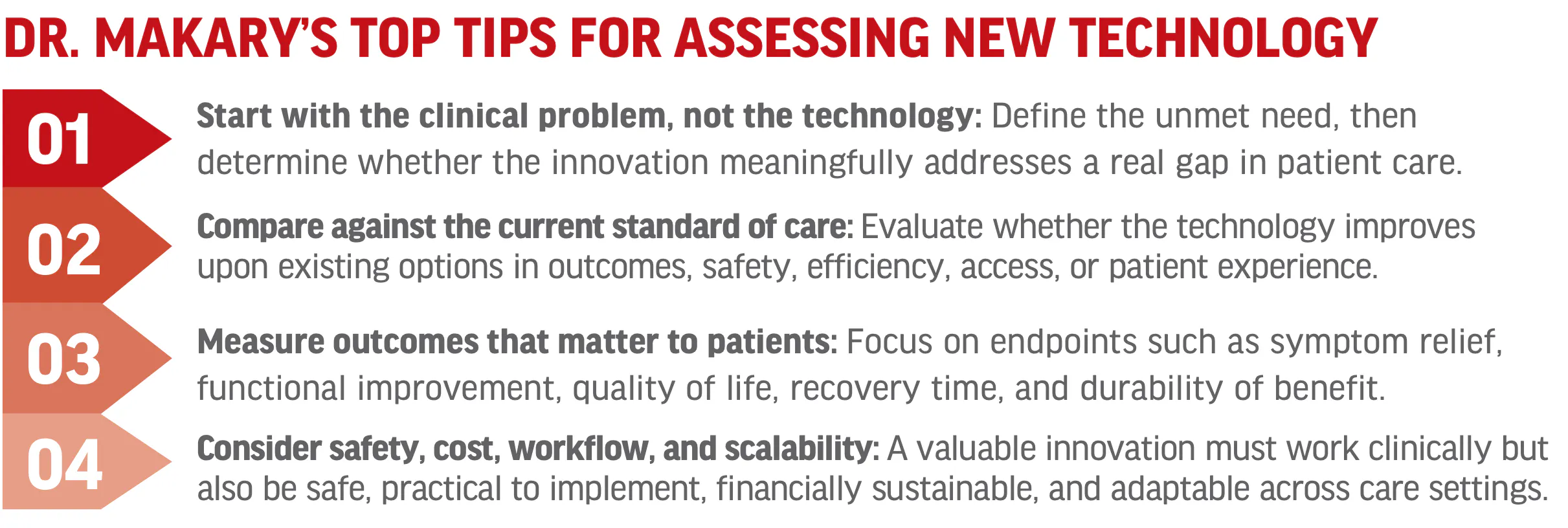
I am consistently drawn to themes of patient-centered innovation, clinical outcomes, multidisciplinary care models, and the responsible adoption of new technology. I’m particularly interested in research that answers practical questions: Does this intervention improve symptoms, quality of life, safety, efficiency, or access to care? Does it change how we manage patients in a meaningful way?
I see part of my role as helping mentees turn clinical curiosity into structured academic work. Many great projects begin with a simple observation in clinic, on rounds, or in the angio suite. My goal is to help colleagues, trainees, and staff refine those observations into answerable questions, build the right team, choose the right methodology, and carry the work through to presentation and/or publication.
I also try to create a culture where scholarship feels accessible. Not everyone begins with grant funding, a national trial, or a large database. Sometimes the most impactful work starts with a pilot study, a brief report on a novel approach, or a multidisciplinary collaboration. The key is helping young physicians build confidence, momentum, and rigor.
You frequently study innovations in the vascular field and lately have been exploring artificial intelligence (AI) applications in interventional oncology. In an ideal world, what might AI-guided hepatocellular carcinoma (HCC) management look like? What will it take to realize its full potential?
Ideally, AI-guided HCC management would support the entire patient journey, not just one isolated decision point. It could begin with earlier detection and risk stratification, then assist with tumor characterization, liver function assessment, treatment selection, procedural planning, response prediction, and longitudinal surveillance.
For example, AI could help synthesize imaging, laboratory values, tumor burden, liver reserve, prior therapies, performance status, and molecular or clinical data to guide how a patient may benefit from specific locoregional therapies, systemic therapies, or combination/multimodality approaches. AI could also help predict which tumors are likely to respond, identify early recurrence, and flag patients who need closer follow-up.
To realize that potential, we need high-quality, multicenter data; standardized definitions of outcomes; prospective validation; and models that are explainable and clinically usable. AI must work in real-world practice, across different institutions, patient populations, scanners, imaging protocols, and treatment strategies. We also need thoughtful governance around bias, privacy, accountability, and workflow integration. The goal should not be to replace physician judgment but to augment multidisciplinary decision-making and personalize care.
You developed the genicular artery embolization (GAE) service line at your institution and are an early pioneer for this procedure in your region. What challenges and opportunities have you encountered? What are the foundational building blocks for developing a new IR service line?
Developing a GAE service line has been both exciting and instructive. GAE sits in a unique clinical space because it addresses a very common problem, in a way that is still relatively new to many patients, referring physicians, and payers. It augments the treatment paradigm for symptomatic knee osteoarthritis well and addresses an important gap, given the limited enduring options available.
Some of the challenges with GAE include patient selection, expectations, lack of awareness, acceptance by referring providers, lack of technique standardization, and evolving data. The opportunity is nonetheless significant. There is a large group of patients who have persistent symptoms despite conservative therapy but are not ready for, eligible for, or interested in arthroplasty. GAE may offer an effective minimally invasive option for some of these patients.
For any new IR service line, the foundational building blocks are usually a clear clinical need, multidisciplinary alignment, rigorous patient selection, standardized protocols, outcome tracking, patient education, and a sustainable referral pathway. It is also important to build trust with the specialties already caring for these patients. A successful service line is built through collaboration, not in isolation.
Tell us about your role developing and leading the IR advanced practice provider (APP) inpatient service at The Ohio State University Wexner Medical Center. What value do you find this brings to patients undergoing interventional procedures at your institution?
I developed this service after recognizing a gap in how patients were being cared for around IR procedures. Too often, IR was viewed as a procedural endpoint rather than a clinical service involved in the full episode of care. I saw an opportunity to build a model that allowed us to take ownership of the periprocedural process, from initial consultation and evaluation through procedure planning, postprocedure rounding, follow-up, and communication with referring teams.
The service is focused on improving the patient experience and quality of care surrounding IR procedures. Our APPs play a central role in coordinating consults, educating patients, preparing them for procedures, addressing medication or safety concerns, communicating with primary teams, and helping ensure timely, appropriate follow-up. By creating a dedicated clinical structure, we have been able to improve communication, education, turnaround time, safety, and patient satisfaction.
For me, this service reflects the broader evolution of IR as a clinical specialty. We are not simply performing procedures; we are caring for patients before, during, and after those interventions. That continuity helps build trust with patients, strengthens relationships with referring providers, improves outcomes, and elevates the role of IR as a true clinical service in the patient’s care journey.
You are deeply involved in multidisciplinary work at your institution. How has this involvement changed how other specialties integrate with and view the role of IR?
Being involved in multidisciplinary clinics and collaborations has allowed IR to participate earlier in the patient care process, rather than entering only after a procedure has been requested. In these settings, we can contribute to diagnosis, treatment planning, patient counseling, and determining where minimally invasive options fit within the overall care pathway. That earlier involvement helps ensure that patients are offered the right intervention at the right time, with input from all relevant specialties.
This has helped reshape how other specialties view IR. Instead of seeing us solely as proceduralists, colleagues increasingly recognize the value we bring to clinical decision-making, longitudinal care, and disease management. Over time, that visibility builds trust, strengthens referral relationships, and reinforces IR’s role as an integrated clinical specialty. For patients, this model creates a more coordinated and informed care experience. Hearing from multiple specialists in the same care pathway gives them a clearer understanding of their options and helps align treatment decisions with their goals. For IR, it leads to more appropriate referrals, stronger patient selection, and deeper collaboration with colleagues. Ultimately, multidisciplinary care reinforces the role of IR not just in performing procedures but also in helping guide comprehensive disease management.
Where do you think the IR field is currently falling short in supporting the next generation of interventional radiologists?
We still have work to do in making IR more visible, accessible, and sustainable for the next generation. Many trainees discover IR late, and some never get a clear understanding of what the specialty actually offers: clinical decision-making, patient relationships, procedural creativity, and the opportunity to build new areas of care.
We also need to be honest about the pressures trainees face. Burnout, attrition, and uncertainty about career identity do not happen in a vacuum. They are often tied to workload, scarce mentorship, limited autonomy, unclear expectations, and the challenge of balancing clinical excellence with research, family, and personal well-being. IR attracts those who are innovative, driven, and willing to take on complex problems. We have to make sure the training pathway nurtures and supports those qualities.
Supporting the next generation means providing early exposure, strong mentorship, sponsorship, research opportunities, and realistic guidance about career development. It also means creating training environments where wellness is not just discussed but operationalized through thoughtful scheduling, supportive culture, and meaningful professional development.
You’ve described mentorship as one of the most rewarding elements of your career. What do you hope your mentees take away from these relationships, beyond technical or research experience?
Beyond the clinical or research skills, I hope my mentees take away curiosity, passion, resilience, and a sense of ownership over their careers. Mentorship goes beyond helping someone publish a paper or learn a procedure; it is about helping them see what’s possible and achieve their goals. I encourage my mentees to approach their careers with intention, while remaining open to unexpected opportunities that may shape their path.
I want my mentees to learn how to ask good questions, recover from setbacks, seek feedback, and build relationships with integrity. I hope they see that true success is not measured by titles, publications, or technical skills but rather by the people you help, the teams you build, and the doors you open for others. Those lessons often shape a career just as much as any technical milestone.
One of the most rewarding parts of mentorship is watching someone begin to believe in their own potential. If mentees leave our relationship feeling more capable, more supported, and more equipped to navigate the next stage of their career, then I consider that a success. This impact is what makes mentorship one of the most meaningful investments we can make in the future of our field.
Advertisement
Advertisement
Interested in reading more interviews?
To read more interviews with thought leaders in the vascular field, check out our Profiles & Perspectives hub.
Read More