Advertisement
Advertisement
June 2026
An Interview With Nishita Kothary, MD, FSIR
Dr. Kothary discusses the evolving role of interventional radiology in value-based and longitudinal patient care, the importance of outcomes-driven research and physician leadership, and the cultural shifts shaping the next generation of IR.

Research is a core part of your career, often in collaborative settings and leadership roles. How do you approach research as a shared process with other teams and trainees?
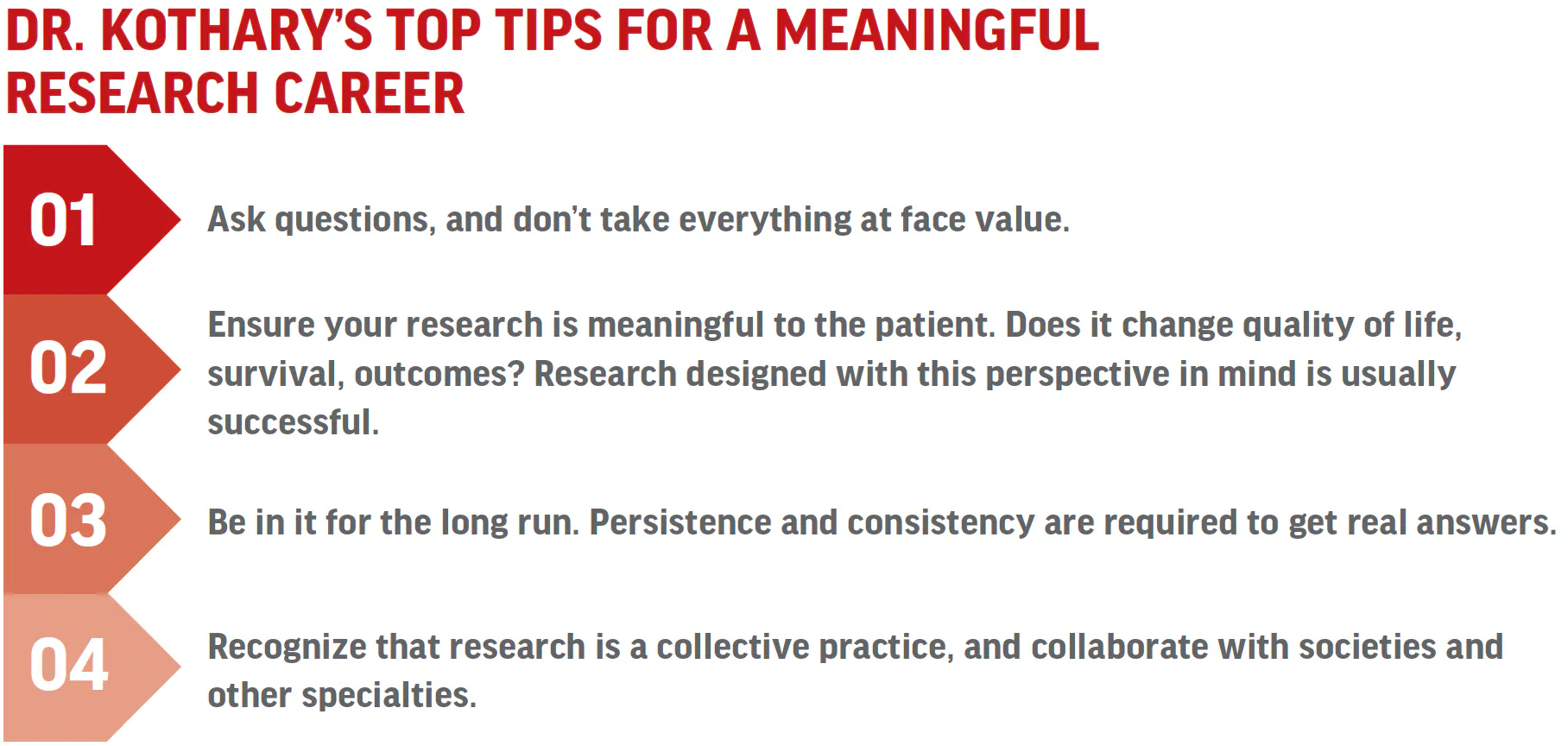
Being a physician-scientist is probably one of the most exciting aspects of medicine, especially in interventional radiology (IR). We’ve made so much progress in just the last 50 years, and the field keeps growing. Understanding the science, our outcomes, and how we change patients’ lives—this is how we move medicine forward. I tell my fellows that research requires perseverance and tenacity, and that it evolves with the stage of one’s career. Early on, you may be doing smaller, technical studies, but the goal is to keep building. I often compare research to peeling an onion: As you go deeper into your research question, you systematically uncover new layers of understanding, each leading to new questions. In this way, research is not just one study; it’s a continuous process, with multiple studies or questions emerging from a single idea.
This ongoing exploration is especially evident in IR research, which allows for significant breadth. Consider hepatocellular carcinoma. There are technical aspects (watershed tumors, short- and long-term outcomes, imaging basic science, cost-effectiveness—the whole spectrum). The core question, of course, should always be, “How does this benefit the patient?” Even technical observations should be about understanding outcomes and improving care, emphasizing that the ultimate goal ties back to patient impact.
IR has breadth, but we often need partners for depth. This is where collaboration becomes critical. You may be collaborating with a cardiologist, an oncologist, or a nephrologist, and then there are the data scientists, the biostatisticians, etc. There is a whole host of specialties you can bring together, but IR is still the epicenter because it’s an IR-related question. The strength lies in trusted networks, whether within your institution, across disciplines, or across the United States among other interventional radiologists.
At Stanford, you are Co-Chair of Value-Based Care and Medical Co-Director for Supply Chain. How do these roles inform your day-to-day work as a physician, and how do you see this evolving?
The practice of medicine is shifting. What used to be driven by physician choice and experience is now driven by outcomes and financial stewardship. Quality of care, while clearly the most important aspect, is increasingly linked to managing costs, a consideration that was sometimes secondary for previous generations of clinicians.
This is where IR is uniquely positioned. We are device heavy, making us valuable to our supply chain partners and financial gatekeepers. Because IR can adapt easily, our efforts to optimize use, reduce unwarranted variation, and identify high-value technologies can and should be used as a template. Ultimately, we must be good stewards of health care dollars, separating the “me-too” technologies from the true game-changers. This is precisely what the C-suite wants to see: reduced variation and nonlabor costs while delivering higher-value care.
Second, innovation and care must align with sustainability. At the macro level, clinical innovation should be matched with system-level responsibility. Having the next-generation technology is meaningless if it costs hundreds of thousands of dollars and fails to improve outcomes. It simply becomes another expensive toy instead of adding real value. True innovation is not about adopting every new tool but about choosing the right ones.
Physician leadership is essential. Physicians need to bridge clinical care, economics, and operations. This is how we are evaluated and reimbursed. The future is higher-value care delivered conscientiously and intelligently, and IR is ready for this.
What advice would you share with fellow physicians on making a case to hospital administration for investments in new equipment or technology?
I think IR needs to change its mindset a little bit here. We are so broad that we struggle to quantify our value in concrete terms. We do some of this, and some of that. IR needs to get to a point where we can articulate the value we bring to the hospital in hard dollars and quantitative data. It doesn’t really matter whether you are high volume/low complexity versus low volume/high complexity. There is value in both, but you need to show it. Drs. Matt Hawkins and Rob Lookstein set the standard at the Society of Interventional Radiology (SIR) 2026 annual meeting, stating unequivocally that understanding your technical revenue contribution is essential. Master dollars and cents, budgets, and revenue streams to stay ahead. We must learn to speak the language of the C-suite. Building a business case or pro forma is a core skill; we must clearly explain how a new technology or procedure impacts the hospital’s margin, patient experience, and outcomes. The argument should focus on whether this attracts patients, improves patient experience and satisfaction, and drives downstream referrals. IR is inherently innovative, collaborative, and nimble. This positions our specialty at the center of the health care conversation as the system shifts toward outpatient care, shorter length of stay, and faster recovery. We have the opportunity to communicate clearly—across patients, hospital leadership, payers, and policymakers—that we deliver excellent care in a thoughtful, disciplined, high-value way. This is exactly where SIR leadership is focused: on defining, measuring, and articulating our value.
You’ve been a Principal Investigator for numerous clinical trials over the years. What have you learned about what works when bringing a study from idea to completion?
Over 25 years in practice, I’ve learned that clinical trials are expensive and often disconnected from real-world care, although this is beginning to change. Initiatives like SIR’s VIRTEX registry can make trials more pragmatic, scalable, and relevant to daily practice—in real time, not years later.
Industry collaboration also can be a strength when done right. Working with industry helps answer our key questions and helps companies build better devices. That’s a win-win. Done right, this becomes a true partnership. Put patients at the center, and you can design studies that evaluate long-term outcomes rather than just technical success or the minimum data needed for FDA clearance. This generates outcomes data that matter to patients, a shift we’re seeing more often. It is about not just funding but also cocreating better solutions.
The key is how we generate questions and design trials. As interventional radiologists, our strength is designing studies that go beyond simply getting devices to market—answering questions that are important to Centers for Medicare & Medicaid Services (CMS), payers, and patients. Early involvement lets us shape trials to be outcomes driven rather than just technical. This is where real impact happens.
You and colleagues recently published a paper on the efficacy and safety of sequential transarterial embolization and cryoablation for renal masses > 3 cm.1 How might these results change how interventional radiologists treat more complex cancers? What does this hybrid approach say about where interventional oncology is heading in the next decade?
This manuscript is part of a broader body of literature we are creating to demonstrate that outcomes in this patient group extend beyond oncologic results. For T1a and T1b renal masses, local control rates for partial nephrectomy, radical nephrectomy, and thermal ablation all reach approximately 90% to 95%. The key question is no longer can we control the tumor but rather what trade-offs are we willing to accept.
Kidney function is now the primary driver of long-term outcomes in T1N0M0 renal cell carcinoma (RCC), and it has a greater impact on long-term survival than the cancer itself. Less than 20% of patients with localized RCC die from cancer-related mortality, while the majority die from sequelae of chronic kidney disease, including chronic kidney disease-related cardiovascular events. Thus, preserving nephrons and minimizing glomerular filtration rate decline become central therapeutic goals, not secondary considerations.
This reflects where interventional oncology is heading: an era of multimodality, patient-centered care that aims to treat the tumor and optimize the patient. This also exposes a blind spot in how we evaluate success. We often emphasize short-term technical outcomes, such as local control, while overlooking the larger picture. Local control is irrelevant if the patient’s risk of dying from other causes remains high.
During your time as SIR Women in IR Chair, you spearheaded an “Owning Success” series that highlighted the successes, rather than struggles, of women and underrepresented minorities in the IR field. Why is such an approach needed, and what role does it play in shaping the culture of the field?
I’m generally optimistic by nature. At this stage in my career, I am very comfortable in my own skin, quirks and all. This mindset led to the creation of “Owning Success.” I have met so many women, specifically in IR, who are having fun, leading, delivering exceptional care, and being genuinely good people. Given these experiences, I thought, why not celebrate that? The name was inspired by the iconic moment at the 2019 World Cup, when Megan Rapinoe owned the field after scoring. This was a picture of unapologetic success, with no excuses or downplaying the achievement. For me, it’s important to own the hard work you put in, and there should be no shortchanging that.
From your perspective within SIR’s leadership, what are the field’s biggest priorities and challenges over the next decade—and how is the society positioned to address them?
This will sound very dramatic, but we are at a critical moment in IR, and the momentum is with us. We are synonymous with minimally invasive procedures, and the question now is whether we will fully seize this opportunity and demonstrate the value we bring. Patients want these therapies, systems need them, and our industry partners are looking for collaborators.
The challenge will be to build on this momentum and demonstrate the broader value of IR as a specialty, beyond our technical excellence as proceduralists. Will we fully step into the role of physicians who can manage patients from A to Z, or will we revert to being technically excellent proceduralists who operate day to day without broader accountability? It’s easy to fall into this second path, but that’s not where the future is.
Again, a big component to this is understanding and articulating our value, not in soft terms but in hard data that resonate from the C-suite to CMS and even Congress. We need to clearly articulate and communicate the value that IR brings to health care: reduced length of stay, longitudinal care delivery, minimally invasive procedures, quicker patient recovery, and lower costs to the health care system.
This is something SIR leadership is focused on right now, including via the VIRTEX registry, and I think these efforts are now coming to fruition. SIR wants to elevate the specialty to the next level, serving as innovators and comprehensive clinicians driving patient-centered care.
You frequently speak about cultural and systemic challenges in IR, including work-life balance. How do you think the field can evolve to better support work-life balance for physicians? What are some practices or habits that have helped you navigate that balance in your own career?
Work-life balance is all about the lens through which you view it. Personally, I don’t see work and life as completely separate silos. It’s a continuum. There are times in the evening when I’m working on something patient related, and there are moments during the workday when I’m handling personal matters. Of course, all practice models are different, and there are always exceptions and circumstances that change the equation.
I strongly push back on the idea that you can’t have it all (assuming good health, since health scares are curveballs). I find this to be a frustrating, limiting narrative that does not do anyone justice, but especially women. At this stage in my career, I can very confidently say I’ve experienced a full spectrum—a physician-scientist career and leadership roles, parent-teacher association president, traveling, volunteering, and family life. I believe everyone should have the choice to have it all if they so choose. What people must recognize is that you may not be able to do all of it at the exact same moment. There are ebbs and flows, but you can have as much of “it all” as you decide you want.
Your choices matter more than the system, and your day-to-day reality is primarily shaped by your decisions. First is your partner. My mom always told me that your partner is the one relationship you can choose. Having a true partner in the journey and setting shared expectations is foundational. I have been lucky enough to have that. My husband and I divide responsibilities based on our strengths. He is a better cook than I am, and I make sure the kids’ schoolwork is all done. I also think it’s important to be upfront early on about your expectations and what you want out of life. I hear too often that partnership dynamics determine how much people practice or the opportunities they pursue. These conversations should be open from the start. You can’t go at it alone; you need someone else who can work with you. Both my husband and I work crazy hours, and he traveled 50% of the time when the kids were young, but we have a true 50-50 partnership.
Second is who you work with. Don’t chase incremental salary differences if leadership and values don’t align. It’s rarely worth it. Third is how you design your life. Something as simple as minimizing your commute can profoundly impact quality of life. In my opinion, living in a small house 10 minutes from work, without highways, is exponentially more important than having a large amount of space, deer, and privacy. But to each their own. Just prioritize your wants in life.
I think the culture of IR is evolving, and that’s a positive thing. Historically, IR had elements of exclusivity, but this is changing. The next generation, particularly women, entering the field are confident and unwilling to accept outdated norms. Many in leadership are evolving as well, with a balance prevailing. If we want the next generation to become leaders, we have to show them what is possible and make it clear that we believe they can achieve it.
1. Hung ML, Wang R, Yu C, et al. Efficacy and safety of sequential transarterial embolization and cryoablation of renal masses greater than 3 cm. Urol Oncol. 2026;44:110964. doi: 10.1016/j.urolonc.2025.11.018
Advertisement
Advertisement
Interested in reading more interviews?
To read more interviews with thought leaders in the vascular field, check out our Profiles & Perspectives hub.
Read More