Advertisement
Advertisement
June 2026
Intra-Arterial Therapy for Glioblastoma: Beyond Access to Effective Tumor Delivery
A neurointerventional perspective on technique, limitations, and the evolving role of precision delivery strategies.
By Juan Diego Alzate, MD, MSc; John Boockvar, MD; David Langer, MD; Miroslaw Janowski, MD, PhD; and Yafell Serulle, MD, PhD
Glioblastoma remains one of the few diseases in modern medicine where technical success, whether in surgical resection, radiation delivery, or drug development, rarely translates into meaningful survival gains. Despite maximal resection, radiation, and systemic therapy, outcomes remain poor, and recurrence is almost inevitable.1 For decades, the focus has been on developing new drugs, but a more fundamental problem persists: Most agents simply do not reach the tumor in effective concentrations.
The blood–brain barrier (BBB) is often framed as the primary obstacle, but in practice, drug delivery in glioblastoma is far more complex. Even when the barrier is disrupted, heterogeneous tumor vascularity, abnormal flow dynamics, and rapid washout limit drug residence within the tumor.2 As a result, systemic therapies frequently underperform—not necessarily because they lack efficacy, but because they fail to be delivered where they are needed.
In this context, intra-arterial (IA) therapy has emerged as a compelling strategy. Advances in microcatheter technology and imaging now allow superselective catheterization of tumor-feeding arteries with a level of precision that was not previously achievable.3 Combined with techniques such as osmotic BBB disruption (BBBd), IA delivery offers the potential to significantly increase local drug concentration while minimizing systemic toxicity.4 However, the modern resurgence of IA chemotherapy raises an important question: Is improved tumor access enough?
CLINICAL EVIDENCE
The only completed phase 3 trial in this space, comparing intracarotid carmustine to intravenous carmustine in newly resected malignant glioma, showed no survival difference and was limited by significant neurotoxicity, including encephalopathy, visual loss, and white matter necrosis.5 This early negative experience was instrumental in redirecting the field toward superselective catheterization techniques and less neurotoxic agents, and it remains an important historical benchmark.
Contemporary IA therapy has evolved substantially. Across a recent meta-analysis of nine studies and 230 glioma patients undergoing selective or superselective IA cerebral infusion (SIACI/SSIACI) with BBBd, the pooled rate of cases with complications was 27.1% (95% CI, 19.8%-35.7%), with procedure-related complications in 15.4%, major complications in 4.3%, and stroke in 3.1%, with no procedure-related deaths. Pooled radiographic outcomes demonstrated complete response rates of 10.4%, partial response 24.2%, and stable disease 38.2%, indicating that the majority of patients achieve at least temporary disease control.6
One of the largest single-center safety data sets originates from the Sherbrooke program, encompassing 2,991 procedures in 642 patients, with a periprocedure symptomatic complication rate of 0.9%, primarily driven by stroke (0.8%).7 The notably lower complication rate compared with the pooled SIACI data likely reflects differences in complication definitions, reporting thresholds, and procedural technique. In the glioblastoma cohort treated with IA carboplatin and osmotic BBBd, the median overall survival (OS) from diagnosis was 32.2 months.4 Notably, these procedures were not performed using superselective techniques, as infusions were limited to the internal carotid and vertebral arteries, and BBBd was applied only in a subset of cases. Additionally, the cohort was heterogeneous with respect to tumor histology. More recent preclinical work from this group has focused on screening novel agents for IA delivery, including topotecan and reformulated carboplatin, demonstrating promising results in animal models.2
In the most rigorous prospective evaluation to date, Patel et al conducted a phase 1/2 trial of repeated SIACI bevacizumab (15 mg/kg) with BBBd in 23 patients with newly diagnosed glioblastoma. The median progression-free survival (PFS) was 11.5 months, and median OS was 23.1 months with a 12-month OS of 77.3%.8 Notably, the cohort was predominantly IDHwt (isocitrate dehydrogenase–wildtype) and MGMT (O-6-methylguanine-DNA methyltransferaseO-6-methylguanine-DNA methyltransferase)–unmethylated, a molecular profile typically associated with worse outcomes, making these results particularly encouraging when compared to historical Stupp protocol benchmarks (median OS, approximately 14.6 months).
More recently, our group published the largest cohort to date of SIACI with osmotic BBBd, reporting outcomes from 70 patients who underwent 139 SIACIs and 246 infusions with bevacizumab or cetuximab.9 All planned infusions were completed successfully, with 95.7% of patients discharged within 1 day. Procedure-related and drug-related adverse events occurred in 11.4% and 8.6% of patients, respectively, with no procedure-related mortality. Preliminary survival analysis in the recurrent glioblastoma cohort showed a median OS of 24 months from initial diagnosis.
These findings establish SIACI after osmotic BBBd as a highly feasible, safe, and reproducible intervention that can be performed at scale within a dedicated endovascular neuro-oncology program. Our institutional commitment to this approach is further reflected in several active clinical trials, including a phase 3 randomized trial comparing SIACI bevacizumab with standard chemoradiation versus chemoradiation alone in newly diagnosed glioblastoma (NCT05271240), phase 1/2 studies of SIACI cetuximab in both newly diagnosed and recurrent settings (NCT02861898, NCT02800486), and a phase 1 feasibility study of IA yttrium-90 (Y90) radioembolization for recurrent glioblastoma (NCT05303467). A representative case is shown in Figure 1.
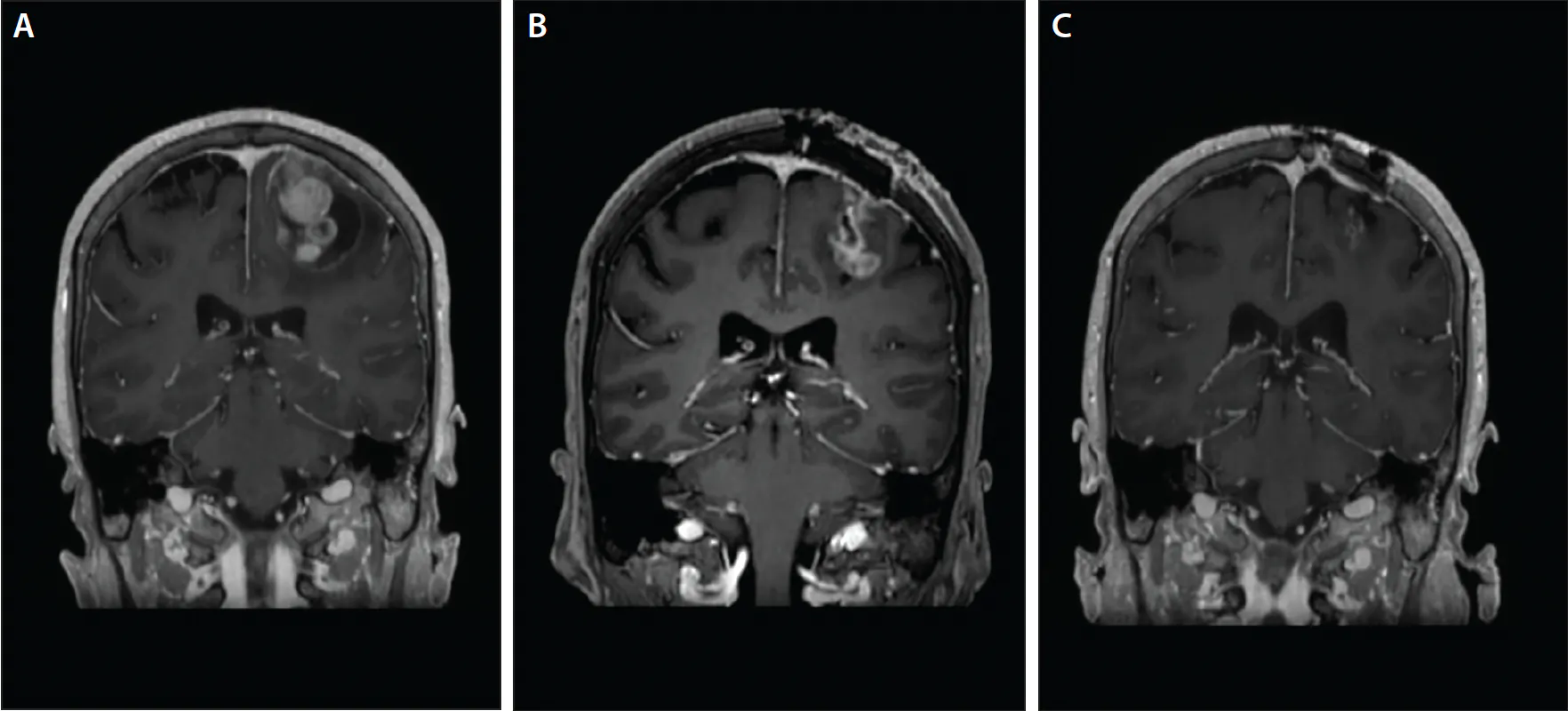
Figure 1. Representative case of a female in her early 60s with glioblastoma (IDHwt, mGMT unmethylated, epidermal growth factor receptor–amplified) treated with gross total resection followed by SSIACI of cetuximab with osmotic BBBd. Preoperative T1-weighted postgadolinium MRI demonstrating enhancing tumor (A). Postresection, pretreatment T1-weighted post-gadolinium MRI obtained approximately 1 month after surgery and prior to the first SSIACI cetuximab session (B). Follow-up T1-weighted post-gadolinium MRI obtained approximately 6 months postoperatively, after two SSIACI cetuximab sessions and prior to the third planned treatment, demonstrating sustained radiographic control without evidence of tumor recurrence (C).
These findings should be contextualized against systemic benchmarks. In recurrent glioblastoma, intravenous bevacizumab yields a median PFS of < 4 months and OS of approximately 8 months, with no proven overall survival benefit.1,10 Intravenous bevacizumab prolongs PFS but not OS, and interpretation of imaging-based endpoints is complicated by the pseudoresponse phenomenon inherent to antiangiogenic agents.
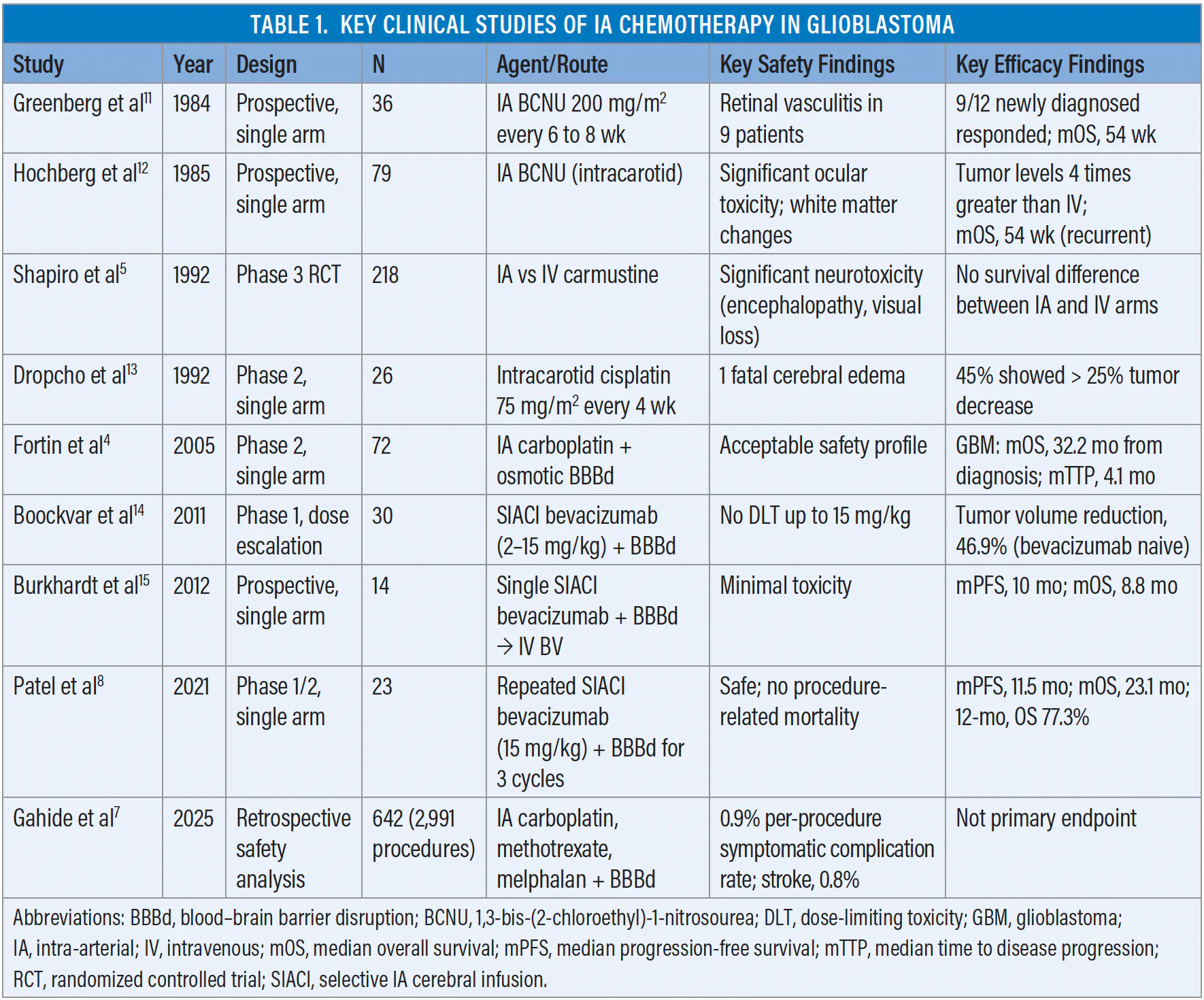
Key clinical studies of IA chemotherapy are shown in Table 1.4,5,7,8,11-15
TECHNIQUE AND PROCEDURAL CONSIDERATIONS
Patient selection typically favors individuals with preserved functional status (KPS [Karnofsky Performance Status] ≥ 70) and either newly diagnosed or recurrent glioblastoma. Procedures are most commonly performed under general anesthesia, with vascular access obtained using standard neuroendovascular techniques followed by superselective catheterization of tumor-feeding arteries. Vertebral artery access has been shown to significantly increase stroke risk compared to internal carotid artery access, a clinically relevant technical consideration.7
A key component of most contemporary protocols is osmotic BBBd, typically achieved with IA mannitol infusion prior to drug delivery. Increasingly, advanced imaging techniques are being incorporated: Fusion of preprocedural MRI with intraprocedural cone-beam CT allows three-dimensional visualization of tumor volume in relation to the vascular tree, and microcatheter-based perfusion imaging can generate real-time volumetric maps of the infused territory, confirming overlap with the tumor and minimizing nontarget delivery.16
Slow, controlled infusion under continuous fluoroscopic monitoring is used to minimize reflux and optimize territorial distribution. However, even with technically precise delivery, drug distribution remains highly dependent on local flow dynamics, which can vary significantly between patients and vascular territories. In a contemporary series, SIACI has been shown to be highly feasible, with high technical success rates and the vast majority of patients discharged within 24 hours.9
LIMITATIONS
The limitations of IA therapy extend beyond technical execution and are rooted in fundamental biological and hemodynamic constraints. First, the BBB is not the only obstacle. Even with pharmacologic disruption, drug penetration remains highly variable due to heterogeneity in the blood–tumor barrier and regional differences in vascular permeability.17 Second, drug distribution is governed by flow, streaming effects, preferential perfusion of the normal brain, and competition between vascular territories, which can all limit effective delivery.18 Third, drug residence time within the tumor is frequently inadequate; rapid washout through the tumor microcirculation reduces sustained exposure.19
These factors collectively explain a key paradox: Drug delivery can be reliably increased, yet effective intratumoral exposure remains inconsistent. Overcoming this gap will be essential for translating technical success into meaningful clinical benefit.
BEYOND CHEMOTHERAPY
IA therapy in glioblastoma is no longer confined to chemotherapy; it is increasingly being redefined as a delivery platform for next-generation therapeutics. Targeted biologics such as bevacizumab and cetuximab have already been adapted to IA protocols, illustrating how molecularly specific agents can be paired with precision delivery.14 The inaugural Society of NeuroInterventional Surgery’s Neurointerventional Oncology Summit in 2024 highlighted several emerging agents for IA delivery, including Y90 radioembolization, oncolytic viruses, and cellular immunotherapy, signaling that the field is organizing around this emerging subspecialty.3
Y90 radioembolization introduces the possibility of delivering radiation from within the vascular compartment. An in silico proof-of-concept study demonstrated feasibility and favorable dosimetry compared to volumetric modulated arc therapy, with higher tumor doses and dramatically lower nontarget brain exposure.20 This approach reframes endovascular therapy not just as a means of drug delivery but also as a method of delivering energy directly to tumor tissue.
FUTURE DIRECTIONS
The future of IA therapy will depend on reframing it as a precision delivery system. A key area of advancement is focused ultrasound (FUS), which offers spatially controlled BBB modulation beyond what is achievable with global osmotic disruption. The BT008NA trial—the first comparative report of microbubble-enhanced FUS combined with temozolomide in newly diagnosed high-grade glioma—reported a median OS of 31.3 months and median PFS of 13.5 months, with the additional innovation of sonoliquid biopsy enabling noninvasive plasma biomarker-based disease surveillance.21 These results directly support the argument that tissue-level delivery enhancement can meaningfully impact outcomes.
Optimization of BBBd itself remains an active area of investigation. Recent preclinical work has shown that combining hypertonic saline with standard mannitol can nearly double the area of BBB opening while maintaining safety, suggesting current osmotic protocols may be substantially improved.22 Additionally, the concept of spatially fractionated IA delivery, sequential treatment of vascular territories to maximize coverage while limiting off-target exposure, has been proposed as a strategy to improve the uniformity of endovascular drug distribution, with potential applicability to cerebral IA therapy.23
Another emerging concept is endovascular sampling, which could provide real-time feedback on tumor biology and treatment response. Equally important is the need to move beyond static treatment paradigms. Current IA protocols are based on fixed variables, dose, infusion rate, and target vessel selection, despite the highly dynamic nature of cerebral blood flow. Future strategies will likely incorporate patient-specific modeling of flow and distribution, treating drug delivery as a continuous and individualized process.
CONCLUSION
IA therapy for glioblastoma has evolved from a technical concept into a feasible and increasingly refined neurointerventional strategy. Advances in catheter technology and delivery techniques now allow precise targeting of tumor-feeding arteries with a high degree of safety. However, improved access alone has not translated into consistent clinical benefit. The limitations are no longer primarily technical; biological and physiological heterogeneity of the BBB and blood–tumor barrier, flow-dependent drug distribution, and rapid washout continue to constrain effective intratumoral exposure.
The future of IA therapy will depend not on delivering more drug but rather on delivering it more effectively, through strategies that integrate precision targeting, real-time monitoring, and an improved understanding of tumor hemodynamics and pharmacokinetics. As neurointerventional oncology continues to evolve, IA therapy has the potential to serve as a central platform for targeted, multimodal treatment. Realizing this potential will require a transition from technical success to biologic effectiveness, supported by rigorous clinical investigation.
1. Van Den Bent MJ, Geurts M, French PJ, et al. Primary brain tumours in adults. Lancet. 2023;402:1564-1579. doi: 10.1016/S0140-6736(23)01054-1
2. Latulippe J, Roy LO, Gobeil F, Fortin D. Optimization of intra-arterial administration of chemotherapeutic agents for glioblastoma in the F98-fischer glioma-bearing rat model. Biomolecules. 2025;15:421. doi: 10.3390/biom15030421
3. Young CC, Narsinh KH, Chen SR, et al. A report from the Inaugural Society of NeuroInterventional Surgery Neurointerventional Oncology Summit. Am J Neuroradiol. 2026;47:1-8. doi: 10.3174/ajnr.A8902
4. Fortin D, Desjardins A, Benko A, et al. Enhanced chemotherapy delivery by intraarterial infusion and blood‐brain barrier disruption in malignant brain tumors: the Sherbrooke experience. Cancer. 2005;103:2606-2615. doi: 10.1002/cncr.21112
5. Shapiro WR, Green SB, Burger PC, et al. A randomized comparison of intra-arterial versus intravenous BCNU, with or without intravenous 5-fluorouracil, for newly diagnosed patients with malignant glioma. J Neurosurg. 1992;76:772-781. doi: 10.3171/jns.1992.76.5.0772
6. Ferreira C, Ferreira MY, Cardoso LJC, et al. Safety and efficacy of selective and superselective intra-arterial cerebral infusion with blood-brain barrier disruption for glioma: a systematic review and meta-analysis. J NeuroInterventional Surg. 2026;18:1337-1346. doi: 10.1136/jnis-2025-024057
7. Gahide G, Vendrell JF, Massicotte-Tisluck K, et al. Safety of cerebral intra-arterial chemotherapy for the treatment of malignant brain tumours. J Clin Med. 2025;14:524. doi: 10.3390/jcm14020524
8. Patel NV, Wong T, Fralin SR, et al. Repeated superselective intraarterial bevacizumab after blood brain barrier disruption for newly diagnosed glioblastoma: a phase I/II clinical trial. J Neurooncol. 2021;155:117-124. doi: 10.1007/s11060-021-03851-2
9. Ferreira C, Ferreira MY, Singh F, et al. Superselective intra-arterial cerebral infusion of chemotherapeutics after osmotic blood-brain barrier disruption in newly diagnosed or recurrent glioblastoma: technical insights and clinical outcomes from a single-center experience. J Neurointerv Surg. 2026;18:585-593. doi: 10.1136/jnis-2025-023068
10. Mohile NA, Messersmith H, Gatson NT, et al. Therapy for diffuse astrocytic and oligodendroglial tumors in adults: ASCO-SNO guideline. J Clin Oncol. 2022;40:403-426. doi: 10.1200/JCO.21.02036
11. Greenberg HS, Ensminger WD, Chandler WF, et al. Intra-arterial BCNU chemotherapy for treatment of malignant gliomas of the central nervous system. J Neurosurg. 1984;61:423-429. doi: 10.3171/jns.1984.61.3.0423
12. Hochberg FH, Pruitt AA, Beck DO, et al. The rationale and methodology for intra-arterial chemotherapy with BCNU as treatment for glioblastoma. J Neurosurg. 1985;63:876-880. doi: 10.3171/jns.1985.63.6.0876
13. Dropcho EJ, Rosenfeld SS, Morawetz RB, et al. Preradiation intracarotid cisplatin treatment of newly diagnosed anaplastic gliomas. The CNS Cancer Consortium. J Clin Oncol. 1992;10:452-458. doi: 10.1200/JCO.1992.10.3.452
14. Boockvar JA, Tsiouris AJ, Hofstetter CP, et al. Safety and maximum tolerated dose of superselective intraarterial cerebral infusion of bevacizumab after osmotic blood-brain barrier disruption for recurrent malignant glioma. Clinical article. J Neurosurg. 2011;114:624-632. doi: 10.3171/2010.9.JNS101223
15. Burkhardt JK, Riina H, Shin BJ, et al. Intra-arterial delivery of bevacizumab after blood-brain barrier disruption for the treatment of recurrent glioblastoma: progression-free survival and overall survival. World Neurosurg. 2012;77:130-134. doi: 10.1016/j.wneu.2011.05.056
16. Chen SR, Chen MM, Ene C, et al. Perfusion-guided endovascular super-selective intra-arterial infusion for treatment of malignant brain tumors. J Neurointerv Surg. 2022;14:533-538. doi: 10.1136/neurintsurg-2021-018190
17. Arvanitis CD, Ferraro GB, Jain RK. The blood-brain barrier and blood-tumour barrier in brain tumours and metastases. Nat Rev Cancer. 2020;20:26-41. doi: 10.1038/s41568-019-0205-x
18. Joshi S, Wang M, Etu JJ, et al. Transient cerebral hypoperfusion enhances intraarterial carmustine deposition into brain tissue. J Neurooncol. 2008;86:123-132. doi: 10.1007/s11060-007-9450-z
19. Joshi S, Ellis JA, Ornstein E, Bruce JN. Intraarterial drug delivery for glioblastoma mutiforme: will the phoenix rise again? J Neurooncol. 2015;124:333-343. doi: 10.1007/s11060-015-1846-6
20. Paolani G, Minosse S, Strolin S, et al. Intra-arterial super-selective delivery of yttrium-90 for the treatment of recurrent glioblastoma: in silico proof of concept with feasibility and safety analysis. Pharmaceutics. 2025;17:345. doi: 10.3390/pharmaceutics17030345
21. Woodworth GF, Anastasiadis P, Ozair A, et al. Microbubble-enhanced transcranial focused ultrasound with temozolomide for patients with high-grade glioma (BT008NA): a multicentre, open-label, phase 1/2 trial. Lancet Oncol. 2025;26:1651-1664. doi: 10.1016/S1470-2045(25)00492-9
22. Qiao G, Chu C, Gulisashvili D, et al. A safe MRI- and PET-guided method for increasing osmotic blood-brain barrier permeability. Radiology. 2025;316:e243396. doi: 10.1148/radiol.243396
23. Salemdawod A, Walczak P, Janowski M. Rethinking CRISPR delivery for liver-targeted gene editing: the case for spatially fractionated intra-arterial approaches. Mol Ther Nucleic Acids. 2025;36:102782. doi: 10.1016/j.omtn.2025.102782
Advertisement
Advertisement