Advertisement
Advertisement

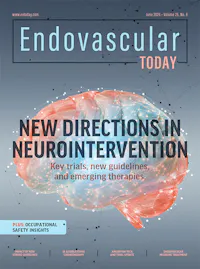
This edition of Endovascular Today highlights the rapid evolution of neurointervention and the expanding multidisciplinary efforts shaping contemporary cerebrovascular and endovascular care. From updated stroke management recommendations and emerging device technologies to novel intra-arterial therapies and precision drug delivery strategies for glioblastoma, our contributors examine the innovations redefining procedural practice and patient outcomes. Alongside these advances, we also turn our attention to the critical and increasingly urgent topic of radiation safety, featuring expert perspectives on exposure reduction, ergonomic protection, and the cultural and technologic changes needed to support long-term clinician well-being. Together, these articles reflect the continued momentum of innovation across neurointervention and interventional radiology (IR), while emphasizing the importance of safety, leadership, and evidence-based practice in shaping the future of the field.
To kick off our neurointervention issue, Basel Musmar, MD, and Stavropoula I. Tjoumakaris, MD, review the new 2026 American Heart Association/American Stroke Association stroke guidelines through five practice points.
Anthony P. Terraciano, BS; Khushal Gupta, MBBS; and David J. Altschul, MD, provide an update on the evolving role of emerging and ongoing intravascular devices in clinical trials in the United States, along with the shifting standards for intrasaccular flow disruption.
Next is a review of the current clinical evidence on refractory migraine by Rami Fakih, MD; Pervinder Bhogal, MBBS; Alex Sirakov, MD; M. Fareed K. Suri, MD; and Adnan I. Qureshi, MD. They discuss the efficacy, mechanism, and optimization of intra-arterial middle meningeal artery (MMA) lidocaine infusion, while reviewing the role of MMA embolization within the broader treatment paradigm.
Last, Juan Diego Alzate, MD; John Boockvar, MD; David Langer, MD; Miroslaw Janowski, MD; and Yafell Serulle, MD, share their perspectives on intra-arterial therapy techniques for glioblastoma, limitations, and the evolving role of precision delivery strategies.
Elsewhere in this issue, we explore the ins and outs of radiation safety. In an interview, physicist Ehsan Samei, PhD, provides advice on what clinicians should know about exposure, risk, and protection in the cath lab. Antonio Solano, MD, and Melissa L. Kirkwood, MD, next outline a stepwise approach to reducing radiation risk during fluoroscopically guided interventions, centered on optimizing the imaging system, personal protective equipment, and shielding systems.
Next, Mina S. Makary, MD, and Giorgio A. Medranda, MD, discuss their perspectives on the steps needed to translate awareness of radiation and musculoskeletal (MSK) risks into action. Finally, Stéphan Haulon, MD, discusses integrating technologic innovation and cultural shifts to achieve durable reductions in radiation exposure and MSK strain.
We close out this issue with an interview with Nishita Kothary, MD. She discusses the evolving role of IR in value-based and longitudinal patient care, the importance of outcomes-driven research and physician leadership, and the cultural shifts shaping the next generation of IR.
As the fields of neurointervention and IR continue to advance, the themes explored throughout this issue underscore both the remarkable pace of innovation and the responsibility that accompanies it. Whether through improved stroke systems of care, next-generation endovascular technologies, novel therapeutic strategies, or renewed commitments to radiation and occupational safety, each contribution highlights the collaborative and forward-thinking mindset driving the specialty ahead. We thank our authors and interviewees for sharing their expertise and insights, and we hope this issue provides readers with practical knowledge, fresh perspectives, and inspiration for continued progress in patient care and procedural excellence.
Pascal Jabbour, MD
Guest Chief Medical Editor
Advertisement
Advertisement