Advertisement
Advertisement
March 2026
Sponsored by Medtronic
A Private Practice Physician’s Experience Treating Chronic Venous Insufficiency

My practice’s paradigm has been developed over 20 years of treating chronic venous insufficiency (CVI) in the office setting. Initially, we start with a consultation to evaluate a patient’s history and physical exam. We take into account personal history, family history, and history of any vascular pathology, such as peripheral artery disease, deep vein thrombosis, and superficial venous thrombosis. From there, we discuss the patient’s primary concerns for seeking treatment. If they are having symptoms of leg pain, swelling, cramps, heaviness, restlessness, or skin changes such as wounds or bleeding varicosities, we arrange for a venous duplex mapping of the lower extremities in my office. The patient will return after the duplex exam to go over the findings and discuss treatment options. If the patient has no symptoms and is only concerned about visible telangiectasias—excluding corona phlebectatica—I recommend cosmetic sclerotherapy without a duplex exam. A 6-week follow-up is arranged, and if the patient is satisfied with the results, further sclerotherapy treatments can be offered as needed.
INTERVENTION OPTIONS
Saphenous reflux treatment is offered using two approaches in my practice: thermal or nonthermal ablation.
Thermal Ablation
I typically use the ClosureFast™ 6F endovenous radiofrequency ablation catheter (Medtronic) for radiofrequency ablation (RFA). The catheter provides radiofrequency energy, resulting in contraction of the collagen fibers of the treated vein, and it requires tumescent anesthesia. The primary benefit of thermal ablation is avoidance of hypersensitivity reactions due to chemicals or agents foreign to the body. Limitations of RFA treatment include the length of the vein that can be treated per procedure to avoid nerve injury, such as the saphenous and sural nerves. RFA requires multiple tumescent anesthesia injections along the length of the treated vein to avoid pain or surrounding tissue injury. This may be challenging for individuals who are uncomfortable with needles. Another drawback is that patients need to adhere to compression stockings for at least 1 week postprocedure.
Nonthermal Ablation
The VenaSeal™ closure system (Medtronic) is my primary treatment of choice for nonthermal ablation. I can treat lengthy veins down to the ankle, without concern for nerve injury. Cyanoacrylates, when combined with blood or plasma, polymerize, resulting in fibrosis and occlusion of the treated vein. An anesthetic is applied only to the injection site, reducing overall punctures. An additional advantage is that postprocedure compression hose is not required in most cases. The drawback of cyanoacrylate products is hypersensitivity reactions, which can occur in 6% of cases.1 If the patient has a history of multiple allergies with food, medications, or beauty products, or skin sensitivity to cyanoacrylates, I will not recommend the VenaSeal system and would prefer RFA.2
Cleanup
Prior to the closure of saphenous veins, I notify patients that cleanup of the residual surface veins is sometimes necessary, and that saphenous vein ablation may not remove all visible varicose veins. Cosmetic liquid sclerotherapy, ultrasound-guided foam sclerotherapy, or microphlebectomy can address leftover veins, and we typically evaluate the need for these additional treatments at the 4-month follow-up visit. I do not routinely perform these treatments at the same time as saphenous vein ablation. In many cases, patients are satisfied with the results of the closure. Over time, large visible varicosities may resolve without the need for further treatment, as demonstrated by the WAVES and VeClose trials.3,4
VENASEAL CASE EXAMPLE
Patient Presentation
A woman in her late 60s presented to our vein center with heaviness, pain, itching, and large, bulging varicose veins of her lower extremities. Conservative measures failed to improve her symptoms. She denied a history of deep vein thrombosis, phlebitis, and cardiopulmonary or vascular abnormalities. She reported a family history of CVI with large varicose veins.
On examination, her varicosities were torturous and prominent. No open wounds or skin lesions were identified. Venous mapping revealed significant reflux in the bilateral great saphenous vein (GSV) and right small saphenous vein (SSV), without evidence of deep vein pathology (Figure 1). The presence of pulsatile venous flow of the right GSV was noted, consistent with severe CVI.5
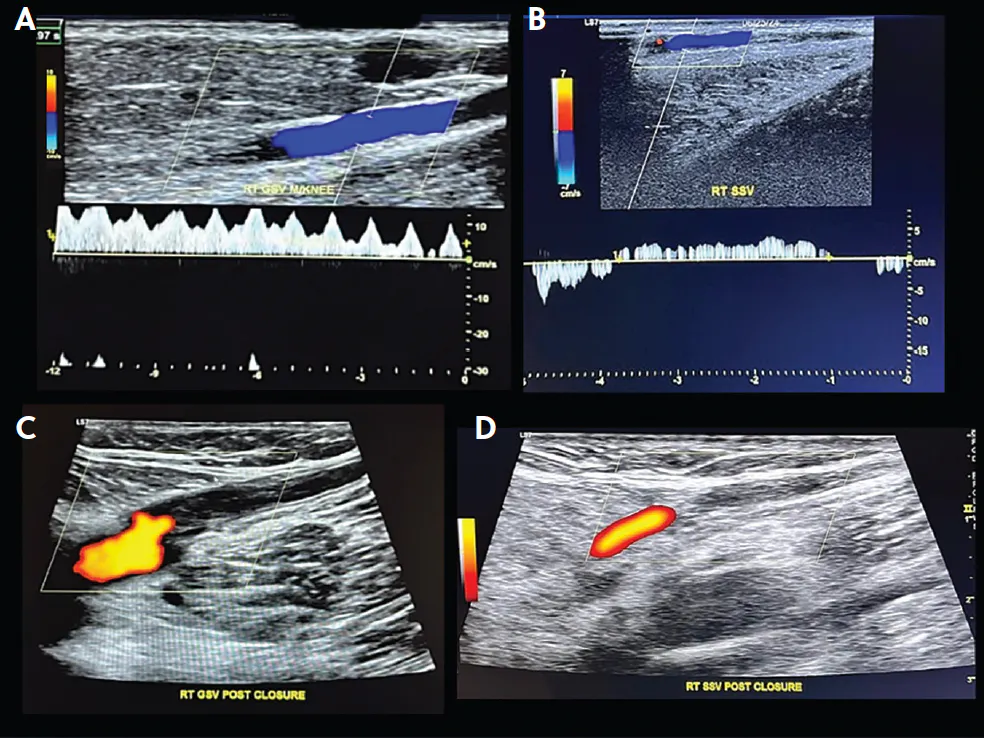
Figure 1. Duplex ultrasound of the right GSV and SSV before (A, B) and after (C, D) VenaSeal system treatment. Figure 1A and 1B demonstrate significant reflux, while Figure 1C and 1D demonstrate complete closure, with no reflux in the treated veins.
Procedural Overview
The patient chose intervention with the VenaSeal system. The treatment was uneventful, and she was pleased with her results. We followed up at 2 weeks and at 4 and 10 months posttreatment, and no additional adjunctive treatments such as microphlebectomy or sclerotherapy were required. Her CEAP (clinical, etiology, anatomy, pathophysiology) score and Venous Clinical Severity Score had significantly improved.
Discussion
Although the before and after photos demonstrate an excellent result (Figure 2), not all patients will have the same experience. Therefore, it is important to evaluate each individual case and listen to a patient’s concerns while giving realistic expectations for treatment.
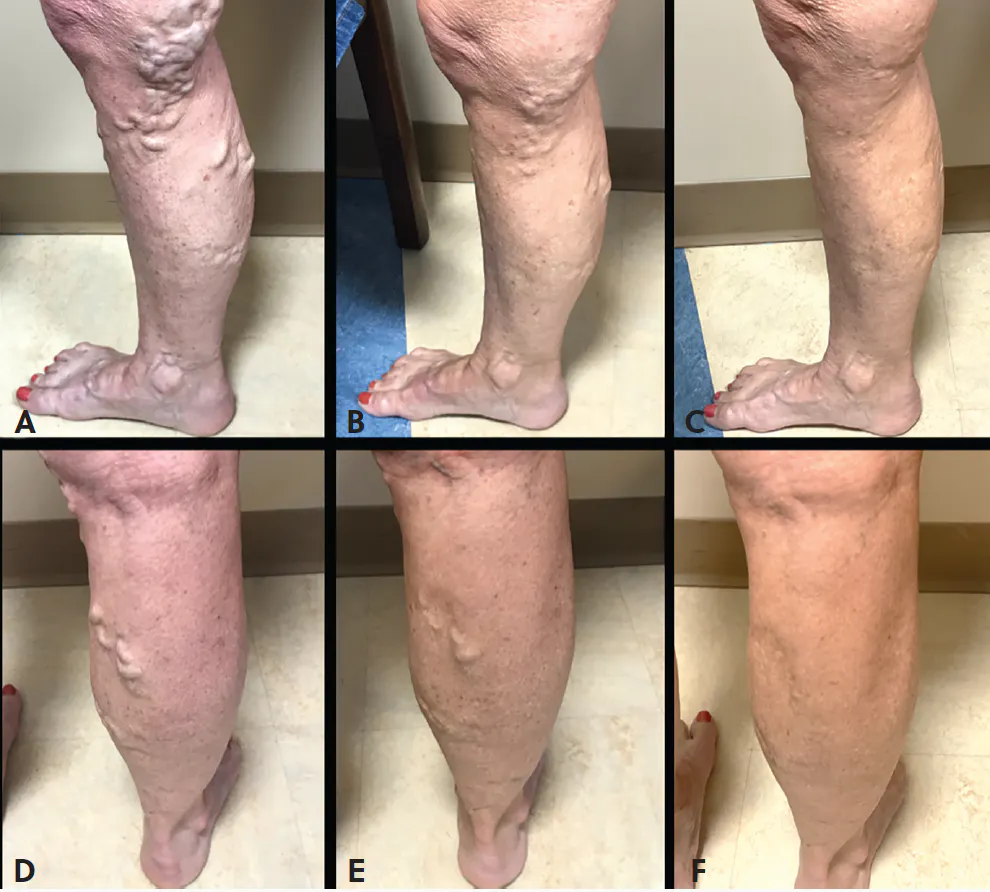
Figure 2. Photos of the patient’s right leg prior to treatment (A, D), 2 weeks posttreatment (B, E), and 4 months posttreatment (C, F).
INTERMITTENT AND LONG-TERM MANAGEMENT
Many of my patients present with lymphedema. It is very important to stress prior to treatment that complete resolution of lymphedema symptoms is unlikely. In many cases, there are multiple causes of lymphedema outside of CVI. Long-standing CVI can permanently damage subcutaneous tissues, allowing for persistent lymphedema. Prior surgery such as joint replacement can result in chronic lymphedema due to damage of the lymphatics. Other causes can include thyroid disease, kidney disease, and heart disease, which should be evaluated and considered prior to venous intervention. Some patients may present with lipedema, which may require other interventions to reduce the subcutaneous tissue volume not related to lymphedema. It is imperative to note the difference between the two entities to achieve optimal patient satisfaction and treatment outcome.
I advise patients with persistent lymphedema to continue wearing compression hose, stay active with exercise, and elevate their legs as needed. I also recommend consulting with a lymphedema therapist for compression therapy and compression pump devices. I discuss the role of venotropic agents/phlebotonics such as citrus bioflavonoid, micronized purified flavonoid fractions (diosmin, hesperidin), horse chestnut extract, or Ruscus aculeatus (Butcher’s Broom), which have been well studied and shown to have benefits in reducing symptoms of CVI and lymphedema.6
1. Gibson K, Minjarez R, Rinehardt E, Ferris B. Frequency and severity of hypersensitivity reactions in patients after VenaSeal™ cyanoacrylate treatment of superficial venous insufficiency. Phlebology. 2020;35:337-344. doi: 10.1177/0268355519878618
2. Fukaya E, O’Banion LA, Shao MY, et al. Hypersensitivity reaction with cyanoacrylate glue: patient selection, technical considerations, and management. Endovasc Today. 2025;24:52-56.
3. Gibson K, Minjarez R, Gunderson K, Ferris B. Need for adjunctive procedures following cyanoacrylate closure of incompetent great, small and accessory saphenous veins without the use of postprocedure compression: three-month data from a postmarket evaluation of the VenaSeal system (the WAVES study). Phlebology. 2019;34:231-237. doi: 10.1177/0268355518801641
4. Morrison N, Gibson K, Vasquez M, et al. Five-year extension study of patients from a randomized clinical trial (VeClose) comparing cyanoacrylate closure versus radiofrequency ablation for the treatment of incompetent great saphenous veins. J Vasc Surg Venous Lymphat Disord. 2020;8:978-989. doi: 10.1016/j.jvsv.2019.12.080
5. Lattimer CR, Azzam M, Kalodiki E, et al. Saphenous pulsation on duplex may be a marker of severe chronic superficial venous insufficiency. J Vasc Surg. 2012;56:1338-1343. doi: 10.1016/j.jvs.2012.04.048
6. Gloviczki ML, Kakkos SK, Urbanek T, et al. The role of venoactive compounds in the treatment of chronic venous disease. J Vasc Surg Venous Lymphat Disord. 2025;13:102258. doi: 10.1016/j.jvsv.2025.102258
Disclosures
Dr. Edwards: Consultant to and speaker for Medtronic.
ClosureFast™ endovenous radiofrequency ablation (RFA) catheter
Reference Statement
Indications for Use: The ClosureFast™ endovenous radiofrequency ablation (RFA) catheter is intended for endovascular coagulation of blood vessels in patients with superficial vein reflux.
Contraindications: The ClosureFast catheter is contraindicated for use in patients with thrombus in the target vein segment.
Potential Adverse Effects of the Device on Health: The potential complications include, but are not limited to, the following: adjacent nerve injury, hematoma, pulmonary embolism, thrombosis, infection, phlebitis, skin burn or discoloration, and vessel perforation.
Important: Please reference the Instructions For Use (IFU) for a complete listing of indications, contraindications, warnings and precautions, adverse effects, and suggested procedure.
CAUTION: Federal (USA) law restricts this device to sale by or on the order of a physician.
VenaSeal™ closure system
Brief Statement
Intended Use/Indications: The VenaSeal™ closure system (VenaSeal™ system) is indicated for use in the permanent closure of lower extremity superficial truncal veins, such as the great saphenous vein (GSV), through endovascular embolization with coaptation. The VenaSeal system is intended for use in adults with clinically symptomatic venous reflux as diagnosed by duplex ultrasound (DUS).
Contraindications: Separate use of the individual components of the VenaSeal closure system is contraindicated. These components must be used as a system. The use of the VenaSeal system is contraindicated when any of the following conditions exist: previous hypersensitivity reactions to the VenaSeal™ adhesive or cyanoacrylates, acute superficial thrombophlebitis, thrombophlebitis migrans, acute sepsis.
Potential Adverse Effects of the Device on Health: The potential adverse effects (e.g., complications) associated with the use of the VenaSeal system include, but are not limited to, adverse reactions to a foreign body (including, but not limited to, nonspecific mild inflammation of the cutaneous and subcutaneous tissue), arteriovenous fistula, bleeding from the access site, deep vein thrombosis (DVT), edema in the treated leg, embolization, including pulmonary embolism (PE), hematoma, hyperpigmentation, hypersensitivity or allergic reactions to cyanoacrylates, such as urticaria, shortness of breath, and anaphylactic shock, infection at the access site, pain, paresthesia, phlebitis, superficial thrombophlebitis, urticaria, erythema, or ulceration may occur at the injection site, vascular rupture and perforation, visible scarring.
Warnings, precautions, and instructions for use can be found in the product labeling at http://manuals.medtronic.com.
CAUTION: Federal (USA) law restricts this device to sale by or on the order of a physician.
VS-404 (IFU: M002482C001)
501915 ©2026 Medtronic. Medtronic, Medtronic logo are trademarks of Medtronic.
All other brands are trademarks of Medtronic. For global distribution. 03/2026
Advertisement
Advertisement