Advertisement
Advertisement
March 2026
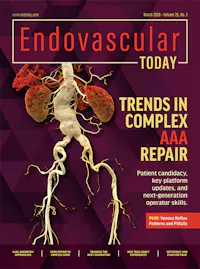
Determining Candidacy for Open Versus Complex Endovascular Repair
Discussing the key factors that shape repair strategy selection, including risk considerations, patient and genetic characteristics, aneurysm anatomy, and more.
With Adam W. Beck, MD; Francis J. Caputo, MD; and James H. Black, III, MD, DFSVS, FAHA, FACS

My practice is largely focused on disease of the aorta and its primary branches, with the majority of interventions involving complex endovascular techniques. Overall, approximately 70% to 80% of my cases are endovascular, with the remainder consisting of open or hybrid reconstructions. Rather than defaulting to a specific modality, I approach each patient using a consistent decision framework that prioritizes risk-benefit balance and long-term durability.
When considering intervention, I go through the same mental exercise for every patient: (1) What is the risk of doing nothing (eg, estimated annual rupture risk)? (2) Who is the patient (eg, age, physiologic reserve, anticipated life expectancy with reasonable quality of life)? (3) What is the risk of doing something, accounting for the specific open, endovascular, or hybrid approach required and its expected durability? I synthesize this through what I often refer to as the “mommy or daddy test.” That is, what would I recommend if this were my own family member? If an intervention does not pass that test, I am comfortable recommending surveillance or nonoperative management.
Patients are most often declined for intervention when comorbidity burden, frailty, or limited life expectancy make it unlikely that the benefits of repair will be realized or when available endovascular solutions would require excessive anatomic compromise without a durable result. In these situations, nonintervention is framed as a deliberate, patient-centered decision rather than a lack of therapeutic options.
Genetic aortopathy plays a major role in strategy selection. At University of Alabama at Birmingham, we work closely with our genetics colleagues through a dedicated adult cardiogenomics clinic and a parallel pediatric genetics program. A substantial proportion of patients, particularly those with a first-degree relative with aortic disease, multisite aneurysms, or younger age at presentation with aneurysm/dissection, undergo formal genetic evaluation. This information directly informs both whether to intervene and how, often lowering my threshold for open repair in appropriate patients where long-term durability is paramount, and also informs the frequency of follow-up when in surveillance.
My practice is largely centered around patients who have failed endovascular therapies and those with anatomies not amenable to endovascular therapies. My approximate ratio of open versus complex endovascular repair is 70/30, favoring open repair.
Determining patient candidacy for open versus complex endovascular repair really relies on several things. One is the physiologic status of the patient. This takes into account the age, comorbidities, and risk stratification of the patient. The second is the anatomy of the aneurysm and whether or not endovascular repair would be successful in not only the short term but also the long term. Third, in patients with genetic aortopathies, I confirm that they are truly not an open candidate given the need for reinterventions as well as the potential durability issues of endovascular repair.
Generally speaking, in patients who are good open repair candidates with marginal endovascular options, I choose open repair for that population. In physiologically compromised patients whose anatomy is suitable for a commercially available device, such as Gore Excluder thoracoabdominal branch endoprosthesis (Gore & Associates) or Zenith Fenestrated AAA endovascular graft (Cook Medical), or who meet criteria for our physician-modified endovascular graft investigational device exemption, endovascular repair is warranted. For patients who are physiologically unfit for open repair and have anatomy that is hostile for endovascular repair, I believe palliation is warranted.

In my practice, I see approximately 40% open repairs versus 60% complex endovascular repairs. The most common reason I turn patients down for intervention is anatomic constraint. In women, this is most often related to inadequate access, whereas in men it is more frequently due to severe aortic anatomy, especially postdissection.
When considering patients with suspected or confirmed genetic aortopathy, my decision-making begins with confirming the underlying condition. I then assess the patient’s family pedigree, including patterns of response to surgical intervention, and engage in extensive discussions with the patient regarding the risks and benefits of both open and endovascular repair strategies.
Advertisement
Advertisement