Advertisement
Advertisement
March 2026
Small Saphenous Vein Reflux: Patterns and Pitfalls Influencing Treatment
Understanding anatomic variability, reflux complexity, and procedural nuances to optimize outcomes in SSV insufficiency.
Due to the higher prevalence of reflux, much of the literature focuses on the great saphenous vein (GSV).1 However, 10% to 20% of patients who present with symptomatic varicose veins have incompetence of the small saphenous vein (SSV).2 The SSV is distinctly different from the GSV with respect to presentation, anatomic challenges, and outcomes. Patients with SSV incompetence tend to present at an older age, with fewer visible varicose veins, and a lower Venous Clinical Severity Score.3 Anatomic variation of the SSV at the saphenopopliteal junction (SPJ) and proximity to tibial and sural nerves make its treatment more complex than the GSV. Finally, some studies have demonstrated an increased incidence of postprocedure thrombus extension and paresthesia after endovenous treatment of the SSV.4,5 For these reasons, it is essential to evaluate all patients presenting with venous insufficiency for incompetence of the SSV to determine the extent and pattern of reflux and understand these unique characteristics when determining an appropriate treatment strategy.
ANATOMY
The SSV originates from the lateral marginal vein of the foot, courses posterior to the lateral malleolus, and extends proximally along the posterior aspect of the calf, typically between the bellies of the gastrocnemius muscle within its fascial compartment.6 Most commonly, the SSV will drain into the popliteal vein (PV). The gastrocnemius veins (GVs) drain into the PV in over 80% of people, although they can also join the proximal SSV.
An SPJ is present in approximately 75% of limbs and located within 4 cm of the popliteal skin crease; it is otherwise absent or rudimentary in 25%.6 In approximately 70% of limbs, the SSV continues superiorly as the cranial extension of the SSV. The vein courses between the semitendinosus and biceps femoris muscles and may connect to a sciatic perforating vein of the thigh, the inferior gluteal vein, or the femoral vein via a thigh perforator.7,8 When the cranial extension of the SSV joins the posterior thigh circumflex vein and ultimately connects with the GSV, it is termed the intersaphenous vein (ISV; formerly known as the vein of Giacomini).9
Considerable anatomic variability exists at the level of the popliteal fossa. Three main specific patterns regarding the SPJ junction have been classified4,7:
- Type A: SSV joins the PV directly with the presence of a cranial extension of the SSV or ISV coming off the proximal SSV.
- Type B: SSV continues cephalad as either a cranial extension of the SSV or ISV. There is a small connection with the PV via a tiny “anastomotic” vein.
- Type C: SSV has no direct connection into the PV, and the SSV continues proximally as a cranial extension of the SSV or ISV above the popliteal fossa.
The neuroanatomy of the popliteal fossa and posterior leg is pertinent in SSV treatment. The sciatic nerve descends the posterior thigh and divides into the tibial and common peroneal nerves in the popliteal area. The tibial nerve continues inferiorly toward the medial ankle and innervates muscles for plantar flexion of the ankle and sensation in the plantar surface of the foot.10
The medial sural cutaneous nerve is a sensory nerve that runs adjacent to the SSV in the distal third of the leg. The proximal and mid SSV is located within a fascial compartment deep to the superficial fascia and superficial to the deep muscular fascia, and the medial sural cutaneous nerve is situated under the deep muscular fascia. However, below the inferior border of the gastrocnemius muscle, the medial sural cutaneous nerve becomes more superficial and lies adjacent to the SSV, making it more prone to injury.11 The sural nerve is purely sensory, and injury can lead to neuropathy in the posterolateral aspect of the distal third of the leg and the lateral aspect of the foot.6
REFLUX PATTERNS
Duplex ultrasound is essential for accurate characterization of venous disease and hemodynamic assessment. Reflux in the SSV is defined as a minimum value of > 500 ms of reversed flow when the patient is evaluated in the standing position.12 The use of color flow imaging is critical for accurately determining reflux patterns within the SSV system. A complete venous ultrasound for reflux should include evaluation of the SSV, the cranial extension of the SSV, any connection between the GVs and the SSV, incompetent perforator veins, axial reflux of the GSV, and mapping of adjacent varicose veins to determine their origin. In one study, only 50% of evaluated limbs demonstrated combined SPJ and SSV reflux, while the remaining limbs exhibited various combinations of reflux involving the cranial extension of the SSV/ISV, GVs, perforator veins, and tributaries.13
Reflux patterns in the SSV have significant variability, reflecting the complex anatomy of this system. Several of these patterns include descending reflux extending from the SJP into the SSV, with or without adjacent reflux in the PV, or ascending reflux in the SSV with adjacent dilated tributary varicose veins. This latter pattern of reflux may be segmental, signifying early venous disease; in this case, consideration of a saphenous-sparing procedure, such as ASVAL (ambulatory selective varicose vein ablation under local anesthesia), may be appropriate. Less commonly, reflux from tributary varicose veins or an incompetent perforating vein may lead to segmental SSV reflux. There may be reflux in the GSV and SSV simultaneously with connecting tributary varicosities on the posterior and medial aspect of the calf.2 Proper mapping with duplex ultrasound allows for determination of the appropriate treatment modality.
TREATMENT OPTIONS
The 2023 Society for Vascular Surgery, American Venous Forum, and American Vein & Lymphatic Society clinical practice guidelines recommend endovenous ablation of incompetent SSV as opposed to high ligation and stripping.12 A randomized controlled trial comparing high ligation and stripping to endovenous laser ablation (EVLA) found lower anatomic closure rates and increased sensory disturbance in the 1-month postoperative period for ligation, with persistent differences in closure rates extending to 2 years in favor of endovenous closure.14
When deciding between thermal and nonthermal treatment options, consideration of the risks of thermal nerve injury and anatomy should be considered, especially in the distal calf. Thermal tumescent ablation options include EVLA and radiofrequency ablation (RFA), while nonthermal, nontumescent (NTNT) options include cyanoacrylate closure, chemical ablation, and mechanochemical endovenous ablation (MOCA). The NTNT options offer advantages, such as no risk to the adjacent nerves and the ability to treat the SSV in the distal calf, if needed.
When treating isolated SSV insufficiency, prone patient positioning facilitates optimal imaging and venous access. A preprocedural ultrasound with mapping is often helpful to define the anatomy, select the access site, and determine the treatment length (Figure 1). It is important to note whether the GVs join the SSV and if there is a cranial extension of the SSV. For thermal tumescent ablation procedures, access should be obtained at the lowest point of incompetence but not below the level of the inferior border of the gastrocnemius muscle, given the proximity of the sural nerve to the SSV in the lower third of the calf (Figure 2). The SSV will typically deepen its course as it approaches the PV and appear as a 45° bend approximately 2 cm in length (ie, the fascial curve).10 If performing thermal ablation, the catheter tip should be positioned (1) at the level where the fascial curve begins to avoid injury to the tibial nerve and decrease the risk of ablation-related thrombus extension (ARTE) and (2) caudal to the GVs, if they join the SSV directly, to assure continued patency (Figure 3).
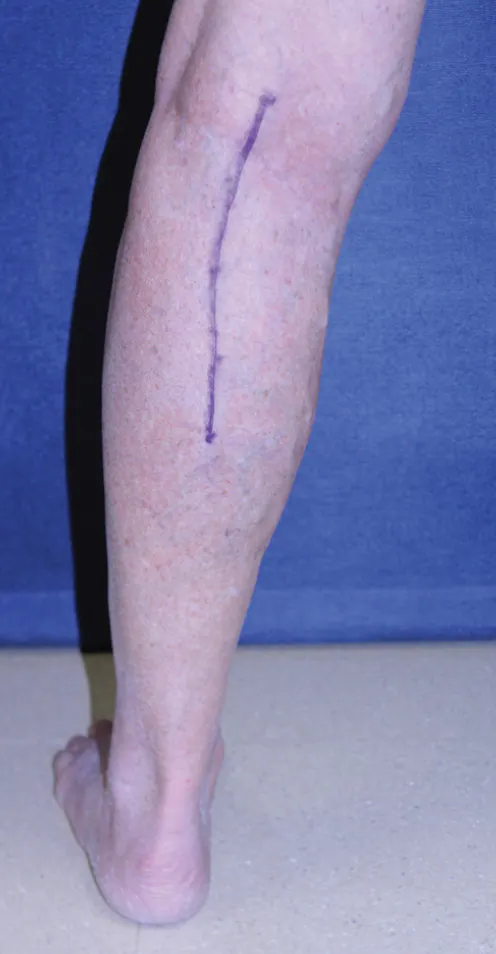
Figure 1. Ultrasound mapping of the SSV prior to the procedure.
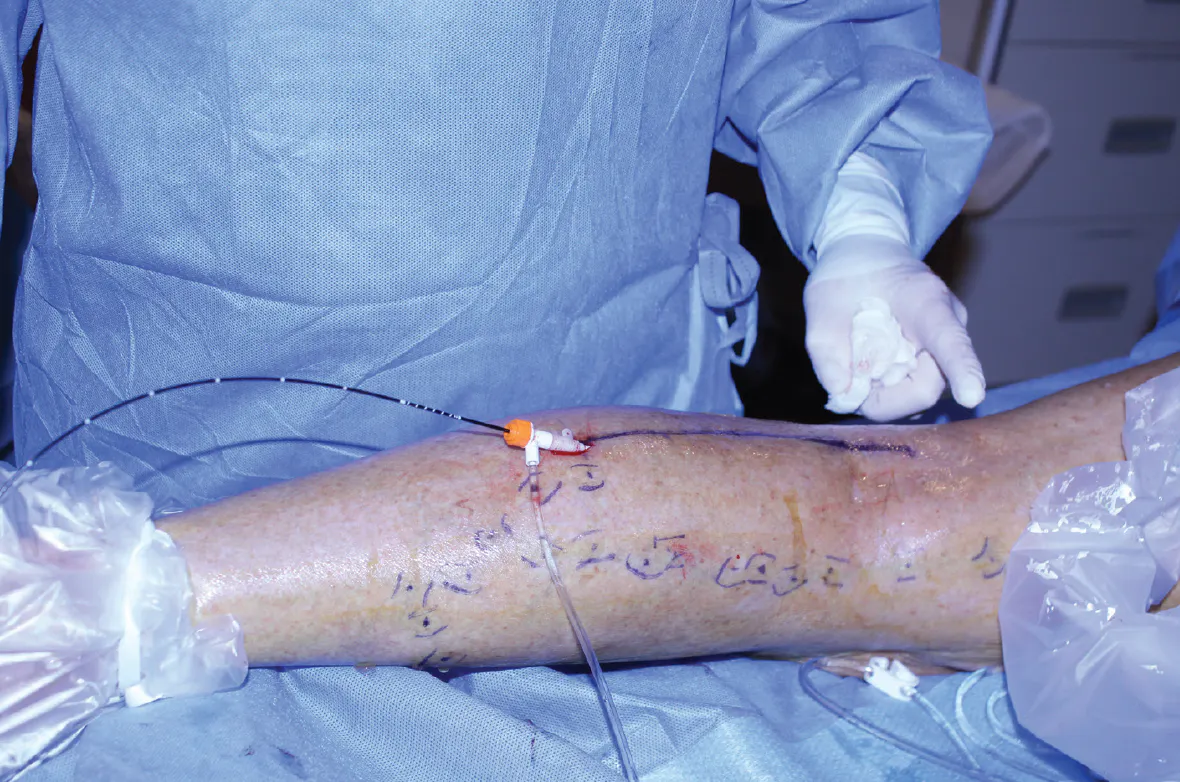
Figure 2. For thermal ablation procedures, access should be obtained at or above the inferior border of the gastrocnemius muscle to avoid thermal injury to the sural nerve.
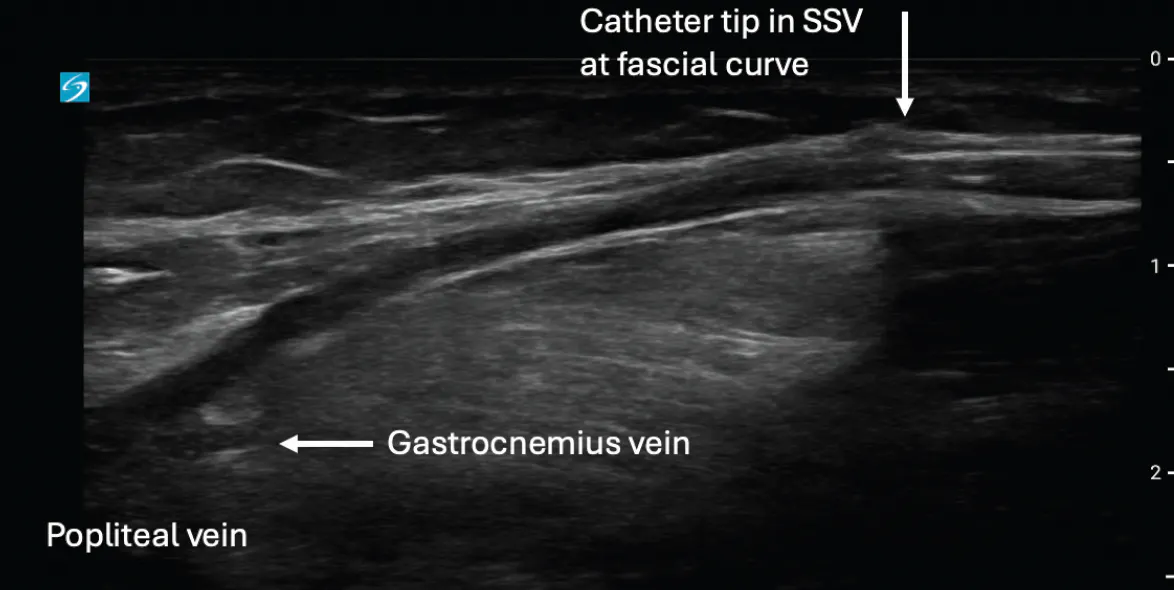
Figure 3. Ultrasound image of the SSV with the tip of the catheter at the fascial curve, where it dives through the fascia to join the PV.
In the presence of a high SPJ, the proximal SSV is in closer proximity to the tibial nerve, which should be identified on ultrasound (appearing as a honeycomb pattern) if possible. In this case, tumescent anesthesia may be used to push the tibial nerve away from the SSV; however, this maneuver is seldom necessary when the catheter tip is placed at the fascial curve. Because the SSV lies within a fascia sheath similar to the GSV, administration of adequate perivenous tumescent anesthesia is comparable. However, the SSV may be more superficial than the GSV, so it is important to use enough tumescent to create at least 1 cm of distance from the skin to avoid skin burns.
In clinically significant reflux in the SSV and cranial extension of the SSV, the catheter or laser fiber may be inserted into the SSV and directed into the cranial extension. If this maneuver is not accomplished easily, a separate puncture site for the cranial extension may be needed. When treating the cranial extension of the SSV/ISV, care should be taken to identify the tibial nerve, typically located cephalad and close to the bifurcation of the SSV and cranial extension.11 For NTNT procedures, the SSV may be cannulated more distally if necessary, although the incidence of clinically significant reflux in the distal calf is low.15
ANATOMIC SUCCESS RATES AND COMPLICATIONS
Anatomic success rates for ablation procedures range from 89% to 98%. Anatomic success rates for thermal tumescent ablation typically range from 95% to 98%. A recent trial comparing RFA to cyanoacrylate closure demonstrated no significant difference in symptom relief and comparable occlusion rates.16 Studies on endovenous microfoam chemical ablation procedures in the SSV have documented closure rates of 89% to 93%, with one study noting that sequential planned treatments may be necessary in select patients.17,18
Some studies have noted a higher incidence of thrombophlebitis and skin pigmentation with chemical ablation. Initial trials demonstrated a slightly higher risk of thrombotic events. However, a contemporary study outlines adjunctive techniques to decrease these thrombotic risks.19 These maneuvers include leg elevation > 45°, ultrasound mapping and digital occlusion of large perforator veins, limitation of foam volume per session, injection of saline prior to treatment, dorsi and plantar flexion of the leg after microfoam injection, and compression of the leg while in the elevated position. Additional benefits of microfoam chemical ablation compared to other NTNT methods include the ability to simultaneously treat associated tributary varicosities. However, multiple sessions may be needed to achieve adequate long-term closure of the SSV.19 Finally, a small retrospective study comparing MOCA to surgery found less pain and earlier return to work for the MOCA group. Additionally, there was no paresthesia in the MOCA group, compared to 3.4% of patients in the surgery group.20
Complications associated with endovenous ablation of the SSV are similar to the treatment of the GSV and include ARTE, deep vein thrombosis (DVT), pulmonary embolism, and nerve injury. In a study evaluating efficacy and complications of EVLA of the SSV, 5.7% of treated limbs developed a DVT, defined as thrombus extending into the PV from the SPJ. Patients with type A SSV anatomy (with an SPJ without significant branches) had increased odds of developing an ARTE.4 For patients with symptomatic ARTE after endovenous ablation, anticoagulation with a direct oral anticoagulant is recommended over a vitamin K antagonist.12 The incidence of sural neuralgia after endovenous thermal ablation of the SSV ranges from 4.4% to 26%, with most patients experiencing transient cutaneous numbness.21,22
In a recent, large national venous registry database study evaluating outcomes after SSV ablation, there was a 2.8% recanalization rate at any time point, with 48% occurring within the first year.23 Predictors of recanalization were larger vein diameter, shorter SSV length, and lower volume of tumescent anesthesia used. Procedural complications included pain (28%) and skin staining (7%), with peripheral neuropathy occurring in only < 0.1%.
CONCLUSION
SSV incompetence, although less prevalent than GSV incompetence, occurs in 20% of patients with varicose veins, and evaluation should be routine in the workup of chronic venous disease. There are distinct differences between the SSV and GSV, including presentation, anatomy, and outcomes. To avoid complications, this great variability in the anatomy of the SSV system and reflux should be carefully assessed by color Doppler prior to treatment planning and during endovenous procedures.
1. Kundu S, Grassi CJ, Khilnani NM, et al; Multi-disciplinary quality improvement guidelines for the treatment of lower extremity superficial venous insufficiency with ambulatory phlebectomy from the Society of Interventional Radiology, Cardiovascular Interventional Radiological Society of Europe, American College of Phlebology and Canadian Interventional Radiology Association. J Vasc Interv Radiol. 2010;21:1-13. doi: 10.1016/j.jvir.2009.01.035
2. Engelhorn CA, Engelhorn AL, Cassou MF, Salles-Cunha SX. Patterns of saphenous reflux in women with primary varicose veins. J Vasc Surg. 2005;41:645-651. doi: 10.1016/j.jvs.2004.12.051
3. Pochec K, Mühlberger D, Hummel T, et al. Significant differences in patients with a complete insufficiency of the great versus small saphenous vein. Phlebology. 2019;34:445-452. doi: 10.1177/0268355518798277
4. Gibson KD, Ferris BL, Polissar N, Neradilek B, Pepper D. Endovenous laser treatment of the small [corrected] saphenous vein: efficacy and complications. J Vasc Surg. 2007;45:795-801; discussion 801-3. Published correction appears in J Vasc Surg. 2007;45:1293. doi: 10.1016/j.jvs.2006.11.059
5. Proebstle TM, Gül D, Kargl A, Knop J. Endovenous laser treatment of the lesser saphenous vein with a 940-nm diode laser: early results. Dermatol Surg. 2003;29:357-361. doi: 10.1046/j.1524-4725.2003.29085.x
6. Bergan JJ, Bunke-Paquette N. The Vein Book. 2nd ed. Oxford University Press; 2013.
7. Cavezzi A, Labropoulos N, Partsch H, et al. Duplex ultrasound investigation of the veins in chronic venous disease of the lower limbs--UIP consensus document. Part II. Anatomy. Eur J Vasc Endovasc Surg. 2006;31:288-299. doi: 10.1016/j.ejvs.2005.07.020
8. Caggiati A, Bergan JJ, Gloviczki P, et al; International interdisciplinary consensus committee on venous anatomical terminology. Nomenclature of the veins of the lower limbs: an international interdisciplinary consensus statement. J Vasc Surg. 2002;36:416-422. doi: 10.1067/mva.2002.125847
9. Veselá M, Dostálová G, Brabec K, et al. Intersaphenous veins of the leg: an ultrasonographic study in young population. Ann Anat. 2025;260:152658. doi: 10.1016/j.aanat.2025.152658
10. Almeida JI. Atlas of Endovascular Venous Surgery. 2nd ed. Elsevier; 2019.
11. Kerver AL, van der Ham AC, Theeuwes HP, et al. The surgical anatomy of the small saphenous vein and adjacent nerves in relation to endovenous thermal ablation. J Vasc Surg. 2012;56:181-188. doi: 10.1016/j.jvs.2011.11.127
12. Gloviczki P, Lawrence PF, Wasan SM, et al. The 2023 Society for Vascular Surgery, American Venous Forum, and American Vein and Lymphatic Society clinical practice guidelines for the management of varicose veins of the lower extremities. Part II: endorsed by the Society of Interventional Radiology and the Society for Vascular Medicine. J Vasc Surg Venous Lymphat Disord. 2024;12:101670. Published correction appears in 2024;12:101923. doi: 10.1016/j.jvsv.2023.08.011
13. Labropoulos N, Giannoukas AD, Delis K, et al. The impact of isolated lesser saphenous vein system incompetence on clinical signs and symptoms of chronic venous disease. J Vasc Surg. 2000;32:954-960. doi: 10.1067/mva.2000.110349
14. Nandhra S, El-sheikha J, Carradice D, et al. A randomized clinical trial of endovenous laser ablation versus conventional surgery for small saphenous varicose veins. J Vasc Surg. 2015;61:741-746. doi: 10.1016/j.jvs.2014.09.037
15. Neuhardt DL, Salles-Cunha SX, Morrison N. Prevalence and patterns of small saphenous vein reflux. J Vasc Ultrasound.2009;33:19-22. doi: 10.1177/154431670903300104
16. Kim H, Cho S, Kim SJ, Joh JH. Long-term outcomes of radiofrequency ablation versus cyanoacrylate closure for isolated small saphenous vein insufficiency: a comparative study. J Vasc Surg Venous Lymphat Disord. 2026;14:102317. doi: 10.1016/j.jvsv.2025.102317
17. Kim PS, Elias S, Gasparis A, Labropoulos N. Results of polidocanol endovenous microfoam in clinical practice. J Vasc Surg Venous Lymphat Disord. 2021;9:122-127. doi: 10.1016/j.jvsv.2020.04.015
18. Deak ST. Treatment of superficial venous insufficiency in a large patient cohort with retrograde administration of ultrasound-guided polidocanol endovenous microfoam versus endovenous laser ablation. J Vasc Surg Venous Lymphat Disord. 2022;10:999-1006.e2. doi: 10.1016/j.jvsv.2021.11.007
19. Jimenez JC, Lawrence PF, Woo K, et al. Adjunctive techniques to minimize thrombotic complications following microfoam sclerotherapy of saphenous trunks and tributaries. J Vasc Surg Venous Lymphat Disord. 2021;9:904-909. doi: 10.1016/j.jvsv.2020.11.015
20. Apruzzi L, Bilman V, Ardita V, et al. Comparison of mechanochemical ablation versus ligation and stripping for the treatment of incompetent small saphenous vein. Phlebology. 2022;37:48-54. doi: 10.1177/02683555211045191
21. Park JY, Galimzahn A, Park HS, et al. Midterm results of radiofrequency ablation for incompetent small saphenous vein in terms of recanalization and sural neuritis. Dermatol Surg. 2014;40:383-389. doi: 10.1111/dsu.12456
22. Theivacumar NS, Beale RJ, Mavor AI, Gough MJ. Initial experience in endovenous laser ablation (EVLA) of varicose veins due to small saphenous vein reflux. Eur J Vasc Endovasc Surg. 2007;33:614-618. doi: 10.1016/j.ejvs.2006.10.030
23. Echevarria C, Scovell S, Blebea J, et al. Clinical outcomes following treatment for small saphenous vein insufficiency: an AVLS PRO venous registry study. Phlebology. 2025;40:518-527. doi: 10.1177/02683555251317854
Advertisement
Advertisement