Advertisement
Advertisement

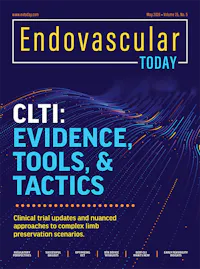
I’m pleased to present this May edition of Endovascular Today, dedicated almost entirely to chronic limb-threatening ischemia (CLTI). In this issue, we’ve curated a full “menu” of CLTI-focused content, featuring both familiar staples and fresh perspectives not previously explored.
To start, we offer an interview with David Armstrong, MD, who shares his podiatric perspective on key trends in limb preservation. He underscores the importance of multidisciplinary management of patients with CLTI and reflects on the progress that has made this team-approach widely accepted. He also explores advances in diabetes therapies, as well as the emerging roles of machine learning and artificial intelligence.
Next on the menu is an update on outcomes of substudies of the BEST-CLI trial by Michael B. Strong, MA; Matthew Menard, MD; Alik Farber, MD; and Kenneth Rosenfield, MD. The BEST-CLI trial has generated a wealth of data, and these substudy analyses provide greater clarity on which patients may benefit most from a surgical versus endovascular approach. Echoing Dr. Armstrong’s insights, the authors emphasize the essential role of multidisciplinary collaboration in completing this landmark effort, which continues to help close important knowledge gaps in CLTI.
Another main course is a panel discussion featuring Yolanda Bryce, MD; Edward Choke, MD; Andrew Holden, MD; and Bruno Migliara, MD, which focuses on key decisions and techniques for successful bailout. Their discussion covers when to pivot, how to escalate, and which additional strategies are most effective in complex chronic total occlusion interventions when standard methods fall short.
An FDA interview with Misti Malone, PhD, and Donna Buckley, MD, provides insight into modern lower extremity revascularization trials, including evolving endpoint definitions, the role of surrogate endpoints, and the advantages and limitations of adaptive trial designs.
We then have an article on optimizing optical coherence tomography (OCT) in the below-the-knee (BTK) segment by Chrissy van Wely, MD; Rens J. Oosterveld, MD; Lieke C.D. Brugman, MSc; Ozan Yazar, MD; and Lee H. Bouwman, MD. The authors offer practical guidance, outlining the benefits, limitations, and technical considerations of the use of OCT in BTK treatment, particularly in the context of bioresorbable scaffold placement.
Rounding out the issue’s main courses, Marianne Brodmann, MD; Yann Gouëffic, MD; and Michael Siah, MD; share their opinion on must-haves and wishlists for BTK devices, including device limitations, imaging gaps, and the future of innovation in the space.
Some additions to this issue’s menu include an article on the FDA Early Feasibility Study Program by Dorothy B. Abel and Aditi Upadhye, as well as a featured interview with Ms. Anna Louise Pouncey, who discusses the WARRIORS trial, her health equity–focused research approach, and more.
I hope you enjoy this full course of CLTI-focused content—bon appétit.
Jos C. van den Berg, MD, PhD
Guest Chief Medical Editor
Advertisement
Advertisement