Advertisement
Advertisement
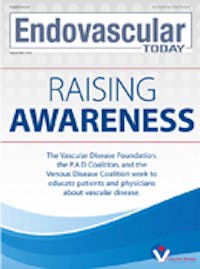
September is Peripheral Arterial Disease (PAD) Awareness Month, a time to communicate the seriousness of the disease as well as share new tools to help patients with vascular disease live better. Fall is also a season of renewal and a prime time to reflect on what we have accomplished this year and make plans for the coming year.
With this in mind, we are most pleased to launch the September supplement to Endovascular Today. In this special edition, we will preview new clinical practice tools from the Vascular Disease Foundation (VDF) and its P.A.D. Coalition and Venous Disease Coalition, showcasing our organization's activities. These are excellent resources for patients, but they also save clinicians' time, which can then be focused on patient management and treatment. We thank Cook Medical (Bloomington, IN) for sponsoring this supplement and helping us share our important work with vascular specialists worldwide.
Now in its 12th year, the VDF is proud to continue its mission to “reduce death and disability for all from vascular disease.” Established in 2004, our P.A.D. Coalition is now an alliance of more than 80 leading medical organizations, government agencies, and corporations united to improve the health and care of people with PAD. Our Venous Disease Coalition (VDC) is a collaborative network of more than 40 professional and public organizations united by one mission—to increase public and health professional awareness of venous disease.
Examples of some of our newest initiatives aimed at helping to educate patients and save clinicians' time include the following:
•Our popular newsletter, Keeping in Circulation®, the essential resource for patients living with vascular disease, has been revamped and released in a new magazine format.
•In partnership with the Centers for Disease Control and Prevention, we are launching “This is Serious,” a national campaign to drive awareness and action around the prevention of deep vein thrombosis (DVT) and pulmonary embolism (PE) in women.
•We developed the VTE Toolkit, a resource to help clinicians educate other providers and patients who have or are at risk for venous thromboembolism (VTE).
•We released an online, multimedia workbook on PAD to help patients better manage their disease.
•We developed the PAD Exercise Training Toolkit to enable cardiac rehabilitation and other health care professionals to work within their communities to improve access to supervised exercise programs for people with intermittent claudication.
•In June, we issued a new radio campaign that illustrates PAD as a serious disease with devastating consequences. To date, these ads have been aired more than 38,000 times on 324 nationwide radio stations.
•We were successful in securing the inclusion of a provision in health care reform legislation that we believe will lead to improved Medicare coverage for ankle-brachial index testing for PAD.
More information on each of these items is included throughout this supplement.
As we look ahead, the VDF plans to:
•Create and launch a nationwide vascular awareness and education campaign that will command attention for vascular diseases, position our organization as the leading source for patient information, provide a patient voice in advocacy efforts, and direct resources to the critical issue of health professional awareness and outreach.
•Work toward building an organizational infrastructure that will facilitate future growth.
•Identify and implement awareness, education, advocacy, and other science-based strategies to improve the care of patients with critical limb ischemia.
•Continue our 5-year collaboration with the Centers for Disease Control and Prevention to improve the health of women who have or are at risk for VTE.
As we move forward, I ask that all vascular specialists embrace the VDF and its Coalitions and determine how you can best help the VDF as we continue fighting vascular disease and improving vascular health. Throughout this supplement, we will provide tips and ideas on how you can become involved.
We hope you find the information and resources in this issue valuable, and we thank you for your efforts to improve your patients' vascular health.
Advertisement
Advertisement