Advertisement
Advertisement
Europe August 2014 Supplement
Sponsored by Cordis Corporation
Addressing Type II Endoleaks
Diagnosing and treating this continually perplexing EVAR complication.
By Maxime Raux, MD; Prof. Jean-Pierre Becquemin, MD; and Kenneth Ouriel, MD, MBA
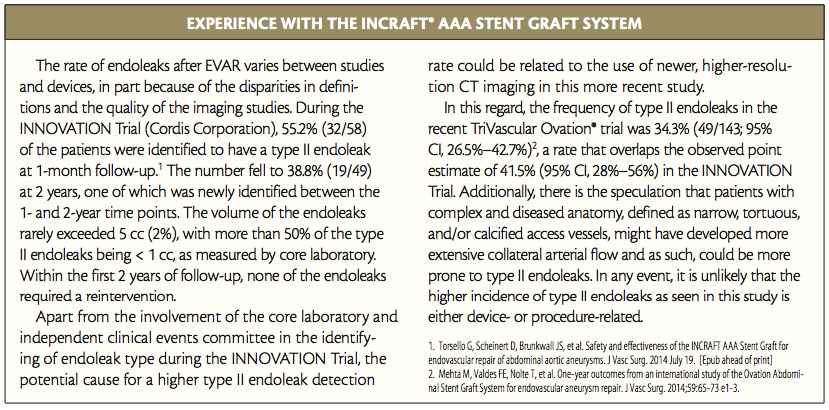
Over the last 15 years, EVAR has become the predominant modality of abdominal aortic aneurysm (AAA) treatment in suitable patients, gradually replacing open surgical repair (OSR).1,2 Large, multicenter, randomized trials have highlighted benefits of EVAR over OSR as a less invasive technique, resulting in a reduction of 30-day mortality.3,4 Notwithstanding, these benefits are lost over time.5,6 EVAR still carries a certain rate of complications including rupture, reintervention, and conversion to open repair. Endoleaks, defined by a persistent blood flow outside the lumen of the graft but within the aneurysm sac, appear to be responsible for 60% of complications after EVAR and 45% of all reinterventions. 3 Furthermore, in a recent large-cohort study, Schanzer et al underscored that EVAR failed to prevent aneurysm sac enlargement in 41% of patients after 5 years, mainly due to the presence of any kind of endoleak.7 Type II endoleaks are the most frequent, resulting in perfusion of the sac through collateral arteries (eg, lumbar [Figures 1 and 2] and inferior mesenteric [Figures 3 and 4] arteries). Type IIa endoleaks refer to simple endoleaks due to one collateral artery. Type IIb endoleaks are defined as complex, with backflow through two or more vessels. The occurrence and prevalence of this type of endoleak varies in the literature, from 7% to 44%.8 These variations most likely result from a lack of standardization of endoleak recording. Some authors only recorded early endoleaks within the first month after EVAR placement.
IMAGING
Contrast-enhanced computed tomography (CT) scan is, so far, the gold standard to detect endoleaks; however, its sensitivity and specificity are technique-dependent and has several limitations. Directional flow cannot be accurately determined. When the endoleak is in continuity with a lumbar artery, it could be either a type II if the blood flow in the lumbar artery is retrograde, or type I if the flow is anterograde. The other counterpart is irradiation. Even if radiation exposure of a single CT scan is relatively low, repeated exposure increases cumulative dose and remains a concern.9
Alternative imaging modalities are magnetic resonance imaging (MRI) and duplex ultrasound. MRI poses the problem of accessibility, which is often more restrictive than a CT scan. Furthermore, MRI remains more expensive and is not recommended for ferromagnetic stent grafts, such as the Zenith® graft (Cook Medical).10 Duplex ultrasound is less expensive and innocuous, but is influenced by the technician’s experience level and the patient’s characteristics, such as obesity or gas interposition. Sandford et al showed a sensitivity of 67%, with many endoleaks present on CT scan that were not seen by ultrasound.11
Contrast timing is one of the key points of detecting type II endoleaks. Three phases are mandatory. The first phase is a noncontrast study to detect calcifications and thrombus remodeling. Many aneurysm sacs contain calcifications that cannot be differentiated from the contrast from an endoleak in the absence of a comparative noncontrast study. The second phase is a contrast view with early arterial acquisition. This phase usually detects type I and III endoleaks and some type II endoleaks. The third phase is acquired with delayed arterial phase images. Many lower-flow type II endoleaks are evident only on delayed acquisition.
CURRENT LITERATURE
The natural history of type II endoleaks remains poorly understood, and their management and consideration still remain controversial. A recent meta-analysis showed that type II endoleaks spontaneously resolve in 35.4% of cases within a range of 3 months to 4 years.12 Some consider type II endoleaks as a benign condition; others hold them responsible for late ruptures, underlying a strategy of aggressive management and treatment at some centers. Several reports in the literature showed that nearly 20% of early type II endoleaks persist and account for rupture or secondary interventions.13,14
DEFINING TYPE II ENDOLEAKS
There are different types of type II endoleaks, with different complications. Not all of them are benign. Persistent endoleaks are defined by the absence of resolution after 6 months. Recurrent type II endoleaks correspond to the onset of a new endoleak from the same origin, independent of the resolution of the first one, regardless of delay between the two. A recent analysis of more than 750 patients during 15 years at Henri Mondor Hospital (Créteil, France) emphasized the seriousness of this complication. Incidence of type II endoleaks was 28.7%. Factors related to the onset of type II endoleaks included larger-sized aneurysms, older patients, female gender, and lumbar artery patency. Existence of a type II endoleak, regardless of its type, was associated with a higher rate of complications compared to patients without endoleak. Two main complications were related to type II endoleak: aneurysm sac enlargement (40.3% vs 16.8% for patients without endoleak; P < .001); and reintervention (14.9% vs. 6.6%; P < .002).8
Concerning the type of leak, persistent type II endoleak was associated with aneurysm sac enlargement (P < .001). Recurrent type II endoleaks were associated with higher reintervention rates, conversion to open repair, and sac enlargement (P < .05). These data are confirmed by multivariate analysis showing that persistent (HR 3.16; 95% CI, 2.55%–6.03%; P < .001) and recurrent type II endoleaks (HR 1.88; 95% CI, 1.18%–3.01%; P = .008) were significantly predictive of sac growth.8 These data confirm that type II endoleaks are not benign and can deeply impact or even jeopardize outcomes after EVAR, with life-threatening complications. The data also support close follow-up with adequate imaging to detect and treat type II endoleaks in a timely manner. These data are supported by a recent long-term cohort study published by Zhou et al. This review states that delayed type II endoleaks (appearing < 12 months after EVAR implantation) are common, occurring in 41% of patients. These delayed endoleaks are significantly associated with aneurysm sac enlargement.15
Nevertheless, pure type II endoleak doesn’t seem to increase the risk of rupture. Actually, ruptured AAA after EVAR with type II endoleak appears to be rare, occurring in less than 1% of cases in the EuroSTAR registry. Importantly, one third of ruptures occur without sac growth.12
The timing of treatment for type II endoleaks varies among studies, but indications such as aneurysm sac growth > 5 mm or endoleaks persisting > 6 months are well-accepted.14,16
TREATMENT
There are a wide variety of strategies available for treating type II endoleaks. These include transarterial embolization, gaining access through branches of the hypogastric arteries for lumbar endoleaks, or through branches of the superior mesenteric arteries for endoleaks originating from the inferior mesenteric arteries. Translumbar embolization of the sac and its feeding branches has also been employed with success, as has open or laparoscopic ligation of inflow arteries. Occasionally, open surgical reinterventions with aneurysm sac placation or open conversions are necessary.
CONCLUSION
In summary, type II endoleak after EVAR is a commonly encountered finding. While the frequency of aneurysm sac regression is lower in the presence of a type II endoleak, the vast majority of such leaks are of no clinical consequence to the patient. Occasionally, however, type II endoleaks can be associated with sac enlargement or symptoms, and in these cases, treatment with transarterial embolization or other reinterventions are indicated.
Maxime Raux, MD, is with the Department of Vascular Surgery, Henri Mondor Hospital in Créteil, France. He has disclosed that he has no financial interests related to this article.
Jean-Pierre Becquemin, MD, is Professor of Vascular Surgery at Henri Mondor Hospital in Créteil, France. He has disclosed that he received an honorarium from Cordis Corporation for this article. Dr. Becquemin may be reached at jean-pierre.becquemin@hmn.aphp.fr.
Kenneth Ouriel, MD, MBA, is President of Syntactx in New York, New York. He has disclosed that Syntactx receives research fees from Cordis Corporation. Dr. Ouriel may be reached at kouriel@syntactx.com.
- Giles KA, Pomposelli F, Hamdan A, et al. Decrease in total aneurysm-related deaths in the era of endovascular aneurysm repair. J Vasc Surg. 2009;49:543-550; discussion 550-551.
- Schwarze ML, Shen Y, Hemmerich J, Dale W. Age-related trends in utilization and outcome of open and endovascular repair for abdominal aortic aneurysm in the United States, 2001-2006. J Vasc Surg. 2009;50:722-729 e722.
- EVAR trial participants. Endovascular aneurysm repair versus open repair in patients with abdominal aortic aneurysm (EVAR trial 1): randomised controlled trial. Lancet. 2005;365:2179-2186.
- Blankensteijn JD, de Jong SE, Prinssen M, et al. Two-year outcomes after conventional or endovascular repair of abdominal aortic aneurysms. N Engl J Med. 2005;352:2398-2405.
- Greenhalgh RM, Brown LC, Powell JT, et al. Endovascular versus open repair of abdominal aortic aneurysm. N Engl J Med. 2010;362:1863-1871.
- De Bruin JL, Baas AF, Buth J, et al. Long-term outcome of open or endovascular repair of abdominal aortic aneurysm. N Engl J Med. 2010;362:1881-1889.
- Schanzer A, Greenberg RK, Hevelone N, et al. Predictors of abdominal aortic aneurysm sac enlargement after endovascular repair. Circulation. 2011;123:2848-2855.
- El Batti S, Cochennec F, Roudot-Thoraval F, Becquemin JP. Type II endoleaks after endovascular repair of abdominal aortic aneurysm are not always a benign condition. J Vasc Surg. 2013;57:1291-1297.
- Brenner DJ, Hall EJ. Computed tomography—an increasing source of radiation exposure. N Engl J Med. 2007;357:2277-2284.
- . Hiramoto JS, Reilly LM, Schneider DB, et al. The effect of magnetic resonance imaging on stainless-steel Z-stent-based abdominal aortic prosthesis. J Vasc Surg. 2007;45:472-474.
- Sandford RM, Bown MJ, Fishwick G, et al. Duplex ultrasound scanning is reliable in the detection of endoleak following endovascular aneurysm repair. Eur J Vasc Endovasc Surg. 2006;32:537-541.
- Sidloff DA, Stather PW, Choke E, et al. Type II endoleak after endovascular aneurysm repair. Br J Surg.2013;100:1262-1270.
- Sarac TP, Gibbons C, Vargas L, et al. Long-term follow-up of type II endoleak embolization reveals the need for close surveillance. J Vasc Surg. 2012;55:33-40.
- Jones JE, Atkins MD, Brewster DC, et al. Persistent type 2 endoleak after endovascular repair of abdominal aortic aneurysm is associated with adverse late outcomes. J Vasc Surg. 2007;46:1-8.
- Zhou W, Blay E Jr., Varu V, et al. Outcome and clinical significance of delayed endoleaks after endovascular aneurysm repair. J Vasc Surg. 2014;59:915-920.
- Chaikof EL, Brewster DC, Dalman RL, et al. SVS practice guidelines for the care of patients with an abdominal aortic aneurysm: executive summary. J Vasc Surg. 2009;50:880-896.
Durability and long-term data of the INCRAFT® AAA Stent Graft System are based on 2-year clinical follow-up and benchtop data.
Advertisement
Advertisement