Advertisement
Advertisement
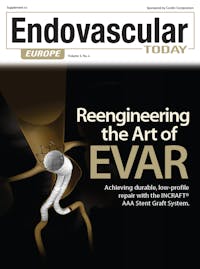
Europe August 2014 Supplement
Sponsored by Cordis Corporation
Innovation Without Compromise: The INCRAFT® AAA Stent Graft System
Clinical results driven by the refined features of a new device.
Since the first endovascular aneurysm repair (EVAR) was described by Parodi et al,1 continued improvements have been made to stent graft design. EVAR has been shown as a safe alternative to open surgery for the treatment of abdominal aortic aneurysms (AAAs), with reduced early morbidity and mortality rates.
The EUROSTAR registry reports that the rate of secondary interventions and conversions is relatively high,2 and the incidence of early open conversion after EVAR is mainly linked to technical misadventure, such as iliac calcification or tortuosity, technical failure during stent graft deployment, or immediate postprocedure graft thrombosis.3
To overcome the current limitations, manufacturers introduced new technologies to improve durability and modifications to constrain the devices in lower-profile delivery systems. Unfortunately, the balance between profile and performance is not easy, as demonstrated by some unsuccessful projects that were aborted by industry. In addition, the use of low-profile devices to treat patients with small vascular access was linked to an increased rate of early limb occlusions and thrombosis.4 As an example, clinical experience has reported an 11% rate of stenosis and a 2% rate of occlusions with recent devices (eg, Endurant, Medtronic, Inc.).5
Despite the progress, EVAR remains challenging in patients with small (< 10 mm), calcific, or tortuous iliac vessels, as well as in patients with hostile proximal aortic neck (< 15 mm) anatomy; this group represents 70% of the entire AAA population.6
The balance between innovations and the need for proven data can be challenging, too, and early promises should be supported by mid- to long-term follow-up.
AN INNOVATIVE TECHNOLOGY WITH STRONG CLINICAL DATA
The INCRAFT® AAA Stent Graft System (Cordis Corporation) (Figure 1) is an advanced EVAR technology now available for the treatment of infrarenal abdominal aneurysms. This system is the result of a long engineering history.
The INCRAFT® System is designed to address the unmet needs of current endografts by combining unique features and new refinements to existing endografts.
For the first time, a stent graft system was conceived together with its delivery system, which allows the device to be delivered through a flexible and ultra-low-profile system (equivalent to a 12-F sheath introducer for the iliac limb delivery system). The INCRAFT® System was designed to allow for increased packing efficiency without compromising on durability.7 The remarkable radial force and flexibility of the INCRAFT® System make it conformable in challenging anatomies such as tortuous iliac arteries.
INNOVATION Trial
It is important that when a groundbreaking device is brought to market, it is backed up with solid data on midterm clinical results. S. Raffaele Hospital (Milan, Italy) and Nuovo Ospedale S. Agostino Estense (Modena, Italy) participated as investigational centers in the first study performed with the INCRAFT® System. The INNOVATION Trial is a multicenter, open-label, prospective, nonrandomized study of the first-in-human use of the INCRAFT® System in patients with infrarenal AAAs.8 This trial involves six vascular centers in Germany and Italy, and 60 asymptomatic patients with AAAs were enrolled.
The aim of the INNOVATION Trial is to assess the safety and efficacy of the INCRAFT® System for the management of AAAs. The primary endpoint is technical success and patient safety through 1-month follow-up.* The 1-year safety endpoints include the absence of device- or procedure- related major adverse events, absence of type I, III, or IV endoleaks, and maintenance of device integrity through 1 year of follow-up.
The main inclusion criteria of this study are a proximal neck length of ≥ 15 mm and ≤ 27 mm in diameter, an access vessel large enough to accept the 14-F outer diameter of the delivery catheter, and an aortic bifurcation > 18 mm in diameter.
In Table 1, the key anatomical measurements are reported. Some of the patients enrolled had severe morphologies—in particular, access vessel and aortic bifurcation diameters; 33% of the patients had a bifurcation diameter inferior to 18 mm; and 45% of the patients had access vessel diameters inferior to 7 mm, according to core lab measurements.
Since the first patient was enrolled in 2010, the preliminary data at 30 days8 and the midterm data at 1 year9 are already available, and they are very promising. The rate of technical success at 1 month was 97% (56/58 patients of the original 60 patients who were enrolled) with freedom-from-aneurysm enlargement of 100% up to 1 year and absence of both type I and III endoleaks in all patients at this time point.
These satisfactory results were confirmed at 2-year follow- up.10 At 2-year follow-up, there were no incidences of endoleaks (type I or type III), device- or procedure-related major adverse events (death, QMI, CVA, renal failure), stent graft migrations, or stent fractures. In addition to no incidences of aneurysm sac enlargement, sac regression was observed in 45% of the patients (Figure 2). Despite the high number of patients with severe morphologies, no early limb occlusions were seen in up to 1-year follow-up (Figure 3). One patient did, however, develop a late limb occlusion at day 666 due to sac contraction and limb conformation change. There were two type I endoleaks—one found at 30-day follow-up and one found at 6-month follow-up. Both were resolved before 1-year follow-up after endovascular reintervention. Table 2 shows the summary of the acute and midterm results.
The collection of the 3-year follow-up data is now closed, and the results will be presented soon; in the meantime, the 4-year follow-up visit was performed for some patients, with confirmed motivating results.
INSPIRATION Trial
The next clinical program for the INCRAFT® System was the INSPIRATION Trial, an investigational device exemption study that started in 2012 and enrolled 190 patients in the United States and Japan. At 30 days postprocedure, the INSPIRATION Trial also showed 100% (189/189) freedom from endoleaks (type I, III, IV), and 100% stent graft patency. As in the instructions for use of the product, the inclusion criteria in this trial allowed treatment of necks that were 10 mm in length.
Future Research
With such strong midterm clinical results collected in more than 250 patients across the world, along with extensive benchtop testing, the INCRAFT® System is ready to live up to its promises.
To continue building a strong reputation for the INCRAFT® System, a postmarket study, which will include an additional 150 patients throughout Europe, is currently being set up and is expected to begin enrollment in the coming months.
WHAT AN ULTRA-LOW PROFILE MEANS FOR PHYSICIANS AND PATIENTS
Patients with small, tortuous, calcified access vessels account for 6% to 19% of procedures, as described in various literature.
With an ultra-low-profile device, the applicability of EVAR can be increased over a broader spectrum of the aortoiliac anatomic configurations that are encountered, as well as improve the deliverability of the device for the whole patient population. Access-related complications such as iliac rupture, dissection, and pseudoaneurysm occur in 3% to 13% of cases, and hematoma, infection, and lymphocele occur in 1% to 10% of cases.
For these reasons, the INCRAFT® System must be considered as a new referral in the EVAR technology and should not be intended as a bailout device to be used only in challenging anatomies. The profile is an important added value for all patients with an AAA.
Local anesthesia and an early discharge may be considered when performing EVAR using the INCRAFT® System.
Whether percutaneous access will ultimately be beneficial over open femoral exposure remains to be proven; however, the ultra-low profile of the INCRAFT® System allows the physicians to choose their preferred access approach to practice EVAR.
A NEW “USER-FRIENDLY” TECHNOLOGY
What is notably different with the INCRAFT® System is that it introduces an innovative concept without deviating from an already-proven stent graft approach. The INCRAFT® System is a three-piece modular system made of low-porosity polyester and segmented nitinol stents. During the procedure, surgeons follow very familiar procedural steps, but with a simplified flow, to complete the EVAR procedure without deviating too much from their current standard practice. The integrated sheath, the hydrophilic coating of the shaft, the cap-free fixation release mechanism of the suprarenal stent, and, most importantly, the in situ length adjustment make the procedure easy, fast, and accurate.
SUMMARY
The 2-year data from the INNOVATION Trial confirm excellent results with the INCRAFT® AAA Stent Graft System. This study proves that the technology is designed to overcome the limitations of current stent grafts for the management of AAAs with alleviated concern regarding the technical compromises. With an ultra-low-profile delivery system and the ability to customize the implant during the procedure (thanks to the bilateral in situ length adjustment features and the introduction of partial proximal repositioning), this graft aims for high deliverability and placement accuracy in a durable (Figure 4) and easy-to-use system with broad anatomical coverage.
Prof. Roberto Chiesa, MD, is Chief of the Vascular Surgery Department, Vita-Salute University, IRCCS San Raffaele Scientific Institute in Milan, Italy. He has disclosed no commercial, proprietary, or financial interest in any products or companies described in this article. Dr. Chiesa may be reached at +390226437130; chiesa.roberto@hsr.it.
Prof. Gioachino Coppi, MD, is Chief of the Vascular Surgery Department, University of Modena and Reggio Emilia, Nuovo Ospedale S. Agostino Estense, Baggiovara in Modena, Italy. He has disclosed no commercial, proprietary, or financial interest in any products or companies described in this article. Dr. Coppi may be reached at +390593961225; gioachino.coppi@unimore.it.
- Parodi JC, Palmaz JC, Barone HD. Transfemoral intraluminal graft implantation for abdominal aortic aneurysms. Ann Vasc Surg. 1991;5:491-499.
- Cuypers P, Leheij RJ, Buth J. Which factors increase the risk of conversion to open surgery following endovascular abdominal aortic aneurysm repair? The EUROSTAR collaborators. Eur J Vasc Endovasc Surg. 2000;20:183-189.
- Million A, Deelchand A, Feugier P, et al. Conversion to open repair after endovascular aneurism repair: causes and results. A French multicentric study. Eur J Vasc Endovasc Surg. 2009;38:429-434.
- Carroccio A, Faries PL, Morrissey NJ, et al. Predicting iliac limb occlusions after bifurcated aortic stent grafting: anatomic and device-related causes. J Vasc Surg. 2002;36:679e84.
- Torsello G, Brunkwall JS, Scheinert D. Cordis INCRAFTTM ultra-low profile AAA Stent-Graft System. J Cardiovasc Surg (Torino). 2011;52:661-667.
- Torsello G. Complex anatomy—challenges with current EVAR devices. Presented at: Charing Cross International Symposium; April 2014; London, UK.
- Torsello G, Troisi N, Tessarek J, et al. Endovascular aortic aneurysm repair with the Endurant stent-graft: early and 1-year results from a European multicenter experience. J Vasc Interv Radiol. 2010;21:73-80.
- Scheinert D, Pratesi C, Chiesa R, et al. First-in-human study of the INCRAFT endograft in patients with infrarenal abdominal aortic aneurysms in the INNOVATION trial. J Vasc Surg. 2013;57:906-914.
- Coppi G, Njila M, Coppi G, et al. INCRAFT® Stent-Graft System: one-year outcome of the INNOVATION Trial. J Cardiovascu Surg. 2014;55:51-59.
- Torsello G, Scheinert D, Brunkwall JS, et al. Safety and effectiveness of the INCRAFT AAA Stent Graft for endovascular repair of abdominal aortic aneurysms. J Vasc Surg. 2014 July 19. [Epub ahead of print]
*Technical success will be defined by the successful deployment of the stent-graft to the desired location in the absence of type I, III or IV endoleaks at the conclusion of the procedure. Safety will be defined by the absence of type I, III, or IV endoleaks and device- and/or procedural-related major adverse events (death, MI, stroke, and renal failure) within 1 month post-procedure.
Durability and long-term data of the INCRAFT® AAA Stent Graft System are based on 2-year clinical follow-up and benchtop data.
Advertisement
Advertisement