Advertisement
Advertisement
July 2015
The Best Answers Come From the Hardest Questions . . . So Keep Asking ‘Em

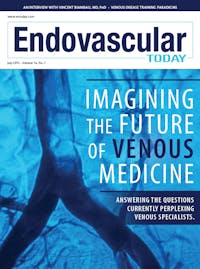
In all of our efforts to improve venous patient care, the most exciting moments are when we imagine the future. “People used to have painful swollen legs for years after their DVT . . . We used to have to reopen stents every few years, glad that’s history . . . I had a PE years ago, but I feel fine today . . . They did that procedure, and my ulcer went away for good . . . My area of specialization is venous disease.”
In this issue, we imagine a future where venous medicine is evidence-based medicine that boldly pushes ahead and asks hard questions, even when they provoke. To begin, Cees Wittens, MD, and Maaike J. De Geus, MD, summarize the evidence from state-of-the-art trials on acute DVT therapy and anticipate the post-CAVA, post-ATTRACT future. Constantino S. Peña, MD; Ripal T. Gandhi, MD; and James F. Benenati, MD, boldly envision a future where fibrinolytic drugs are history, tantalizing us with cases in which new mechanical thrombectomy devices provided effective therapy. Peter Henke, MD, breaks down the biology of postthrombotic syndrome and hints at future targets for innovative therapies.
With the publication of trials on catheter-directed thrombolysis in the last few years, submassive pulmonary embolism has become an increasingly hot—and controversial—topic. Akhilesh K. Sista, MD, describes how we must reinvent our ideas of how an ideal clinical trial for new PE therapies should look.
Next, we spoke with Gerard O’Sullivan, MD, on current trends in venous stenting—when to turn to this option, nuances in placement and imaging, and what’s on the horizon for more sophisticated devices, training, and formal guidelines.
Men get congested gonads too . . . but, unlike women, they don’t have to worry about carriers denying coverage for indicated venous embolization procedures. Outraged? Neil M. Khilnani, MD, and Melvin Rosenblatt, MD, explore how this double standard can continue even as the evidence for treating pelvic congestion syndrome improves.
Next, Chieh-Min Fan, MD, addresses an area of particular challenge for many venous providers—when to ablate a refluxing perforator vein.
Finally, Steven E. Zimmet, MD, and Anthony J. Comerota, MD, discuss improvements to venous disease training. Crucial gaps remain—are bolder steps needed?
It’s been a pleasure assisting with this issue of Endovascular Today, and I hope you enjoy it. Step by step, we move toward a brighter future where evidence-based, multidisciplinary venous disease care is the norm. I’m ready now!
Suresh Vedantham, MD
Guest Chief Medical Editor
Advertisement
Advertisement