Advertisement
Advertisement
April 2020 Supplement
Sponsored by Guerbet
Selective Liver Embolization in Unresectable, Multifocal Hepatocellular Carcinoma
CASE SUMMARY
A 64-year-old man was referred to the hepatobiliary multidisciplinary team (MDT). He had a known diagnosis of liver cirrhosis and presented with right upper quadrant pain, Child-Pugh A, and an ECOG (Eastern Cooperative Oncology Group) score of 1. His past medical history included type 2 diabetes mellitus, hypertensive heart disease, myocardial infarction, and multiple other comorbidities, including anemia. Initial investigations included abdominal ultrasound (US), liver function tests, and alpha-fetoprotein tests, followed by contrast-enhanced CT and US-guided liver biopsy.
After completing the investigations, CT revealed multifocal hepatocellular carcinoma (HCC) with two lesions in the right lobe of the liver (Figure 1 and Figure 2). The largest lesion in segment 8 measured 6.8 cm, and a second smaller lesion in segment 6 measured 4.3 cm. Both lesions showed avid arterial enhancement and washout. Biopsy of the largest lesion confirmed a diagnosis of HCC.
DIAGNOSIS
Multifocal HCC
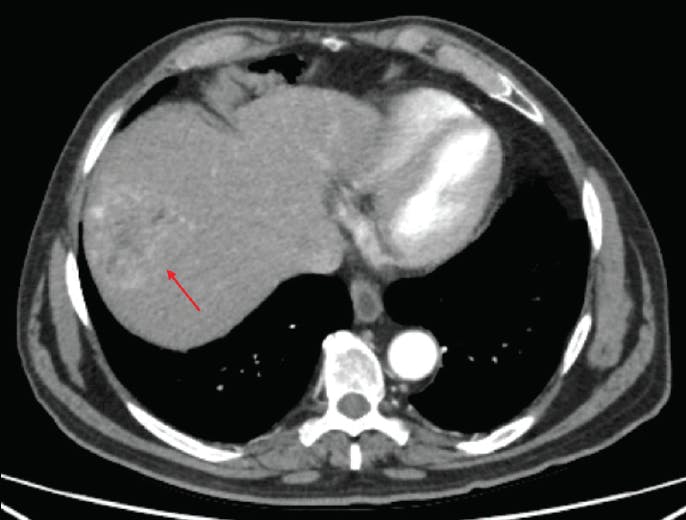
Figure 1. Enhancing HCC in segment 8, measuring 6.8 cm (arrow).
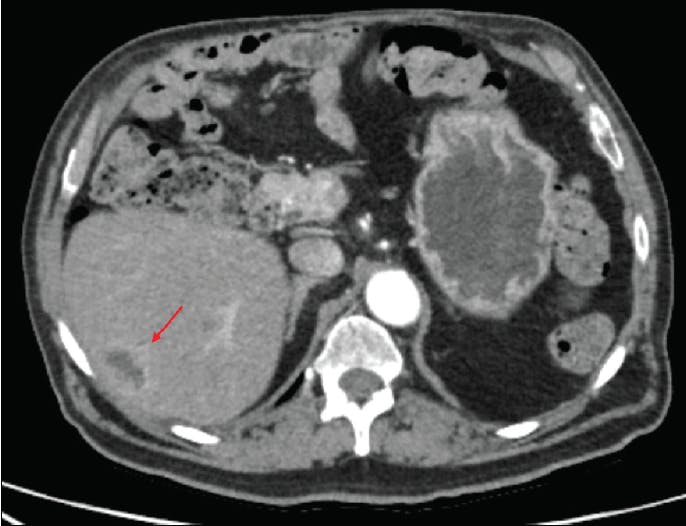
Figure 2. Enhancing HCC in segment 6, measuring 4.3 cm (arrow).
TREATMENT OPTIONS
The patient was not suitable for surgical resection due to the location of the lesions, concerns over future liver volume, and significant comorbidities. Microwave ablation was considered but excluded due to the lesion size. Per our normal institutional policy and the MDT discussion, the patient was referred for transarterial chemoembolization (TACE).
COURSE OF TREATMENT
After the MDT meeting, the patient was scheduled for TACE within 4 weeks. After written informed consent, he was brought into the interventional radiology suite and placed in a supine position. The right groin was prepped and draped, and 10 mL of lidocaine (1%) was administered. US-guided puncture of the right common femoral artery was performed using an 18-gauge needle. A wire was placed, followed by a 4-Fr vascular sheath. The hepatic artery was replaced off the superior mesenteric artery and accessed using a 4-Fr C2 Cobra catheter (Cordis, a Cardinal Health company). Angiography was performed, showing faintly enhanced areas corresponding to the HCCs (Figure 3). A 2.4-Fr SeQure® microcatheter (Guerbet) and a Fathom 0.016-inch guidewire (Boston Scientific Corporation) were used to navigate a tortuous right hepatic artery into the branch supplying both HCCs (Figure 4). Rotational CT was performed, confirming satisfactory coverage of both tumors. The vessel was then embolized to stasis using 75-mg doxorubicin loaded onto 100–300-µm DC Beads (Boston Scientific Corporation) mixed with contrast. Flow-directed embolization was observed with no reflux seen.
Hemostasis was achieved using manual compression, and the patient was discharged home the next day.
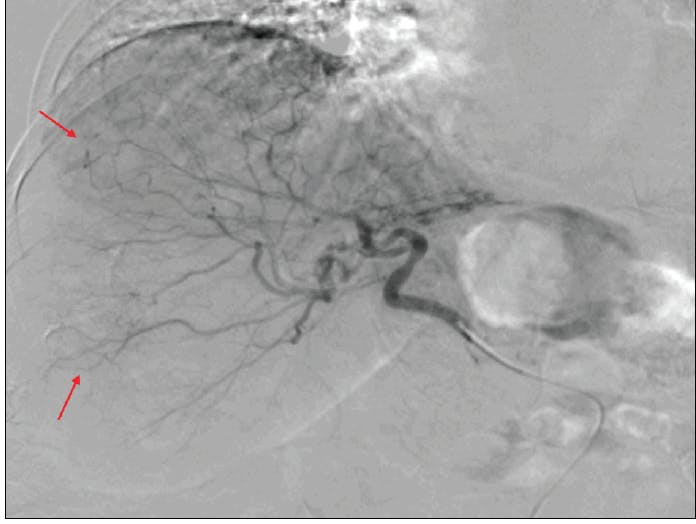
Figure 3. Angiogram showing a C2 Cobra catheter in the replaced hepatic artery and a faint enhancement of the HCCs (arrows).
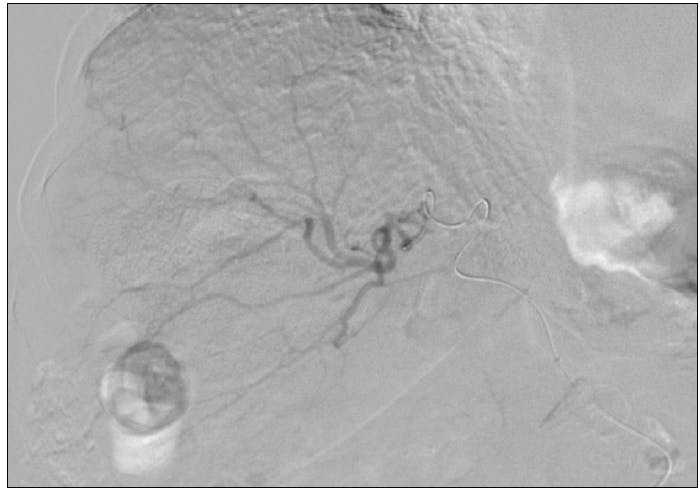
Figure 4. Angiogram showing the SeQure® microcatheter through the tortuous right hepatic artery branches in a distal branch, which was shown to supply both HCCs on rotational CT.
RESULTS
The patient had an uneventful recovery period and was followed up per institutional policy with contrast-enhanced CT at 4 weeks, followed by a review in clinic. The CT showed a complete response in both lesions. No further enhancement of the two HCCs was seen; the segment 8 lesion decreased in size to 3.8 cm and the segment 6 lesion decreased to 1.8 cm (Figure 5). Normal appearance of the liver was observed, with no evidence of any treatment complications and, specifically, no evidence of any nontarget embolization.
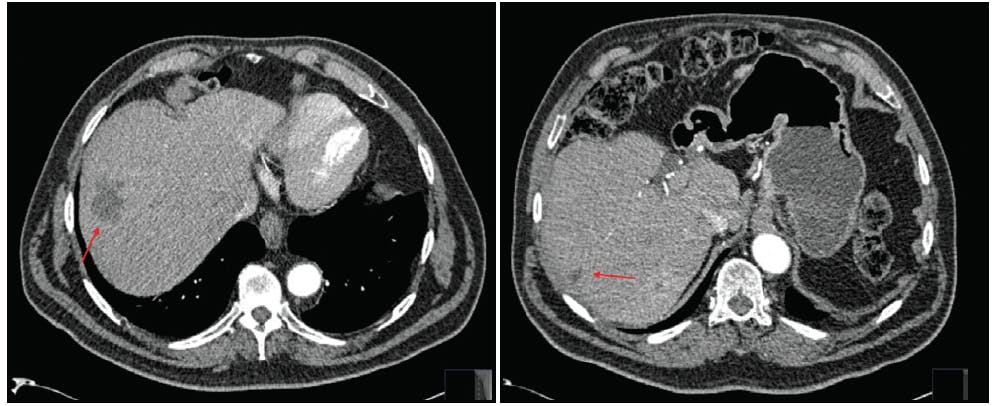
Figure 5. CT showing complete response in both lesions, with no arterial enhancement and significant reduction in size. No evidence of nontarget embolization is noted.
DISCUSSION
Microcatheters designed for embolization in the liver must have the flexibility and pushability to navigate often tortuous hepatic vessels to obtain distal positions and treat lesions as selectively as possible. The SeQure® microcatheter tip design allows reflux control and reduces the risk of nontarget embolization and potential significant complications (eg, cholecystitis, gastric/duodenal injury, biliary ischemia). SeQure® lumen diameters are adequate to allow administration of microspheres and varying sizes containing chemotherapy without blockage. This case highlights these important features and shows good safety and usability of the SeQure® microcatheter in liver embolization. Further studies will be required to test the microcatheter in other settings and indications.
Results from case studies are not necessarily predictive of results in other cases. Results in other cases may vary.
P20000019
Advertisement
Advertisement