Advertisement
Advertisement
April 2020 Supplement
Sponsored by Guerbet
Transarterial Chemoembolization With the SeQure® Microcatheter*
By Pedro Pardo Moreno, MD, PhD; Gonzalo Ruíz Villaverde, MD, PhD; and Juan José Ciampi-Dopazo, MD, EBIR
CASE PRESENTATION
A 61-year-old man with a medical history of ethylic cirrhosis underwent routine surveillance in the hepatology clinic. He had a microwave ablation 4 months previously for a 3.1-cm focal hepatocellular carcinoma.
Further workup revealed an aspartate aminotransferase level of 65 U/L (normal, 0–39 U/L), an alanine aminotransferase level of 60 U/L (normal, 7–41 U/L), an alkaline phosphatase level of 85 U/L, a total bilirubin level of 1.2 mg/dL, negative hepatitis serology, normal renal function, and an alpha-fetoprotein level of 11 µg/L. Abdominal CT and MRI demonstrated multiple liver lesions, with a dominant 55-mm lesion in segment 6 showing significant growth.
The multidisciplinary liver tumor board consensus was a recommendation for transarterial chemoembolization (intermediate-stage patient, according to Barcelona Clinic Liver Cancer stage B) to limit disease progression, with the potential for downstaging and consideration of liver transplant in the future.
PROCEDURAL OVERVIEW
Right femoral access was achieved through a 5-Fr introducer sheath. Using a combination of a 5-Fr C2 Glidecath catheter (Terumo Europe) and a 0.035-inch hydrophilic guidewire, the celiac trunk and the proper hepatic artery were catheterized. Angiography was then performed, and the nutrient vessels of the dominant lesion in segment 6 were visualized (Figure 1). Subsequently, a 2.8-Fr SeQure® microcatheter (Guerbet) was advanced to the right hepatic artery branch over a 0.014-inch guidewire, irrigating the target lesion in segment 6. Mixed preparation of embolic materials consisted of 7 mL of iodinated contrast and 5 mL of saline loaded with 100–300-µm and 300–500-µm DC Beads (Boston Scientific Corporation). The total amount of administered doxorubicin was 150 mg. The target artery was embolized with approximately 11 mL of the DC Bead mixture until blood stasis was observed. The DC Beads/contrast mixture injection could be controlled by observing the contrast reflux with the proximal radiopaque marker of the SeQure® microcatheter (Figure 2). Complete occlusion of the branches responsible for tumor irrigation was achieved (Figure 3).
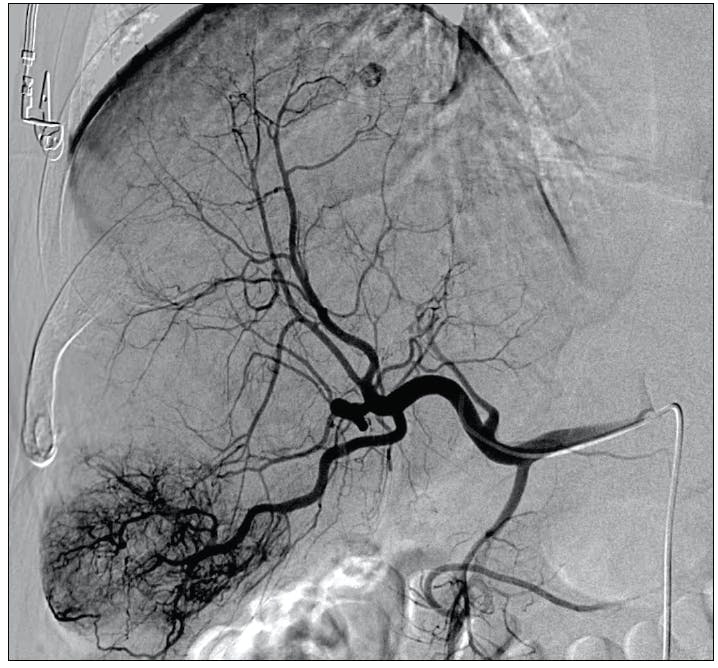
Figure 1. Hepatic artery angiogram demonstrating the dominant hepatocellular carcinoma lesion in segment 6.
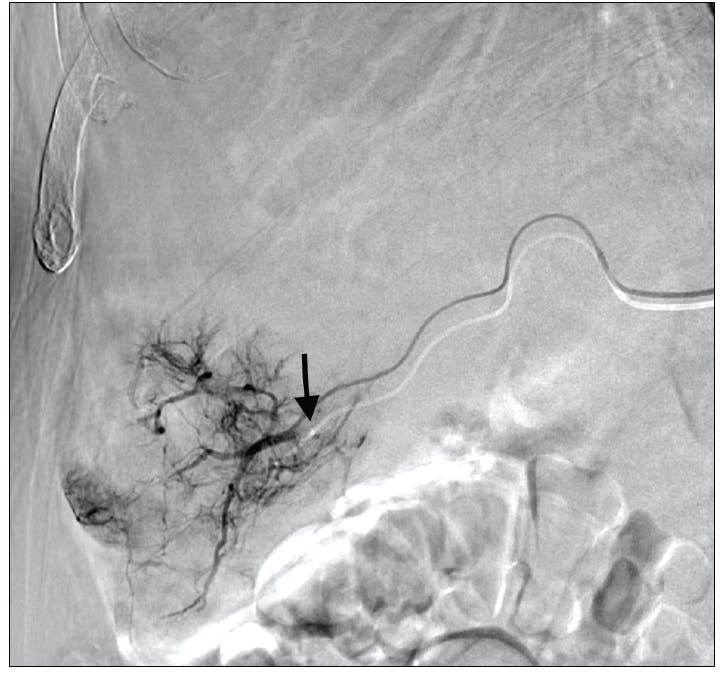
Figure 2. A 2.8-Fr SeQure® microcatheter was advanced to the feeding tumoral artery, and embolization was performed without occlusion of the other right segmental arteries. The black arrow shows the microcatheter’s proximal radiopaque mark.
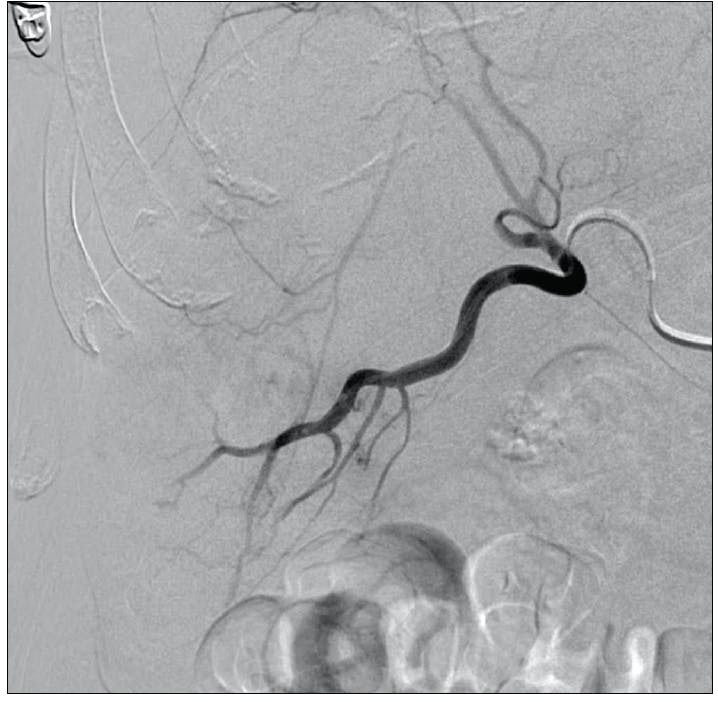
Figure 3. After embolization, there was no further flow into the tumoral branch vessel, and arterial flow into other segmental nontarget branches was preserved.
There were no immediate complications and no inadvertent/nontarget embolization of other right segmental arteries. The patient was discharged after 48 hours, without postembolization syndrome.
DISCUSSION
The radiopaque marker located at the tip allows for the correct positioning of the SeQure® microcatheter. The side holes, which are located proximal to the radiopaque marker, allow for reflux of only iodinated contrast, not embolic beads. This reduces the risk of reflux and avoids embolization of undesired vascular territories.
Our experience with this device demonstrates the correct target embolization and helps decrease inadvertent complications.
*As per IFU, for guiding catheters, the SeQure® microcatheter is recommended for use with minimum 0.038-inch guidewire compatible.
Results from case studies are not necessarily predictive of results in other cases. Results in other cases may vary.
P20000020
Advertisement
Advertisement