Advertisement
Advertisement
August 2020 Supplement
Sponsored by Silk Road Medical
The Cadence of the TCAR Procedure

In simplest terms, a cadence is defined as a rhythmic sequence. Within a medical therapeutic environment, a cadence refers to the frequency, format, and sequence with which a manager/operator meets with the individuals on their team to achieve common goals, teach all aspects of the intervention, and define the attributes of the interaction to ensure satisfactory results. With the transcarotid artery revascularization (TCAR) procedure, the team’s common goal is to efficiently reduce the risk of procedural and long-term stroke compared to best medical therapy. This efficiency is optimally displayed in the procedural speed, fluidity, team confidence, and the perioperative and long-term results of the intervention.
Attaining optimal cadence for the TCAR procedure can be divided into multiple areas of consideration. These include (1) the preoperative evaluation of the patient and relevant noninvasive imaging to have a good understanding of what is being treated and how to approach the lesion in question, (2) the preoperative teaching of staff for their important role as a therapeutic team member and having appropriate equipment available, (3) the preoperative/intraoperative teaching of anesthesia staff and their very important role in the successful outcome of the procedure with their hematologic and physiologic assistance, and (4) the combined efficient completion of the procedure by the entire team and the importance of this for a successful short and long-term outcome for the mutual satisfaction of the patient and operator.
PREOPERATIVE EVALUATION
The preoperative evaluation will typically first focus on the indication for a carotid intervention based on the patient’s history, examination, and carotid duplex. If the patient appears to be a good candidate for the TCAR procedure, a CTA examination will typically be performed. The combination of the duplex and CTA will offer information of the quality of the arch inflow; the length, diameter, and quality relationships of the common carotid artery; the procedural considerations for the lesion being treated (quality of the plaque and the wire crossability of the lesion); and the quality of collateral flow intracranially for flow reversal. This information is critical to placement of the arterial access sheath, optimal angle of therapeutic imaging, sizing of percutaneous transluminal angioplasty (PTA) predilatation, and sizing of stent. All this information should be considered prior to going to the operating room. All sizing choices regarding PTA balloons and stents should be made preoperatively and not intraoperatively.
PREOPERATIVE TEACHING OF STAFF
The preoperative teaching of staff must ensure that all equipment is available for the procedure. This will include the intraoperative ultrasound, appropriate drapes for the access sites, ACT machine and cuvettes, heparin dosing, separate micropuncture kit for venous access, proprietary Silk Road Medical flow reversal kits, and an adequate selection of 0.014-inch access wires, PTA monorail balloons, and stents. The operative staff will typically have experience with 0.035-inch wires and over-the-wire systems for aortic endografting. However, they may have little understanding of monorail 0.014-inch systems. They should be instructed on the fundamentals of monorails systems and the length relationships of the arterial sheath (33 cm from tip to diaphragm) and of the monorails balloons/stents (22 cm from tip to wire exit). The entire team should also understand the absolute importance of the depth of the wire relationships. The 0.035-inch J-wire needs deliberate placement—either short (just below the lesion) or long (well into the external carotid artery) as the lesion being treated allows. Furthermore, once the lesion is crossed with the therapeutic 0.014-inch wire, there should be a good understanding of the depth of position of this wire to maintain access but not cause intracranial complication. The goal should be to maintain the weld-point junction at the base of the skull, with the floppy platinum portion in the petrous portion of the internal carotid and the stiff portion in treated cervical carotid.
PREOPERATIVE/INTRAOPERATIVE TEACHING OF ANESTHESIA STAFF
It is essential to ensure the preoperative teaching of the anesthesia staff regarding the importance of an arterial blood pressure line in the appropriate extremity for reliable continuous measurement of central arterial pressure. Their role in the maintenance of adequate rate/blood pressure product (rate > 70 and blood pressure > 140-160/70) is essential to flow reversal. They need to understand that heparin needs to be given at the time of the neck incision to avoid procedural delay. Also, we frequently give glycopyrolate prior to carotid manipulation to support heart rate. Approximately 3 minutes after heparin administration, an ACT should be checked. The ACT goal should be > 250 seconds at the time of carotid intervention. When the procedure is completed, protamine should be given due to the short length of the procedure. There are ample data that this will lower the bleeding rate but not adversely affect the stroke rate. A test dose of protamine should be given first and then the therapeutic ½ reversal dose relative to the amount of heparin given.
EFFICIENT COMPLETION OF THE PROCEDURE
If these first three categories are well understood and taught to all team members, the efficient completion of the case is likely. During proctoring experiences that we have witnessed, the main limitation of efficient and successful outcome falls short when these foundational minimums have not been addressed.
Once the patient is prepared and draped, intraoperative ultrasound should be used for the following four reasons.
Reason 1. The accuracy of venous puncture in the groin is improved. If patients are obese, the early saphenous vein can be punctured and used as a safer more superficial site of venous access. The tip of the 8-F venous sheath will still be in the external iliac vein for optimal reversal flow.
Reason 2. The position of the carotid can be marked on the skin relative to the clavicle and window between the sternocleidomastoid heads. Confidence is gained from observing the relationship of the carotid to the jugular and the musculoskeletal landmarks. I find this helpful for operators’ early cases, especially on the left side where the artery is deeper.
Reason 3. Examine the site of sheath entry for a quick recheck for any calcification and overall quality of artery.
Reason 4. Assess the carotid bifurcation with the patient in the surgical position to predict the best orthogonal angle of imaging. This facilitates obtaining a best-quality digital subtraction angiography (DSA) and avoids unnecessary multiple injections to find this angle.
The efficient steps of optimal imaging are as follows. We typically perform five DSA runs to do the TCAR procedure. Each of these is performed with 3-5 mL of half-strength contrast. The assistants/technicians for the procedure need to understand that the contrast syringes need to be drawn up gently so that air is not sonicated in the contrast. We typically draw up our five syringes early and let them lay on the field so that any microbubbles can come out of solution prior to use.
DSA 1. An initial arterial micropuncture image needs to be obtained in a plane perpendicular to the carotid bifurcation and is determined by the preoperative ultrasound. This image will guide the insertion of the 0.035-inch J-wire for placement of the arterial sheath.
DSA 2. Once the arterial sheath is placed, the opposite orthogonal view will show the relationship of the sheath tip to the back wall of the common carotid artery to be sure that the arterial access is uncomplicated.
DSA 3. An ipsilateral oblique working view with the image intensifier close to the patient will show the treatment site from the tip of the sheath to the base of the skull with the bifurcation profiled to ease lesion crossing of the working 0.014-inch wire.
DSA 4 and 5. Bi-plane completion views after PTA and stenting to be sure the stent is fully opened and no complications are noted.
A helpful hint is that once the stent is deployed and we are waiting the mandatory reversal time for clearance of possible debris, orthogonal noncontrast images of the stent can be taken to see if the stent is fully opened. If needed, larger poststent PTA balloons can be selected, prepared, and deployed. This is needed in only approximately 5% of cases.
Another very important consideration is the appropriate shaping of the 0.014-inch working wire. The operator needs to consider the bias of the arterial sheath relative to the axis of the common carotid artery and how that will affect the delivery of the wire from the sheath toward the lesion being crossed. Furthermore, the actual course of the true lumen through the lesion needs to be assessed to properly shape the wire tip for a highly successful first attempt at lesion crossing.
When these tenants are followed, we typically find that flow reversal times are < 7-8 minutes and total procedural times are < 60 minutes. This can easily occur with no one feeling rushed. The cadence of the procedural completion occurs in a relaxed and successful team environment.
TCAR Cadence in the Carolinas

As has been discussed, the cadence and understanding of a procedure is paramount to maximizing the preferred outcomes while implementing it through the group to increase efficiency and improve quality. I certainly agree with all of Dr. Massop’s thoughts as well as his methodology for completing TCAR, with a few minor caveats.
OUR EXPERIENCE
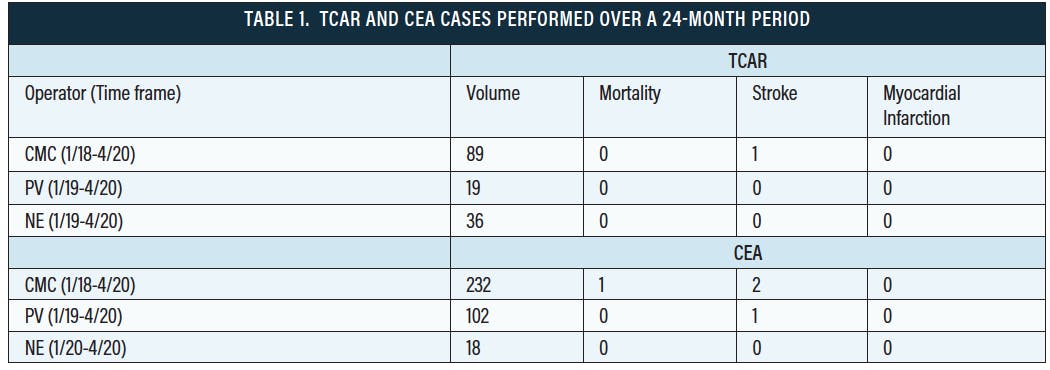
A brief history of our TCAR procedure is helpful in understanding where we were and how we got to where we wanted to be, and will enlighten the reader to any potential learning curves, as well as how to navigate any potential credentialing issues that may be roadblocks. Our initial experience was part of the ROADSTER 2 trial, as well as the enrollment in the Vascular Quality Initiative. The standard proctoring as part of the ROADSTER 2 trial was the initial experience for learning TCAR. I had at the time full credentials for transfemoral carotid stenting. Three different proctors were utilized during the initial phase in of the trial. Each proctor had a different cadence and steps for the procedure and each one was successful. After this roll in phase, I then proctored those in the group as part of the trial. Our group consisted of three surgeons at the time with transfemoral carotid artery stenting (CAS) privileges. Credentialing required a total of 20 CAS as the primary or assistant operator, with 10 as the primary surgeon. During introduction of TCAR to our group of surgeons, we had three with CAS privileges. With a total of 10 surgeons in the group we wanted to train each surgeon who had a robust carotid practice. Thus, we had to train a total of seven surgeons. Over the 4 year period, we have trained all of them but one, who is just four procedures short of getting full credentials. The reason for training all was due to the fact that each surgeon in the group had a robust carotid practice, and we believed that this was a procedure that was safe, effective, and important in the management of certain patients with carotid disease. Over a 4-year period, six of the seven were trained and credentialed, with the last one very close, and most have adopted a single method of doing the procedure. We believed that adopting a single method was important as we have nearly standardized our methodology for CEA as well to reduce variance. Table 1 shows the number of cases of TCAR and CEA performed by our group over a 24-month time frame, demonstrating the location and outcomes at three hospitals of varying size (300 to 1,000 beds) for both asymptomatic and symptomatic patients (not separated).
Dr. Massop lists these four criteria to obtain optimal cadence for TCAR and I wholeheartedly agree: (1) the preoperative evaluation of the patient and relevant noninvasive imaging to have a good understanding of what is being treated and how to approach the lesion in question, (2) the preoperative teaching of staff for their important role as a therapeutic team member and having appropriate equipment available, (3) the preoperative/intraoperative teaching of anesthesia staff and their very important role in the successful outcome of the procedure with their hematologic and physiologic assistance, and (4) the combined efficient completion of the procedure by the entire team and the importance of this for a successful short and long-term outcome for the mutual satisfaction of the patient and operator.
OUR TCAR PROCEDURE
Our preoperative evaluation of the patient includes appropriate noninvasive imaging, as well as CTA of the head and neck to look at both the characteristics of the lesion and the access vessel of the carotid, as well as the intracranial circulation. Preoperative medications for TCAR are standardized across the group with protocols, including a high-dose statin if the patient is not currently on statin therapy as well as dual antiplatelet therapy with aspirin and clopidogrel. Our preference is for 7 days of clopidogrel therapy prior to the procedure. We also agree with the pre-decision planning with review of the preoperative CTA. Based on the CTA, the size of the balloon is determined, as well as the size and length of the stent that will be used. We no longer use ultrasound prior to intervention in the operating room because it adds time and does not offer anything over the preoperative CTA.
We continue to perform all cases under general anesthesia, with patients receiving an arterial line but we do not use a Foley catheter. All patients are premedicated at the start of the procedure with glycopyrrolate if there are no contraindications. We use a small longitudinal incision just above the clavicle. The carotid is dissected out and encircled with a vessel loop. The patient is systemically anticoagulated with 100 U/kg of heparin while simultaneously gaining venous access under ultrasound guidance. The sheath is then flushed. Concurrently, we aim for a mean arterial pressure of 100 mm Hg or a systolic pressure of ≥150 mm Hg. We do not place a Prolene suture (Johnson & Johnson) prior to accessing the carotid artery. Because every procedure is performed similarly, the anesthesia team, as well as the operating room team and our cardiac catheterization team, are simultaneously doing their respective portions of the procedure.
Preoperative teaching of the anesthesia team, operating room team, and catheterization lab team has been instituted in the past but even prior to the procedure a team huddle is utilized to go over the steps, including the hemodynamics and the sizes of the balloons and stents to be chosen. The stent and balloon are opened for predilatation and the wire of choice is preloaded onto the rapid exchange balloon, simultaneous to the cutdown and the venous access sheath.
The carotid artery is then accessed with the micropuncture set. Arteriography is then performed. We use only a single plane and the angle chosen is again based on the preoperative imaging. We do not do two-plane angiography to assess for dissection because we believe our technique has improved since the very early learning curve that we no longer have dissection.
We mark the bifurcation and typically use the stiff wire to land short of the bifurcation. We always predilate entry into the carotid with venous sheath dilator. We then place the flow reversal catheter, suture it in, and place the proximal clamp. We always use high flow on the reversal and flow reversal is evaluated and confirmed prior to crossing. We do use cerebral oximetry during the case and most patients with flow reversal have had little change in their oximetry. The predilatation balloon is loaded with wire and the combination are advanced to just below the lesion. Arteriography with roadmapping is performed and any adjustments to gantry angle are made at this time. The 0.014-inch wire used to cross the lesion varies among operators but all use a 190-cm wire with appropriate shaping based on the arteriogram. Careful evaluation of the depth of the wire is assessed and maintained through the case. Once the lesion is crossed, the balloon is advanced to the lesion and the lesion is predilated. The balloon is removed and the chosen stent is advanced to the lesion and deployed. Final angiography is performed and any postdilation is decided upon at that point.
Once we complete the procedure, we shut off the flow reversal and we return any blood back through the venous sheath. The operating room team moves to the incision, the access sheath is removed, the carotid is allowed to back bleed out of the arteriotomy, the artery is controlled, and two interrupted 5-0 Prolene sutures are placed and the arteriotomy is closed after appropriate flushing of the vessels. Protamine is used for reversal and the venous sheath is removed simultaneously. After hemostasis is achieved, the wound is closed. Patients are awakened in the operating room, neurologically assessed, and sent to the postanesthesia care unit and then to a telemetry bed. Patients are typically discharged the next day.
SUMMARY
By utilizing a standard protocol, being comfortable with the steps and the preprocedure imaging, teaching and allowing team members to do their part of the procedures, avoiding the use of indwelling urinary catheters, and premedication with heparin and glycopyrrolate, we have significantly reduced our procedural time. Most are performed in well under 60 minutes, with flow reversal times under 10 minutes in nearly all patients treated throughout a large health system in the western Carolinas. This method has allowed us to rapidly spread the technology throughout the system while maintaining the excellent results we achieved at the main quaternary hospital.
Advertisement
Advertisement