Advertisement
Advertisement
July 2020 Supplement
Sponsored by The PERT Consortium®
COVID-19 and VTE: What We Know and What We Don’t Know
A review of what is currently known about the role of inflammation, markers of disease in coagulation studies, pathologic and clinical evidence of thrombosis, and the approach to anticoagulation of COVID-positive hospitalized patients.
By Oren A. Friedman, MD; Eugene Yuriditsky, MD; and James Horowitz, MD, FACC
In December 2019, an outbreak of novel coronavirus SARS-CoV-2, subsequently termed COVID-19, led to a global pandemic. At the time of this writing, more than 7.2 million cases and 411,000 deaths have been reported worldwide, with nearly 2 million cases and over 110,000 deaths in the United States.1 Reports in the United States suggest a high intensive care unit (ICU) mortality and a stressed health care system.2,3 It was soon recognized that the virus can manifest with high levels of inflammation, abnormal coagulation studies, pathologic evidence of microvascular thrombosis, and clinical evidence of large vessel thrombosis.
ROLE OF INFLAMMATION
SARS-CoV-2 infection is characterized by a high inflammatory state associated with elevated C-reactive protein, erythrocyte sedimentation rate, fibrinogen, and interleukin (IL)-6 levels.4 The inflammation plays an integral role in the pathology of the virus, and many anti-inflammatory and immunomodulatory treatments including IL-6 inhibitors, hydroxychloroquine, and JAK inhibitors have been used. In fact, higher levels of proinflammatory cytokines have been associated with worse disease.5 Inflammation and coagulation are intricately linked at an evolutionary level, and disseminated intravascular coagulation, sepsis-induced coagulopathy, and deep vein thrombosis (DVT) are common in the highly inflamed states of severe infection.6 Inflammation and its subsequent effects on coagulation are therefore not unique to COVID-19, but there is evidence that the degree of hypercoagulability in COVID-19 may warrant a different therapeutic approach. It is likely that the unique phenotype of inflammatory storm with COVID-19 will lead to a similarly unique coagulation profile.
LABORATORY CLOTTING STUDIES
The coagulation profile in COVID-19 typically reveals a normal prothrombin time (PT), international normalized ratio (INR), partial thromboplastin time (PTT), platelet count, and elevated fibrinogen and D-dimer levels. A classic disseminated intravascular coagulopathy pattern is rare. There is a link between elevated D-dimer and mortality. In a large study of 1,099 COVID-19 patients from > 550 hospitals in China, D-dimer was found to predict severe illness and mortality.7 In response, many have advocated for serially trending D-dimer as a marker of disease and even to guide clinical decisions about anticoagulation or anti-inflammatory treatment.
Thrombocytopenia is less common with COVID-19, although one large meta-analysis of nine studies found that it was more common in patients with severe disease.8 Elevated von Willebrand factor and factor VIII levels have also been described. The presence of antiphospholipid (APL) antibodies may be common, with one multicenter trial finding positive results in 50 of 57 patients who were tested.9 However, the clinical implications of APL antibodies are not clear, as their presence can be seen in active infections, and the diagnosis of APL syndrome requires repeated positive results over time.
Thromboelastography (TEG) has been increasingly used in various clinical scenarios and may be a better tool to characterize clotting activity than traditional laboratory assays. TEG also allows separation of heparin effect with the use of heparinase assays. In a small cohort study of 20 critically ill COVID-19 patients, 19 of 20 had hypercoagulable TEG results, and elevated maximal amplitude (MA) on TEG conferred 100% sensitivity for thrombotic results. The MA on TEG was a better predictor of thrombosis than PT, INR, PTT, or platelet levels.10 In a study of critically ill patients with COVID-19, Yuriditsky et al found a large proportion to have hypercoagulable TEG profiles. Parameters related both to coagulation factors, as well as fibrinogen and platelet function (MA) were commonly deranged.11
PATHOLOGIC EVIDENCE OF CLOT
Despite the high worldwide death rate with COVID-19, there are relatively few autopsy studies. Examining the limited COVID-19 autopsy case series, several found microvascular thrombosis, including fibrinous thrombi in small pulmonary arterioles and an increased amount of megakaryocytes on pulmonary pathology.12,13 Similarly, a series from Italy found fibrin thrombi in small arterial vessels in 87% of autopsies.14 Another small series from New York found microvascular thrombosis as well as endothelial injury and complement deposition in lung and skin biopsies.15 This series was notable in that it demonstrated a vascular tropism of the virus in more than one organ and also raised the possibility that complement deposition may contribute to the vascular injury pattern.
CLINICAL EVIDENCE OF THROMBOSIS
In addition to pathologic evidence of small vessel thrombosis, an even larger number of studies have identified clinically relevant large vessel thrombosis. A single center in Lille, France, noted a higher than expected number of patients with pulmonary embolism (PE) in their first consecutive 107 patients. They compared the COVID-19 patients to a matched cohort of influenza patients from 2019 and found PE was more frequent (20.6% vs 7.5%).16 A small study of 26 critically ill COVID-19 patients on either prophylactic or therapeutic anticoagulation found a very high rate of thromboembolic events (69%; 18 DVT and 6 PE). They performed systematic screening with ultrasound and CTA for unexplained respiratory failure, which may have impacted the high percentages.17 A single French center reviewed 34 ICU patients on mechanical ventilation due to COVID-19. They similarly screened all patients for DVT and found 65% had DVT on admission and 79% after 48 hours.18
A multicenter cohort study of 184 patients in the Netherlands found a 31% cumulative incidence of thrombosis, including 25 PEs and three arterial thromboses. All patients were receiving prophylaxis. The authors recommended higher doses of anticoagulation prophylaxis based on their findings.19 Another multicenter prospective study from four French ICUs analyzed 150 COVID-19 patients with acute respiratory distress syndrome, finding 64 clinically relevant thrombotic complications. PE predominated, but ischemic strokes and clotting of renal replacement therapy were also common.9
The totality of these aforementioned findings suggests COVID-19 is associated with a high percentage of venous thromboembolism (VTE), but it is important to recognize that VTE is common in critically ill patients in general. Indeed, one study found a 29% rate of PE in critically ill patients sent for CTA.20 Noncritically ill patients hospitalized with pneumonia also have an elevated risk for VTE related to active infection, immobility, and an elevated inflammatory state. Additional risk factors including age, obesity, cancer, heart failure, and prior history of VTE. Obesity is of interest, as it has been linked to severe disease with COVID-19.2,21 Irrespective of COVID-19, a dose of enoxaparin 40 mg subcutaneously twice daily has been shown to be superior to standard dosing in morbidly obese patients.22 Whether COVID-19 infection is truly associated with a greater occurrence of thrombosis than other severe viral illnesses is an area of active investigation.
AUTHORS’ PROPOSED VTE THROMBOPROPHYLAXIS RECOMMENDATIONS FOR HOSPITALIZED COVID-19 PATIENTS
- All hospitalized COVID-19–positive patients should receive standard VTE thromboprophylaxis
- Enoxaparin 40 mg twice daily should be used for obese patients
- Accelerated thromboprophylaxis (enoxaparin 40 mg subcutaneously twice daily or 0.5 mg/kg subcutaneously twice daily) should be used in critically ill patients
- Empiric therapeutic anticoagulation for a short duration should be considered on an individual patient basis
- High-risk features include critically ill, highly elevated (two- to threefold higher) D-dimer levels, acute kidney injury, elevated dead space fraction on mechanical ventilation, rising inflammatory markers
- Follow anti-Xa levels for unfractionated heparin dosing as the prevalence of antiphospholipid antibodies may render the partial thromboplastin time unreliable
- Consider extended postdischarge prophylaxis with either rivaroxaban or betrixaban in selected patients after weighing risks of clotting versus thrombosis. Patients should be considered based on the populations who benefited in the MAGELLAN and APEX trials, respectively28,29
- Ongoing review of the literature is a must. Randomized controlled trials for anticoagulation are enrolling and have the potential to be practice-changing
TREATMENT
Unless there are contraindications, all hospitalized COVID-19 patients should receive VTE prophylaxis. However, there is debate as to whether COVID-19 patients should receive accelerated prophylaxis or therapeutic anticoagulation in the absence of diagnosed thrombosis. Some suggest full-dose anticoagulation not only to prevent large vessel clot but to mitigate microvascular thrombosis and capillary injury. However, prior trials of anticoagulation in sepsis have not shown a benefit. It is also unclear whether clinicians should follow D-dimer and other markers to guide decisions over anticoagulant intensity. Although there are ongoing randomized trials to help answer these questions, all data are currently retrospective. A retrospective analysis of 449 patients with severe COVID-19 (respiratory rate > 30 breaths/min; PaO2/FiO2 < 300 mm Hg) found that those with an elevated sepsis-induced coagulopathy score and those with elevated D-dimer (> 3 µg/mL) had lower mortality when treated with heparin prophylaxis.23 Another larger retrospective study of 2,773 patients from a single center in New York City found an in-hospital mortality rate of 22.5% in patients receiving therapeutic anticoagulation and 22.8% in those who did not receive anticoagulation. In a subset of 395 mechanically ventilated patients, 29% who received anticoagulation and 62.7% who did not receive anticoagulation died.24
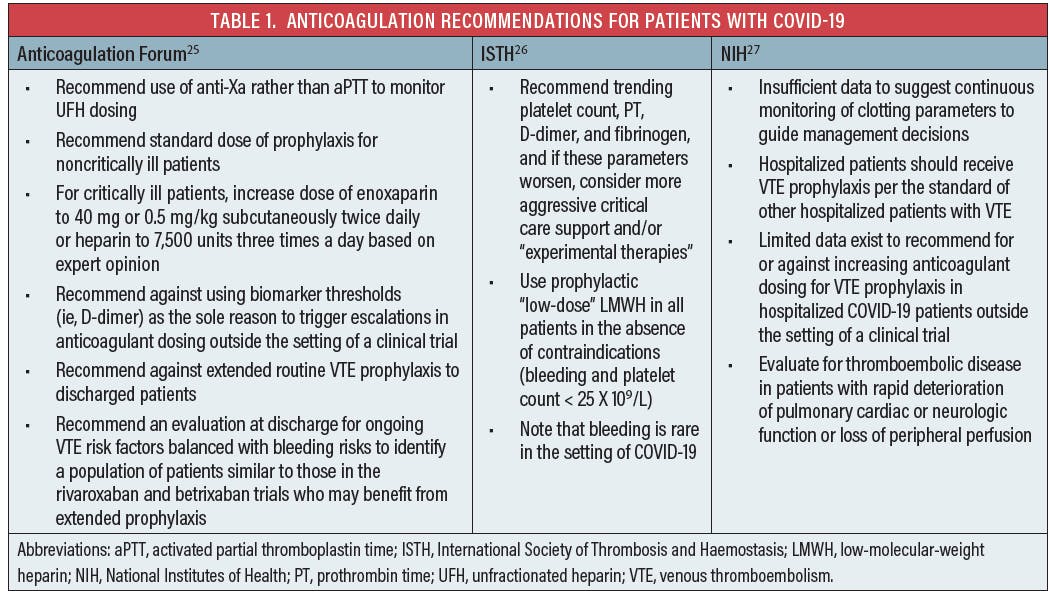
Societies including the International Society on Thrombosis and Haemostasis (ISTH), American Society of Hematology, National Institutes of Health (NIH), and the Anticoagulation Forum have published guidelines about anticoagulation for COVID-19–positive patients (Table 1),25-27 and the authors’ proposed recommendations are noted in the Sidebar.28,29 The ISTH and NIH recommend standard prophylactic doses of low-molecular-weight heparin only.26,27 The Anticoagulation Forum recommends a standard dose for noncritically ill patients and an accelerated dose of enoxaparin 0.5 mg/kg subcutaneously twice daily or heparin 7,500 units three times a day for critically ill patients.25
SUMMARY
COVID-19 infection appears to be associated with a high rate of venous thromboembolic disease. There is pathologic evidence of small vessel thrombosis, and observational clinical studies have shown high rates of DVT and PE. Many clinicians have begun to employ higher doses of thrombosis prophylaxis and even therapeutic anticoagulation for more severe cases of COVID-19, although data regarding benefit are sparse. The community is eagerly awaiting more data, especially results of randomized trials of full versus prophylactic doses of anticoagulation. Until then, several societies have published recommended anticoagulation guidelines for COVID-positive patients, and we have provided our recommendations.
1. John’s Hopkins coronavirus resource center. Accessed June 11, 2020. https://coronavirus.jhu.edu/us-map
2. Goyal P, Choi JJ, Pinheiro LC, et al. Clinical characteristics of COVID-19 in New York City. N Engl J Med. 2020;382:2372-2374. doi: 10.1056/NEJMc2010419
3. Richardson S, Hirsch JS, Narasimhan M, et al. Presenting characteristics, comorbidities, and outcomes among 5700 patients hospitalized with COVID-19 in the New York City area. JAMA. 2020;323:2052-2059. doi: 10.1001/jama.2020.6775
4. Chen G, Wu D, Guo W, et al. Clinical and immunological features in severe and moderate forms of coronavirus disease 2019. J Clin Invest. 2020;130:2620-2629. doi: 10.1172/JCI137244
5. Huang C, Wang Y, Li X, et al. Clinical features of patients infected with 2019 novel coronavirus in Wuhan, China. Lancet. 2020;395:497-506. doi: 10.1016/S0140-6736(20)30183-5
6. Iba T, Levy JH, Raj A, Warkentin TE. Advance in the management of sepsis-induced coagulopathy and disseminated intravascular coagulation. J Clin Med. 2019;8:728. doi: 10.3390/jcm8050728
7. Tang N, Li D, Wang X, Sun Z. Abnormal coagulation parameters are associated with poor prognosis in patients with novel coronavirus pneumonia. J Thromb Haemost. 2020;18:844-847. doi: 10.1111/jth.14768
8. Lippi G, Plebani M, Henry BM. Thrombocytopenia is associated with severe coronavirus disease 2019 (COVID‐19) infections: a meta-analysis. Clin Chim Acta. 2020;506:145-148. doi: 10.1016/j.cca.2020.03.022
9. Helms J, Tacquard C, Severac F, et al. High risk of thrombosis in patients with severe SARS-CoV-2 infection: a multicenter prospective cohort study. Intensive Care Med. 2020;46:1089-1098. doi: 10.1007/s00134-020-06062-x
10. Mortus JR, Manek SE, Brubaker LS, et al. Thromboelastographic results and hypercoagulability syndrome in patients with coronavirus disease 2019 who are critically ill. JAMA Network Open. 2020;3:e2011192. doi: 10.1001/jamanetworkopen.2020.11192
11. Yuriditsky E, Horowitz JM, Merchan C, et al. Thromboelastography profiles of critically ill patients with coronavirus disease 2019. Crit Care Med. Published online June 26, 2020. doi: 10.1097/CCM.0000000000004471
12. Tian S, Hu W, Niu L, et al. Pulmonary pathology of early phase 2019 novel coronavirus (COVID-19) pneumonia in two patients with lung cancer. J Thorac Oncol. 2020;15:700-704. doi: 10.1016/j.jtho.2020.02.010
13. Dolhnikoff M, Duarte-Neto AN, de Almeida Monteiro RA, et al. Pathological evidence of pulmonary thrombotic phenomena in severe COVID-19. J Thromb Haemost. 2020;18:1517-1519. doi: 10.1111/jth.14844
14. Carsana L, Sonzogni A, Nasr A, et al. Pulmonary post-mortem findings in a large series of COVID-19 cases from Northern Italy. Preprint. Posted online April 22, 2020. medRxiv. doi.org/10.1101/2020.04.19.20054262
15. Magro C, Mulvey JJ, Berlin D, et al. Complement associated microvascular injury and thrombosis in the pathogenesis of severe COVID-19 infection: a report of five cases. Transl Res. 2020;220:1-13. doi: 10.1016/j.trsl.2020.04.007
16. Poissy J, Goutay J, Caplan M, et al. Pulmonary embolism in COVID-19 patients: awareness of an increased prevalence. Circulation. Published online April 24, 2020. doi: 10.1161/CIRCULATIONAHA.120.047430
17. Llitjos JF, Leclerc M, Chochois C, et al. High incidence of venous thromboembolic events in anticoagulated severe COVID-19 patients. J Thromb Haemost. Published online April 22, 2020. doi: 10.1111/jth.14869
18. Nahum J, Morichau-Beauchant T, Daviaud F, et al. (2020). Venous thrombosis among critically ill patients with coronavirus disease 2019 (COVID-19). JAMA Netw Open. 2020;3:e2010478. doi: 10.1001/jamanetworkopen.2020.10478
19. Klok FA, Kruip MJHA, Van der Meer NJM, et al. Incidence of thrombotic complications in critically ill ICU patients with COVID-19. Thromb Res. 2020;191:145-147. doi: 10.1016/j.thromres.2020.04.013
20. Girardi AM, Bettiol RS, Garcia TS, et al. Wells and Geneva scores are not reliable predictors of pulmonary embolism in critically ill patients: a retrospective study. J Intensive Care Med. Published online December 16, 2018. doi: 10.1177/0885066618816280
21. Sattar N, McInnes IB, McMurray JJ. Obesity a risk factor for severe COVID-19 infection: multiple potential mechanisms. Circulation. Published online April 22, 2020. doi: 10.1161/CIRCULATIONAHA.120.047659
22. Wang TF, Milligan PE, Wong CA, et al. Efficacy and safety of high-dose thromboprophylaxis in morbidly obese inpatients. Thromb Haemost. 2014;111:88-93. doi: 10.1160/TH13-01-0042
23. Tang N, Bai H, Chen X, et al. Anticoagulant treatment is associated with decreased mortality in severe coronavirus disease 2019 patients with coagulopathy. J Thromb Haemost. 2020;18:1094-1099. doi: 10.1111/jth.14817
24. Paranjpe I, Fuster V, Lala A, et al. Association of treatment dose anticoagulation with in-hospital survival among hospitalized patients with COVID-19. J Am Coll Cardiol. Published online May 5, 2020. doi: 10.1016/j.jacc.2020.05.001
25. Barnes GD, Burnett A, Allen A, et al. Thromboembolism and anticoagulant therapy during the COVID-19 pandemic: interim clinical guidance from the anticoagulation forum. J Thromb Thrombolysis. 2020;50:72-81. doi: 10.1007/s11239-020-02138-z
26. Thachil J, Tang N, Gando S, et al. ISTH interim guidance on recognition and management of coagulopathy in COVID-19. J Thromb Haemost. 2020;18:1023-1026. doi: 10.1111/jth.14810
27. National Institutes of Health. COVID-19 treatment guidelines Panel. Accessed June 9, 2020. https://www.covid19treatmentguidelines.nih.gov/
28. Cohen AT, Spiro TE, Büller HR, et al. Rivaroxaban for thromboprophylaxis in acutely ill medical patients. N Engl J Med. 2013;368:513-523. doi: 10.1056/NEJMoa1111096
29. Cohen AT, Harrington RA, Goldhaber SZ, et al. Extended thromboprophylaxis with betrixaban in acutely ill medical patients. N Engl J Med. 2016;375:534-544. doi: 10.1056/NEJMoa1601747



Advertisement
Advertisement