Advertisement
Advertisement
April 2021
Type II Endoleak Embolization: The Methods Behind the Access
A discussion of approaches to access and preferred tools for type II endoleak embolization.
With Robert Morgan, MBChB, MRCP, FRCR, EBIR; Ian M. Loftus, MD, FRCS; and Gianmarco Falcone, MD


When discussing embolization of endoleaks, we refer to the management of type II endoleaks, which are usually only treated in the setting of aneurysm sac expansion. However, on occasion, undefined endoleaks may be approached in this way, where sometimes assumptions have to be made about the precise origin of an endoleak.
Embolization may be performed using transarterial, transcaval, or direct percutaneous routes. Occasionally, a transarterial and parastent approach might be considered. The specific embolization technique depends predominantly on the anatomy of the feeding arteries, plus the precise site and nature of the leak.
Transarterial embolization of the dominant feeding vessel is the most commonly employed approach. This technique requires a navigable route from the vessel origin via collaterals to the feeding vessel and endoleak cavity. The technical success of this approach is limited if the responsible feeding vessel cannot be cannulated or if a viable path to the endoleak cavity cannot be found.
One of the most common problems encountered is a type II endoleak from the inferior mesenteric artery (IMA). Retrograde filling from the IMA can usually be treated by catheterizing the superior mesenteric artery (SMA) and navigating through the arc of Riolan or other middle colic and marginal artery branches (Figure 1). This technique is generally performed using a femoral access, although an upper extremity access can be used for challenging anatomic cases. A long access sheath (6 F, 45 cm) is placed with its tip just below the origin of the SMA. A reverse-shape, curved catheter is used to engage the SMA, and angiography is performed to confirm filling of the endoleak cavity and provide an arterial map for access to the cavity. Over a wire, the parent catheter is advanced as far as possible into the middle colic artery before a microcatheter is used to negotiate through the arterio-arterial anastomosis and into the IMA and endoleak cavity. Our embolic agents of choice are coils (pushable or detachable), a liquid embolic or glue, or a combination of coils and liquid embolic. Adverse anatomic features for transarterial access include an angulated aorta at the level of the visceral arteries, in particular if there is extensive calcification and/or thrombus. High tortuosity of the arc of Riolan or the middle colic artery can also be a challenge.

Figure 1. A type II endoleak supplied by the inferior mesenteric artery (A, B). A catheter was advanced into the endoleak via the middle colic branch of the inferior mesenteric artery (C). The endoleak nidus was embolized with Onyx (Medtronic) (D). Completion angiography shows no residual filling of the endoleak (E).
Type II endoleaks arising from lumbar arteries can be treated by accessing iliolumbar branches arising from the internal iliac artery (IIA) (Figure 2). A short 6-F access sheath is placed in the ipsilateral femoral artery, and an angled catheter is used to catheterize the IIA. After angiography, a microcatheter is used to navigate through the ascending iliolumbar artery into the lumbar artery and endoleak cavity. These vessels are tortuous and small in caliber, making this technique challenging, with a lesser probability of successfully accessing the endoleak. Proximal embolization of the iliolumbar artery itself, without occlusion of the endoleak cavity, can be performed with relative ease. However, this usually results in recurrence due to the presence of other collateral vessels, which may supply the endoleak cavity.
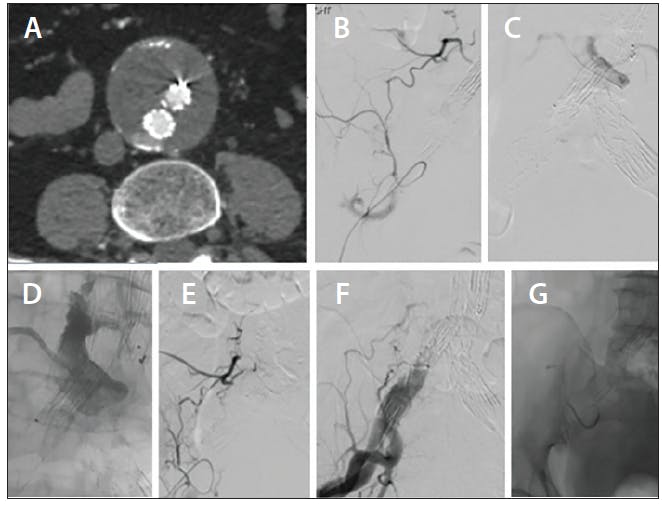
Figure 2. Successful transarterial embolization of a type II endoleak (A-G).
Adverse anatomic features, in addition to the tortuosity and caliber of the access vessels, include partial or complete coverage of the IIA by an endograft. However, it has occasionally been possible in selected cases to track a microcatheter alongside a stent to access the target vessels. There is a relatively high failure rate reported after transarterial embolization. This may in part be due to failure to completely occlude the endoleak cavity and may reflect the shortcomings of earlier techniques, such as performing embolization using coils alone without liquid embolic agents or embolization of the feeding vessels without occlusion of the endoleak cavity. Our approach is to try to achieve as complete an occlusion of the feeding vessels as possible at the first attempt and ensure as complete a filling of the cavity as possible, using a combination of materials when appropriate.
In cases in which transarterial access via the dominant feeding vessel is not possible, other techniques may achieve access to the endoleak cavity for embolization. Transiliac paraendograft embolization is a technique for treatment of type II endoleaks that cannot be accessed by a standard approach. This technique offers the advantage of avoiding general anesthesia and can be performed in the same sitting as an attempt at conventional transarterial embolization. Prior CT imaging is reviewed initially to specifically assess the degree of apposition between the distal aspect of each of the endograft’s iliac limbs and the artery wall. The area with least apposition between the iliac limb and the artery wall is targeted for access. The technique is performed via ipsilateral retrograde femoral access, and a short 6-F sheath is inserted with its tip just distal to the end of the iliac limb. An angled catheter and a straight hydrophilic guidewire are used to gain access into the paraendograft space. These are then advanced superiorly between the graft and the artery wall until they enter the aneurysm sac. Standard catheter and wire manipulations are used until there is blood flow from the catheter, confirming access into the endoleak cavity. A microcatheter is inserted coaxially through the parent catheter, and an “endoleakogram” is performed to assess the cavity anatomy and plan subsequent embolization. A liquid embolic agent is used to completely fill the endoleak cavity and may or may not reflux into the feeding arteries. Adverse anatomic features that may preclude this technique include a close apposition of the endograft to the iliac artery wall and extension of endograft of coverage into the external iliac artery, especially if further lined by a reinforcing bare-metal stent.
Direct percutaneous puncture of the aneurysm sac is usually performed under general anesthesia (or sometimes local anesthesia) and is largely reserved for cases when the previously mentioned techniques have failed or are deemed likely to fail. Prior CT imaging is initially reviewed to plan the approach to the endoleak cavity with reference to fluoroscopic landmarks. Access can be achieved using fluoroscopic guidance, cone-beam CT, CT guidance, or even ultrasound if the endoleak is sonographically visible. Access is usually via a left posterolateral translumbar approach to avoid inadvertent injury to the inferior vena cava (IVC). Under fluoroscopic guidance, a 20-gauge Chiba needle is advanced until there is brisk, pulsatile blood flow through the needle, indicating a satisfactory position within the endoleak cavity. Angiography is performed to depict the anatomy of the endoleak and plan subsequent embolization. A super stiff guidewire is inserted and the Chiba needle is exchanged for a 6-F short sheath and 4/5-F catheter. The technique can also be performed using a needle without a sheath, with injection of the embolic agent through the needle. If possible, the feeding vessels are selectively catheterized and embolized. In any case, the endoleak cavity is embolized completely using a liquid embolic agent. Adverse anatomic features that largely preclude this technique include an endoleak below the level of iliac crests or high in the sac, close to the top of endograft. Additionally, an endoleak anterior in the sac and in front of the endograft or on the right side of the sac and close to the IVC can be challenging with this technique. These may be better approached with the transcaval approach.
Embolization of type II endoleaks can be performed using a transcaval approach. We reserve this for specific cases, such as a right-sided or anterior leak where direct approaches have failed. Transcaval access is achieved using an angled tip catheter and an angled sheathed needle (eg, transjugular intrahepatic portosystemic shunt or transjugular liver biopsy set) to penetrate the IVC wall and enter the endoleak cavity. This method is less commonly practiced in Europe than the other methods, and there are limited published data.
We feel that an individualized and multidisciplinary team approach is essential with regard to the management of type II endoleaks. Each case is assessed carefully, based on anatomic appearance; the nature, size, and position of the endoleak; and the clinical sequelae, in particular the rate of sac expansion and relative pros and cons of intervention. In general, we prefer a transarterial method in the first attempt for most type II endoleaks. Direct sac puncture techniques are largely reserved for technical failures of all available transarterial routes and transcaval approaches for very selected right-sided and anterior sac endoleaks.

Type II endoleak is the most common type of endoleak and can be caused by a patent IMA, patent lumbar branches, and, less often, a patent medial sacral artery.1 Timing and indications for type II endoleak treatment have been historically debated in the literature. Around 50% of type II endoleaks resolve spontaneously because they are not associated with aneurysm sac enlargement.2 However, there is now consensus in treating all type II endoleaks when sac enlargement exceeds 5 mm in a 6-month interval.1
Type II endoleak are similar to arteriovenous malformations (AVMs) in that they have at least one feeding artery and one draining vessel, with the sac acting as an AVM nidus.3 To obtain complete sealing, embolization of the nidus is required. Exclusion of inflow-outflow vessels is also important to achieve embolization of the sac.4,5
Several treatment options have been described in the literature, with the main goal of eliminating the residual blood flow and pressure within the aneurysmatic sac, including transarterial embolization, direct translumbar embolization, a transcaval approach, and the trans-sealing (perigraft) technique.4 In cases of persistent type II endoleak, a surgical conversion may be also required.6
Embolization can be performed using different embolic materials: coils, microcoils, or liquid embolic agents, used alone or in combination. Selection is based on the embolization technique, morphology of the sac, nature of the type II endoleak, and operator experience and/or preference.
The direct translumbar embolization technique allows for direct access to the sac and gives the possibility to completely seal the nidus/sac as well as the feeding/draining vessels. This is not always possible with other techniques, such as when trying to navigate the arc of Riolan or the ilIolumbar arteries, especially in elderly patients with marked tortuosity of the vessels. Another relevant aspect is the time reduction of the procedure and thus a lower radiation dose. Moreover, the procedure can be performed in an outpatient setting, discharging the patient on the same day.7-9
For the aforementioned reasons, percutaneous translumbar embolization is my treatment of choice in cases of type II endoleak. Using this method, I can always reach the sac with no complications related to direct introduction of the needle, such as bleeding, or infection. Moreover, we have observed a very low incidence of sac reperfusion, mostly in the initial cases correlated to the learning curve.
The use of rotational angiography in combination with cone-beam CT allows for easy evaluation of the aneurysm and the needle path. However, direct sac puncture can be also performed safely using traditional rotational angiography using the radiopaque markers of the endoprosthesis as a reference.
The left-sided approach is the most common because it avoids puncture of the vena cava with a more direct path to the aneurysm sac. However, in cases where a clear path is not present on the left side due to organ interposition (kidney), a right-sided approach can be used, avoiding puncture of the vena cava.
Of note, it is not mandatory to enter the sac at the level of the endoleak. In fact, once the sac is reached, it is very easy to navigate in any point using a combination of a preshaped catheter (Berenstein, vertebral, cobra) and a guidewire to the area of the endoleak. Also, microcatheters can be useful to achieve better selective embolization.
Another advantage of the percutaneous translumbar technique is that when the aneurysmatic sac is completely embolized, exclusion of the inflow and outflow vessels is not required. In fact, sac reperfusion will no longer be possible, with advantages in terms of duration, complexity, and safety of the procedure.
Direct sac puncture can be performed using a fine needle (21 or 22 gauge), reducing any risk of tissue/organ injury. In the majority of cases, Onyx liquid embolic alone or in combination with coils is our preferred material. It has the advantage of a fully controlled injection that tremendously reduces the risk of nontarget embolization. Onyx can also completely fill the aneurysmatic sac, including the inflow and outflow vessels. In cases with high-low endoleaks, a combination of coil and Onyx is preferred. An initial cast of microcoils helps reduce the blood flow and avoids nontarget embolization. According to the flow characteristics, Onyx can be selected with low (18 centistokes) or higher (34 centistokes) viscosity, with the former generally used in complex and slow-flow type II endoleak to achieve a complete embolization. A combination of both types of Onyx is also used in specific settings to achieve better sealing of the aneurysmatic sac.
Several studies reported a higher success and safety profile of Onyx in comparison to glue.5,10 The major drawback is the artifacts produced by Onyx during follow-up CT. To overcome this problem, a contrast-enhanced ultrasound can be conducted to visualize the absence of flow within the aneurysmatic sac. Some authors suggest performing a noncontrast CT scan to better evaluate the sac diameter.11
1. Moll FL, Powell JT, Fraedrich G, et al. Management of abdominal aortic aneurysms clinical practice guidelines of the European Society for Vascular Surgery. Eur J Vasc Endovasc Surg. 2011;41(suppl 1):S1-S58. doi: 10.1016/j.ejvs.2010.09.011
2. Silverberg D, Baril DT, Ellozy SH, et al. An 8-year experience with type II endoleaks: natural history suggests selective intervention is a safe approach. J Vasc Surg. 2006;44:453-459. doi: 10.1016/j.jvs.2006.04.058
3. Avgerinos ED, Chaer RA, Makaroun MS. Type II endoleaks. J Vasc Surg. 2014;60:1386-1391. doi: 10.1016/j.jvs.2014.07.100
4. Baum RA, Stavropoulos SW, Fairman RM, Carpenter JP. Endoleaks after endovascular repair of abdominal aortic aneurysms. J Vasc Interv Radiol. 2003;14:1111-1117. doi: 10.1097/01.rvi.0000085773.71254.86
5. Khaja MS, Park AW, Swee W, et al. Treatment of type II endoleak using Onyx with long-term imaging follow-up. Cardiovasc Intervent Radiol. 2014;37:613-622. doi: 10.1007/s00270-013-0706-z
6. Bryce Y, Lam CK, Ganguli S, et al. Step-by-step approach to management of type II endoleaks. Tech Vasc Interv Radiol. 2018;21:188-195. doi: 10.1053/j.tvir.2018.06.009
7. Yang RY, Tan KT, Beecroft JR, et al. Direct sac puncture versus transarterial embolization of type II endoleaks: an evaluation and comparison of outcomes. Vascular. 2017;25:227-233. doi: 10.1177/1708538116663992
8. Zener R, Oreopoulos G, Beecroft R, et al. Transabdominal direct sac puncture embolization of type II endoleaks after endovascular abdominal aortic aneurysm repair. J Vasc Interv Radiol. 2018;29:1167-1173. doi: 10.1016/j.jvir.2018.04.002
9. Uthoff H, Katzen BT, Gandhi R, et al. Direct percutaneous sac injection for postoperative endoleak treatment after endovascular aortic aneurysm repair. J Vasc Surg. 2012;56:965-972. doi: 10.1016/j.jvs.2012.03.269
10. Marcelin C, Le Bras Y, Petitpierre F, et al. Safety and efficacy of embolization using Onyx® of persistent type II endoleaks after abdominal endovascular aneurysm repair. Diagn Interv Imaging. 2017;98:491-497. doi: 10.1016/j.diii.2017.01.003
11. Faccioli N, Foti G, Casagranda G, et al. CEUS versus CT angiography in the follow-up of abdominal aortic endoprostheses: diagnostic accuracy and activity-based cost analysis. Radiol Med. 2018;123:904-909. doi: 10.1007/s11547-018-0926-z
Advertisement
Advertisement