Advertisement
Advertisement
April 2021
The New Vocabulary of Pelvic Venous Disorders
Understanding the terminology of pelvic venous disorders and the implications on diagnosis and treatment.
Pelvic venous disorder (PeVD) has become the terminology to describe women with chronic pelvic pain (CPP) of venous origin, combining many syndromic conditions such as May-Thurner syndrome, nutcracker syndrome, pelvic congestion syndrome (PCS), and pelvic dumping syndrome to improve diagnostic clarity accounting for specific pathophysiology. This new terminology is critical for the multisociety efforts to improve care for the large number of women living with CPP, which can account for up to $2.8 billion in health care costs and, ultimately, an incomplete definitive diagnosis and lack of curative treatment.1
CHALLENGES IN A NAME
PCS has been plagued by poor acceptance by the gynecologic community due to an unclear cause and effect relationship and an “intuitive [link] rather than proven [link]” based on small series of data showing improvements in subjective rating scales such as visual analog scale (VAS) pain scores and patient questionnaires.2 In addition to lack of acceptance by the clinicians who are often encountering patients with CPP, many United States medical insurance carriers have medical policies stating that ovarian and internal iliac vein embolization as treatments of PCS are investigational.
In addition to the acceptance challenges, the previous syndromic names also overlook the complex interconnected network of pelvic venous physiology that can allow for similar symptoms to arise from differing pathophysiology. The pelvis is primarily drained by the internal iliac veins and the ovarian veins in women, which subsequently feed into the common iliac vein and left renal vein, respectively. Primary reflux and/or secondary reflux due to central/downstream obstruction can lead to hypertension and dilation of the pelvic venous plexus, which is hypothesized to be responsible for nociceptor depolarization leading to pain sensitization.
PeVD PATHOPHYSIOLOGY AND PRESENTATION
PeVD can be broken down into the pathophysiologic entities of ovarian vein reflux, iliac vein reflux, iliac vein compression, and renal vein compression as well as the resultant clinical presentations of CPP, lower extremity/genital varicosities, lower limb pain/swelling, and flank pain/hematuria. Use of PeVD as an overarching diagnostic structure broken into specific patient components will more clearly demonstrate the appropriate management in this complex patient population.
In an effort to clarify this diagnostic element, the SVP (symptoms, varices, pathophysiology) classification has been created by an international and multisociety working group.3 Pelvic pain of venous origin is often described as dull pain with occasional sharp flares predominantly occurring after prolonged standing, walking, and deep dyspareunia with prolonged postcoital aching.4 Although CPP is a common presentation for patients with PeVD, it is important to analyze the various territories or zones of symptoms, which are broken down using the SVP tool into S0 (no renal or extrapelvic symptoms), S1 (renal symptoms of venous origin), S2 (CPP of venous origin), and S3 (extrapelvic symptoms of venous origin). The varices component of the SVP classification tool differentiates the anatomic reservoirs where varices can be identified using imaging, including V0 (no abdominal, pelvic, or pelvic origin extrapelvic varices), V1 (renal hilar varices), V2 (pelvic varices), and V3 (pelvic origin extrapelvic varices). Finally, the pathophysiology component is divided based on anatomic, hemodynamic, and etiologic subdomains. The anatomic subdomain identifies the vessel of interest or abnormality—the left gonadal vein, for example. This is further categorized based on the presence or absence of obstruction or reflux (hemodynamics) and the etiology of the process as thrombotic, nonthrombotic, or congenital.3 As an example of using the SVP tool, a 48-year-old woman presented with worsening pelvic pain for 4 years. She described pelvic heaviness, discomfort, and bloating rated eight out of 10 on the VAS pain scale that is worse with standing, running, and intercourse. Based on the presence of pelvic varices as shown by pelvic ultrasound and CT images (Figure 1) and a pathophysiology of left ovarian vein reflux as shown in Figure 2, she would be classified as S2V2PLGV,R,C.
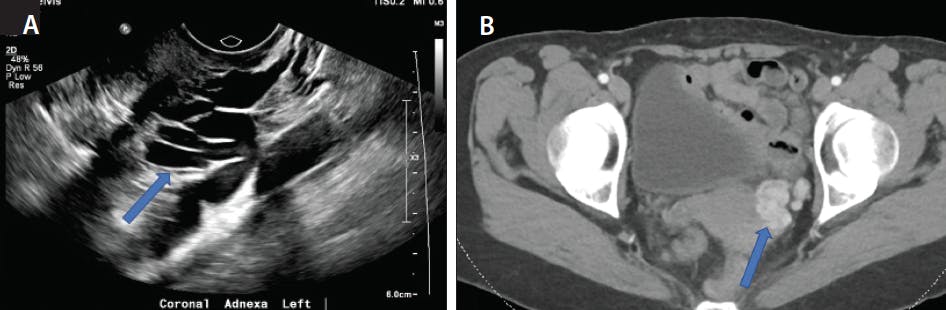
Figure 1. Ultrasound (A) and CT (B) images demonstrate left adnexal and pelvic varices (arrow) measuring up to 7 mm in diameter.
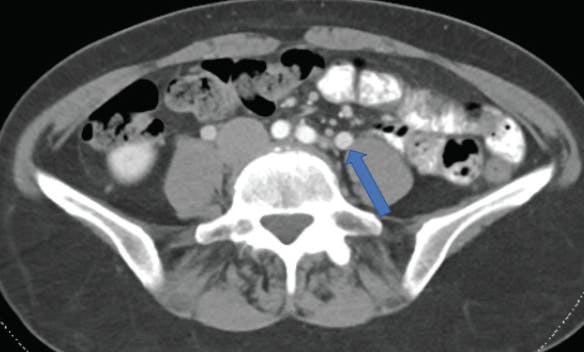
Figure 2. Axial CT image shows contrast within a dilated left ovarian vein without contrast in the inferior vena cava, suggesting reflux from the left renal vein.
FUTURE VALIDATION EFFORTS
The optimal treatment modality for patients with PeVD is lacking, in part due to previous nonrandomized cohort studies with varying treatment modalities in mixed populations of symptoms, varices, and pathophysiology. The majority of studies evaluating the treatment of PeVD focused on coil embolization of the ovarian veins and/or the internal iliac veins, with significant reduction in VAS pain scores in approximately 75% of women treated despite varying techniques.5 In addition to positive results from several systematic reviews including up to 828 patients, a recent large study of 520 patients at a single center treated with bilateral ovarian and internal iliac vein coil embolization demonstrated success in 85% of patients with a reduction in VAS score from 7.63 ± 0.9 to 0.91 ± 1.5 at 5 years.6 Although these studies show benefit from ovarian vein embolization (OVE) procedures, questions continue to persist regarding the validity of these treatments and whether left common iliac vein stenting for nonthrombotic iliac vein lesions should be the preferred treatment modality. One publication demonstrated significant and possibly greater improvements in VAS pain scores after nonthrombotic iliac vein compression stenting compared with OVE alone or staged stenting after OVE.7
A multidisciplinary research consensus panel that convened in 2017 determined that the future management and treatment of PeVD requires delineation of diagnostic criteria, development of a discriminative tool to categorize patients with PeVD, development of a disease-specific quality-of-life (QOL) tool to measure the disease health burden and impact of treatment, and finally, randomized controlled data collection to prove efficacy of intervention.5 The SVP tool fulfills the discriminative tool component and needs to be used widely to continue to acquire knowledge and clarity on the patients within each category. A disease-specific QOL tool is in early development, and it will add significant information on the differentiating symptoms of patients with venous-origin CPP. Diagnostic criteria for those with venous-origin CPP are presumed based on previous publications. Broadly, the criteria are the presence of pelvic varices measuring at least 5 mm in diameter and the presence of pelvic pain. When the discriminative and evaluative QOL instruments have been validated, reevaluation of appropriate diagnostic symptomatology and imaging criteria can be performed. Once all of these tools are finalized, randomized controlled trials evaluating the performance of OVE and iliac vein stenting will need to be performed to define the outcomes based on proper patient delineation/classification as well as using disease-specific and/or validated QOL instruments.
CONCLUSION
PCS, May-Thurner syndrome, nutcracker syndrome, and pelvic dumping syndrome should be replaced in the clinical and research communities to specifically discuss the pathophysiology leading to CPP resulting from PeVDs. Optimal understanding of the disease processes that lead to venous-origin pelvic pain will lead to more accurate identification of patients who can benefit from intervention and optimization of treatment strategies. The SVP classification scheme is a critical thesaurus to understand patients with CPP of venous origin or pelvic-derived lower extremity varicose veins. Application of this tool will allow important future steps to validate interventional strategies and optimize patient evaluation.
1. Latthe P, Latthe M, Say L, et al. WHO systematic review of prevalence of chronic pelvic pain: a neglected reproductive health morbidity. BMC Public Health. 2006;6:177. doi: 10.1186/1471-2458-6-177
2. Leatherby RJ, Harries P, Shah SS. The management of pelvic congestion syndrome - a word of caution. J Obstet Gynaecol. 2020;40:283-284. doi: 10.1080/01443615.2019.1599333
3. Meissner MH, Khilnani NM, Labropoulos N, et al. The symptoms-varices-pathophysiology (SVP) classification of pelvic venous disorders a report of the American Vein & Lymphatic Society international working group on pelvic venous disorders. J Vasc Surg Venous Lymphat Disord. Published online January 30, 2021. doi: 10.1016/j.jvsv.2020.12.084
4. Beard RW, Reginald PW, Wadsworth J. Clinical features of women with chronic lower abdominal pain and pelvic congestion. Br J Obstet Gynaecol. 1988;95:153-161. doi: 10.1111/j.1471-0528.1988.tb06845.x
5. Khilnani NM, Meissner MH, Learman LA, et al. Research priorities in pelvic venous disorders in women: recommendations from a multidisciplinary research consensus panel. J Vasc Interv Radiol. 2019;30:781-789. doi: 10.1016/j.jvir.2018.10.008
6. De Gregorio MA, Guirola JA, Alvarez-Arranz E, et al. Pelvic venous disorders in women due to pelvic varices: treatment by embolization: experience in 520 patients. J Vasc Interv Radiol. 2020;31:1560-1569. doi: 10.1016/j.jvir.2020.06.017
7. Santoshi RKN, Lakhanpal S, Satwah V, et al. Iliac vein stenosis is an underdiagnosed cause of pelvic venous insufficiency. J Vasc Surg Venous Lymphat Disord. 2018;6:202-211. doi: 10.1016/j.jvsv.2017.09.007
Advertisement
Advertisement