Advertisement
Advertisement
April 2021
Visceral Aneurysms: New Tools on the Block
Strategies for the endovascular treatment of aneurysms of the renal, splenic, and pancreaticoduodenal arteries.
With Maria Antonella Ruffino, MD, EBIR; J. Urbano, MD, PhD, EBIR, FCIRSE; and Marc Sapoval, MD, PhD
Targeted Renal Artery Aneurysm Embolization to Preserve Kidney Perfusion
By Maria Antonella Ruffino, MD, EBIR
Renal artery aneurysms (RAAs) account for 25% of all visceral artery aneurysms. They are rare, with an incidence in the general population of 0.1% to 1%.1 The most severe complication of RAA is rupture with massive bleeding, a risk that increases with the aneurysm diameter. The risk of rupture is also higher in specific patient subgroups such as women of childbearing age.
Although no strong recommendation exists concerning the indications for treatment of RAAs, symptomatic aneurysms and aneurysms > 1.5 cm represent indications for treatment.2 Recently, the Society for Vascular Surgery clinical practice guidelines on the management of visceral aneurysms suggested intervention for renal symptomatic aneurysm or rupture (grade 2B recommendation) and for renal aneurysms > 3 cm in patients with uncomplicated RAA of acceptable operative risk (grade 2C conditional recommendation where variation in care is acceptable based on individualized clinical decision-making).3
Several clinical studies have assessed the efficacy and safety of endovascular treatment versus surgical repair of RAAs.4,5 The choice between these two options is generally based on the anatomic characteristics of the lesion—such as the location and morphology of the aneurysm and the number of relevant branches, when present, arising from the aneurysm—and the clinical conditions of the patient.3 Compared to open surgery, endovascular repair of RAAs is associated with a significantly lower rate of postoperative complications and a shorter length of hospital stay.5
A key aspect in the endovascular treatment of RAAs is the preservation of kidney vascularization, which is terminal, without anastomoses between segmental branches. The occlusion of proximal arteries results in segmental infarction, which causes impairment of renal function. In the presence of these lesions, it is very important that the parent branches and the distal flow be preserved.
Simple coiling embolization with pushable coils is used for narrow-necked aneurysms. Coils are deployed only into the aneurysm sac, so no sacrifice of the renal artery occurs. For wide-necked or complex aneurysms, the options include stent- or balloon-assisted coiling and exclusion by flow diverter and stent grafts. The use of detachable microcoils, which are repositionable, instead of pushable coils, allows for precise placement with effective embolization of aneurysms of different sizes while preserving the distal flow without sacrificing the target artery. The remodeling techniques were introduced more recently for the treatment of wide-neck intracranial aneurysms.6 An inflatable balloon or a stent is used to avoid coil migration in the parent artery during the procedure and to increase coil density in the aneurysm. Stent-assisted remodeling was first described for the treatment of RAAs in 2008.7
The use of a simple coiling technique with detachable coils is advantageous in that no antiplatelet therapy is needed after the procedure, thus it is particularly recommended for young patients and women of childbearing age.
Other embolic agents can be used for the treatment of RAAs, alone or in combination with coils. Liquid embolic agents such as cyanoacrylates or ethylene vinyl alcohol copolymers may be used to completely fill in the aneurysmal sac after partial coiling, avoiding the use of too many coils or when packing is not possible anymore due to lack of space.8,9
Technical success of the embolization technique in the treatment of RAAs across larger series is reported as 73% to 100%. Rates of morbidity are highly variable (13%-60%) and include mainly thromboembolism leading to end-organ malperfusion and subsequent postembolectomy syndrome.10-13
1. Tham G, Ekelund L, Herrlin K, et al. Renal artery aneurysms. Natural history and prognosis. Ann Surg. 1983;197:3480-352. doi: 10.1097/00000658-198303000-00016
2. Henke PK, Cardneau JD, Welling TH 3rd, et al. Renal artery aneurysms: A 35-year clinical experience with 252 aneurysms in 168 patients. Ann Surg. 2001;234:454-462. doi: 10.1097/00000658-200110000-00005
3. Chare RA, Abularrage CJ, Coleman D, et al. The Society for Vascular Surgery clinical practice guidelines on the management of visceral aneurysms. J Vasc Surg. 2020;72:3S-39S. doi: 10.1016/j.jvs.2020.01.039
4. Li Z, Zhao Z, Qin F, et al. Outcomes of endovascular treatment and open repair for renal artery aneurysms: A single-center retrospective comparative analysis. J Vasc Interv Radiol. 2018;29:62-70. doi: 10.1016/j.jvir.2017.08.020
5. Tsilimparis N, Reeves JG, Dayama A, et al. Endovascular vs open repair of renal artery aneurysms: Outcomes of repair and long-term renal function. J Am Coll Surg. 2013;217:263-269. doi: 10.1016/j.jamcollsurg.2013.03.021
6. Moret J, Cognard C, Weill A, et al. The “remodelling technique” in the treatment of wide neck intracranial aneurysms. angiographic results and clinical follow-up in 56 cases. Interv Neuroradiol. 1997;3:21-35. doi: 10.1177/159101999700300103
7. Manninen HI, Berg M, Vanninen RL. Stent-assisted coil embolization of wide-necked renal artery bifurcation aneurysms. J Vasc Interv Radiol. 2008;19:487-492. doi: 10.1016/j.jvir.2007.10.026
8. Abath C, Andrade G, Cavalcanti D, et al. Complex renal artery aneurysms: Liquids or coils? Tech Vasc Interv Radiol. 2007;10:299-307. doi: 10.1053/j.tvir.2008.03.009
9. Venturini M, Della Corte A, Lanza C, et al. Embolization of 2 coexisting intraparenchymal renal artery aneurysms with an ethylene vinyl alcohol copolymer agent (Squid) and coils. Cardiovasc Intervent Radiol. 2020;43:942-944. doi: 10.1007/s00270-020-02458-w
10. Etezadi V, Gandhi RT, Benenati JF, et al. Endovascular treatment of visceral and renal artery aneurysms. J Vasc Interv Radiol. 2011;22:1246-1253. doi: 10.1016/j.jvir.2011.05.012
11. Abdel-Kerim A, Cassagnes L, Alfidja A, et al. Endovascular treatment of eight renal artery aneurysms. Acta Radiol. 2012;53:430-434. doi: 10.1258/ar.2012.110458
12. Sedat J, Chau Y, Baque J. Endovascular treatment of renal aneurysms: a series of 18 cases. Eur J Radiol. 2012;81:3973-3978. doi: 10.1016/j.ejrad.2012.08.017
13. Zhang Z, Yang M, Song L, et al. Endovascular treatment of renal artery aneurysms and renal arteriovenous fistulas. J Vasc Surg. 2013;57:765-70. doi: 10.1016/j.jvs.2012.09.042
Splenic Aneurysm Techniques While Preserving the Spleen
By J. Urbano, MD, PhD, EBIR, FCIRSE
The classic treatment for splenic aneurysms is splenectomy.1 Unlike the liver, kidney, or mesenteric artery, the spleen is not essential and could be removed without compromising a patient’s life. However, the spleen has important immunologic and hematologic functions, so preserving the spleen is highly recommended. Although the splenic artery is the only vessel that provides direct flow to the spleen, the spleen can be supplied by collateral arteries, making it quite resistant to ischemia when there is a splenic artery occlusion.
Because of the tortuosity, the loops, and sometimes a steep angulation of the celiac trunk, the access through the splenic artery into the aneurysm sac is often a challenge. Due to the difficulty to navigate into the aneurysm sac, a coaxial technique using soft microcatheters and microwires is often required. The sandwich technique, which occludes the splenic artery using coils or plugs just distal and proximal to the aneurysm neck, is an effective and safe endovascular technique to treat a splenic aneurysm.2 Nevertheless, the current trend is to exclude the splenic aneurysm while maintaining patency and direct flow to the spleen. Each splenic aneurysm should be evaluated individually, and currently, there is no standard technique for the treatment of this disease.3-5 Aneurysm coiling, like brain aneurysm treatment, is the most popular approach. A self-expanding flexible stent graft without coils could be used in the few cases where the aneurysm is located proximally in a straight portion of the splenic artery, without divergence between the proximal and distal caliber.
Treatment planning should include the following key data: (1) the type of aneurysm (saccular or fusiform); (2) the size and shape of the aneurysm; (3) the location regarding the splenic artery (proximal, middle, or hilar); (4) the shape and number of loops of the splenic artery; (5) the exact caliber of the splenic artery both in the proximal and distal sectors of the neck; (6) the presence or absence of segmental splenic branches arising from the aneurysm sac; (7) the angulation of the celiac trunk; (8) the presence of splenomegaly; (9) portal hypertension; and (10) the status of the femoroiliac or brachiosubclavian access.
Our usual practice starts with the acquisition of a high-quality CTA that allows multiplanar and three-dimensional (3D) reformations. Once decided on femoral or brachial access, we use a microcatheter over a navigation microguidewire to go through the aneurysm and reach the intrasplenic portion of the splenic artery. Using the microcatheter, we will exchange the navigation guidewire for a 0.018-inch support guidewire that will serve to advance a 6- or 8-F flexible guiding catheter. The guiding catheter will help us to carry out all the angiographic controls during the procedure, and coaxially we will advance a microcatheter into the aneurysm sac to release the platinum detachable microcoils. It is recommended that the microcatheter has a double distal mark, but this is not mandatory. First, we deploy one or two 3D coils to scaffold the aneurysm sac. The size of the 3D coils should be adjusted to the aneurysm without oversizing or minimally oversizing. Then, we will try to pack the sac adding helical microcoils. Long and different sized microcoils are required.
In some cases, adding Onyx 34 (Medtronic) among the coils may be very useful to obtain a better seal of the aneurysm, which reduces the need for coils, stabilizes and fixes the coils inside the sac, guarantees the durability of the treatment, and saves costs. In the cases where it is necessary to use a stent to avoid coil migration toward the lumen of the artery, we use an 8-F guiding catheter that allows the insertion of two microcatheters in parallel, one for the stent (eg, Leo [Balt USA]; Solitaire [Medtronic]) and the other for the microcoils. In these cases, we use neuroradiology dedicated stents. The microvascular plugs, which are released through a microcatheter and navigate in tortuous anatomies, are useful for the proximal occlusion of accessory branches that arise from the aneurysm sac and should be occluded to avoid reentry. The new flow diverter stents initially designed for neuroradiology, either alone or in combination with the coiling, are going to be a promising future option.
In summary, for the treatment of a splenic artery aneurysm, first we need good planning. Then, we have to solve the challenge of the splenic artery access. And finally, we require a refined technique that may be different according to the features of each particular aneurysm.
1. Barrionuevo P, Malas MB, Nejim B, et al. A systematic review and meta-analysis of the management of visceral artery aneurysms. J Vasc Surg. 2020;72(1S):40S-45S. doi: 10.1016/j.jvs.2020.05.018
2. Belli AM, Markose G, Morgan R. The role of interventional radiology in the management of abdominal visceral artery aneurysms. Cardiovasc Intervent Radiol. 2012;35:234-43. doi: 10.1007/s00270-011-0201-3
3. Hemp JH, Sabri SS. Endovascular management of visceral arterial aneurysms. Tech Vasc Interv Radiol. 2015;18:14-23. doi: 10.1053/j.tvir.2014.12.003
4. Branchi V, Meyer C, Verrel F, et al. Visceral artery aneurysms: evolving interdisciplinary management and future role of the abdominal surgeon. Eur J Med Res. 2019;24:17. doi: 10.1186/s40001-019-0374-9
5. Chaer RA, Abularrage CJ, Coleman DM, et al. The Society for Vascular Surgery clinical practice guidelines on the management of visceral aneurysms. J Vasc Surg. 2020;72(1S):3S-39S. doi: 10.1016/j.jvs.2020.01.039
Embolization of Pancreaticoduodenal Artery Aneurysm
By Marc Sapoval, MD, PhD
Pancreaticoduodenal (PD) artery aneurysms account for 2% of all visceral artery aneurysms.1 Most of them are associated with celiac stenosis or superior mesenteric artery (SMA) stenosis (atheromatous lesion or middle arcuate ligament). The physiopathologic mechanism underlying their development is most likely due to the formation of high flow in small arteries related to celiac stenosis. To compensate the celiac stenosis, all the arterial inflow to the liver and spleen go through small arteries that are not large enough to accommodate and therefore grow in diameter with a propensity for arterial wall degeneration and phenotype modification, resulting is aneurysm creation.2 The risk of rupture is unknown, and there is no apparent relationship between size and risk of rupture. Because mortality is up to 21% in the case of rupture, it is recommended to treat them regardless of the size.3
Watchful follow-up, such as a yearly CTA, can be recommended only in the case of a very small aneurysm (< 3 mm), and if the anatomy is not favorable for exclusion. In this situation, the patient must be informed that in the case of sudden abdominal pain, rapid intervention should be performed. PD artery aneurysms do not generate any symptoms; therefore, they are most often discovered during an abdominal CT for another cause. Given the context, patients should be promptly referred to the interventional radiologist to organize treatment in a reasonable delay after diagnosis.
The location of aneurysms of PD arcade vessels render their surgical extirpation a challenge, so embolization should be the first approach. Embolization can be challenging because of tortuous and small feeding vessels, presence of more than one inflow and outflow branches, and diseased proximal SMA. Several techniques can be proposed including isolation, covered stents, coil packing, liquid embolic agents, and percutaneous thrombin injection.4
In all cases, the first step is placement of a 40- to 50-cm 5- or 6-F sheath at 2 or 3 cm after the origin of the SMA to allow stable and proper navigation and repeat angiographic controls.
The more elegant approach is exclusion of the aneurysm and preservation of the parent artery. This is sometimes possible using small coronary stent grafts or balloon-expandable covered stents (eg, Advanta V12, Getinge). In general, a 4- or 5-mm-diameter stent graft can be pushed to the proximal part of the PD arcades, but usually not very far. Therefore, most of the more distal aneurysms can be treated only after superselective navigation using microcatheters.
In this situation, success is the association of detachable coils and liquid embolic agents.
We favor detachable 0.018-inch coils, delivered through a microcatheter, because precise deployment and avoidance of nontarget embolization is important. The choice will be based upon availability, operator habit, and the aim of coiling. Coils need to be soft and fibered or expandable to ensure optimal navigation and effective vessel occlusion. Coil packing of the sac itself—even if it is theoretically more elegant—is nearly impossible, unless the neck is very narrow and accessible. In addition, because these arteries are in essence highly collateralizable, there is no real downside in performing coil exclusion if another approach is not possible.
The use of a few drops of liquid embolic agent to complete exclusion is sometimes useful as it is time- and cost-effective. In this case, we favor a relatively high viscosity ethylene vinyl alcohol copolymer–based agent (eg, Onyx 34 [Medtronic] or Squid Peri [Balt]) or an iodinized polyvinyl alcohol grafted agent (eg, Easyx, Qmedics AG), shown in Figure 1.
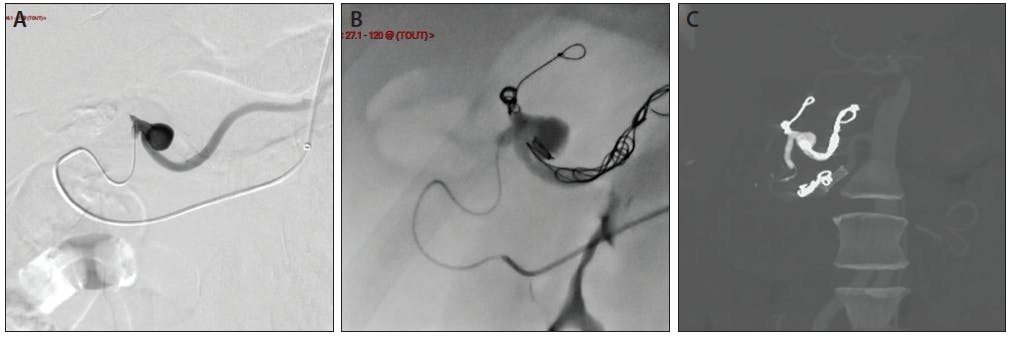
Figure 1. Example of a complex 10-mm aneurysm of the PD artery. The upper aneurysm was treated with detachable coils completed by the liquid embolic Easyx (not FDA approved) (A) and the inferior one with a small stent graft and detachable coils (B). Control cone-beam CT showing exclusion and reduced CT artifact (C).
In most cases, the underlying cause (celiac stenosis) is not treated and new aneurysms can appear. Therefore, CT follow-up is recommended.
Aggressive management of these “silent killer” aneurysms should be proposed. Embolization, although challenging, is the recommended technique.
1. Pasha SF, Gloviczki P, Stanson AW, Kamath PS. Splanchnic artery aneurysms. Mayo Clin Proc. 2007;82:472-479. doi: 10.4065/82.4.472
2. Ogino H, Sato Y, Banno T, et al. Embolization in a patient with ruptured anterior inferior pancreaticoduodenal arterial aneurysm with median arcuate ligament syndrome. Cardiovasc Intervent Radiol. 2002;25:318-319. doi: 10.1007/s00270-001-0109-4
3. Takao H, Doi I, Watanabe T, et al. Natural history of true pancreaticoduodenal artery aneurysms. Br J Radiol. 2010;83:744-746. doi: 10.1259/bjr/17700576
4. Hemp JH, Sabri SS. Endovascular management of visceral arterial aneurysms. Tech Vasc Interv Radiol. 2015;18:14-23. doi: 10.1053/j.tvir.2014.12.003
Advertisement
Advertisement