Advertisement
Advertisement
April 2021
Emborrhoid Technique for Chronic Hemorrhoidal Disease: Where Do We Stand?
A review of the technique, clinical results, and challenges to widespread use.
By Farouk Tradi, MD, MSc; Julien Panneau, MD; and Vincent Vidal, MD, PhD
The emborrhoid technique has emerged as a new treatment option for patients with chronic hemorrhoidal disease. With a prevalence of 4.4% to 39%,1 hemorrhoidal disease is the most common anorectal disease and affects millions of people worldwide with predominant symptoms of bleeding and pain.
Internal hemorrhoids are a physiologic vascular structure made up of a richly anastomosed arteriovenous network that contributes to the anal canal’s continence, forming a circumferential submucosal bulge at the anorectal junction, termed the corpus cavernosum recti (CCR). An inferior hemorrhoidal plexus also exists around the anal opening, giving rise to external hemorrhoids, whereas internal hemorrhoids originate above the dentate line.
Although pathophysiology remains contentious, internal hemorrhoidal pathology is thought to be the result of chronic hypertrophy of these vascular structures, apparently favored by local overexpression of endothelial growth factors. The major inflow to the CCR originates from the superior rectal artery (SRA), which arises from the inferior mesenteric artery (IMA). Middle rectal artery (MRA) contribution has also been significantly noted (in up to 24% as anatomic variations); this branch arises from the internal iliac artery (IIA). Chronic increase of inflow in the CCR ultimately causes hyperplasia of the cushions responsible for congestive symptoms (pain, bleeding) and prolapse.
EMBORRHOID TECHNIQUE
Patients are generally reluctant to have their hemorrhoids treated surgically. In recent years, proctologists developed a new concept of treatment: elective transanal Doppler-guided hemorrhoidal artery ligation (DG-HAL). The DG-HAL technique consists of identifying and ligating the SRAs under transanal Doppler guidance. Ligation of the SRAs provides a significant reduction of arterial blood flow to the hemorrhoid and is effective in treating hemorrhoid disease with a minimally invasive approach.2
The mechanical function of the CCR is dependent on the influx of arterial blood from the branches of the IMA (the SRAs) and sometimes the branches of the IIAs (the MRAs).
On the same principle, we developed the emborrhoid technique, a minimally invasive radiologic alternative to DG-HAL, consisting of endovascular occlusion of the hemorrhoidal branches of the rectal arteries using metallic coils.3,4 The emborrhoid technique does not need periprocedural medication or any “bowel” preparation and is carried out as an outpatient intervention. The femoral artery is punctured using the Seldinger technique under local anesthesia. A radial approach is also completely feasible. A 4-F catheter is placed at the origin of the IMA for selective angiography. Hemorrhoid arteries are then easily identified, appearing tortuous and vertical at the level of the pubic bone. A microcatheter is advanced as far as possible into the SRA branches up to the CCR. Varying embolic agents can be used.
Based on our clinical practice, we use metallic fibered coils to occlude the distal branches of the SRAs (Figure 1). Fibered coils allow an effective occlusion of the target vessels with no risk of bowel ischemia related to a distal but nonterminal embolization. Angiography of the IIAs is now systemically performed to look for a significant MRA that supplies the hemorrhoids. The MRA can be embolized in the same manner (Figure 2). Technical success rates in the literature have been very high, ranging from 93% to 100%.5-11
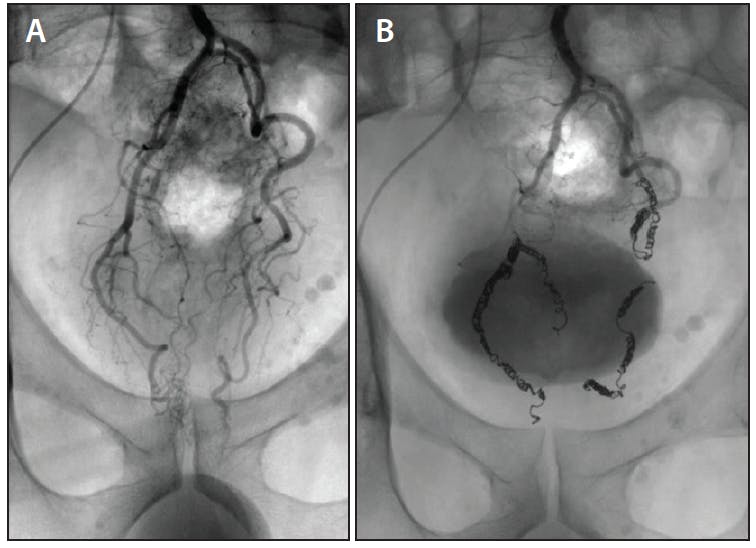
Figure 1. Frontal angiograms of the SRA showing a modal anatomy with hemorroidal branches at the level of the CCR in front of the pubic bone (A). After the embolization, no remaining branches are opacified at the level of the pubic symphysis (B).
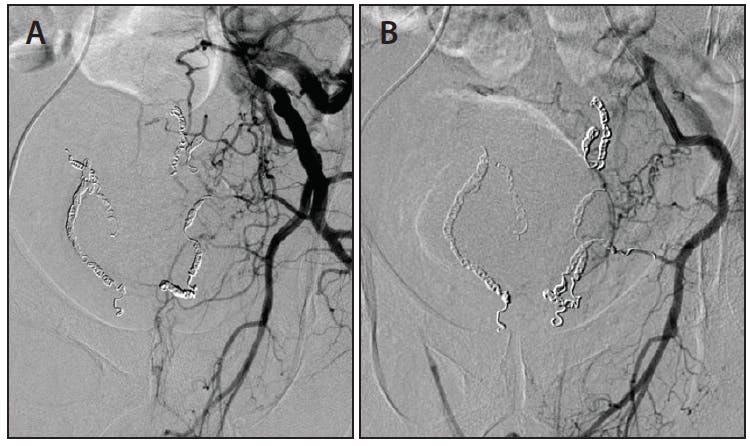
Figure 2. Frontal angiogram of the left IIA in the same patient as Figure 1, showing a significant MRA supplying the CCR downstream to the coil packing (A). After the embolization, no remaining branch is opacified at the level of the CCR (B). A right IIA angiogram did not show any significant MRAs.
CLINICAL RESULTS
To date, the results from almost 250 patients embolized using the emborrhoid technique have been published in several studies.11 The reported clinical success of the emborrhoid technique is between 63% and 94%, with no major complications.5-11 Recurrence of bleeding is the main reason for clinical failure, which can be treated by redo procedures as needed. Treatment failure may be due to the presence of significant MRAs, as found in up to 24% of cases.6 A systematic coil embolization of those arteries in the same session is reasonable and is under evaluation in our center.
For hemorrhoid embolization, the highest rate of efficacy has been reported with particle embolization associated with microcoils.9 This embolic agent can provide a more distal occlusion of the target vessels. Recently, a study of the use of microspheres has confirmed these results, with a clinical success rate of 93%.12 Not surprisingly, the rate of minor complications was high, close to 50%, and consisted of small ischemic ulcerations of the anorectal junction. Thus, evidence regarding the optimal choice of embolic agent remains equivocal, with insufficient evidence to recommend particle embolization over coil embolization at present.
CHALLENGES
Current data support the feasibility, efficacy, and safety of SRA embolization for hemorrhoids. However, since the first publication about the emborrhoid technique 7 years ago, several outstanding questions remain.
Better patient selection is necessary. Patient populations in both previous studies and real-life practice have been heterogeneous. Bleeding scores can aid in better patient selection, reducing the subjective part of the evaluation of symptom severity. A new validated bleeding score has been published recently.13 Such a score will likely provide a more accurate and reproducible method of assessment before and after treatment and thus will improve embolization results.
Guidelines concerning technical considerations, such as the use of microparticles and MRA embolization, will be available in the next few years. Finally, randomized controlled trials with longer follow-up are mandatory to determine the optimal role of this emerging and minimally invasive technique.
1. Riss S, Weiser FA, Schwameis K, et al. The prevalence of hemorrhoids in adults. Int J Colorectal Dis. 2012;27:215-220. doi: 10.1007/s00384-011-1316-3.
2. Infantino A, Altomare DF, Bottini C, et al. Prospective randomized multicentre study comparing stapler haemorrhoidopexy with Doppler-guided transanal haemorrhoid dearterialization for third-degree haemorrhoids. Colorectal Dis. 2012;14:205-211. doi: 10.1111/j.1463-1318.2011.02628.x
3. Vidal V, Louis G, Bartoli JM, Sielezneff I. Embolization of the hemorrhoidal arteries (the emborrhoid technique): a new concept and challenge for interventional radiology. Diagn Interv Imaging. 2014;95:307-315. doi: 10.1016/j.diii.2014.01.016
4. Vidal V, Sapoval M, Sielezneff Y, et al. Emborrhoid: a new concept for the treatment of hemorrhoids with arterial embolization: the first 14 cases. Cardiovasc Intervent Radiol. 2015;38:72.78. doi: 10.1007/s00270-014-1017-8
5. Sun X, Xu J, Zhang J, et al. Management of rectal bleeding due to internal haemorrhoids with arterial embolisation: a single-centre experience and protocol. Clin Radiol. 2018;73:985.e1-985.e6. doi: 10.1016/j.crad.2018.07.105
6. Tradi F, Louis G, Giorgi R, et al. Embolization of the superior rectal arteries for hemorrhoidal disease: prospective results in 25 patients. J Vasc Interv Radiol. 2018.;29:884-892.e1. doi: 10.1016/j.jvir.2018.01.778
7. Moussa N, Bonnet B, Pereira H, et al. Mid-term results of superior rectal artery and coils for hemorrhoidal embolization with particles bleeding. Cardiovasc Intervent Radiol. 2020;43:1062-1069. doi: 10.1007/s00270-020-02441-5
8. Moggia E, Talamo G, Gallo G, et al. Do we have another option to treat bleeding hemorrhoids? The emborrhoid technique: experience in 16 patients. Rev Recent Clin Trials. 2021;16:81-86. doi: 10.2174/1574887115666200313102246
9. Zakharchenko A, Kaitoukov Y, Vinnik Y, et al. Safety and efficacy of superior rectal artery embolization with particles and metallic coils for the treatment of hemorrhoids (emborrhoid technique). Diagn Interv Imaging. 2016;97:1079-1084. doi: 10.1016/j.diii.2016.08.002
10. Moussa N, Sielezneff I, Sapoval M, et al. Embolization of the superior rectal arteries for chronic bleeding due to haemorrhoidal disease. Colorectal Dis. 2017;19:194-199. doi: 10.1111/codi.13430
11. Sirakaya M, O’Balogun A, Kassamali RH. Superior rectal artery embolisation for haemorrhoids: what do we know so far?. Cardiovasc Intervent Radiol. Published online January 3, 2021. doi: 10.1007/s00270-020-02733-w
12. Bülent Küçükay M, Küçükay F. Superior rectal artery embolization with tri-acryl-gelatin particles: a randomized comparison of particle size. J Vasc Interv Radiol. Published online February 25, 2021. doi: 10.1016/j.jvir.2021.02.011
13. Fathallah N, Beaussier H, Chatellier G, et al. Proposal for a new score: hemorrhoidal bleeding score (HBS). Ann Coloproctol. Published online September 18, 2020. doi: 10.3393/ac.2020.08.19
Advertisement
Advertisement