Advertisement
Advertisement
April 2021
Genicular Artery Embolization to Treat Osteoarthritic Knee Pain
Where we are and where we need to go.
Osteoarthritis (OA) of the knee affects millions of people globally, resulting in pain and disability that can severely limit quality of life. Initial treatment involves conservative measures such as physical therapy, use of knee braces, and medical analgesic/anti-inflammatory therapy. As the symptoms become more severe, intra-articular injections are then considered, including corticosteroids and hyaluronic acid compounds. Finally, if patients are still limited by pain despite these measures, surgical treatments including partial and total arthroplasty can be used.
The pathogenesis of pain in the setting of OA of the knee has long been considered to be a result of the erosion of articular cartilage, leading to “bone-on-bone” interactions between the femur, tibia, and patella. However, the latest thinking suggests that the pain is less mechanical and more often a result of chronic inflammation. The degradation of articular cartilage triggers an inflammatory cascade facilitated by the adjacent intra-articular synovial tissue. Inflammatory factors result in the growth of new blood vessels and nerves within the synovium. Irritation of these “new” nerves is ultimately the stimulus that causes the deep joint pain in knee OA.1
Embolization of the arteries within the knee joint is not a novel concept. There have been multiple reports of embolization to treat hemarthrosis, most commonly after total knee arthroplasty. These case series demonstrated that occlusion of genicular arteries with either particles or coils is safe and without a substantial risk of nontarget embolization resulting in vascular compromise of the distal lower extremity or infarction of the bones.2-4
WHAT WE KNOW ABOUT GAE
The idea that embolization of hyperemic intra-articular synovial tissue could reduce pain secondary to knee OA was first proven by Okuno and colleagues in Japan in 2014. In a case series that included 14 patients, genicular artery embolization (GAE) resulted in a reduction of pain and disability for as long as 19 months after treatment.5 Most of the patients in this cohort underwent embolization with cilastatin/imipenem, a combination most commonly used as an antibiotic. However, cilastatin/imipenem also forms particles when mixed with iodinated contrast solution that are less than 40 µm in size and dissolve within 48 hours. This embolic is rarely used in the United States but is more commonly used internationally.
Okuno et al went on to publish the results from a larger cohort of 72 patients (95 knees) who were treated with GAE in 2017.6 Within that patient group, 86% reported that their pain was reduced by at least 50% 6 months after the procedure. Additionally, it was shown that the effect of GAE could last for as long as 2 years in some patients. Another promising finding was that the majority of the patients who were routinely taking opioid and nonsteroidal anti-inflammatory medication prior to GAE reported no longer taking them at 6 months after the procedure. There were no major complications, and the only evidence of nontarget embolization was transient erythema that developed on the skin overlying the treated knee in only a few patients.
A retrospective evaluation of GAE to treat knee OA pain in Korea was published by Lee et al in 2019.7 What was unique about the design of this study was that the patients were divided into cohorts based on the severity of their knee OA. Although improvement after GAE was noted in both the mild/moderate and severe OA cohorts, the effect was greater in magnitude and more durable in the mild/moderate group. Similar to the Japanese study, this study reported that GAE was effective in reducing the need for pain medication, and there were only mild adverse events.
The first United States study to evaluate GAE was led by Dr. Sandeep Bagla and performed at the University of North Carolina and the Vascular Institute of Virginia (Figure 1 and Figure 2).8 This was a pilot study focusing on the efficacy and safety of Embozene microspheres (Varian Medical Systems) for GAE. It is worth noting that patients in this study were substantially more obese than the previously studied Asian populations. Again, GAE proved to be effective in reducing pain and disability. However, a unique finding described by the authors was a transient neurologic deficit in the plantar aspect of the foot reported by two patients. Although both of these patients’ symptoms resolved within 1 month of the procedure, these occurrences caused the investigators to change from 75 µm microspheres to 100 µm for the remainder of the study. With the larger size, no neurologic changes were noted.
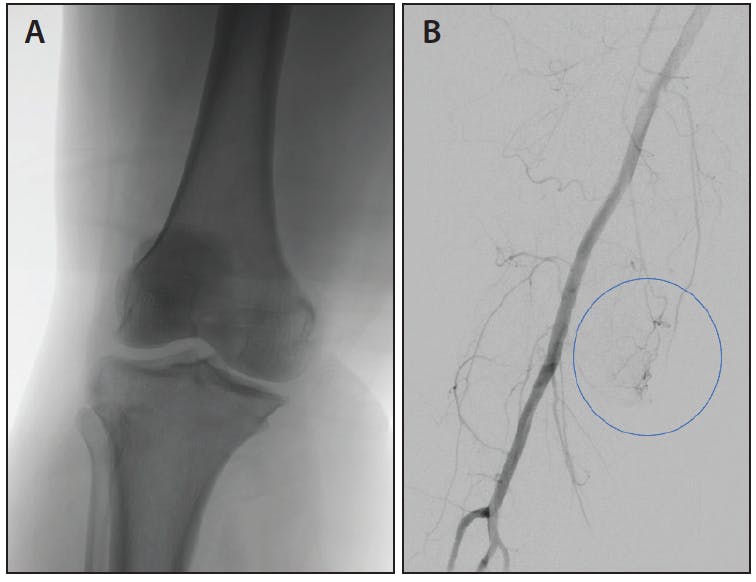
Figure 1. Fluoroscopic image of the right knee in a patient with moderate medial compartment OA (A). Corresponding angiogram demonstrating subtle hyperemia overlying the medial femoral condyle (circle) (B).
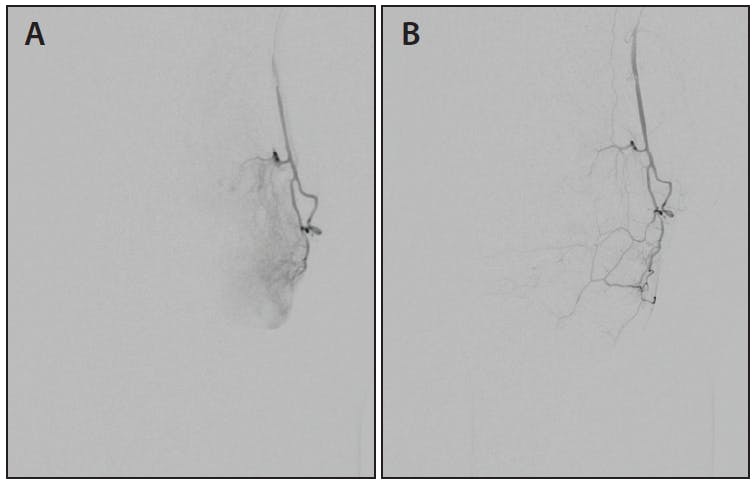
Figure 2. Selective angiogram from the right descending genicular artery demonstrating hyperemic synovial “blush” overlying the medial femoral condyle (A). Angiogram from the same location after embolization endpoint no longer demonstrating “blush,” but genicular arteries are still patent (B).
A final single cohort study was recently published by Little et al in the United Kingdom.9 Thirty-two patients underwent embolization with Embosphere microspheres (Merit Medical Systems, Inc.) and had significant improvement in pain and function out to 1 year after embolization. Additionally, synovitis was significantly reduced on 1-year follow-up MRIs of the knee. This reduction in postcontrast enhancement of the synovium is an important piece of data when determining who is appropriate for GAE and why clinical failure may have occurred. This study resulted in no major complications.
WHAT STILL HAS TO BE DONE
Because GAE is being evaluated as a pain therapy, it will be important to determine if the effect of the treatment is greater than placebo. A prospective, sham-controlled, randomized trial has been performed and is currently under review for publication. Preliminary results presented at the 2020 Society of Interventional Radiology (SIR) annual meeting demonstrated that GAE is significantly more effective than a sham angiogram in reducing pain and improving function 1 month after the procedure.10
One question that lingers in regard to GAE is where it might fit in within the spectrum of OA treatment. A GAE Research Consensus Panel organized by the SIR Foundation convened in January 2021 and included physicians from interventional radiology, orthopedics, rheumatology, and sports medicine. After some discussion, the consensus was that GAE could be an alternative to intra-articular injections in patients who have failed medical therapy but are not yet ready to undergo surgery. There is the potential for being able to achieve sustained pain relief after undergoing one procedure instead of having to return for periodic retreatments, as is the case most typically for injections. However, it was clear that GAE is not meant to be a replacement for total knee arthroplasty in patients with severe OA.
In order for GAE to be offered to patients across the United States, the Centers for Medicare & Medicaid Services and private insurance companies will need to approve reimbursement for it. For this to occur, larger clinical trials with comparison arms will need to be performed to prove the value of this treatment and convince guideline committees from various interested societies to include GAE in their knee OA treatment algorithms.
1. Ashraf S, Mapp PI, Walsh DA. Contributions of angiogenesis to inflammation, joint damage, and pain in a rat model of osteoarthritis. Arthritis Rheum. 2011;63:2700-2710. doi: 10.1002/art.30422
2. Sundaram K, Arnold NR, Mont MA, et al. Selective embolization is safe and effective for total knee arthroplasty-associated recurrent hemarthroses: a systematic review and meta-analysis. J Knee Surg. Published online December 29, 2019. doi: 10.1055/s-0039-3402482
3. Luyckx EGR, Mondelaers AMP, van der Zijden T, et al. Geniculate artery embolization in patients with recurrent hemarthrosis after knee arthroplasty: a retrospective study. J Arthroplasty. 2020;35:550-556. doi: 10.1016/j.arth.2019.09.014
4. Shanmugasundaram S, Chandra V, Kolber M, et al. Endovascular management of hemarthrosis in patients with bleeding diatheses: systematic review. Cardiovasc Intervent Radiol. 2020;43:362-368. doi: 10.1007/s00270-019-02367-7
5. Okuno Y, Korchi AM, Shinjo T, Kato S. Transcatheter arterial embolization as a treatment for medial knee pain in patients with mild to moderate osteoarthritis. Cardiovasc Intervent Radiol. 2015;38:336-343. doi: 10.1007/s00270-014-0944-8
6. Okuno Y, Korchi AM, Shinjo T, et al. Midterm clinical outcomes and MR imaging changes after transcatheter arterial embolization as a treatment for mild to moderate radiographic knee osteoarthritis resistant to conservative treatment. J Vasc Interv Radiol. 2017;28:995-1002. doi: 10.1016/j.jvir.2017.02.033
7. Lee SH, Hwang JH, Kim DH, et al. Clinical outcomes of transcatheter arterial embolisation for chronic knee pain: mild-to-moderate versus severe knee osteoarthritis. Cardiovasc Intervent Radiol. 2019;42:1530-1536. doi: 10.1007/s00270-019-02289-4
8. Bagla S, Piechowiak R, Hartman T, et al. Genicular artery embolization for the treatment of knee pain secondary to osteoarthritis. J Vasc Interv Radiol. 2020;31:1096-1102. doi: 10.1016/j.jvir.2019.09.018
9. Little MW, Gibson M, Briggs J, et al. Genicular artery embolization in patients with osteoarthritis of the knee (GENESIS) using permanent microspheres: interim analysis. Cardiovasc Intervent Radiol. Published online January 20, 2021. doi: 10.1007/s00270-020-02764-3
10. Bagla, Sandeep. Randomized sham controlled multicenter trial of genicular artery embolization to treat osteoarthritic pain. Presented at: Society of Interventional Radiology (SIR) 2020 Virtual; June 13-14, 2020.
Advertisement
Advertisement