Advertisement
Advertisement
August 2021
The Challenge of Calcium and Clot
Moderator: Leigh Ann O’Banion, MD;
Panelists: Yolanda Bryce, MD, RPVI; Laura Drudi, MD, CM, MSc, FRCSC; and Shant Vartanian, MD
CASE PRESENTATION
A man in his early 70s presented to the emergency department with sudden onset of acute left lower extremity pain, paresthesias, and rubor of the left foot. He had a long-standing history of presumed neurogenic claudication but had never had a vascular evaluation. His medical history was significant for mild coronary artery disease, obesity (body mass index, 40 kg/m2), and hyperlipidemia for which he was medically managed with aspirin 81 mg and a statin. Of note, he had a large ventral hernia with loss of domain, a necrotic wound on his lower pannus, and chronic fungal infections in his groins. He is a 40 pack-year smoker.
On physical examination, he had 2+ femoral, popliteal, and pedal pulses on the right and absent femoral, popliteal, and pedal pulses on the left. He had no audible Doppler signals in the left foot, which was cool, mottled, and with reduced sensation. He was immediately placed on a therapeutic heparin drip.
What would be your initial imaging modality of choice? Would you proceed directly to intervention?
Dr. Bryce: Although the diagnosis has been made clinically, there is value in having adequate imaging before an intervention for planning purposes. I would perform CTA before proceeding with an intervention.
Dr. Drudi: If the patient’s creatinine function is normal, I would first proceed immediately with a CTA of the abdomen, pelvis, and lower extremity. This would be followed by subsequent operative intervention given his Rutherford class 2a acute limb ischemia (ALI).
Dr. Vartanian: When time is of the essence and there is a clear explanatory mechanism for the abnormal pulse exam, I’m comfortable foregoing noninvasive imaging and jumping right to interventional treatment. That works with high-acuity, time-sensitive presentations where the initial treatment plan, informed by only the bedside examination, is likely to be executed without too many surprises and imaging introduces unnecessary delays. Classic examples are combined orthopedic vascular trauma or cardioembolism with ALI. In this case, without a clear history of arrhythmias or nonadherance to anticoagulation treatment, other etiologies of ALI come into play, such as acute-on-chronic atherosclerotic presentations or spontaneous dissection. In presentations like this, I prefer to have more information than less and will typically obtain cross-sectional imaging to help guide the interventional plan. This is particularly true if I’m practicing at a center that does not have a wide breadth of endovascular inventory that can handle any interventional situation thrown at it.
CASE CONTINUED
The patient underwent CTA, which revealed occlusive thrombus of the entire left iliac system; reconstitution of the common femoral artery (CFA), profunda femoris artery, and superficial femoral artery (SFA); and complete occlusion of the below-knee popliteal artery, with no visualized flow in the tibial arteries. There appeared to be heavily calcified plaque at the external iliac artery (EIA) origin (Figure 1).
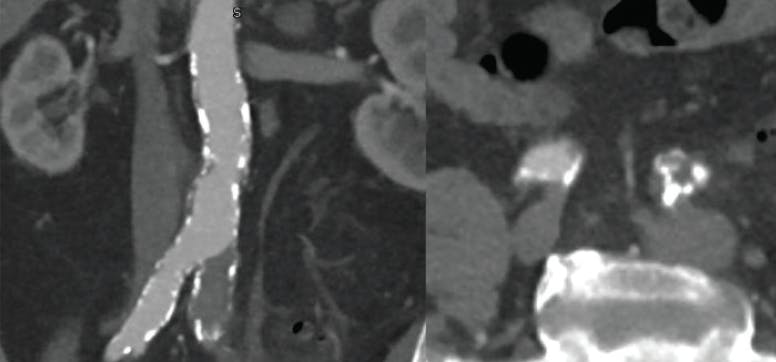
Figure 1.
Given the patient’s history and presentation, how would you approach revascularization? What type of access would you use (open or percutaneous) and at what location? Do the patient’s body habitus and hostile groins weigh into your decision-making? Is there a role for initial lytic therapy in this patient prior to treatment?
Dr. Drudi: The patient’s morbid obesity and hostile groins secondary to the chronic fungal infections would preclude open or percutaneous access in the groins. I would ensure the patient has no absolute contraindications to thrombolysis. I would initially attempt to puncture the right proximal SFA under ultrasound guidance and place a short 4-F sheath. I would then go up and over using a 4-F RIM catheter and would subsequently use a straight 0.035-inch Glidewire (Terumo Interventional Systems). If the wire traverses the clot easily, I would send the wire down into the left CFA and SFA. If I have difficulty with support while exchanging for a Glidecath (Terumo Interventional Systems), I would attempt to send the wire down to the popliteal artery. My initial plan would be to go sheathless and install my thrombolysis catheter. I would exchange the support catheter for a 4-F, 135- X 30-cm Uni-Fuse thrombolysis catheter (AngioDynamics) and proceed with administration of tissue plasminogen activator (tPA).
Given the patient’s Rutherford class 2a ALI, I would be comfortable commencing with thrombolysis, and with this approach, I would be able to address the thrombus in the inflow and outflow vessels. I would return the patient to the operating room the next day, perform an angiographic control to visualize the inflow and outflow vessels, and proceed with subsequent intervention of culprit lesions.
Dr. Vartanian: This looks like a presentation of acute-on-chronic peripheral artery disease with in situ thrombosis of an atherosclerotic common iliac lesion with distal thromboembolism. The ultimate goals of treatment here are twofold: clear the thrombus from the iliac lesion so that it can be adequately assessed and safely treated and deal with the popliteal thromboembolism that is resulting in ALI. Although acute thrombus responds well to lytic therapy, in the setting of ALI, you can have permanent nerve damage, irreversible tissue loss, and significant future disability if you wait too long to adequately revascularize the limb. In presentations with neurologic compromise, I would favor suction thrombectomy or catheter-directed thrombomechanical lysis for a more immediate effect over other methods of thrombus removal.
A necrotic pannus with active groin infections certainly makes CFA access unsavory. If the pathology was limited to the iliac system, I would consider arm access, but for treating popliteal and potentially tibioperoneal thromboembolism, brachial access would require special inventory and may not be reachable for most. Open exposure certainly gives you the most flexibility for revascularization, but the downside is that it limits thrombolysis options. Oozing from on-table lysis can be managed during an open exposure, but ongoing overnight lysis with an open wound carries unacceptable bleeding risk. In situations like this, where tibioperonal or pedal thromboembolism may be present and indwelling overnight thrombolysis could be necessary, I would favor a totally percutaneous approach. In this case, I would access the contralateral SFA retrograde, with a plan to remove access with a closure device.
Dr. Bryce: No mention is made of motor function but assuming that it is preserved, the patient has Rutherford class 2a ALI. I would plan overnight thrombolysis if the patient does not have any contraindications. Hopefully, we could find an entry spot in the groin that is not involved by his rash. I would access the contralateral groin and do an up-and-over approach. If the patient had Rutherford class 2b ALI, a faster approach than is afforded by lytic therapy may be indicated. In this case, I would consider a contralateral groin approach, preclose the groin with Perclose ProGlide closure devices (Abbott), and attempt aspiration thrombectomy with a CAT12 device (Penumbra, Inc.) given the size of the vessel.
CASE CONTINUED
Our treatment plan for the iliac disease was to attempt pharmacomechanical thrombectomy and address the iliac lesion once the clot had been adequately debulked. Due to the patient’s morbid obesity, hostile groins, and thrombus extending throughout the EIA, we made the decision to cut down on the mid-SFA and place our 12-F DrySeal sheath (Gore & Associates) through the SFA into the proximal CFA (Figure 2). The large sheath then provided protection from distal embolization into the profunda during treatment. We were able to maneuver a 0.035-inch angled Glidewire and Glidecath up into the aorta.
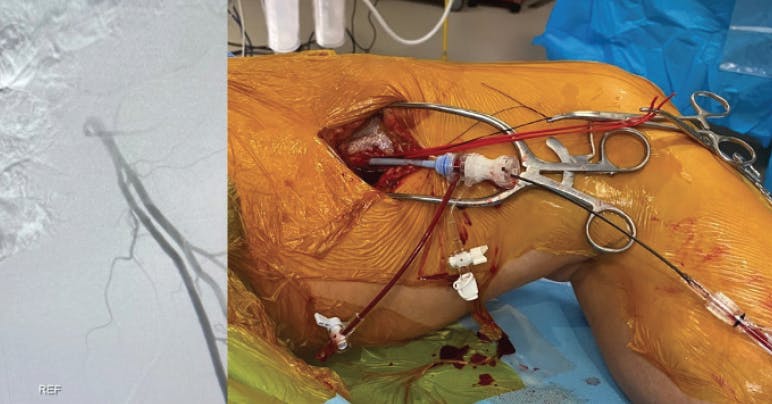
Figure 2.
What type of pharmacomechanical thrombectomy would you favor in this specific patient?
Dr. Vartanian: Once committed to an open exposure at the mid thigh, it’s tempting to want to pass a Fogarty embolectomy catheter retrograde to extract the thrombus. The downside is that the profunda is unprotected without the large sheath in place, and the clot can be pulled down into it with loss of the thigh circulation; we would ideally avoid this because the ipsilateral hypogastric artery is also likely to be lost. With extensive thrombus burden and a presentation that includes a neurologic deficit, the most expedient method would be aspiration thrombectomy. With thrombus originating flush at the aortic bifurcation, I also worry about embolizing down the contralateral leg during thrombus manipulation. Engaging the clot with suction, along with arterial pressure pushing on the other side of the thrombus, may help mitigate that risk. The high-grade iliac stenosis may not allow for a larger-caliber aspiration thrombectomy system to pass. In that case, I would debulk with the larger system as best I could, downsize to a smaller system, and only use catheter-directed thrombomechanical lysis if I couldn’t clear the thrombus across the lesion adequately.
Dr. Drudi: Prior to using a pharmacomechanical thrombectomy device, I would attempt to use the Rotarex S thrombectomy device (BD Interventional), which is ideal for thrombotic occlusions in inflow and outflow vessels. The rotation of the catheter tip creates a vortex in the circulation, helping to erode occlusive thrombus from the vessel lumen. The rotating tip creates negative pressure inside the device tube (Venturi effect) to act as a conveyor on which the removed material is transported.
I am most comfortable with the AngioJet thrombectomy system (Boston Scientific Corporation), which includes active aspiration and thrombolytic delivery. However, in this case, I would favor Rotarex for quick thrombus removal to rapidly restore blood flow.
Dr. Bryce: I would fully anticoagulate the patient and attempt aspiration thrombectomy with a CAT12 device.
CASE CONTINUED
tPA 10 mg was instilled across the thrombus and allowed to dwell for approximately 10 minutes. We then proceeded with mechanical thrombectomy using a CAT12 device, which was successful at debulking most of the clot. Aortography revealed the inciting lesion in the proximal EIA as well as some residual disease in the proximal common iliac artery (CIA). The right iliac system appeared normal (Figure 3).
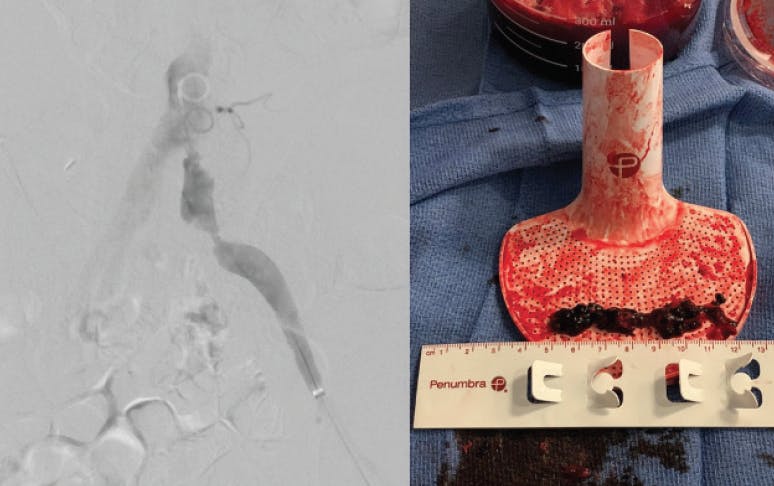
Figure 3.
How would you treat the residual disease and near-occlusive lesion in the iliac artery? Given the heavy calcification, would there be a role for intravascular lithotripsy (IVL)? Do you feel intravascular ultrasound (IVUS) plays a role in the successful treatment of this case?
Dr. Bryce: In examining the images, it appears that the stenosis is due to stenoses from atherosclerotic plaque and probably residual thrombosis. I would use IVUS to assess the severity of plaque and thrombosis. A covered stent such as Gore VBX (Gore & Associates) can be used to both address the stenosis and trap the clot. After stenting with a covered stent, if there is residual stenosis due to calcified atherosclerotic plaque, one may use IVL to further expand the vessel safely and with low trauma.
Dr. Drudi: The residual disease in the CIA would require stenting. Given how proximal the burden of disease is, this may require kissing stents. However, with a more magnified view of the common iliac system, I may see if I could perform only one stent on the left side. I would favor BeGraft peripheral stents (Bentley).
Dr. Vartanian: It is not clear to me whether these are tandem lesions or whether there is simply residual thrombus at the origin of the CIA. Looking at the original CT scan, I suspect it’s the latter, and I would try an additional pass of a thrombomechanical lysis catheter. Regardless, there is almost always residual thrombus adherent to the irregularly shaped atherosclerotic lesion, and I prefer to trap that against the artery wall with a covered stent. With focal common iliac lesions (even those that are densely calcified), a balloon-expandable covered stent typically works well. When it comes to sizing the stent, the preoperative CT scan is all you need for nominal arterial diameters, but the potential value of IVUS here is to precisely define the lesion length and how much artery we need to cover, especially if it’s not crystal clear on the digital subtraction angiogram.
CASE CONTINUED
We felt the burden of disease required kissing iliac stents to adequately treat the entire length of the CIA into the proximal EIA. The contralateral groin was percutaneously accessed with an 8-F sheath after deploying a Perclose device. Amplatz wires were placed into the aorta bilaterally, and 8-mm-long Gore VBX stents were deployed in a kissing fashion and expanded using 14-mm Armada balloons (Abbott). Postintervention angiography revealed widely patent stents and no residual thrombus within the entire aortoiliac system. The CFA and profunda were also widely patent (Figure 4). Angiography of the lower leg confirmed occlusion of the popliteal artery with no distal runoff (Figure 5).
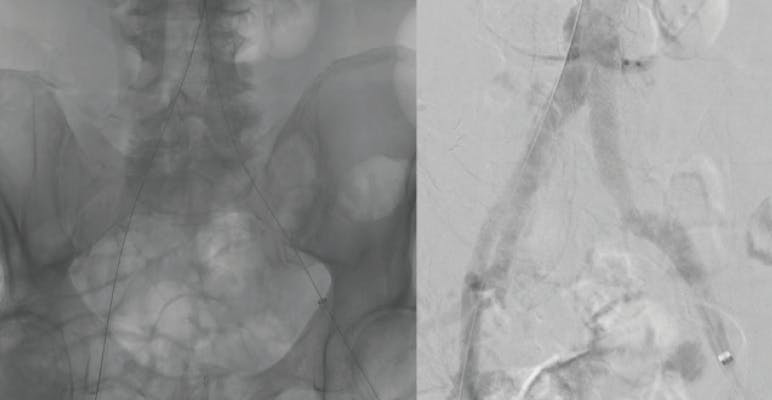
Figure 4.
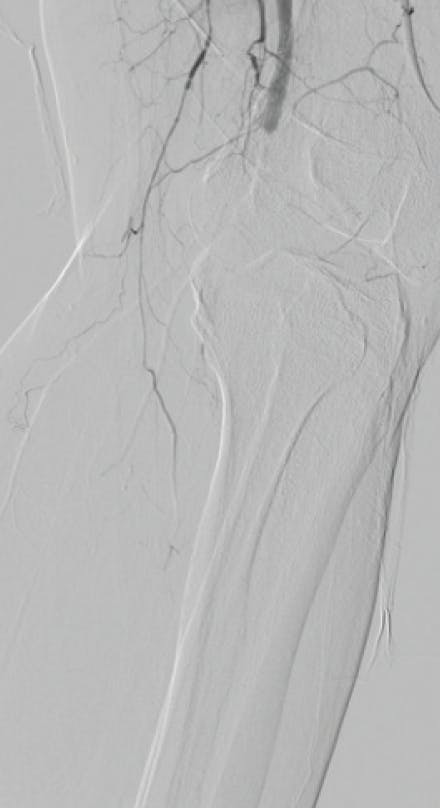
Figure 5.
How would you treat the popliteal and tibial occlusions?
Dr. Drudi: I would proceed with a below-knee popliteal cutdown visualizing the takeoff of the anterior tibial artery, followed by standard Fogarty embolectomy. I would guide my Fogarty balloon proximally and distally and then would guide the Fogarty catheter under visualization into the anterior tibial artery and subsequently into the tibioperoneal trunk. After the embolectomy, I would perform control angiography to visualize the runoff.
Dr. Vartanian: With an open exposure of the SFA just above the thromboembolism, it’s easy enough to pull the sheath and, working through the arteriotomy, pass a Fogarty embolectomy catheter antegrade across the thrombus. One issue with blindly passing the embolectomy catheter is that it’s not steerable, and the path of least resistance is often into the peroneal artery. If there is significant trifurcation thromboembolism that extends appreciably into any of the branches, it takes a lot of luck to completely extract the thrombus with this method. I’ve found over-the-wire embolectomy catheters to be very useful here, with a combination of fluoroscopic guidance and diluted contrast solution in the balloon to direct the catheter selectively into each of the involved tibial arteries.
One issue with using balloon-expandable kissing stents is that they can raise the aortic bifurcation, making contralateral femoral access very difficult, if not impossible. If we had started this case with percutaneous contralateral SFA access instead of open ipsilateral access, I would have treated the iliac lesion with plain old balloon angioplasty first, creating space to manage the popliteal thromboembolism and leaving the iliac stenting for last, assuming we had a good result with no need for additional overnight thrombolysis.
Dr. Bryce: The popliteal embolus/thrombosis may be addressed with aspiration thrombectomy. I would use a CAT8 at this level, as this patient’s vessels look very large overall. More distally, a CAT6 or CAT4 may be employed depending on the extent of the embolus/thrombosis.
CASE CONTINUED
Given the acuity of the patient’s presentation and the degree and duration of ischemia in the foot, four compartment fasciotomies were required. Thus, we elected to perform open Fogarty thromboembolectomy of the residual lower leg disease. The procedure was performed through the preexisting SFA arteriotomy and a below-knee incision. A large clot burden was removed, and pulsatile inflow and brisk outflow were restored. The completion angiogram demonstrated in-line flow via the anterior tibial artery into the foot, and the patient had a palpable dorsalis pedis pulse. Four compartment fasciotomies were then performed, and the case was concluded (Figure 6).
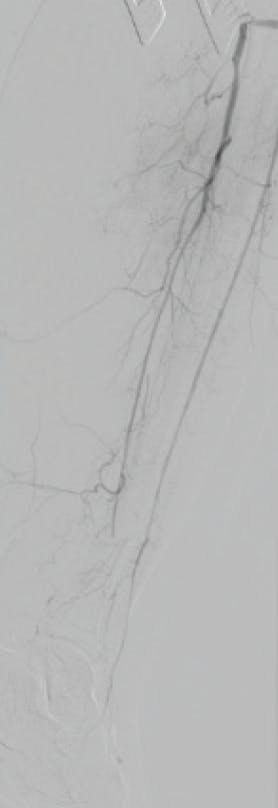
Figure 6.
What combination of antiplatelet and anticoagulation medication would you place this patient on, and how long would you continue anticoagulation in this patient?
Dr. Vartanian: Even in cases with an acute-on-chronic presentation, if the intervention was limited to the iliac artery and there was a good technical result without residual stenosis or evidence of untreated thromboembolism, I would feel comfortable managing the patient with antiplatelet therapy only. However, looking at this completion angiogram, although the limb is adequately revascularized, there does appear to be significant residual thrombus in the posterior tibial and plantar circulation. In these situations, I choose to anticoagulate the patient (typically with a novel oral anticoagulant) for up to 3 months in hopes of clearing some of the residual thrombus. Depending on the thrombus burden, some patients will have a palpable posterior tibial artery pulse a few weeks out from the procedure. In these situations, I typically confirm antegrade flow in the plantar bifurcation by ultrasound and transition from a novel oral anticoagulant back to antiplatelet therapy.
Dr. Bryce: Normally, I would elect that this patient is placed on dual antiplatelet therapy with aspirin and clopidogrel. However, lately I’ve been progressively using ultra-low-dose rivaroxaban (2.5 mg daily) with low-dose aspirin according to the study by Bonaca et al, which demonstrated decreased rates of adverse limb and other cardiovascular events in the study arm.1
Dr. Drudi: I would use rivaroxaban in combination with aspirin for life as long as there are no major bleeding events.
CASE CONCLUSION
The patient was transitioned to clopidogrel 75 mg and rivaroxaban 20 mg daily. His fasciotomies were closed prior to discharge. He remained on clopidogrel and rivaroxaban for 3 months, after which he transitioned to aspirin 81 mg and rivaroxaban 2.5 mg daily. At 3-month follow-up, he had no symptoms of claudication or rest pain with a palpable dorsalis pedis pulse on the left foot and ankle-brachial index of 0.9, but he continued to smoke.
MODERATOR’S SUMMARY
As we see the paradigm shift from historically pure open surgical management to a hybrid approach with new endovascular technology, we have the opportunity to expand our toolbox so that we can apply a tailored approach to each patient unique to their anatomy and pathology. Each expert panelist has provided a perspective on the myriad options available to treat acute-on-chronic limb ischemia. Catheter-directed thrombolysis, pharmacomechanical thrombectomy, IVUS, percutaneous stenting, and open surgical thromboembolectomy are all tools that can be used to successfully treat this patient from a variety of access options. There is no one right answer, and we are fortunate as vascular and endovascular physicians to have virtual platforms to engage in discussions on challenging patients to promote a continuous learning environment that strives to improve patient care.
1. Bonaca MP, Bauersachs RM, Anand SS, et al. Rivaroxaban in peripheral artery disease after revascularization. N Engl J Med. 2020;382:1994-2004. doi: 10.1056/NEJMoa2000052
Advertisement
Advertisement