Advertisement
Advertisement
January 2021 European Supplement
Sponsored by Getinge
COBEST Landmark Study Review
Study demonstrates long-term patency of covered stents versus bare-metal stents for aortoiliac occlusive disease.
*The Advanta V12 covered stent system is indicated for restoring and improving the patency of iliac and renal arteries. Renal approval includes 5–7-mm diameter Advanta V12 sizes. In Canada, the Advanta V12 covered stent indication excludes renal arteries. The Advanta V12 stent is not available in the United States.
Approximately 8.5 million people aged 40 years or older in the United States have peripheral artery disease (PAD),1 a consequence of an aging, less active population. Aortoiliac occlusive disease (AIOD) is one expression of PAD that results in partial or total vascular occlusion due to atherosclerosis. AIOD typically begins in the distal aortic segment near the origin of the common iliac arteries and progresses deceptively with concurrent, effective collateral development.2 Indications for intervention include disabling or progressive claudication, ischemic rest pain, and tissue loss. Based on the severity and ultimate diagnosis, current guidelines recommend either endovascular or surgical intervention for patients who have significant functional disability that is vocation- or lifestyle-limiting and otherwise unresponsive to medical or exercise therapy.
Reproducible classification systems are crucial to objective evaluation and treatment of patients and to validate clinical trials when comparing medical, surgical, and endovascular treatment paradigms. The TransAtlantic Inter-Society Consensus (TASC) II (updated in 2007 with increased emphasis on PAD) classifies AIOD by location and severity and recommends treatment options. Based on the group’s recommendations, TASC A lesions should garner excellent results from endovascular management alone; TASC B lesions should have good results from endovascular management, with endoluminal interventions as a first approach; TASC C lesions should receive superior long-term results from surgical management, with endovascular techniques reserved for surgical high-risk patients; and TASC D lesions should be treated by open surgery.3
Since the publication of the TASC II document in 2007, a number of scientific publications and observational reports have documented the rapid adoption of endovascular therapy as a primary strategy for the treatment of symptomatic PAD. Although TASC II provides a disciplined framework to compare therapeutic techniques, it has been the advancement of endovascular techniques that has resulted in an increase in the adoption of the endovascular-first strategy for even the most complex TASC II D lesions, thus decreasing the number of anatomies that are primarily referred for open surgical revascularization.4 COBEST is one such trial that supports an alternative treatment for the most complex of revascularization scenarios.5
STUDY OVERVIEW
In 2006, COBEST was the first multicenter trial to investigate the patency of covered stents over bare-metal stents (BMSs) for the treatment of AIOD. Conducted between January 2006 and December 2008 with 13 physicians across eight major Australian centers, COBEST started with 125 patients and 168 iliac arteries. Assignments were random and binary, with patients receiving either a balloon expandable covered stent (Advanta V12 balloon expandable covered stent, Getinge*) or a commercially available BMS.6
The Advanta V12 is a low-profile, premounted, balloon expandable covered stent made of radial expandable 316-L stainless steel that provides a smooth-flow lumen. Encapsulated within a patented one-piece polytetrafluorethylene covering, the technology enables uniform expansion without ridges or folds, prevents tissue from prolapsing through the expanded stent, and offers an effective barrier against neointimal hyperplasia.7
The primary endpoints of the initial study included freedom from binary restenosis and stent occlusion of the treated area, as determined by ultrasound imaging, quantitative visual angiography, or both. Secondary endpoints included stent patency (as assessed by the TASC classification), stent integrity, and target vessel revascularization. Postprocedural follow-up was conducted at 1, 6, 12, and 18 months.6
COBEST: 18-MONTH DATA
Aortoiliac lesions treated with the Advanta V12 were significantly more likely to remain free from binary restenosis than those treated with a BMS (Figure 1). Freedom from occlusion was higher in lesions treated with a covered stent than in those treated with a BMS. Subgroup analyses demonstrated a significant difference in freedom from binary restenosis for covered stents in TASC C and D lesions compared with BMSs.6
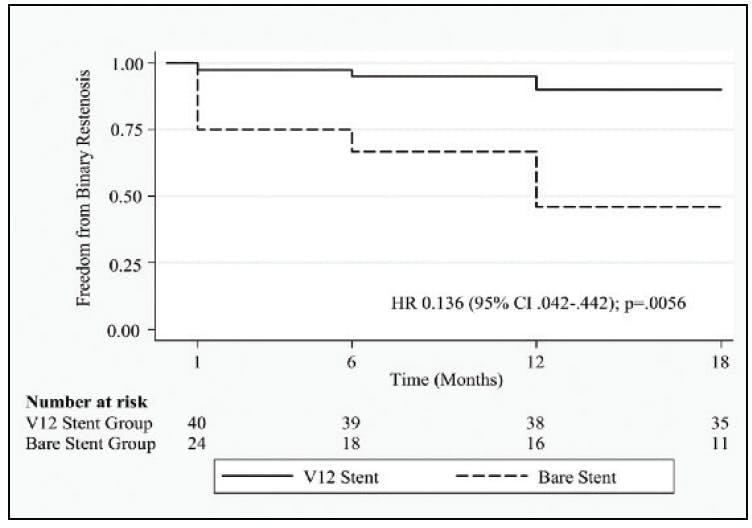
Figure 1. Kaplan-Meier curves demonstrating freedom from binary restenosis for the intention-to-treat population. HR, hazard ratio.
Results at 18 months also revealed that covered stents were superior to BMSs in maintaining patency for TASC C and D lesions and equivalent to BMSs for TASC A and B lesions. In addition, the covered stent group experienced fewer reinterventions compared with the BMS group at 6, 12, and 18 months.6
Unlike BMSs, covered stents can exclude plaque and endothelium, potentially mitigating late luminal loss by halting migration and proliferation of cells through open stent struts. This may result in a reduction of restenosis caused by intimal hyperplasia. Covered stents may also offer the benefit of being less thrombogenic than BMSs.6 The short-term results of the COBEST study warranted a follow-up review to determine if the initial patency advantage of covered stents compared with BMSs in aortoiliac lesions would be sustained in the longer term.
COBEST: 5-YEAR DATA
A retrospective post hoc analysis of COBEST was performed, extending the original 18-month data to 5 years to evaluate the durability of the initial results. With the 5-year data, 77 of the 125 patients (61.6%; 119 limbs, 62 in the covered stent group and 57 in the BMS group) were assessed at 60 months for the primary and secondary endpoints, with particular attention paid to outcomes stratified according to TASC lesion severity.5
The primary endpoint was the rate of primary patency, defined as uninterrupted patency (lack of stenosis of > 50% or occlusion of the treated segment) determined by ultrasound imaging or quantitative visual angiography after the procedure. The secondary endpoints included assisted primary patency, secondary patency, and freedom from all-cause death (probability of survival).5
The COBEST 5-year results showed that the Advanta V12 had a significantly higher patency rate than the BMS at 5 years (74.7% vs 62.9%). On subgroup analysis, the covered stent showed significantly higher patency (Figure 2) and survival benefit in TASC C and D lesions compared with the BMS. Moreover, fewer patients received target limb revascularization in the covered stent group than in the BMS group, with a twofold lower incidence of reintervention; however, there was no statistically significant difference in the rate of amputations between the groups.5
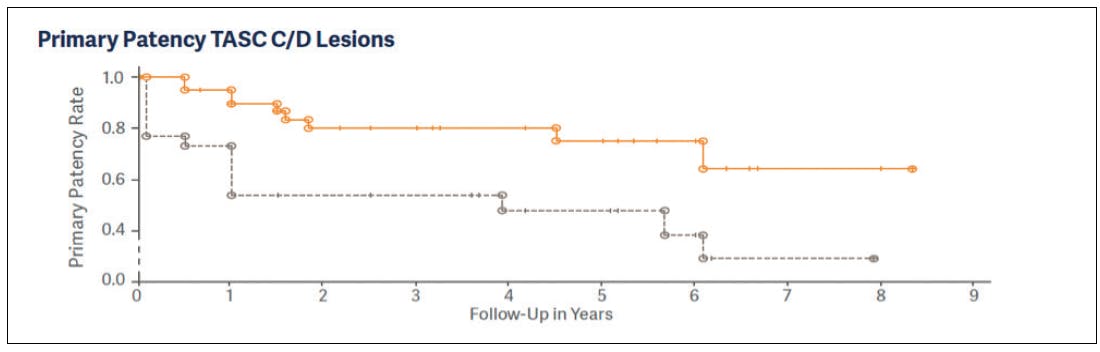
Figure 2. Patency evaluated at 18, 24, 48, and 60 months (Advanta V12: 95.1%, 82.1%, 79.9%, 74.7% vs BMS: 73.9%, 70.9%, 63%, 62.9%). Orange line = Advanta V12; dashed line = BMS.
ADVANTA V12: DESIGNED FOR SUPERIOR RESULTS
The Advanta V12 forms a mechanical barrier, excluding the plaque and endothelium, thereby limiting intimal hyperplasia by preventing migration of macrophages into the endothelium. If allowed to migrate into the endothelium, these macrophages release further proinflammatory agents (eg, cytokines) that contribute to initiating the process of neointimal hyperplasia and subsequent restenosis. BMSs do not form this protective barrier and hence may be associated with a higher risk of restenosis. In addition, the decreased risk of iliac rupture in patients who have covered stents may lead to improved dilation with the use of higher inflation pressures, which may also explain the poorer patency seen in patients with BMSs in this study.5 Produced by Getinge, the proven and trusted Advanta V12 is conformable, deliverable, and flexible to track through tortuous arteries and flex to accommodate the iliac arteries. Furthermore, its ability to postdilate up to 16 mm provides additional customization to the patient’s anatomy.
TAKEAWAY POINTS
- COBEST provides a basis for the use of Advanta V12 in AIOD, with a definite and enduring patency benefit in the long-term follow-up compared with the balloon expandable BMS.
- The benefit of covered stents was seen in more complex TASC C and D lesions, as demonstrated in the initial COBEST randomized controlled trial.
- Patients who receive Advanta V12 are less likely to need a reintervention.
CONCLUSION
COBEST has become a landmark study, supporting Advanta V12 as a choice of treatment in AIOD. The 5-year results of the COBEST trial demonstrate that the Advanta V12 has an enduring patency advantage over the BMS in both the short and long term. The Advanta V12 stent has been shown to consistently improve patient outcomes by restoring iliac patency, reducing restenosis and reintervention rates, improving ankle-brachial indices, and sustaining symptom relief.5 As the only covered stent with randomized controlled data up to 8 years, the Advanta V12 stent demonstrates superior patency versus BMSs year after year, even in the most challenging TASC C and D lesions.5
1. Benjamin EJ, Muntner P, Alonso A, et al. Heart disease and stroke statistics-2019 update: a report from the American Heart Association. Circulation. 2019;139:e56-528. doi: 10.1161/CIR.0000000000000659
2. Brown KN, Muco E, Gonzalez L. Leriche syndrome. In: StatPearls. StatPearls Publishing; 2020.
3. Hardman RL, Jazaeri O, Yi J, et al. Overview of classification systems in peripheral artery disease. Semin Intervent Radiol. 2014;31:378‐388. doi: 10.1055/s-0034-1393976
4. TASC Steering Committee; Jaff MR, White CJ, Hiatt WR, et al. An update on methods for revascularization and expansion of the TASC lesion classification to include below-the-knee arteries: a supplement to the inter-society consensus for the management of peripheral arterial disease (TASC II). Vasc Med. 2015;20:465-478. doi: 10.1177/1358863X15597877
5. Mwipatayi BP, Sharma S, Daneshmand A, et al. Durability of the balloon-expandable covered versus bare-metal stents in the covered versus balloon expandable stent trial (COBEST) for the treatment of aortoiliac occlusive disease. J Vasc Surg. 2016;64:83‐94.e1. doi: 10.1016/j.jvs.2016.02.064
6. Mwipatayi BP, Thomas S, Wong J, et al. A comparison of covered vs bare expandable stents for the treatment of aortoiliac occlusive disease. J Vasc Surg. 2011;54:1561‐1570. doi: 10.1016/j.jvs.2011.06.097
7. Data on file at Getinge.
PN011605 REVAA
Advertisement
Advertisement