Advertisement
Advertisement
January 2021 European Supplement
Sponsored by Getinge
Synopsis of “A Systematic Review of Covered Balloon-Expandable Stents for Treating Aortoiliac Occlusive Disease”
Reviewing an extensive literature analysis on Advanta V12 compared with other covered balloon expandable stents for patients with complex aortoiliac lesions.
The Advanta V12 balloon expandable covered stent is CE marked and TGA approved for restoring and improving the patency of iliac and renal arteries. Renal approval is for 5–7-mm diameter arteries. Advanta V12 has Canadian Health Ministry license for restoring the patency of iliac lesions. The Advanta V12 stent is not available in the United States.
“A Systematic Review of Covered Balloon-Expandable Stents for Treating Aortoiliac Occlusive Disease” is the first extensive analysis that supports the use of covered balloon expandable (CBE) stents as a viable solution to treat aortoiliac occlusive disease (AIOD), even for complex cases when lesions have a higher percentage of occlusions.1 Conducted by B. Patrice Mwipatayi, MD, et al, this peer-reviewed work was recently published in the Journal of Vascular Surgery. The review outlines key differences between Advanta V12 balloon expandable covered stent (Getinge) and its competitors in objective clinical terms.1 With more than 15 years of clinical experience and the only stent included in the review used in real-world procedures, the Advanta V12 is a trusted, reliable, proven solution for the treatment of aortoiliac disease.2-7 In this article, we distill the results of this seminal review and support the claims of safety, efficacy, and advantages of the Advanta V12.
METHODOLOGY
Utilizing Medline and the Cochrane Library, researchers employed an exhaustive search of the literature to identify relevant studies published between 2000 and 2019, which resulted in 404 references. Baseline anatomic variables, procedural variables, and outcome data were identified and compared. Outcomes of interest included technical success, ankle-brachial index (ABI), primary and secondary patency, freedom from target lesion revascularization (TLR), amputation, 6-month mortality, and 12-month mortality. Eight exclusion criteria were developed, including “no data on CBE stents” and “not related to AIOD treatment,” among others. These criteria helped screen the initial 404 references down to 14 studies (eight prospective, six retrospective) tied to five CBE stents, including Advanta V12 (nine studies), Viabahn VBX (Gore & Associates; two studies), BeGraft (Bentley; one study), LifeStream (BD Interventional; one study), and Jostent (Abbott; one study).
BACKGROUND
During the past 20 years, endovascular strategies have become the preferred treatment for mild to moderate AIOD.6 Long, diffuse, heavily calcified lesions continued to create risk of technical failure, with stenting of TransAtlantic Inter-Society Consensus (TASC) C/D lesions associated with long-term primary patency rates that were lower than with surgical bypass. This was confirmed in TASC II guidelines that recommended open surgery for TASC D (and some TASC C) lesions.6
Despite this guidance to the contrary, practitioners are gravitating toward endovascular approaches, even with TASC C/D lesions. Physicians are increasingly concerned that patients with complex lesions often have comorbidities, present greater risk for open surgery, and require significant hospital resources to treat. Although primary patency rates achieved after stenting complex lesions are not likely to surpass those of the surgical approach, secondary patency rates after stenting TASC C/D lesions are approximately equivalent. This narrowing of outcomes across lesion types emboldened the American College of Radiology to advocate an endovascular-first approach in its 2017 appropriate use criteria, regardless of TASC classification.8
STUDY OVERVIEW
The complete review of the 14 selected studies included 1,012 patients and 1,463 limbs treated with CBE stents for AIOD. Of these, 680 patients and 926 limbs were treated in a clinical trial, and 332 patients and 537 limbs were treated in real-world settings. The Advanta V12 was included in all six retrospective studies. Three of the 14 studies had a two-arm design, with bare-metal stent (BMS) as the comparator. All others were single-arm studies.
There was a significant disparity between the clinical trial and real-world populations concerning disease severity and lesion characteristics. Patients treated in clinical trials had far less severe lesions than those treated in real-world settings. For example, < 15% of TASC D lesions were treated in the clinical setting. Likewise, occlusions were treated at a rate of 8.8% to 17.1% in the clinical setting compared with 42.6% to 63.3% in the retrospective real-world population. Technical success was similar for both groups, with 98% to 100% in the trials and 95% to 100% in the real-world studies. Low rates of procedural complications (< 16.8%) were observed in both settings, with vessel dissections and hematomas as the most common.1
RESULTS
The clinical trial setting achieved slightly higher primary patency rates compared to real-world studies, ranging from 89.1% to 96.9% in the clinical trial setting and 83.6% to 92% in real-world studies at 1 year. Secondary patency rates were similar across both settings. Four of five retrospective studies indicated secondary patency rates from 95% to 100%. There were three clinical trials with available 12-month secondary patency data (two with Viabahn VBX, one with LifeStream on 9-month patency), ranging from 91.9% to 100%. Interestingly, secondary patency rates were similar for TASC C/D and TASC A/B lesions among studies reporting 12-month data.1
A smaller chasm was observed in TLR data between real-world settings and clinical studies. In the three retrospective studies reporting freedom from TLR at 12 months, rates ranged from 89.6% to 100%; however, the rates ranged from 96.1% to 97.4% in five prospective studies.1
ABI values were reported in eight studies. The greatest ABI improvement was exhibited by the Advanta V12 in Bosiers et al, with a mean ABI measurement of 0.59 at baseline, 0.98 immediately poststenting, and 0.99 at 12 months.4 The smallest ABI improvement was reported by Holden et al with the Gore CBE stent, which reported mean ABI measurements of 0.79 at baseline and 0.95 at 12 months.9 Combining the eight studies with pre- and poststenting ABI values, measurements ranged from 0.59 to 0.77 prestenting and from 0.84 to 0.99 at 12 months.1
DEVICE COMPARISON
The Advanta V12 was the most prolific device studied in the literature (67%) and was used in the treatment of 60% of the 1,012 patients. The Viabahn VBX was the focus of two articles (13%; 164 patients). The LifeStream (155 patients), BeGraft (70 patients), and Jostent (12 patients) were each included in one article. The Advanta V12 population also included more TASC D lesions than the other devices (approximately 28% for Advanta V12 vs 1%, 3%, and 7% for LifeStream, BeGraft, and Viabahn VBX, respectively). Most lesions treated with the LifeStream (62%) and BeGraft (77%) were TASC A. The increased complexity of the Advanta V12 population is due to a preponderance of real-world procedures. Equally significant, the Advanta V12 also had the longest published follow-up, up to 60 months compared with 6 to 12 months for the other devices.1
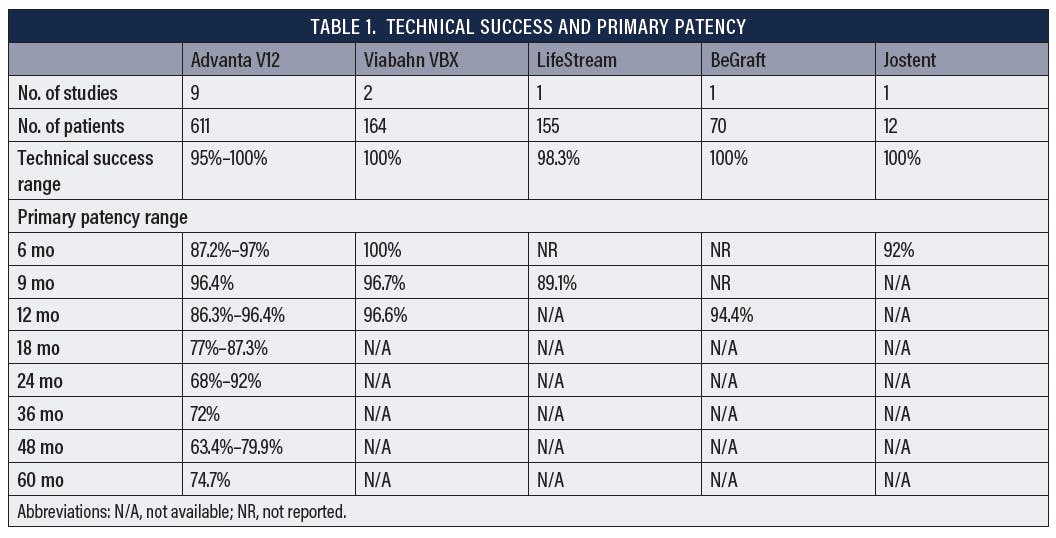
All devices reported primary patency; however, different time durations and definitions were used, complicating comparisons. The randomized prospective study of Advanta V12 (COBEST) and four retrospective studies (each also employing Advanta V12) reported a 24-month primary patency range of 72% to 92% and a 24-month secondary patency range of 92% to 100%. The Viabahn VBX trials reported 6-, 9-, and 12-month primary patency rates of 100%, 96.7%, and 96.6%, respectively. The single-arm investigational device exemption trial evaluating LifeStream reported a 9-month primary patency of 89.1%. At 1 year, the BeGraft primary patency rate was 94.4%. Jostent had only one recorded primary patency rate: 92% at 6 months. The COBEST trial with the Advanta V12 was the only study to report longer-term primary patency data, with durations at 48 (79.9%) and 60 (74.7%) months (Table 1).1
COMPARISONS WITH BMS
Three studies evaluated outcomes with CBE stents versus BMSs (one randomized controlled trial, two retrospective studies). In COBEST, 83 patients treated with the Advanta V12 were compared with 85 patients treated with balloon expandable and self-expanding BMSs. Although the baseline characteristics were similar, a greater percentage of patients treated with the Advanta V12 had TASC C/D lesions (49.2% vs 27.3%). At 5 years, primary patency was significantly higher in the Advanta V12 group (74.7% vs 62.9%), despite its higher degree of lesion severity. Secondary patency was not statistically different, but rates were significantly higher in patients with TASC C/D lesions treated with the Advanta V12 CBE.1
DISCUSSION
Direct comparisons among stents should be made cautiously due to differences in lesion severity, patient populations, and follow-up lengths. The reviewed clinical trial studies were composed of patients with mild to moderate AIOD and simple lesions, based on study designs to meet regulatory approval. For example, the two Viabahn VBX studies excluded patients with lesions requiring atherectomy or laser ablation and enrolled patients with the shortest lesion lengths of the reviewed studies, ultimately reporting the best primary patency rates at 12 months.1
The retrospective studies that used the Advanta V12 were largely all-comer studies that provided realistic anatomic profiles to physicians who choose CBE stents in actual practice. These patients had a high percentage of TASC C/D lesions, chronic total occlusions, and critical limb ischemia. Logically, advanced lesion severity would be associated with more procedural complications and diminished 12-month primary patency rates. However, there was little difference between real-world and clinical trial outcomes with respect to 12-month patency. The same was true at 24 months; however, outcomes beyond 12 months were limited to only the Advanta V12, preventing head-to-head comparisons with other CBE stents. The technical success and freedom from TLR were also similar among all devices at 12 months. Again, beyond 12 months, data were only available for the Advanta V12.1
Comparisons of BMS versus CBE are also important, with the decision often based on cost (BMSs are less expensive). However, the higher cost of CBE stents might be offset by improved outcomes through reduced reintervention rates. Covered stents also avoid appositional defects and their attendant hemodynamic consequences, as well as the potential for hyperplastic ingrowth through BMS interstices, creating a smoother lumen. Additionally, the covering of a CBE device likely protects against iliac artery rupture or disruption, as illustrated by the low procedural complication rates.1
TAKEAWAY POINTS
- Long-term data were only available for the Advanta V12, which had a primary patency rate of 74.7% at 5 years.
- The Advanta V12 is the only CBE stent with evidence from real-world studies, with a greater severity of cases compared to other CBE stents.
CONCLUSIONS
The reviewed data clearly provide evidence of CBE stents as effective treatment for AIOD, demonstrating high technical success and 12-month patency rates. In addition, the data support CBE stents compared with BMSs for complex aortoiliac lesions because of their benefits—which, at least for Advanta V12, appear to last up to 5 years. However, with favorable long-term data only available for one device (Advanta V12) used in real-world settings, new randomized trials are needed to compare different stent designs (ie, self-expanding and balloon expandable) and their impacts on outcomes.1
1. Mwipatayi BP, Ouriel K, Anwari T, et al. A systematic review of covered balloon-expandable stents for treating aortoiliac occlusive disease. J Vasc Surg. 2020;72:1473-1486.e2. doi: 10.1016/j.jvs.2020.01.084
2. Mwipatayi BP, Thomas S, Wong J, et al. A comparison of covered vs bare expandable stents for the treatment of aortoiliac occlusive disease (COBEST). J Vasc Surg. 2011;54:1561-1570. doi: 10.1016/j.jvs.2011.06.097
3. Cerezo M, Tinto G. Long term results (7 years) of the use of a new peripheral covered stent. Endovasc Techniques. 2008;11:2371-2379.
4. Bosiers M, lyer V, Deloose K, et al. Flemish experience using the Advanta V12 stent-graft for the treatment of iliac artery occlusive disease. J Cardiovasc Surg (Torino). 2007;48:7-12.
5. Chang R, Goodney P, Baek J, et al. Long-term results of combined common femoral endarterectomy and iliac stenting/stent grafting for occlusive disease. J Vasc Surg. 2008;48:362-7. doi: 10.1016/j.jvs.2008.03.042.
6. Mwipatayi BP, Sharma S, Daneshmand A, et al. Durability of the balloon-expandable covered versus bare-metal stents in the covered versus balloon expandable stent Trial (COBEST) for the treatment of aortoiliac occlusive disease. J Vasc Surg. 2016;64:83-94.e1. doi: 10.1016/j.jvs.2016.02.064
7. Harris W, Lesar C, Sprouse L, et al. Covered stents convey improved performance over bare-metal stents for artherosclerotic renal artery stenosis. J Vasc Surg. 2013;57(suppl):92S. doi: 10.1016/j.jvs.2013.02.216
8. Expert Panel on Interventional Radiology; Copelan AZ, Kapoor BS, AbuRahma AF, et al. ACR Appropriateness Criteria® iliac artery occlusive disease. J Am Coll Radiol. 2017;14(suppl):S530-S539. doi: 10.1016/j.jacr.2017.08.039
9. Holden A, Merrilees S, Buckley B, et al. First-in-human experience with the Gore balloon-expandable covered endoprosthesis in iliac artery occlusive disease. J Endovasc Ther. 2017;24:11-18. doi: 10.1177/1526602816680570
PN011604 REVAA
Advertisement
Advertisement