Advertisement
Advertisement
July 2021 Supplement
Sponsored by The PERT Consortium®
COVID-19 and Venous Thromboembolic Disease: Where Are We Today?
What is currently known about the pathophysiology of the SARS-CoV-2 virus, prevalence of venous thromboembolism in COVID-19 patients, and the current approach to anticoagulation.
The devastating impact of COVID-19 on global health care delivery, especially intensive care medicine, has been unparalleled. A substantial contributor to this impact is the predilection of the severe acute respiratory syndrome coronavirus 2 (SARS-CoV-2) virus for the respiratory tract, which in turn leads to an elevated transmission rate along with a propensity for lung infection and severe hypoxemia frequently requiring intensive care unit (ICU) level of care. Early in the pandemic, numerous reports emphasized an increased incidence of venous thromboembolism (VTE) in the setting of SARS-CoV-2 infection, prompting many to suggest a change in VTE prophylaxis for these patients.1 In addition, autopsy reports suggested multiple thrombi present in the lungs of COVID-19 patients, raising the specter of a viral-induced coagulopathy and/or vasculitis.2 By coupling this concept with the well-described “cytokine storm”3 induced by this coronavirus, the lungs have the potential to be damaged on all levels, further escalating the challenge in caring for these patients.
PATHOPHYSIOLOGY OF SARS-CoV-2
At the basic level, SARS-CoV-2 relies on the angiotensin-converting enzyme 2 (ACE 2) and transmembrane serine protease 2 (TMPRSS2) receptors for cell entry.4 These critical host entry receptors are both heavily concentrated within the pulmonary vascular endothelium and in alveolar epithelial cells, which explains in part the tremendous pulmonary pathophysiology seen with COVID-19. The vascular endothelium is a dynamic system, and its activation triggers a cascade of inflammation via numerous cellular mechanisms. The cytokine storm phenomenon ensues, with elevated levels of biomarkers including fibrinogen, interleukin-6, von Willebrand factor, tumor necrosis factor-α, C-reactive protein, D-dimer, and others. Additionally, the endotheliopathy induced by SARS-CoV-2 infection can induce a hypercoagulable state, leading to an increase in the incidence of thromboembolism (including arterial thrombosis), also termed as “CAC” or COVID-19–associated coagulopathy.5 In a landmark early autopsy study of COVID victims, the lungs showed diffuse alveolar damage, severe endothelial injury, and a unique preponderance of widespread thrombosis with microangiopathy in the vascular beds.2 This hypercoagulable state along with a high prevalence of traditional risk factors for VTE among COVID-19 patents, such as immobility, central venous catheters, and critical illness, has further spurred interest into how to prevent these vascular events.
PREVALENCE OF VTE IN COVID-19 PATIENTS
The true prevalence of VTE in patients with COVID-19 is unclear and varies widely among studies. This is due to the tremendous difficulty in performing CTA on many patients due to fear of spread, as well as the critically ill, severely hypoxemic nature of these patients precluding their safe transport outside of the ICU. Evidence for this most recently came from a single-center study at a New York academic hospital examining the number of pulmonary embolism response team (PERT) activations during the pandemic. In this study, Finn and colleagues reported a much lower use of CTA for the definitive diagnosis of pulmonary embolism (PE) in COVID-19 patients compared to historical controls (58.1% vs 92.3%; P = .001), likely leading to an underdiagnosis of PE in these patients.6 The literature is also fraught with the confounders of various strategies of anticoagulation used in these patients, which makes the true incidence unknown to date. Kollias et al recently demonstrated a pooled prevalence of PE and deep vein thrombosis of 32% (95% CI, 25%-40%) and 27% (95% CI, 21%-34%), respectively, across 47 studies performed through the end of September 2020.7 Although the true prevalence is unknown and the numbers vary by study, all reported studies show a higher incidence of VTE in COVID-19 patients compared to those without COVID-19 based on historical data. Even in view of potential selection bias in clinical studies, the numbers are high.
ANTICOAGULATION IN COVID-19 PATIENTS
The higher prevalence of VTE in COVID-19 patients has prompted numerous studies evaluating various levels of aggressiveness of prophylactic anticoagulation in an attempt to effectively prevent this potentially fatal complication. Most recently, the INSPIRATION randomized trial, conducted at 10 centers in Iran, showed no difference between intermediate-dose (enoxaparin, 1 mg/kg daily) and standard prophylactic dose (enoxaparin, 40 mg daily) anticoagulation in 562 COVID-19 patients admitted to the ICU on the composite endpoint of adjudicated venous or arterial thrombosis, treatment with extracorporeal membrane oxygenation, or mortality within 30 days.8 However, in this trial, mortality in each group was > 40% (ie, much higher than at most United States academic hospitals treating a large number of COVID-19 patients), and thus it is unclear if these results can be extrapolated to United States centers. Several multicenter randomized trials (ACTIV-4a,9 ATTACC,10 PROTHROMCOVID,11 REMAP-COVID12) evaluating various anticoagulant dosing strategies for VTE prophylaxis in hospitalized COVID-19 patients have been conducted. The preliminary report for those patients with severe COVID-19 enrolled in the REMAP-CAP, ACTIV-4a, ATTACC open-label, adaptive, multiplatform, randomized, anticoagulation trials (> 400 sites worldwide in total) has been released,13 but the final report should offer useful insight.
These and other trials involving various permutations of antithrombotics, antiplatelets, and other strategies to combat VTE in these patients have been recently summarized.14 At present, there is no single risk score that has been proven to effectively predict which patients with COVID-19 are at the highest risk for VTE nor the optimal prophylaxis or treatment for these patients. Currently, clinicians must use the available data combined with clinical judgment regarding patient-specific risk factors for both VTE and bleeding. When all of the clinical trial data are ultimately available for analysis, we must rigorously and critically analyze them, taking into account the various forms of bias that are present in most and use them to the best of our abilities.
PERT Consortium® Consensus Recommendations
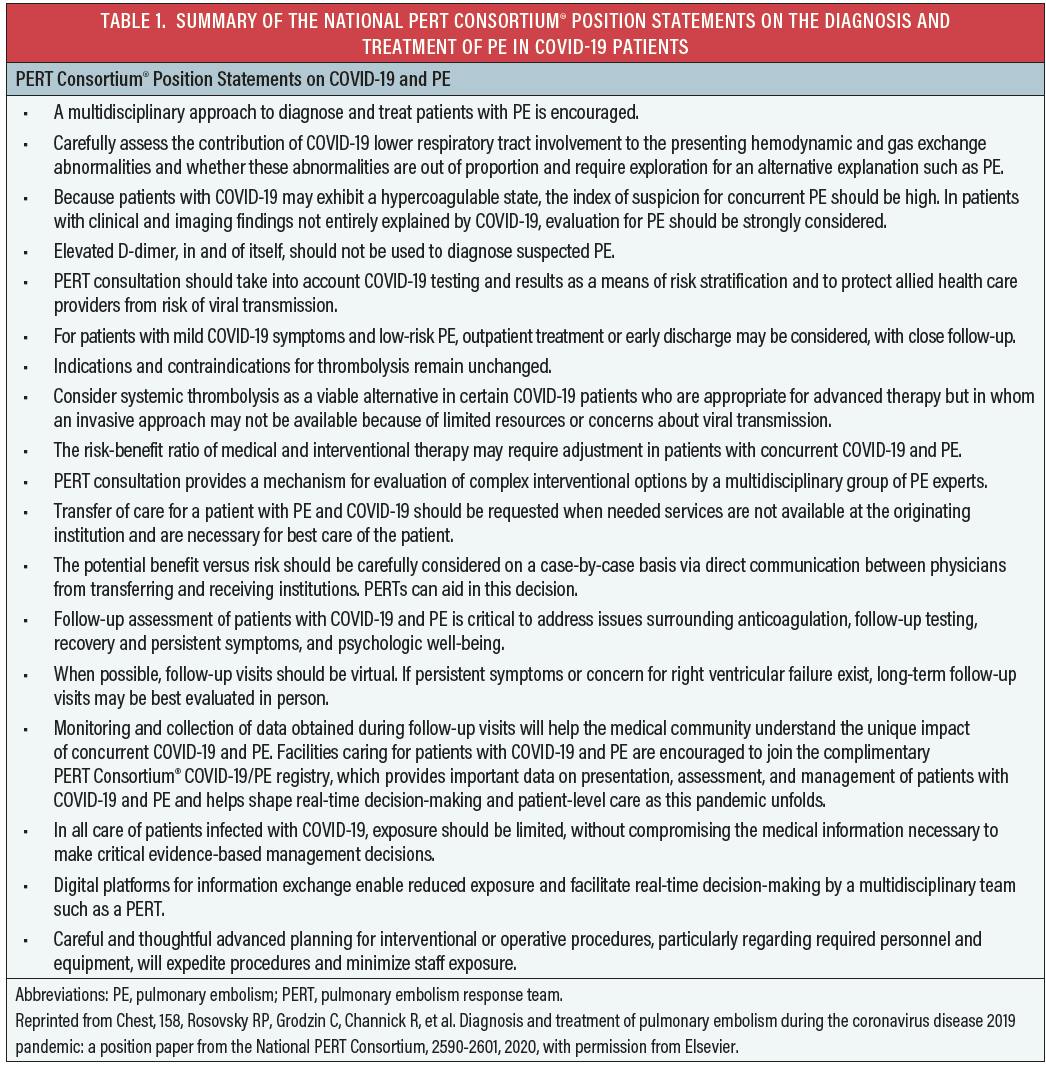
The pandemic has also provided a unique forum for the creation and expansion of PERTs across the globe. Born from a multidisciplinary approach to VTE, The National PERT Consortium® is the largest organization in the world specifically dedicated to improving outcomes in acute PE. The PERT Consortium® has provided consensus recommendations for the diagnosis, treatment, and follow-up of patients with acute PE15 and recently provided an update for COVID-19 patients.16 The position statements are summarized in Table 1. The PERT Consortium® emphasizes the need for a multidisciplinary approach in those patients who may have two simultaneous critical cardiopulmonary conditions (COVID-19 and PE) while being limited in diagnostic testing abilities, all in a setting designed to optimize patient outcomes while protecting health care personnel from viral transmission.
CONCLUSION
The complexity of care required to optimize outcomes in critically ill patients with COVID-19 is staggering. Standardized treatment protocols based on the most recent literature must constantly evolve, and this requires a true multidisciplinary team. No one specialty can offer the medical literature vigilance nor the expertise required in such a constantly changing clinical environment; thus, clinicians should consider the creation of COVID-19 teams with expertise in pulmonary, critical care, cardiology, hematology/oncology, vascular medicine,17 vascular surgery, cardiothoracic surgery, radiology, and pharmacy to ensure the development of order sets that are as standardized as the available evidence base will permit to successfully prevent and treat VTE in critically ill COVID-19 patients. Sound clinical judgment by these expert teams will still be required in this complex and continuously changing area of medicine.
1. Tan BK, Mainbourg S, Friggeri A, et al. Arterial and venous thromboembolism in COVID-19: a study-level meta-analysis. Thorax. Published online February 23, 2021. doi: 10.1136/thoraxjnl-2020-215383
2. Ackermann M, Verleden SE, Kuehnel M, et al. Pulmonary vascular endothelialitis, thrombosis, and angiogenesis in Covid-19. N Engl J Med. 2020;383:120-128. doi: 10.1056/NEJMoa2015432
3. Fajgenbaum DC, June CH. Cytokine storm. N Engl J Med. 2020;383:2255-2273. doi: 10.1056/NEJMra2026131
4. Hoffmann M, Kleine-Weber H, Schroeder S, et al. SARS-CoV-2 cell entry depends on ACE2 and TMPRSS2 and is blocked by a clinically proven protease inhibitor. Cell. 2020;181:271-280.e8. doi: 10.1016/j.cell.2020.02.052
5. Iba T, Connors JM, Levy JH. The coagulopathy, endotheliopathy, and vasculitis of COVID-19. Inflamm Res. 2020;69:1181-1189. doi: 10.1007/s00011-020-01401-6
6. Finn MT, Gogia S, Ingrassia JJ, et al. Pulmonary embolism response team utilization during the COVID-19 pandemic. Vasc Med. Published online April 4, 2021. doi: 10.1177/1358863X21995896
7. Kollias A, Kyriakoulis KG, Lagou S, et al. Venous thromboembolism in COVID-19: a systematic review and meta-analysis. Vasc Med. Published online April 4, 2021. doi: 10.1177/1358863X21995566
8. INSPIRATION investigators; Sadeghipour P, Talasaz AH, Rashidi F, et al. Effect of intermediate-dose vs standard-dose prophylactic anticoagulation on thrombotic events, extracorporeal membrane oxygenation treatment, or mortality among patients with COVID-19 admitted to the intensive care unit: the INSPIRATION randomized clinical trial. JAMA. 2021;325:1620-1630. doi: 10.1001/jama.2021.4152
9. Anti-thrombotics for adults hospitalized with COVID-19 (ACTIV-4). Clinicaltrials.gov website. Accessed June 7, 2021. https://clinicaltrials.gov/ct2/show/NCT04505774
10. Houston BL, Lawler PR, Goligher EC, et al. Anti-thrombotic therapy to ameliorate complications of COVID-19 (ATTACC): study design and methodology for an international, adaptive Bayesian randomized controlled trial. Clin Trials. 2020;17:491-500. doi: 10.1177/1740774520943846
11. Standard vs high prophylactic doses or anticoagulation in patients with high risk of thrombosis admitted with COVID-19 pneumonia (PROTHROMCOVID). Clinicaltrials.gov website. Accessed June 7, 2021. https://clinicaltrials.gov/ct2/show/NCT04730856
12. Randomized, embedded, multifactorial adaptive platform trial for community-acquired pneumonia (REMAP-CAP). Clinicaltrials.gov website. Accessed June 7, 2021. https://clinicaltrials.gov/ct2/show/NCT02735707
13. The REMAP-CAP, ACTIV-4, ATTACC investigators; Zarychanski R. Therapeutic anticoagulation in critically ill patients with Covid-19—preliminary report. medRxiv. 2021. doi: 10.1101/2021.03.10.21252749
14. Talasaz AH, Sadeghipour P, Kakavand H, et al. Recent randomized trials of antithrombotic therapy for patients with COVID-19: JACC state-of-the-art review. J Am Coll Cardiol. 2021;77:1903-1921. doi: 10.1016/j.jacc.2021.02.035
15. Rivera-Lebron B, McDaniel M, Ahrar K, et al. Diagnosis, treatment and follow up of acute pulmonary embolism: consensus practice from the PERT Consortium. Clin Appl Thromb Hemost. 2019;25:1076029619853037. doi: 10.1177/1076029619853037
16. Rosovsky RP, Grodzin C, Channick R, et al. Diagnosis and treatment of pulmonary embolism during the coronavirus disease 2019 pandemic: a position paper from the National PERT Consortium. Chest. 2020;158:2590-2601. doi: 10.1016/j.chest.2020.08.2064
17. Han H, Barnes GD. PERTinent new insights into venous thromboembolism risk and management in hospitalized patients with COVID-19. Vasc Med. Published online May 20, 2021. doi: 10.1177/1358863X211012776


Advertisement
Advertisement