Advertisement
Advertisement
July 2021 Supplement
Sponsored by The PERT Consortium®
The HI-PEITHO Study of Ultrasound-Facilitated, Catheter-Directed Thrombolysis Versus Anticoagulation
The first large randomized controlled trial of an intervention versus anticoagulation for patients with acute intermediate–high-risk pulmonary embolism.
By Stavros V. Konstantinides, MD; Michael R. Jaff, DO, FACP, FACC; and Kenneth Rosenfield, MD, MHCDS
Intermediate–high-risk pulmonary embolism (PE) is a challenging condition to treat for a variety of reasons, including the heterogeneity with which PE presents, the high associated rates of morbidity and mortality, the need for a truly multidisciplinary approach to treatment planning and management, and the lack of level 1 evidence guiding treatment.1 Further complicating management of acute intermediate–high-risk PE is that there is no clear consensus on which treatment options should be recommended as first-line therapy.1 Physicians may treat patients presenting with intermediate–high-risk PE medically, without intervention (ie, with anticoagulants alone), or more aggressively, with an interventional approach (eg, surgical embolectomy, systemic thrombolytic therapy, catheter-directed thrombolysis [CDT], or other advanced endovascular intervention).
Part of the reason for lack of consensus can be attributed to the paucity of randomized controlled trials (RCTs) comparing interventional approaches with systemic anticoagulation, the current “standard of care” for patients with intermediate–high-risk PE. There are some notable, well-designed RCTs comparing reperfusion therapies to anticoagulation across all intermediate-risk patients, such as the PEITHO trial testing the thrombolytic agent tenecteplase plus heparin versus heparin alone; however, these trials did not focus on intermediate–high-risk patients because they predated the newer stratification paradigm for this group of patients.2 Although studies have been published suggesting that anticoagulation alone may not be sufficient for intermediate–high-risk patients, they have largely been observational in nature.3 Without large head-to-head RCTs comparing interventions with the standard of care for patients with intermediate–high-risk PE, decisions as to whether to pursue advanced treatment options will continue to be based on existing observational data, the patient’s clinical presentation, physician experience and preference, and cost.
A thoroughly studied and frequently performed interventional treatment for patients with intermediate-risk PE, with a large volume of published clinical data to date, is ultrasound-facilitated CDT (USCDT), in which CDT is augmented with ultrasound energy to increase the dispersion of the chosen lytic agent into the thrombus. In the only existing RCT comparing an intervention (in this case, USCDT) to anticoagulation alone, USCDT was associated with significantly improved clinical outcomes with no increase in bleeding risk. The study was relatively small and included a broad spectrum of severity within the intermediate-risk patient group (ie, both intermediate–low- and intermediate–high-risk PE).4 To address this gap in evidence, the Higher-Risk Pulmonary Embolism Thrombolysis (HI-PEITHO) study was recently launched.
WHAT IS THE HI-PEITHO STUDY?
HI-PEITHO (NCT04790370) is a prospective, multicenter RCT comparing USCDT and best medical therapy (BMT; systemic anticoagulation) with BMT alone in patients with acute intermediate–high-risk PE. The primary objective of HI-PEITHO is to assess whether USCDT and anticoagulation are associated with a significant reduction in the composite endpoint of PE-related mortality, cardiorespiratory decompensation or collapse, and/or nonfatal PE recurrence within 7 days of USCDT treatment. The secondary objectives of the trial are to (1) gather additional data, which will add to the existing evidence on the treatment and clinical outcomes of acute intermediate–high-risk PE, and (2) contribute controlled data on catheter-based interventions to the existing evidence base. HI-PEITHO is a joint research study between The Pulmonary Embolism Response Team (PERT) Consortium®, the University of Mainz and European PEITHO network, and Boston Scientific Corporation.
Study Design
HI-PEITHO is a randomized (1:1), controlled, open-label, multicenter, adaptive-design, parallel-group comparison clinical trial comparing USCDT (EkoSonic endovascular system, Boston Scientific Corporation) plus systemic anticoagulation with systemic anticoagulation alone in patients with acute intermediate–high-risk PE (Figure 1). The null hypothesis (H0) of the study, which has been approved by local site institutional review boards, is that neither treatment is superior to the other in terms of clinical and safety outcomes. The alternative hypothesis (H1) assumes that USCDT will be superior to anticoagulation alone in terms of efficacy without compromising safety (ie, without an increase in major bleeding). The study uses blinded adjudication of the primary composite outcome. The HI-PEITHO trial will include up to 65 sites across the United States and Europe. Target enrollment is 406 to 544 patients, which is based on a statistically robust adaptive trial design including a prespecified planned interim analysis. The trial will follow all rules of clinical research as set forth in the Declaration of Helsinki.
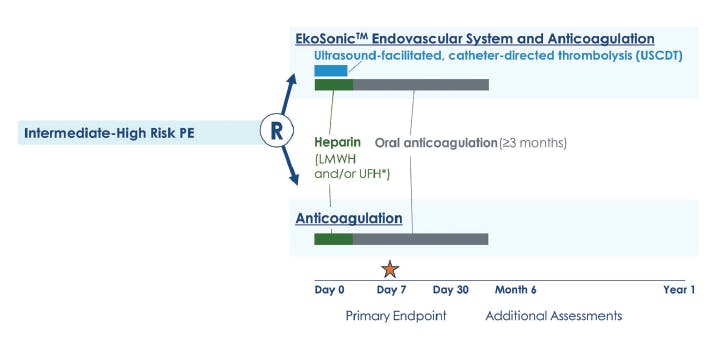
Figure 1. The HI-PEITHO study flow. LMWH, low-molecular-weight heparin; UFH, unfractionated heparin.
Patients who meet all inclusion and no exclusion criteria will be enrolled in the study upon receipt of written informed consent. Given the urgency for treatment, randomization and initiation of assigned therapy should occur as soon as possible after confirmation of diagnosis. For patients assigned to the USCDT arm, it is recommended to begin the intervention within 2 hours of randomization. Patients will be followed up to 12 months, with follow-up study visits at 7 days, 30 days, 6 months, and 12 months postrandomization. Patients meeting the primary endpoint criteria for cardiorespiratory collapse or decompensation are eligible for rescue reperfusion treatment (such as systemic thrombolysis or CDT). Arbitrary crossover to the intervention (USCDT) arm or use of any other reperfusion treatment after randomization in the absence of primary endpoint criteria or of appropriate justification and documentation of the medical need will be strongly discouraged and considered a protocol deviation.
Patient Inclusion and Exclusion Criteria
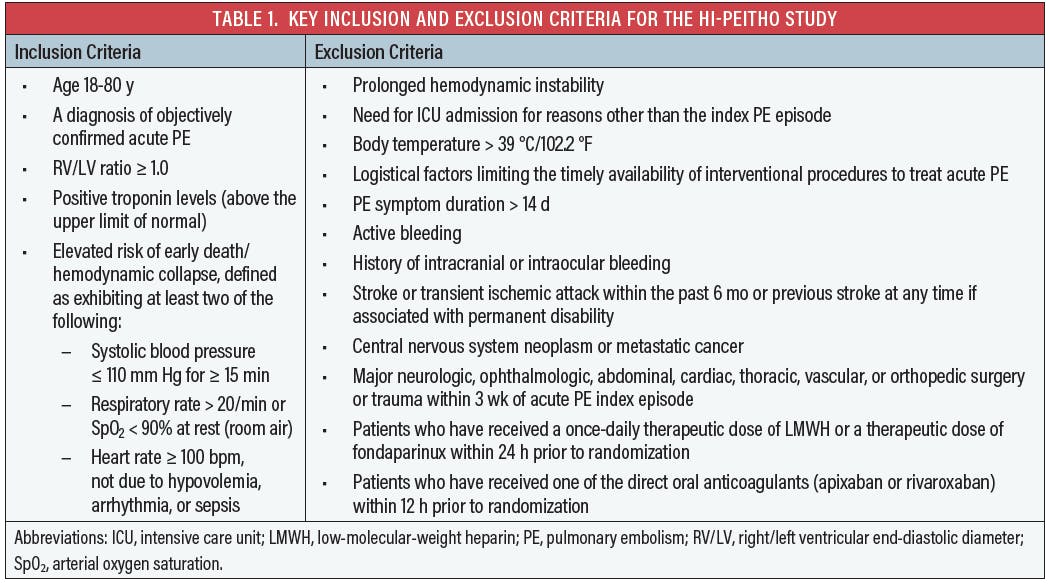
Key patient inclusion and exclusion criteria are outlined in Table 1. Given the current context in which HI-PEITHO is being launched, it is important to note that patients who test positive for severe acute respiratory syndrome coronavirus-2 (SARS-CoV-2) infection are eligible for the trial if the enrolling investigator believes that the intermediate–high-risk PE is the dominant culprit for the clinical presentation and the qualifying inclusion and exclusion criteria.
Primary Endpoint
The primary endpoint in HI-PEITHO is defined as a composite of PE-related mortality, cardiorespiratory decompensation or collapse, and/or nonfatal PE recurrence within 7 days of initial USCDT treatment. Cardiorespiratory collapse or decompensation is defined as one or more of the following: cardiac arrest or need for cardiopulmonary resuscitation, signs of shock (new-onset arterial hypotension with end-organ perfusion), placement on extracorporeal membrane oxygenation, intubation or noninvasive mechanical ventilation, and/or National Early Warning Score (NEWS) ≥ 9 (Figure 2).5,6 All outcome components will be adjudicated by an independent clinical events committee, using a blinded adjudication process.
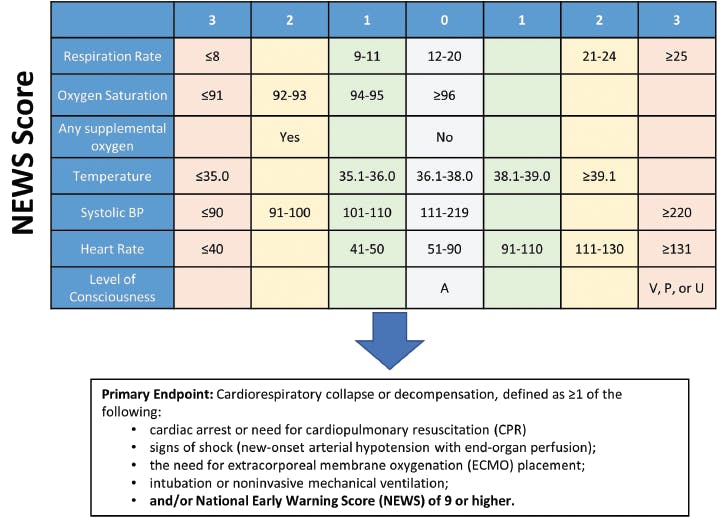
Figure 2. The NEWS score paradigm and composite primary endpoint for HI-PEITHO. NEWS score reproduced from Royal College of Physicians. National Early Warning Score: standardizing the assessment of acute illness severity in the NHS. Report of a working party. London: Royal College of Physicians; 2012.
Notably, the primary endpoint of the HI-PEITHO study is a combination of established measures and innovative clinical assessment methods. The NEWS score in particular is a standardized clinical tool for anticipating, detecting, and/or responding to a patient’s deterioration and collapse. The peer-reviewed and validated NEWS scoring methodology considers respiratory rate, oxygen saturation, whether supplemental oxygen is required, body temperature, systolic blood pressure, heart rate, and level of consciousness. This comprehensive evaluation has been shown to have greater prognostic accuracy compared to each of its individual components.7 NEWS has been validated in several different clinical settings internationally. When implemented correctly, it has been shown in several single- and multicenter studies to quickly and accurately determine which patients are at highest risk for cardiac arrest, intensive care unit (ICU) admission, and/or death within 24 hours of assessment.6,8,9
Key Additional Assessments
In addition to the primary endpoint detailed previously, several other key measures are being collected as part of the HI-PEITHO trial. These include the individual primary outcome components, GUSTO (Global Utilization of Strategies to Open Occluded Coronary Arteries) major (moderate and severe) bleeding within 7 days of treatment, International Society on Thrombosis and Haemostasis major bleeding, ischemic or hemorrhagic stroke within 7 and 30 days posttreatment, all-cause mortality, symptomatic PE recurrence within 30 days and 6 months, change from baseline right ventricular/left ventricular end-diastolic diameter ratio on echocardiography at 6 months, chronic thromboembolic pulmonary hypertension diagnosis within 12 months, health economic assessments, functional status and quality-of-life measures, and cardiopulmonary exercise testing parameters at select sites.
WHAT IS THE POTENTIAL IMPACT OF HI-PEITHO?
Currently, the existing evidence on intervention beyond BMT for PE suggests that acute intermediate-risk PE remains potentially life-threatening if treated with anticoagulants alone. Although early reperfusion with full-dose intravenous thrombolysis has the ability to improve hemodynamics and, in turn, early clinical outcomes, it is not routinely recommended as first-line therapy because it is associated with a high major (particularly intracranial) bleeding risk. However, newer patient stratification paradigms (classifying patients as either intermediate-low or intermediate-high risk) and USCDT dosing protocols like those tested in the OPTALYSE trial strongly suggest that lower lytic doses with shorter durations of infusion can achieve comparable clinical and better safety outcomes in many patients with acute intermediate–high-risk PE.10 Consequently, many patients in this risk category may currently be deprived of potentially life-saving therapeutic options.
The goal of HI-PEITHO is to close this evidence gap and provide high-quality clinical data capable of informing future guidelines on the treatment of patients with acute intermediate–high-risk PE. HI-PEITHO is the first large, state-of-the-art international RCT of an interventional PE treatment against the current standard of care using validated, clinically relevant endpoints. It is also the first trial with adequate power to show a significant impact of an interventional approach on the prognosis of patients with intermediate–high-risk PE. The trial is led by expert clinical trialists in PE in the United States and Europe, who have taken care to standardize and precisely define, in the trial protocol, all key aspects of the study design (including time from PE diagnosis and randomization to intervention, USCDT duration and thrombolytic dose, and dose and scheme of anticoagulation regimen). Moreover, the trial protocol includes a clear rule to prevent arbitrary crossover between the treatment arms. Regardless of outcome, there is little doubt that HI-PEITHO will help clinicians manage some of the most challenging cardiovascular patients.
Acknowledgments: We thank Alexandra Greenberg-Worisek, PhD, MPH (Boston Scientific Corporation) for providing medical writing assistance.
1. Smith SB, Geske JB, Kathuria P, et al. Analysis of national trends in admissions for pulmonary embolism. Chest. 2016;150:35-45. doi: 10.1016/j.chest.2016.02.638
2. Meyer G, Vicaut E, Danays T, et al. Fibrinolysis for patients with intermediate-risk pulmonary embolism. N Engl J Med. 2014;370:1402-1411. doi: 10.1056/NEJMoa1302097
3. Chatterjee S, Chakraborty A, Weinberg I, et al. Thrombolysis for pulmonary embolism and risk of all-cause mortality, major bleeding, and intracranial hemorrhage: a meta-analysis. JAMA. 2014;311:2414-2421. doi: 10.1001/jama.2014.5990
4. Kucher N, Boekstegers P, Müller OJ, et al. Randomized, controlled trial of ultrasound-assisted catheter-directed thrombolysis for acute intermediate-risk pulmonary embolism. Circulation. 2014;129:479-486. doi: 10.1161/CIRCULATIONAHA.113.005544
5. National Early Warning Score (NEWS): Standardising the assessment of acute-illness severity in the NHS. Report of a working party. Royal College of Physicians; 2012.
6. Smith GB, Prytherch DR, Meredith P, et al. The ability of the National Early Warning Score (NEWS) to discriminate patients at risk of early cardiac arrest, unanticipated intensive care unit admission, and death. Resuscitation. 2013;84:465-470. doi: 10.1016/j.resuscitation.2012.12.016
7. Jarvis S, Kovacs C, Briggs J, et al. Aggregate National Early Warning Score (NEWS) values are more important than high scores for a single vital signs parameter for discriminating the risk of adverse outcomes. Resuscitation. 2015;87:75-80. doi: 10.1016/j.resuscitation.2014.11.014
8. Smith ME, Chiovaro JC, O'Neil M, et al. Early warning system scores for clinical deterioration in hospitalized patients: a systematic review. Ann Am Thorac Soc. 2014;11:1454-1465. doi: 10.1513/AnnalsATS.201403-102OC
9. Gerry S, Bonnici T, Birks J, et al. Early warning scores for detecting deterioration in adult hospital patients: systematic review and critical appraisal of methodology. BMJ. 2020;369:m1501. doi: 10.1136/bmj.m1501
10. Tapson VF, Sterling K, Jones N, et al. A randomized trial of the optimum duration of acoustic pulse thrombolysis procedure in acute intermediate-risk pulmonary embolism: the OPTALYSE PE trial. JACC Cardiovasc Interv. 2018;11:1401-1410. doi: 10.1016/j.jcin.2018.04.008


Advertisement
Advertisement