Advertisement
Advertisement
July 2021 Supplement
Sponsored by The PERT Consortium®
Transitions of Care for Patients With Venous Thromboembolism
A review of the barriers and solutions for VTE transitions of care and how The National PERT Consortium® can assist with implementing a VTE transitions of care program.
By Rachel P. Rosovsky, MD, MPH; Geoffrey D. Barnes, MD, MSc; and Geno Merli, MS, MACP, FSVM, FHM
Venous thromboembolism (VTE) is a common disorder affecting 900,000 Americans annually, with a resulting cost of care of $7 to $10 billion per year.1-4 Acute VTE is estimated to cause 100,000 deaths per year, mainly attributed to the development of a pulmonary embolism (PE).3 Of patients who survive the acute event, several thousand will develop chronic sequelae, such as postthrombotic syndrome or chronic thromboembolic pulmonary hypertension, which can result in significant morbidity and mortality with a resultant increase in health care costs.5-7 With the high incidence of VTE and hospitalization, this patient population requires a focused plan to transition their care from the hospital to home.
Transition of care (TOC) is defined as the movement of patients between health care providers or settings. This process, when not effectively completed, can lead to adverse events, higher hospital readmission rates, and increased health costs.4,7 Anticoagulants are the cornerstone of therapy for VTE and are commonly associated with bleeding and recurrent VTE events secondary to inadequate dosing or failure to comply with treatment plans.8 These types of medication errors have been implicated as a leading cause of hospital readmissions. The inherent high-risk nature of VTE coupled with associated adverse drug events provide a perfect opportunity to optimize the TOC process for this patient population.9
The goals of a VTE TOC program are to provide effective predischarge and ongoing patient education, reduce the risk of recurrent thrombosis by increasing medication adherence, minimize the risk of bleeding, and prevent readmissions.10,11 The specific objectives of a VTE TOC program include streamlining the evidence-based management of VTE for specific patient populations; providing effective patient education programs, which also includes assessment of patient knowledge; improving patient adherence to prescribed therapy; and outlining core requirements for effective handoffs and communication of the plan of care. To achieve these important objectives, it is essential to identify both the barriers to and the solutions for a successful program, including how to utilize The National Pulmonary Embolism Response Team (PERT) Consortium® to accomplish these goals.
BARRIERS TO VTE TOC
Barriers to VTE TOC are outlined in Table 1. One of the greatest challenges in coordinating a patient’s health care across various settings is ensuring effective communication. Because patients with VTE often have multiple specialists involved in their care, determining who is responsible for providing accurate and timely discharge information and instructions, including a follow-up plan, may be difficult. Furthermore, when patients move from the inpatient setting to home or another facility, there may be pending test results that require timely follow-up. A recent study found that over one-third of patients diagnosed with VTE were lost to VTE-specific follow-up, particularly patients who were discharged to a facility rather than home.12
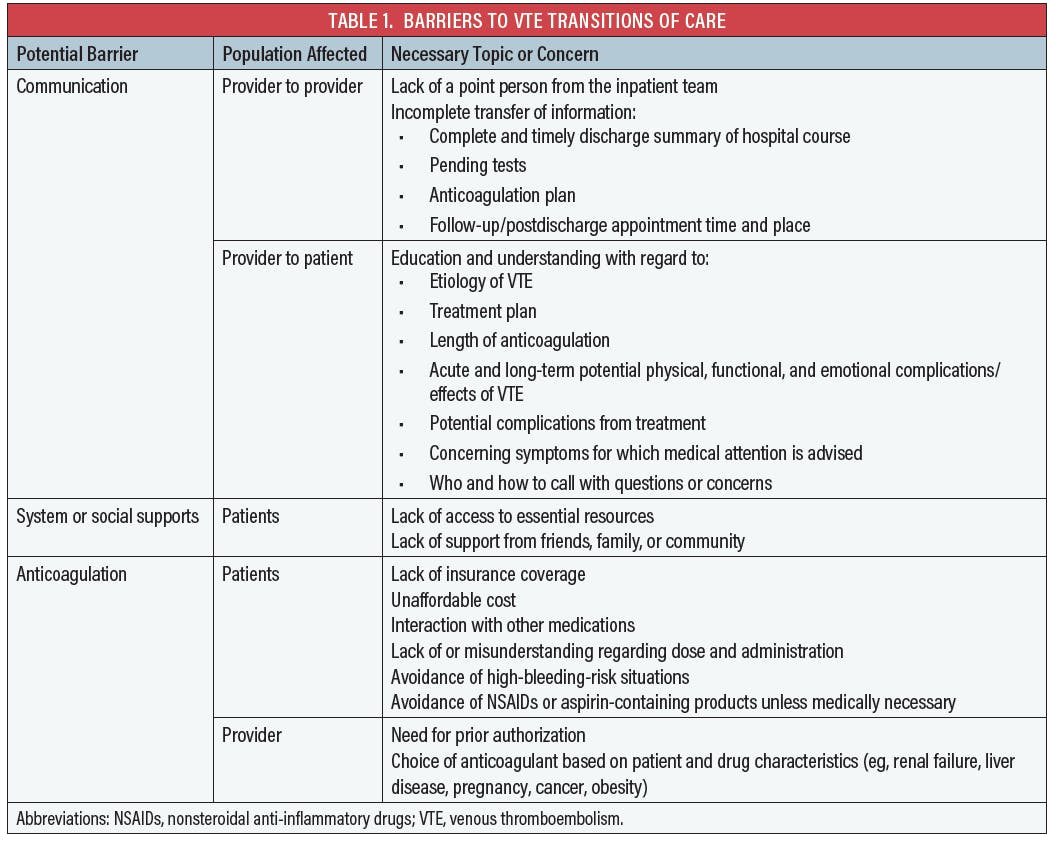
The mainstay of therapy for VTE is anticoagulation.13,14 Determining which anticoagulant to use for each patient requires an in-depth knowledge of a patient’s medical comorbidities as well as a comprehensive understanding of the various anticoagulants and their pharmacologic properties. It is also essential for providers to emphasize the importance of and frequently inquire if their patients are taking the anticoagulant correctly. A recent study demonstrated that patients receiving direct oral anticoagulants at nonrecommended doses and/or regimens experienced a higher rate of VTE recurrence than patients who received recommended doses and regimens.15
Educating patients about their clinical course, medications, and treatment plans requires time, planning, and an understanding of a patient’s health literacy. Patients may not fully understand the significance of having a VTE, and once they do, they may grapple with trying to determine the underlying cause. Moreover, patients are often frightened of the consequences and potential long-term sequelae after a VTE, including the possibility of death. Explaining the rationale for the use of anticoagulation as well as the possible side effects can be perplexing and daunting for patients, especially in those who may require long-term use. Patients may also have unusual or exaggerated expectations and anxieties relative to their VTE or anticoagulant and may have questions about the necessity of certain restrictions and their duration.
Possibly one of the biggest obstacles to medication adherence is cost, especially if a patient leaves the hospital without knowing whether the drug is covered by insurance.16 Given the known side effects and potential lack of understanding regarding the importance of taking anticoagulants regularly, patient compliance may become an issue. However, being compliant with out-of-hospital medication regimens is crucial to recovery from VTE. Another challenge for patients when transitioning from the inpatient setting to home or another facility may be lack of social supports or social systems. Trying to maneuver the health care system alone can be overwhelming, and not having access to essential resources can be detrimental to a patient’s health.
Given all of the potential obstacles patients face during this vulnerable time underscores the necessity for smooth transitions from one phase of care to the next.
SOLUTIONS FOR VTE TOC
In order to decrease the morbidity and mortality associated with VTE, determining and operationalizing protocols to ensure access to and adherence and compliance with anticoagulation is critical. Creating a “meds to beds” program whereby a patient would not leave the hospital without medication in hand addresses the cost and insurance barrier. It is important for patients not only to have easy and affordable access to anticoagulation, but also to understand the rationale behind, side effects of, and how to take this vital medication. Understanding both the disease process and its treatment plays an enormous role in long-term treatment success. This task can be accomplished by providing patients with simple, clear, culturally sensitive, and appropriate information.10 Visual aids and videos may also help break down complex medical terminology and educate patients about what happened to them and how the medications work. In addition, asking patients to “teach back” what they heard can help gauge their understanding. Offering videos and other educational materials during the acute hospital setting will allow patients the opportunity to ask questions prior to discharge. Patients must also be provided with appropriate contact information if problems or other questions arise after discharge. Furthermore, before leaving the hospital, patients should have a timely (usually within a week) follow-up visit scheduled with a VTE specialist to ensure continuity of care. To take it one step further, many programs have a nurse call the patient within 24 to 48 hours of discharge to inquire about adverse events and medication compliance and address any questions or concerns. Importantly, in order to ensure a smooth transition from the inpatient setting to home (or another facility), the primary inpatient team must provide a comprehensive discharge and follow-up plan, which includes what prompted the admission; a detailed hospital course including any procedures and significant or pending results; a specific anticoagulation plan with rationale for type, dosing, and any concerns for side effects; and the time and place of the follow-up visit.
Finally, the COVID-19 pandemic brought an opportunity to redesign how the medical community delivers health care. By providing telehealth visits to patients with VTE, the costs associated with routine follow-up visits, such as transportation, parking, and having to take time off of work, will be dramatically reduced, which may lead to an increase in follow-up compliance. Further ideas to improve patient follow-up care include a VTE tool kit with solutions that address each of the challenges and barriers faced by patients or an interactive phone application specific to VTE.
MEASURING THE EFFECTS OF A SUCCESSFUL VTE TOC PROGRAM
With any new program, it is important to measure the success and identify opportunities for improvement through clinically meaningful metrics. Metrics specific to a VTE TOC program will mirror the general goals, which are to effectively educate patients about their illness and treatment and develop strategies to minimize the complications associated with those medical conditions. Hospital length of stay and readmission rates are two important outcomes important to both patients and payors alike. Using electronic health records will help identify whether patients have a follow-up visit in place prior to discharge. Medication diaries can be used to assess compliance with home regimens. Patient satisfaction scores and functional assessments are examples of further qualitative measurements.17
USING THE PERT CONSORTIUM® TO IMPROVE VTE TOC
The National PERT Consortium®, a 501(c)(3) nonprofit organization founded in 2016 for the purpose of promoting the multidisciplinary care of patients with PE, is ideally posed to help create, implement, and disseminate a VTE TOC program. The PERT Consortium® consists of over 150 institutions and over 1,500 clinicians in the United States and globally, and it is focused on improving outcomes from PE by advancing its recognition, diagnosis, and treatment.18 PERT teams are on the front lines of managing patients with PE at their institutions.19 The education and clinical protocols committees of The PERT Consortium® are collaborating with corporate partners to develop a comprehensive VTE TOC program. Furthermore, The PERT Consortium® manages the largest prospective United States registry of PE patients, which serves as a database for future research and clinical innovation. The PERT Consortium® will leverage the infrastructure of this existing registry, which utilizes the user-friendly and rapidly scalable REDCap Cloud platform, to collect TOC metrics to further refine the program.
CONCLUSION
VTE is a major cause of morbidity and mortality, and patients are often hospitalized for the initial treatment. However, care does not stop there, and the transition from inpatient stay to home or another facility is a vulnerable time. Creating a comprehensive VTE TOC program is vital to safely and effectively treat VTE patients. Using The PERT Consortium® to identify barriers and create solutions will help develop a successful VTE TOC program. The PERT Consortium® is also poised to disseminate and measure the effect of the program and further improve on its goals.
1. Grosse SD, Nelson RE, Nyarko KA, et al. The economic burden of incident venous thromboembolism in the United States: A review of estimated attributable healthcare costs. Thromb Res. 2016;137:3-10. doi: 10.1016/j.thromres.2015.11.033
2. Heit JA. Venous thromboembolism: disease burden, outcomes and risk factors. J Thromb Haemost. 2005;3:1611-1617. doi: 10.1111/j.1538-7836.2005.01415.x
3. Wendelboe AM, Campbell J, Ding K, et al. Incidence of venous thromboembolism in a racially diverse population of Oklahoma County, Oklahoma. Thromb Haemost. 2021;121:816-825. doi: 10.1055/s-0040-1722189
4. Mahan CE, Borrego ME, Woersching AL, et al. Venous thromboembolism: annualised United States models for total, hospital-acquired and preventable costs utilising long-term attack rates. Thromb Haemost. 2012;108:291-302. doi: 10.1160/TH12-03-0162
5. Kahn SR, Comerota AJ, Cushman M, et al. The postthrombotic syndrome: evidence-based prevention, diagnosis, and treatment strategies: a scientific statement from the American Heart Association. Circulation. 2014;130:1636-1661. doi: 10.1161/CIR.0000000000000130
6. Pengo V, Lensing AW, Prins MH, et al. Incidence of chronic thromboembolic pulmonary hypertension after pulmonary embolism. N Engl J Med. 2004;350:2257-2264. doi: 10.1056/NEJMoa032274
7. Lin J, Lingohr-Smith M, Kwong WJ. Incremental health care resource utilization and economic burden of venous thromboembolism recurrence from a U.S. payer perspective. J Manag Care Pharm. 2014;20:174-186. doi: 10.18553/jmcp.2014.20.2.174
8. Piazza G, Nguyen TN, Cios D, et al. Anticoagulation-associated adverse drug events. Am J Med. 2011;124:1136-1142. doi: 10.1016/j.amjmed.2011.06.009
9. Jaffray J, Rajpurkar M, Sharathkumar A, et al. Transition of care for patients with venous thromboembolism: Rationale, design and implementation of a quality intervention project conducted at American Thrombosis and Hemostasis Network (ATHN) affiliated sites. Thromb Res. 2018;163:146-152. doi: 10.1016/j.thromres.2018.01.043
10. DeSancho M, Munn JE, Billett HH, et al. Transition of care for pediatric and adult patients with venous thromboembolism: a National Quality Improvement Project from the American Thrombosis and Hemostasis Network (ATHN). Thromb Res. 2021;200:23-29. doi: 10.1016/j.thromres.2021.01.001
11. Trocio J, Rosen VM, Gupta A, et al. Systematic literature review of treatment patterns for venous thromboembolism patients during transitions from inpatient to post-discharge settings. Clinicoecon Outcomes Res. 2019;11:23-49. doi: 10.2147/CEOR.S179080
12. Rokosh RS, Grazi JH, Ruohoniemi D, et al. High incidence of patients lost to follow-up after venous thromboembolism diagnosis—identifying an unmet need for targeted transition of care. Vascular. Published online June 3, 2021. doi: 10.1177/17085381211020969
13. Kearon C, Akl EA, Ornelas J, et al. Antithrombotic therapy for VTE disease: CHEST guideline and expert panel report. Chest. 2016;149:315-352. doi: 10.1016/j.chest.2015.11.026
14. Streiff MB, Agnelli G, Connors JM, et al. Guidance for the treatment of deep vein thrombosis and pulmonary embolism. J Thromb Thrombolysis. 2016;41:32-67. doi: 10.1007/s11239-015-1317-0
15. Trujillo-Santos J, Di Micco P, Dentali F, et al. Real-life treatment of venous thromboembolism with direct oral anticoagulants: the influence of recommended dosing and regimens. Thromb Haemost. 2017;117:382-389. doi: 10.1160/TH16-07-0494
16. Pulleyn T, Kim K, Witt DM, et al. Understanding patients’ care barriers in the treatment of venous thromboembolism. J Thromb Thrombolysis. 2019;48:35-41. doi: 10.1007/s11239-019-01880-3
17. Webb D, Kim K, Tak CR, et al. Patient satisfaction with venous thromboembolism treatment. Clin Appl Thromb Hemost. 2019;25:1076029619864663. doi: 10.1177/1076029619864663
18. Rosovsky R, Chang Y, Rosenfield K, et al. Changes in treatment and outcomes after creation of a pulmonary embolism response team (PERT), a 10-year analysis. J Thromb Thrombolysis. 2019;47:31-40. doi: 10.1007/s11239-018-1737-8
19. Rosovsky R, Borges J, Kabrhel C, Rosenfield K. Pulmonary embolism response team: inpatient structure, outpatient follow-up, and is it the current standard of care? Clin Chest Med. 2018;39:621-630. doi: 10.1016/j.ccm.2018.04.019


Advertisement
Advertisement