Advertisement
Advertisement
July 2021
Sponsored by Medtronic
Iliac Vein Stenting: Best Practices for Patient Safety and Successful Outcomes
Venous stenting first emerged as a treatment for iliofemoral venous outflow obstruction in the 1990s. Recently, several factors have led to a significant increase in the volume of these procedures being performed around the world. There has been an increased awareness of the contribution of venous outflow obstruction to the causation of disabling symptoms such as venous claudication, chronic edema and/or venous ulceration, and other manifestations of postthrombotic syndrome (PTS). Venous outflow obstruction may be secondary to iliofemoral deep vein thrombosis (DVT) or nonthrombotic iliac vein lesions (NIVLs, previously termed May-Thurner syndrome). The development of improved endovascular skill sets among various specialties, improving awareness of the treatment of venous disorders, and an expansion of endovascular treatment into nonhospital-based facilities have all likely contributed to an increase in venous stenting. Additionally, the development of stents specifically designed for venous indications, providing more straightforward deployment, has increased enthusiasm for the treatment of venous outflow obstruction.
Although an increase in the accessibility of venous stenting procedures will undoubtedly help improve patient quality of life, overuse or misapplication of the technology can be harmful. Two of the venous-dedicated stents have recently been withdrawn from the marketplace, allegedly due to issues with stent deployments and migrations (whether these are permanent or temporary recalls is not known at this time). As with any burgeoning technology, proper patient selection, physician training, and patient aftercare and follow-up are key to safe, successful treatment of venous outflow obstruction.
VENOUS STENTS: AN OVERVIEW
The use of self-expanding stents for the treatment of venous outflow obstruction was reported by Drs. Neglén and Raju more than 20 years ago.1 Their described technique included the use of the venous Wallstent™* endoprosthesis stent (Boston Scientific Corporation), a braided, self-expanding stent composed of Elgiloy (a Co-Cr-Ni alloy). Although the venous Wallstent was not initially designed as a venous stent, its large diameters, compression (crush) resistance, radial force, and fracture resistance lent itself well to venous stenting. Over the ensuing decades, venous stenting techniques using Wallstents were refined. Despite its strengths, there are several drawbacks to the venous Wallstent. Their deployment accuracy can be imprecise because they can foreshorten considerably depending on the diameter of the vessel in which they are deployed. Additionally, the ends of the stent lack the radial force present throughout the rest of the stent body and are prone to collapse. As the point of maximal compression in the case of NIVLs is typically at the confluence of the left common iliac vein (CIV) and the inferior vena cava (IVC), the venous Wallstent typically needs to be extended cranially into the IVC to avoid collapse and potential subsequent occlusion if the weakest portion of the stent is placed too caudally. If the stent is placed too far into the IVC, there is risk of the stent covering the confluence of the contralateral iliac vein, which can lead to contralateral limb thrombosis.2 Due to this lack of radial force at the end of the stents, care also must be taken with the venous Wallstent to ensure appropriate overlap when more than one stent is placed.
The need for accurate deployment to avoid complications with placement of the venous Wallstent coupled with their tendency to foreshorten somewhat unpredictably makes for a steep learning curve for successful deployment. Even in the most expert hands, a perfect venous Wallstent placement can be an elusive endeavor. Although the venous Wallstent has a long and successful track record in the treatment of venous outflow obstruction, its shortcomings spurred the development of various venous dedicated stents. The ideal venous stent would be adaptable to a variety of venous anatomic features, available in a wide range of diameters and lengths, strong and able to resist both recoil and compressive forces, flexible and able to negotiate the curves of the venous anatomy in the pelvis without kinking or distorting the vein, durable and able to withstand repetitive movement without loss of integrity, and able to offer accurate and precise deployment at both stent ends.
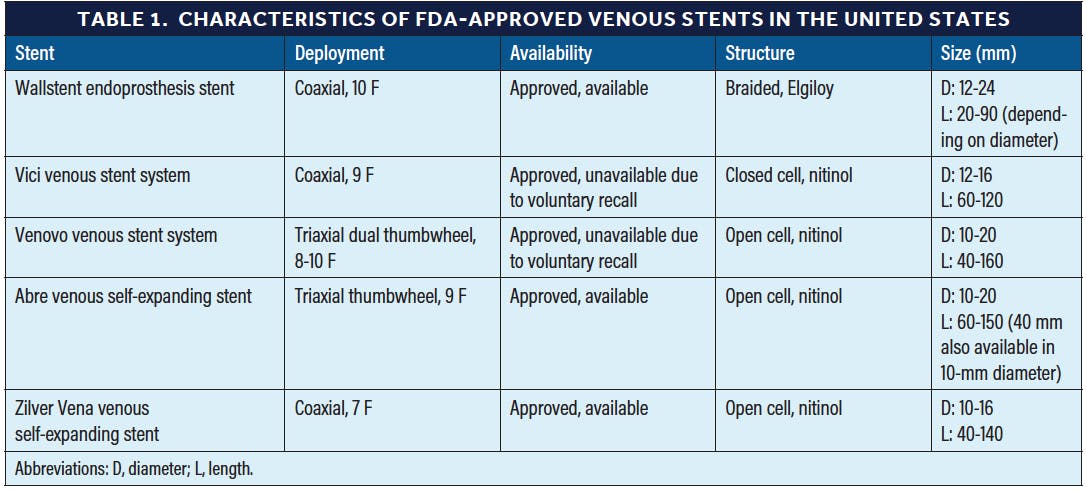
Four dedicated venous stents have received FDA approval after investigational device exemption (IDE) trials: Vici venous stent™* system (Boston Scientific Corporation; VIRTUS IDE trial), Venovo™* venous stent system (BD Interventional; VERNACULAR IDE trial), Zilver™* Vena™* venous self-expanding stent (Cook Medical; VIVO IDE trial), and Abre™ venous self-expanding stent system (Medtronic; ABRE IDE trial). With the exception of the VIRTUS trial, all of these IDE trials included patients with acute and chronic obstructions and showed acceptable efficacy and safety.3-9 The Vici stent is a closed-cell stent, and the other approved dedicated venous nitinol stents are open cell. Characteristics of the approved stents are listed in Table 1. At the time of this publication, both the Vici venous stent and the Venovo venous stent system have been pulled from the market.
PATIENT SELECTION
Proper patient selection, both in terms of clinical presentation and anatomic findings, is essential to successful treatment of symptomatic venous outflow obstruction. In all clinical scenarios where a venous stent is being considered, the patient’s symptoms and the impact of these symptoms on their quality of life is of primary consideration. Venous stents are permanent implants, and as such, diligent consideration should be given as to whether the patient’s symptoms have a significant enough impact on quality of life to warrant their consideration. Placement for minor symptoms such as mild ankle edema is discouraged by most venous experts.
In patients with chronic PTS and venous ulceration, current Society for Vascular Surgery/American Venous Forum clinical practice guidelines recommend venous outflow obstruction be considered to speed ulcer healing if anatomically appropriate.10 Other symptoms impacting patient quality of life such as pain, significant edema, and venous claudication can be alleviated or improved with venous stenting.11 It is generally accepted that as long as adequate thrombus resolution has occurred in patients with acute DVT who have undergone thrombolysis, iliac stenting improves vessel patency and lowers PTS rates.12 In patients with chronic postthrombotic outflow obstruction, anatomic considerations are important in addition to symptom assessment. An axiom for proper venous stenting is to stent from “healthy to healthy.” With the exception of a chronically occluded IVC, which can be recanalized with advanced maneuvers, inadequate venous outflow is not usually a limiting anatomic factor for successful stenting. Significant inflow disease, typically involving the common femoral vein (CFV), is likely the primary anatomic cause of stent failure.13 As such, it is incumbent on the treating physician to be certain that adequate inflow is feasible prior to placement of a venous stent.
Proper patient selection is most critical and controversial in patients with NIVLs because the risk/benefit ratio in this group is less clear. Symptom complexes in these patients can vary and can include chronic pelvic pain,14 venous claudication, and edema. Many patients with anatomic venous compression found on imaging are asymptomatic,15 and venous stenting should never be contemplated prophylactically in such patients. Consideration of an interventional procedure with rare but potentially serious or even fatal outcomes (such as migration of a stent to the right atrium, which is more common in NIVL patients than patients with PTS) must be carefully balanced against any potential long-term benefit for the patient. In particular, intervention for the edema relief alone is fraught with potential disappointment for the patient and the physician because limb edema may have many causes and improvement after stenting is not assured.16 Management of patient expectations to expect improvement but not necessarily resolution of symptoms attributable to NIVLs is crucial.
PROPER IMAGING: PRIOR TO AND DURING INTERVENTION
Preprocedural imaging should be performed for diagnostic purposes and case planning. The technology used is institutionally dependent but could include CT venography (CTV), MR venography, or diagnostic transabdominal duplex scans. At our institution, we rely primarily on transabdominal duplex imaging, reserving CTV for cases of acute thrombosis, chronic occlusive disease involving the IVC, or in patients where an etiology such as malignancy or compression from a nonvascular etiology is being considered (eg, previous back surgery, radiation). With proper training, excellent images can be obtained with duplex ultrasound. For NIVL patients, we follow imaging protocols as described by Labropoulos and colleagues.17 A visible difference in venous diameter at the point of compression, a peak vein velocity ratio > 2.5 in the area of compression, and a reversal of flow in the internal iliac vein (IIV) are all indications of a clinically significant stenosis (Figure 1).
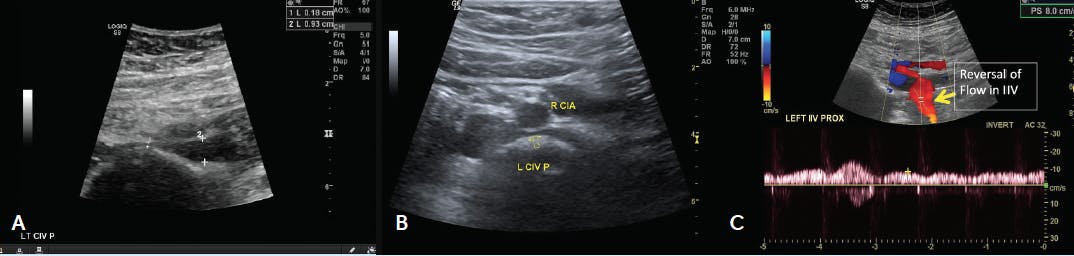
Figure 1. Longitudinal images of left iliac vein compression. CIA, common iliac artery.
Courtesy of Kathleen Gibson, MD, FACS, FAVLS.
Appropriate confirmatory diagnostic imaging on an “intent-to-treat” basis prior to stenting is critical. A combination of multiplanar venography and intravascular ultrasound (IVUS) are gold standards for proper stent placement to identify the degree of stenosis and length of disease. In the case of postthrombotic obstruction, venography demonstrates collateral flow, and the “pathway” to traverse to reach the IVC is often visible (eg, the patient with a chronic bilateral iliac and IVC occlusive disease after DVT in Figure 2). When crossing a chronic occlusion, it is vital to obtain an oblique or lateral view to ensure the wire is in the proper location anterior to the spine because inadvertent stenting into the obturator vein or spinal canal has been reported (Figure 3).18 Venography for NIVL cases will typically demonstrate a “pancaking” of the left CIV, with prestenotic dilatation and a lag in contrast emptying, retrograde flow in the IIV, and cross-pelvic and paraspinous collaterals (Figure 4). For NIVL lesions, IVUS is used to confirm the degree of area reduction in the area of compression (Figure 5). The comparative reference vessel could be the patient’s own ipsilateral normal CIV, their contralateral CIV, or a reference from anatomic literature.19 The VIDIO trial demonstrated that compared to multiplanar venography, IVUS was more sensitive in detecting lesions with > 50% cross-sectional area reduction, an anatomic threshold that, although controversial, is often used to determine which lesions may benefit from stenting.20
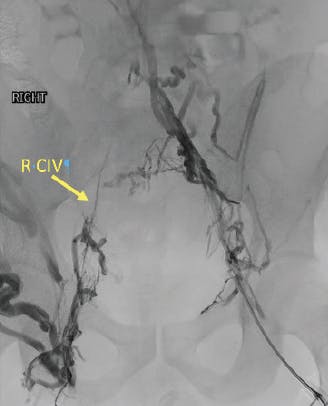
Figure 2. Venography in a patient with occlusion of the right CIV and IVC.
Courtesy of Kathleen Gibson, MD, FACS, FAVLS.
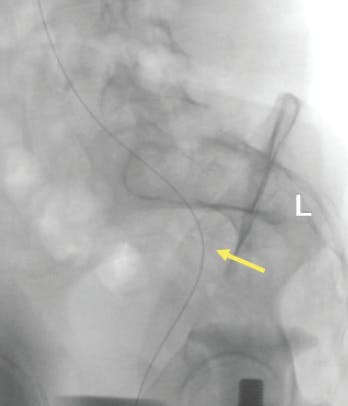
Figure 3. Proper course of a wire crossing the pelvis in a patient with chronic occlusion of the left CIV.
Courtesy of Kathleen Gibson, MD, FACS, FAVLS.
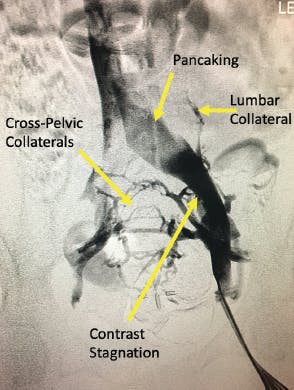
Figure 4. Venography of a NIVL demonstrating “pancaking of vein,” contrast stagnation, and cross-pelvic and lumbar collaterals.
Courtesy of Kathleen Gibson, MD, FACS, FAVLS.
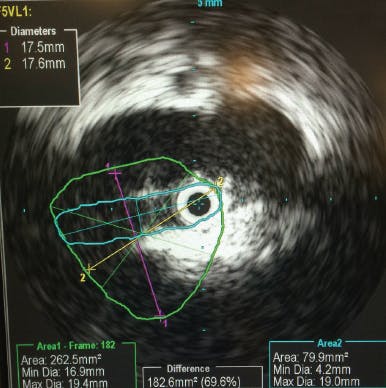
Figure 5. IVUS determination of cross-sectional area reduction in a NIVL.
Courtesy of Kathleen Gibson, MD, FACS, FAVLS.
PROPER ACCESS AND STENT PLACEMENT
The choice of access vessel for stent placement depends on the extent and location of the venous disease. In patients with acute venous thrombosis, stenting is often performed in conjunction with thrombolysis or mechanical thrombectomy. The most common venous access site for acute interventions is the popliteal vein, although the posterior tibial vein is increasingly being used. In patients with chronic occlusive disease, it is important to determine the caudal-most extent of disease, as there must be enough room between the end of the venous sheath and the end of the stent to facilitate placement. Although many physicians prefer the popliteal vein for chronic occlusive disease access, I prefer the midfemoral vein if it is patent because it allows the patient to remain in a supine position and permits easy access to the jugular vein. If the femoral vein is diseased, my preferred approach is via the right jugular vein. Occasionally, I will use great saphenous vein access to cross the occlusion from below, snaring the wire in the IVC placed via internal jugular vein (IJV) access and redirecting the IJV wire into the profunda vein or diseased femoral vein. This allows precise stent landing at the lesser trochanter, which is the usual location of the confluence of the profunda and femoral veins (Figure 6).
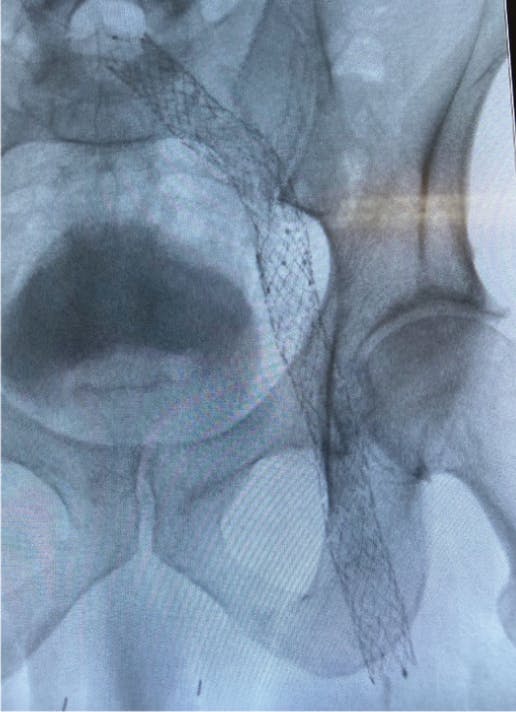
Figure 6. Placement of a venous stent from IVC confluence to confluence of the profunda and femoral veins at the lesser trochanter.
Courtesy of Kathleen Gibson, MD, FACS, FAVLS.
Once proper access is achieved, confirmatory imaging is completed, and systemic heparinization is administered, the length of the venous segment that requires stenting and diameter of the stent to be used is then determined. For a chronically occluded vein, stent sizing can be based on known normal diameters of iliac veins: 14 to 16 mm for the CIV, 12 to 14 mm for the external iliac vein (EIV), and 10 to 12 mm for the CFV.19 The length of stent(s) needed is determined most efficiently by the IVUS catheter, which has radiopaque markers. With long segments of disease in PTS patients, more than one stent is usually required, and the physician must account for allowance of sufficient overlap between stents (common practice is a minimum 2-cm overlap). If the length of disease extends from the iliac confluence to the lesser trochanter, three stents are usually needed when using the venous Wallstent in an average-sized patient, whereas the longer lengths of the newer nitinol stents will often allow this to be achieved with two stents. IVUS is used to determine the landing zones cranially and caudally, with a goal of stenting from “healthy to healthy” vessel.
The choice of stent sizing is more controversial in NIVL cases and is critically important because the majority of stent migration cases occur in these clinical scenarios. The cross-sectional area of the CIV at the point of compression may be quite reduced, but the length of this area reduction may be quite short and the vein caudal to the compression point quite dilated, creating a significant size mismatch. Placing a short but anatomically appropriately sized stent (14 or 16 mm) in the wall apposition existing only at the point of compression creates a dependence on that very short stretch of constricted vein to hold the stent in place as the caudal end of the stent is “floating” in the dilated segment. If the cross-sectional view of the vein in the area of compression is not accurately measured and the stent is undersized, migration of the stent may occur.
Two opposing strategies exist to overcome the issue of stent migration, and there are no published data supporting one strategy over the other. The first is to place a stent with a diameter matching the size of the CIV caudal to the area of compression. In some cases, this could necessitate the placement of an 18- or 20-mm stent. The advantage to this strategy is the much longer length of vein wall apposed to the stent. The main disadvantage is an increase in the incidence of postprocedure back pain with larger stents. The severity and duration of back pain after venous stenting procedures has not been well characterized, but it is a common patient complaint; it is not typically long-lasting, but it can be distressing. Although rare, chronic back pain after venous stenting can occur, and stent explantation has been required in some cases.21 The second approach used to prevent stent migration is to place a longer stent by extending the stent into the EIV past the curve in the pelvis. The stent has venous wall apposition at the confluence and along the length in the EIV, so the stent diameter can be smaller (usually 14-16 mm). Proponents of this approach point to a theoretical decrease in migration and a decrease in postprocedure pain. Opponents argue this approach has a disadvantage of placing more stent material in healthy vein and covering the IIV, which could theoretically complicate future access of this vessel.
With either approach to venous stent placement in NIVL cases, accurate IVUS assessment is important. Veins are not “round” throughout their entire course and can vary in size depending on patient position, hydration status, and respiration. Patients are commonly instructed to be NPO (nothing by mouth) for a period of time prior to a procedure, so intravenous prehydration is a good practice. Asking the patient to perform a Valsalva maneuver during IVUS measurement can also be helpful. Most practitioners determine vein diameter on IVUS either by adding the major diameter to the minor diameter and dividing that number by two or by taking the square root of the area, dividing by π, and multiplying by two (area = πr2). The chosen stent should be 1 to 2 mm larger than the calculated vein diameter. The caudal end of a venous stent should not land at the “dip” in the pelvis (yellow arrow, Figure 3) or the inguinal ligament. Placement at the curve in the pelvis can lead to straightening or kinking of the vein, and placement at the inguinal ligament subjects the stent to a significant amount of repetitive motion and stretch; both could theoretically lead to stent thrombosis.
Pre- and postdilatation of venous segments to the chosen stent diameter is recommended (the Abre venous stent instructions for use requires predilatation and recommends postdilatation), typically with a high-pressure balloon. For chronic venous occlusion, serial dilatation with balloons of increasing diameter may be necessary. Predilatation to the intended stent diameter allows the stent to expand more easily. For NIVL cases, predilatation also allows an important safety check on sizing. Some physicians will inflate a balloon to nominal size and then perform venography. If contrast passes readily around the balloon, the vein diameter may have been undermeasured, or there might be no clinically relevant compression. Another technique is to inflate a balloon at the point of compression and gently pull the balloon caudally. If it pulls back easily, as with the previous technique, vein measurement or the need for stent placement should be reassessed. Postdilatation of venous stents is also important, particularly for nitinol stents as the maximal resistive force of the alloy is not achieved without dilatation to its nominal diameter. Postdilatation venography and IVUS are also performed; ideally, venography will demonstrate prompt antegrade emptying of contrast and an absence of collaterals, and IVUS will show good wall apposition and expansion of the stent(s) to its nominal diameter.
POSTPROCEDURAL FOLLOW-UP AND ANTICOAGULATION
The success or failure of a venous outflow intervention does not end with stent placement. In my clinical practice, full heparinization is administered after placement of a large venous sheath (usually 9 or 10 F), and the heparin is redosed throughout the procedure as needed. In practices where an activated clotting time (ACT) is measured, it is typical to aim for an ACT > 250 sec during treatment. A variety of anticoagulation regimens have been suggested for thrombotic and nonthrombotic patients poststenting, with no evidence for superiority of any particular approach. For thrombotic patients (acute or chronic), most practitioners will prescribe twice-daily enoxaparin for 3 to 4 weeks and then transition to either a vitamin K antagonist or a direct oral anticoagulant (DOAC) for a variable period of time. For patients with unprovoked DVT or hypercoagulable states, indefinite prophylactic-dose DOACs should be considered after treatment with standard anticoagulation. For a NIVL patient, the need for anticoagulation after a stenting procedure is less clear, with regimens of antiplatelet agents, DOACs, heparins, or vitamin K antagonists being used by various practices. Some would argue that no anticoagulation is necessary in these cases. Postprocedural imaging within weeks of the procedure to assess for flow disturbance in the stents and the presence of any mural thrombus is recommended. Early intervention should be considered to prevent stent failure if any significant narrowing or flow disturbance is found on follow-up imaging. In our practice, follow-up imaging via duplex ultrasound after the initial postprocedural scan occurs every 6 months for 2 years, then annually.
SUMMARY
Venous stenting for venous outflow disease has the potential to improve the quality of life for millions of patients, but to prevent poor outcomes, proper patient selection and careful technique are of paramount importance. The introduction of dedicated venous stents is welcome, but the recent withdrawal of some of these stents from the market is a caution that education and training in the use of these stents, focusing on their safe placement, is imperative.
1. Neglén P, Raju S. Balloon dilatation and stenting of chronic venous outflow obstruction: technical aspects and early clinical outcome. J Endovasc Ther. 2000;7:79-91. doi: 10.1177/152660280000700201
2. Murphy EH, Johns B, Varney E, et al. Deep venous thrombosis associated with caval extension of iliac stents. J Vasc Surg Venous Lymphat Disord. 2017;5:8-17. doi: 10.1016/j.jvsv.2016.09.002
3. Razavi MK, Black S, Gagne P, et al. Pivotal study of endovenous stent placement for symptomatic iliofemoral venous obstruction. Circ Cardiovasc Interv. 2019;12:1-9. doi: 10.1161/CIRCINTERVENTIONS.119.008268
4. Black S. ABRE study: 12 month results of the Abre™ venous stent system. Presented at: Charing Cross Symposium; April 15-18, 2019; London, United Kingdom.
5. Dake, M. VENOVO® venous stent – 12-month update on the Vernacular trial. Presented at: Leipzig Interventional Course; January 22-25, 2019; Leipzig, Germany.
6. Dake M, O’Sullivan G. Treatment of venous iliofemoral occlusive disease with a self-expanding venous stent: a “first look” at 24-month results from the prospective, multicenter VERNACULAR trial. Presented at: Cardiovascular and Interventional Radiology Society of Europe annual conference; September 7-11, 2019; Barcelona, Spain.
7. Dake M. Three-year results from the prospective, multicenter vernacular trial: treatment of iliofemoral venous disease with the self-expanding VENOVO venous stent. Presented at: Society of Interventional Radiology annual meeting; March 20-26, 2021; presented virtually.
8. O’Sullivan GJ. Results from VIVO-EU, a prospective study of the Zilver Vena venous stent in the treatment of symptomatic iliofemoral venous outflow obstruction: on behalf of the VIVO-EU investigators. Presented at: Cardiovascular and Interventional Radiology Society of Europe annual conference; September 10-14, 2016; Barcelona, Spain.
9. Hofmann L. VIVO clinical study of the Zilver Vena venous stent in the treatment of symptomatic iliofemoral venous outflow obstruction: 2-year outcomes; Presented at: Society of Interventional Radiology annual meeting; March 20-26, 2021; presented virtually.
10. O’Donnell TF Jr, Passman MA, Marston WA, et al; Society for Vascular Surgery; American Venous Forum. Management of venous leg ulcers: clinical practice guidelines of the Society for Vascular Surgery® and the American Venous Forum. J Vasc Surg. 2014;60(2 suppl):3S-59S. doi: 10.1016/j.jvs.2014.04.049
11. Raju S. Best management options for chronic iliac vein occlusion and stenosis. J Vasc Surg. 2013;57:1163-1169. doi: 10.1016/j.jvs.2012.11.084
12. Averginos E, Saadeddin Z, Ali A, et al. Outcomes and predictors of failure of iliac vein stenting after catheter-directed thrombolysis for acute iliofemoral thrombosis. J Vasc Surg Venous Lymphat Disord. 2019;7:153-161. doi: 10.1016/j.jvsv.2018.08.014
13. Black SA, Morris R. The unknowns of venous stenting: why do good cases go bad? Endovasc Today. 2019;18:65-66, 68-69.
14. Daughtery S, Gillespie DL. Venous angioplasty and stenting improve pelvic congestion syndrome caused by venous outflow obstruction. J Vasc Surg Venous Lymphat Disord. 2015;3:283-289. doi: 10.1016/j.jvsv.2015.01.003
15. Kibbe MR, Ujiki M, Goodwin A, et al. Iliac vein compression in an asymptomatic patient population. J Vasc Surg. 2004;39:937-943. doi: 10.1016/j.jvs.2003.12.032
16. Raju S, Owen S Jr, Neglen P. The clinical impact of iliac venous stents in the management of chronic venous insufficiency. J Vasc Surg. 2002;35:8-15. doi: 10.1067/mva.2002.121054
17. Labropoulos N, Borge M, Pierce K, Pappas PJ. Criteria for defining significant central vein stenosis with duplex ultrasound. J Vasc Surg. 2007;46:101-107. doi: 10.1016/j.jvs.2007.02.062
18. Di Santo M, Belhaj A, Rondelet B, Gustin T. Intraspinal iliac venous stent migration with nerve root compression. World Neurosurg. 2020;137:372-375. doi: 10.1016/j.wneu.2020.02.028
19. Raju S, Buck WJ, Crim W, Jayaraj A. Optimal sizing of iliac vein stents. Phlebology. 2018;33:451-457. doi: 10.1177/0268355517718763
20. Gagne P, Tahara R, Fastabend C, et al. Venography versus intravascular ultrasound for diagnosing and stenting iliofemoral vein obstruction. J Vasc Surg Venous Lymphat Disord. 2017;5:678-687. doi: 10.1016/j.jvsv.2017.04.007
21. Rathore A, Gloviczki P, Bjarnason H. Open surgical removal of iliac vein Wallstents with excision of pseudointima obstructing the contralateral iliac vein. J Vasc Surg Venous Lymphat Disord. 2016;4:525-529. doi: 10.1016/j.jvsv.2016.06.016

Abre™ venous self-expanding stent system Brief Statement
Intended Use/Indications: The Abre™ venous self-expanding stent system (Abre™ stent system) is indicated for use in the iliofemoral veins for the treatment of symptomatic venous outflow obstruction.
Contraindications: Do not use the Abre™ stent system with patients with known hypersensitivity to nickel titanium (nitinol), with patients who are judged to have a lesion that prevents complete inflation of a balloon dilatation catheter or proper placement of the stent or the stent delivery system, and with patients in whom anticoagulant or antiplatelet therapy is contraindicated.
Potential Adverse Effects of the Device on Health: The potential adverse effects (e.g., complications) associated with the use of the Abre™ stent system include, but are not limited to, access failure, access site infection, allergic reaction to contrast medium or procedure medications; aneurysm; AV fistula; bleeding; bruising; death; device breakage; device maldeployment; edema; embolization; fever; hematoma; hypertension; hypotension, nausea, or other vasovagal response; infection; myocardial infarction, arrhythmia, or other cardiovascular insufficiency; open surgical repair; pain; pseudoaneurysm; renal insufficiency or renal failure (new or worsening); respiratory distress or pulmonary embolism; sepsis; stent fracture; stent malapposition; stent malposition; stent migration; stroke, paradoxical embolism, transient ischemic attack, or intracerebral hemorrhage; tissue necrosis; venous occlusion, restenosis, or thrombosis, within or outside of stented segment; and vessel damage, including intimal injury, dissection, perforation, or rupture.
Warnings, precautions, and instructions for use can be found in the product labeling at http://manuals.medtronic.com.
CAUTION: Federal (USA) law restricts this device to sale by or on the order of a physician.
500825 ©2021 Medtronic. Medtronic, Medtronic logo and Further, Together are trademarks of Medtronic. TM* third party brands are trademarks of their respective owner. All other brands are trademarks of Medtronic. For global distribution. 07/2021
Advertisement
Advertisement