Advertisement
Advertisement
March 2021
Laser Fenestration: An Emergency Technique in the Management of Complex Aortic Aneurysms
Discussing techniques, risks, and application of laser fenestration.
By Thomas Le Houérou, MD; Dominique Fabre, MD, PhD; Justine Mougin, MD; Mark R. Tyrrell, PhD, MBBCh(Wits), DIC, FRCS(Engl), FRCSEd, FRCS(Gen); and Stéphan Haulon, MD, PhD
Complex endovascular aneurysm repair (EVAR) techniques intended to exclude aortic aneurysms while preserving blood flow into critical vessels anatomically included in the sealing zones are ideally done using bespoke custom-made devices (CMDs). This ideal is often compromised by clinical urgency, which has spawned a range of alternative technical options including complex “off-the-shelf” branched devices, chimney/periscope/snorkel EVAR (CHIMPS), and physician-modified endografts (PMEGs). The latter modifications can be done on the bench prior to implantation or in vivo. In situ laser fenestration is an example of the latter.
In situ laser fenestration utilizes laser light energy to produce deliberate holes in the graft fabric of the main device after its deployment, which can be dilated and used as fenestrations for urgent fenestrated EVAR and similar procedures.
The light source is a commercially available medical excimer laser. Excimer is an abbreviation of “excited dimer” and describes a laser technology that relies on the use of a combination of a rare noble gas (helium or xenon) and a halide (bromine or chlorine). The laser light produced is in the ultraviolet range (± 300 nm), has a high energy, and has a maximum absorption depth of 50 µm. This specificity allows the targeted material to be vaporized to a limited depth, without risking injury to structures beyond.
Excimer laser has found wide medical application in fields including ophthalmologic surgery (particularly refractive surgery), interventional cardiology (to facilitate the extraction of pacemaker leads and the recanalization of fibrous and atheromatous occlusive lesions in the coronary arteries), and vascular surgery. Vascular surgeons have used it at the femoropopliteal level for the treatment of chronic stenoses and occlusions as well as in treating in-stent restenosis.
In 2009, Murphy et al described the first in situ use of laser fenestration of a thoracic endograft to salvage a left subclavian artery deliberately covered during thoracic EVAR (TEVAR) during management of an acute aortic transection.1 They describe a retrograde approach from the target subclavian to the TEVAR device and then the aortic lumen and were able to restore flow to the left upper limb and vertebral circulations. Panneton et al have published their large experience confirming the durability of this technique.2
In 2015, we incorporated in situ laser fenestration as a tool for our complex EVAR program and have used an anterograde approach to perform fenestrations from the aortic lumen through the graft and into the visceral arteries as well as the retrograde technique described by Murphy for aortic arch reconstructions. Our experience amounts to 135 in situ fenestrations in 62 patients using excimer laser technology (18 retrograde and 48 anterograde approach, two patients had both).
Based on our preliminary bench tests results, our laser experience is limited exclusively to polyester grafts.3
TECHNIQUE
The principle is a simple one: to generate a small starting hole for dilatation and stenting in the fabric of a deployed endograft using a contact laser fiber exactly sited over the center of the target vessel ostium. Depending on the anatomy, there are two possible approaches to perform in situ fenestrations: anterograde (ie, from the aorta to the target vessel) and retrograde (ie, from the target vessel to the aorta). The technical challenges and the ancillary tools required for each of these approaches are very different.
The retrograde approach described by Murphy requires vascular access downstream from the target artery ostium. The laser probe is introduced in a retrograde fashion and once in contact with the graft, its tip is positioned square-on to the endograft fabric in order to deliver the maximum amount of energy to the smallest surface area and thus create a circular, nonelliptical hole.
The anterograde approach is more challenging. Precise positioning of the laser fiber and a high degree of stability are required, for which steerable sheaths are mandatory. The radio-opaque tip of the steerable sheath is positioned at the level of the ostium of the target artery and confirmed on two orthogonal fluoroscopy views.
Once the origin of the target vessel has been covered by the endograft fabric, it can’t be located by angiography. Prestenting of the target arteries and/or image fusion technology can be used to overcome this issue. For prestenting as a target vessel location technique, balloon-expandable stents are positioned within the target vessels at the beginning of the procedure, prior to inserting the aortic endograft. These stents must be deployed precisely with their proximal extent at—and not before or beyond—the vessel ostium. If deployed too far into in the target artery, they will not be useful in the precise location of the origin of the target vessel and subsequent positioning of the tip of the steerable sheath; if deployed too short with protrusion into the aortic lumen, there are risks of crushing the target vessel stent and disturbing the main aortic device seal. We acknowledge that there is a risk of dissection during prestenting, as well as a risk of jamming the 0.014-inch guidewire into the stent struts and a risk of stent migration when advancing the introducer sheath. The recommended laser fiber diameter for anterograde visceral artery laser fenestrations is 0.9 mm, while a 2.3-mm-diameter fiber is preferred for retrograde fenestration of the supra-aortic trunks.
Once the laser fiber is in contact with the polyester fabric and correctly positioned and stabilized by the steerable sheath, the laser generator is activated for 3 seconds. A 0.014-inch guidewire is then inserted via the monorail laser fiber and advanced through the fenestration into the target vessel.
Successive balloon dilatations of the graft fenestration are required to progressively enlarge it. We use a 2- or 2.5-mm-diameter cutting balloon for visceral arteries and a 6-mm cutting balloon for the supra-aortic trunk for the first dilatation and follow with a semicompliant 4-mm-diameter coronary artery balloon. The 0.014-inch wire is exchanged for a 0.035-inch Rosen wire, and a 6-F sheath is advanced into the target vessel to facilitate positioning and deployment of the bridging (covered) balloon-expandable stent, which is inflated with 3 to 4 mm protruding into the aortic lumen for final flaring using a 9- or 10-mm-diameter balloon.
APPLICATIONS
In situ laser fenestrations are a useful adjunct for EVAR when the proximal landing zone includes the origin of the visceral (abdominal) or the great (arch) vessels. Use of CMDs remains our first choice when it is safe to delay treatment. We recommend the use of laser fenestration only in urgent situations in fragile patients not thought to be good candidates for open surgical repair. Alternative options include CHIMPS and benchtop PMEGs, as well as “off-the-shelf” branched endografts, but these often require more aortic coverage.
Laser fenestration is also useful in the treatment of chronic aortic dissections. The laser fiber can be used to fenestrate the dissection flap to navigate from one lumen to the other. This is a quick maneuver and less aggressive and risky than the alternative solutions that employ transseptal needles or a rigid guidewire tip.
Currently, our main indication for this technology is the treatment of tender or ruptured juxtarenal aneurysms (Figure 1) and symptomatic patients with type Ia endoleaks complicating previous EVAR (Figure 2). We have occasionally treated thoracoabdominal aneurysms, aortic arch aneurysms, and preserved large renal polar arteries using laser fenestrations. Additionally, we have used the principles to convert a previously implanted aorto-uni-iliac stent graft into an aorto-bi-iliac stent graft.
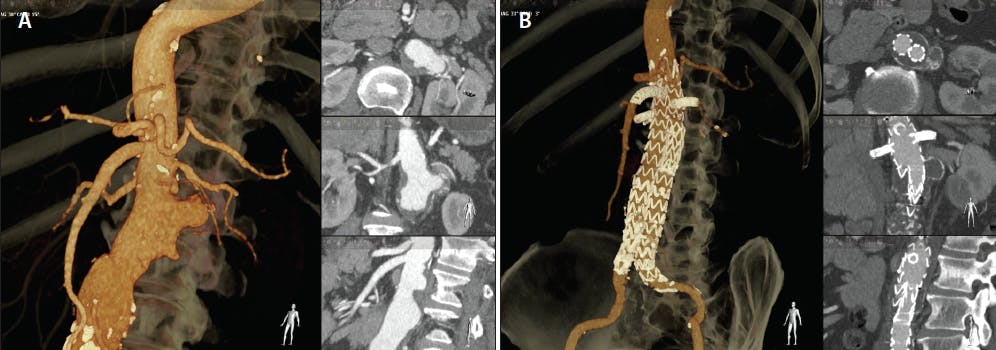
Figure 1. Preoperative CT scan of a juxtarenal tender false aneurysm (A). Postoperative CT scan after three laser in situ fenestrations for both renal arteries and the superior mesenteric artery (B).
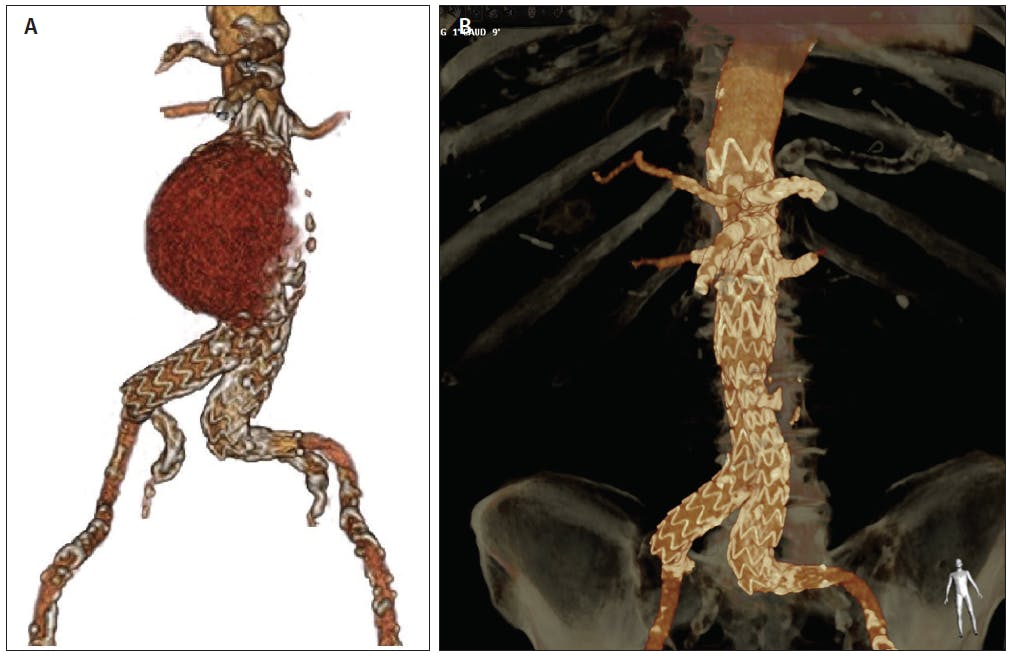
Figure 2. Preoperative CT scan depicting a type Ia endoleak post-EVAR (A). Postoperative CT scan after four laser in situ fenestrations (B).
LIMITATIONS
All emergency and urgent complex endovascular solutions have compromises. CHIMPS operations have the risk of gutter endoleaks and stroke. PMEGs require significant expertise and time for graft preparation.
In situ laser fenestration also has its limitations, specifically the risk of type III endoleaks between the bridging stent and the nonreinforced in situ fenestration. This constitutes a potentially significant diversion from the standard use of reinforcement rings placed around the fenestrations in both PMEG and CMDs. The endograft polyester fabric may be exposed to premature wear secondary to friction and torsion forces as a consequence of pulsation. We try to limit the initial damage to the fabric by using small-caliber laser fibers and by gradually expanding the fenestration. By its nature, in situ laser fenestration exposes patients to some degree of temporary visceral ischemia. With this in mind, we strongly advocate that the visceral fenestration/reperfusion sequence should start with the superior mesenteric artery, then the renal arteries, and finally, the celiac trunk when all four visceral arteries are involved. Nevertheless, with practice, it can be a rapid solution. Our reported median time to perform four fenestrations is < 1 hour.4 A potential advantage of in situ fenestration over the PMEG technique is rapid exclusion of the aneurysm, which can be advantageous when there is rupture.
Treatment success requires the availability of a variety of materials, and a significant stock of standard endografts (tubular and bifurcated) should be immediately available in the operating suite at all hours to perform these emergency procedures. This is usually not an issue in high-volume centers. The laser fiber, steerable catheter, and prestenting of target vessels add to the procedure costs. The cost of the laser generator is usually covered by the manufacturer.
CONCLUSION
In situ laser fenestration is an off-label technique that should be limited to emergent cases in high-risk patients considered unfit for open surgery. It is a challenging endovascular technique requiring significant experience in complex endografting. Close CT scan monitoring is required during follow-up.
1. Murphy EH, Dimaio JM, Dean W, et al. Endovascular repair of acute traumatic thoracic aortic transection with laser-assisted in-situ fenestration of a stent-graft covering the left subclavian artery. J Endovasc Ther. 2009;16:457-463. doi: 10.1583/09-2746.1
2. Redlinger RE Jr, Ahanchi SS, Panneton JM. In situ laser fenestration during emergent thoracic endovascular aortic repair is an effective method for left subclavian artery revascularization. J Vasc Surg. 2013;58:1171-1177. doi: 10.1016/j.jvs.2013.04.045
3. Verscheure D, Garcia Alonso C, Brenot P, et al. In vitro analysis of antegrade in situ laser fenestration of aortic endografts. J Vasc Surg. 2017;65:199S. doi: 10.1016/j.jvs.2017.03.376
4. Le Houérou T, Fabre D, Alonso CG, et al. In situ antegrade laser fenestrations during endovascular aortic repair. Eur J Vasc Endovasc Surg. 2018;56:356-362. doi: 10.1016/j.ejvs.2018.05.014
Advertisement
Advertisement