Advertisement
Advertisement
May 2021
Hybrid Procedures for CLI: Beyond Common Femoral Artery Access
Exploring a combined approach for treatment of critical limb ischemia.
Patients with end-stage peripheral artery disease typically demonstrate multilevel disease that can extend from the aorta to the infragenicular arteries. An evaluation of the lesion location (iliac, femoropopliteal, or infrapopliteal segment) in patients who presented with critical limb ischemia (CLI) demonstrated that the large majority has involvement of at least two arterial segments.1 The lesion distribution combined with the concomitant comorbidities have implications for subsequent treatment, and oftentimes, a pure endovascular or open surgical procedure is not feasible. To treat the patient with complex multilevel disease in a single intervention that can provide an extensive revascularization, hybrid procedures have been successfully used over the last decades.2 In the majority of cases, the surgical procedure involves femoral endarterectomy and the endovascular procedure focuses on the superficial femoral artery (SFA).3 A combined approach is also possible in more distal target vessels using distal access.
HYBRID PROCEDURES: A TOOL FOR COMPLEX, MULTILEVEL DISEASE
Hybrid procedures have become an important tool in the treatment of CLI patients with complex, multilevel disease and combine the advantages of an effective open and a minimally invasive endovascular procedure. The use of a hybrid approach has been reported to be as high as 21% of all peripheral vascular reconstructions.4 Hybrid interventions can be classified according to the location of the endovascular target, where an outflow percutaneous transluminal angioplasty (PTA) refers to an endovascular procedure performed distally from the surgical access, while an inflow PTA describes a procedure proximally from the surgical procedure.3 In cases of multilevel disease, the decision on how to combine the three major treatment arms (endovascular treatment, bypass surgery, and endarterectomy) should be made based on target lesion complexity as well as the underlying condition.5 A hybrid procedure can reduce the perioperative risk, especially in older patients. Distal revascularization in patients with Rutherford category 5 and TASC D lesions, as well as in patients with major tissue loss will lead to better limb salvage, reintervention, and survival rates.6 The majority of reports on the use of hybrid procedures involves simultaneous treatment with endovascular treatment of the aortoiliac segment and surgical intervention for the femoral or femoropopliteal segment (femoral endarterectomy being the key component).4 Distal bypass after endovascular treatment of the femoropopliteal segment should also be considered, especially in patients where availability of autologous vein for a long femorodistal bypass is an issue. Any combination of open and endovascular revascularization can be used and should be attempted to avoid amputation in CLI patients.4 The Case 1 and Case 2 sidebars present a combined approach with distal endovascular arterial access.
CASE 1
A man in his early 80s with a history of diabetes mellitus, hypertension, coronary artery bypass grafting, renal insufficiency, and bilateral carotid stenosis presented with Rutherford class 3 disease (walking distance 50 m, after initial rest pain). Duplex ultrasound demonstrated a bilateral aneurysm of the SFA/proximal popliteal artery with a diameter of 33 mm and an occlusion of the distal popliteal artery on the right side. MRA confirmed the presence of the aneurysm and the occlusion of the distal popliteal artery as well as an occlusion of the tibioperoneal trunk (Figure 1A). The anterior tibial artery was occluded, the posterior tibial artery demonstrated a stenosis in the proximal segment, and the peroneal artery showed a stenosis at its origin, with the connection between these arteries through the very distal, still patent, segment of the tibioperoneal trunk (Figure 1B). At the level of the foot, good filling of the medial and lateral plantar artery was seen. The dorsalis pedis artery was filling through the anterior collateral of the peroneal artery.
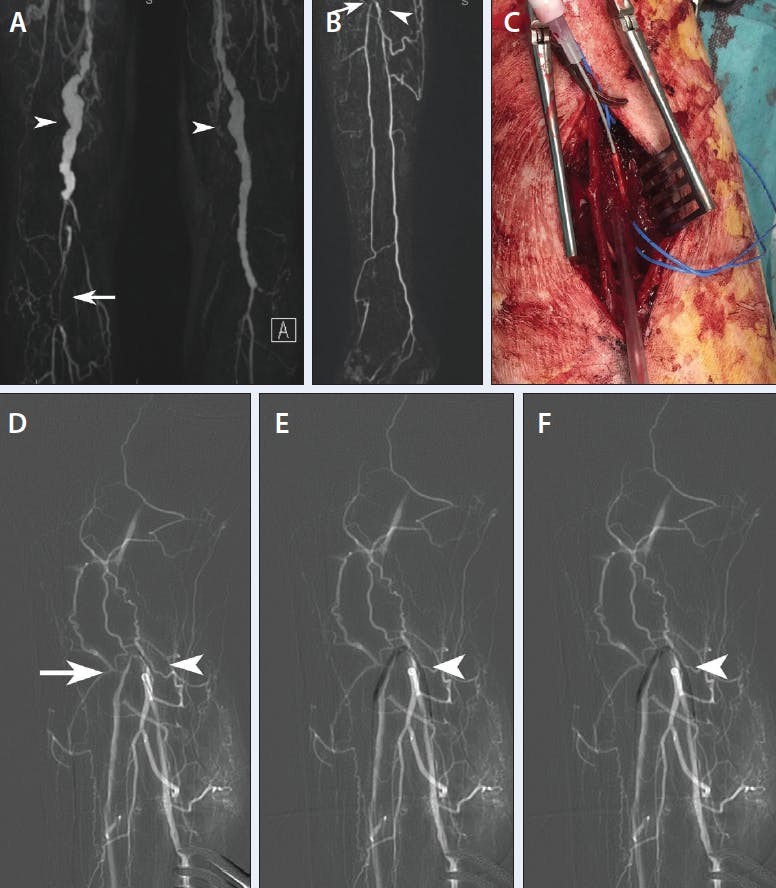
Figure 1. MRA showing bilateral popliteal aneurysms (arrowheads), with occlusion of the distal popliteal artery on the right side (arrow) (A). MRA of the right lower leg demonstrating stenosis of the proximal segment of the posterior tibial artery (arrow), and peroneal artery (arrowhead) (B). Photographic image of distal anastomosis site at the posterior tibial artery with 3-F pedal access set in place (C). Roadmap image of contrast injection through the 3-F sheath demonstrating stenosis of proximal part of posterior tibial artery (arrowhead) and peroneal artery (arrow) (D). Roadmap image after crossing of Advantage 0.014-inch guidewire (Terumo Interventional Systems) with inflated 2.5- X 40-mm Amphirion Deep angioplasty balloon extending from posterior tibial artery into the peroneal artery (arrowhead) (E). Control angiogram demonstrating patency of both posterior tibial and peroneal artery (F).
Surgical repair of the popliteal aneurysm was planned, with a distal anastomosis at the level of the midsegment of the posterior tibial artery because this was the best runoff vessel. After confectioning of the proximal anastomosis of the venous bypass, a direct, retrograde puncture of the posterior tibial artery was performed at the level of the planned distal anastomosis site using a 3-F Pedal Access Set (Cook Medical). To optimize outflow, PTA of the proximal posterior tibial artery and the fibular artery was performed using a 2.5- X 40-mm Amphirion Deep balloon (Medtronic), with the balloon extending from the posterior tibial artery toward the peroneal artery (Figure 1C-F). Subsequently, the distal anastomosis was performed. The clinical course was uneventful.
The endovascular part of a hybrid procedure that involves common femoral artery (CFA) endarterectomy can be performed before or after the patch closure of the CFA, provided the patient remains adequately heparinized,7 although some authors advocate to perform the endovascular procedure after the surgical component has been completed.4 In cases where stenting of the common iliac artery is performed, outflow typically is still guaranteed through the internal iliac artery, and therefore the CFA endarterectomy can be performed without issues after the endovascular procedure. For procedures where stenting of the SFA or external iliac artery is needed, it is better to avoid stagnant flow in the treated segment, and this part of the procedure should be performed after the surgical endarterectomy.
CASE 2
A man in his early 70s with a history of diabetes mellitus, hypertension, and previous coronary artery bypass grafting presented with necrosis of the first, third, and fourth toe (Figure 2A). The medical history also mentioned previous stenting of the distal SFA and proximal popliteal artery, as well as two previous failed attempts of recanalization (both antegrade and retrograde) of a heavily calcified occlusion of the P3 segment of the left popliteal artery. Diagnostic angiography performed during the last endovascular attempt demonstrated multiple stenoses of the SFA and proximal popliteal artery multiple stenosis, while the distal outflow showed a patent tibioperoneal trunk and peroneal artery, a patent posterior tibial artery, and an occluded common plantar artery, as well as an occlusion of the proximal anterior tibial artery. At the level of the foot, patency of the lateral and medial plantar artery was observed, with patency of a reduced caliber dorsalis pedis artery (Figure 2B-E). The patient was scheduled for a femorodistal autologous vein bypass to the posterior tibial artery with endovascular recanalization of the distal posterior tibial/common plantar artery. After preparation of the venous conduit, suturing the proximal anastomosis, and achieving surgical access to the distal anastomotic site, the posterior tibial artery was punctured in an antegrade fashion with a 4-F Radifocus micropuncture introducer set (Terumo Interventional Systems), and recanalization of the occlusion was performed using a 0.014-inch Halberd guidewire (Asahi Intecc USA, Inc.) followed by a 0.014-inch Advantage guidewire. Balloon angioplasty was performed with a 2.5- X 60-mm Armada balloon (Abbott), with good angiographic outcome (Figure 2F-I).
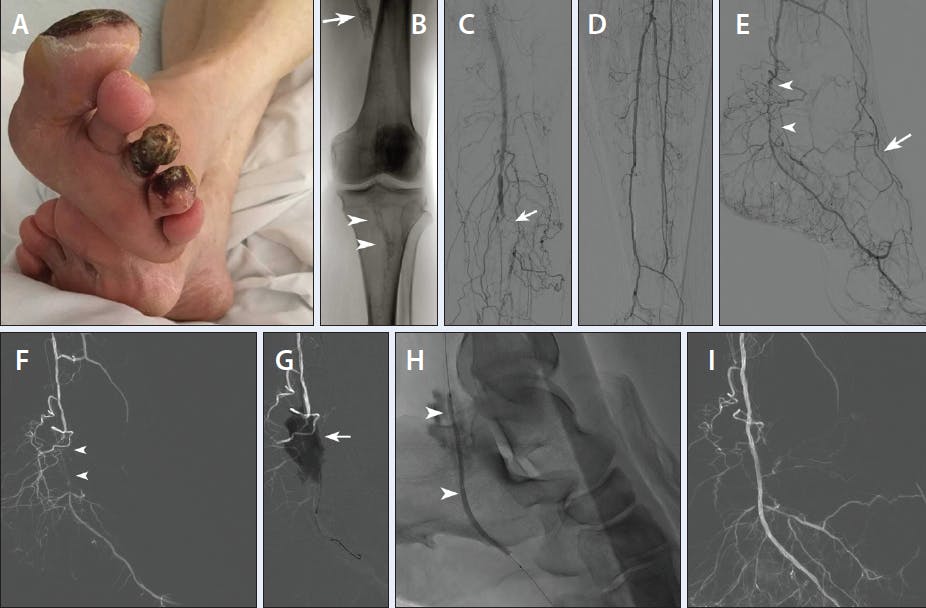
Figure 2. Photograph of the left foot demonstrating necrosis/gangrene of the first, third, and fourth toe (A). Fluoroscopic image demonstrating presence of stent in the proximal popliteal artery (arrow) as well as severe calcification of the distal popliteal artery and tibioperoneal trunk (arrowheads) (B). Digital subtraction angiogram (DSA) confirming occlusion of the distal popliteal artery (arrow) and tibioperoneal trunk (C). DSA showing good patency of posterior tibial and peroneal artery and small-caliber anterior tibial artery (D). DSA showing occlusion of the distal posterior tibial and common plantar artery (arrowheads) and a stenosis in the distal anterior tibial artery with small partially occluded dorsalis pedis artery (arrow) (E). Intraoperative roadmap image demonstrating occlusion of the distal posterior tibial and common plantar artery (arrowheads) (F). Roadmap image after guidewire crossing. Note the extravasation of contrast due to perforation (arrow) caused during attempt to cross the occlusion (G). Fluoroscopic image showing inflated 2.5- X 60-mm Armada angioplasty balloon (arrowheads) (H). Control angiogram showing restoration of direct flow toward the medial and lateral plantar artery (I).
Although hybrid procedures have been performed as staged procedures in the past, a simultaneous approach is now preferred because of several advantages: (1) a simultaneous approach avoids additional delay in achieving complete revascularization and allows for correction of inadequate endovascular results by surgical means and vice versa; (2) it eliminates puncture site complications related to a percutaneous approach; (3) it avoids adjustment of medical therapy (eg, anticoagulation) that would be necessary between two staged procedures; (4) it potentially reduces hospital stay and costs; (5) and it allows for angiographic control of the entire revascularization.2,8 Results of hybrid procedures in CLI patients are good, with limb salvage rates as high as 86% at 10 years.3 Remarkably, no amputations were reported at 3 years in a complex group treated in a hybrid fashion, while the limb salvage rate at 3 years was 80% in simple lesions.4 Even in diabetic patients, similar survival and limb salvage rates can be achieved; a 91.3% limb salvage rate was reported in diabetic patients who underwent a hybrid revascularization procedure as compared to 93.3% in nondiabetic patients (P = .613).9 When performing a hybrid procedure it is important to establish direct runoff to at least one vessel. Complete revascularization has more favorable outcomes than incomplete revascularization, with fewer major amputations, better wound healing potential and pain reduction.5
CONCLUSION
The role of endovascular and surgical treatment should be considered complementary, and a creative use of the combination of techniques will allow for a wider range of complex pathology to be managed successfully and achieve a high rate of limb salvage in CLI patients.
1. van den berg J, Waser S, Trelle S, et al. Lesion characteristics of patients with chronic critical limb ischemia that determine choice of treatment modality. J Cardiovasc Surg (Torino). 2012;53:45-52.
2. Balaz P, Rokosny S, Bafrnec J, Björck M. The role of hybrid procedures in the management of peripheral vascular disease. Scand J Surg. 2012;101:232-237. doi: 10.1177/145749691210100402
3. Serna Santos J, Söderström M, Helminen R, et al. Outcome after hybrid outflow interventions for chronic limb-threatening ischemia. Scand J Surg. Published online December 13, 2020. doi: 10.1177/1457496920975608
4. Dosluoglu HH, Lall P, Cherr GS, et al. Role of simple and complex hybrid revascularization procedures for symptomatic lower extremity occlusive disease. J Vasc Surg. 2010;51:1425-1435.e1. doi: 10.1016/j.jvs.2010.01.092
5. Takayama T, Matsumura JS. Complete lower extremity revascularization via a hybrid procedure for patients with critical limb ischemia. Vasc Endovascular Surg. 2018;52:255-261. doi: 10.1177/1538574418761723
6. Malgor RD, Ricotta JJ 2nd, Bower TC, et al. Common femoral artery endarterectomy for lower-extremity ischemia: evaluating the need for additional distal limb revascularization. Ann Vasc Surg. 2012;26:946-956. doi: 10.1016/j.avsg.2012.02.014
7. Matsagkas M, Kouvelos G, Arnaoutoglou E, et al. Hybrid procedures for patients with critical limb ischemia and severe common femoral artery atherosclerosis. Ann Vasc Surg. 2011;25:1063-1069. doi: 10.1016/j.avsg.2011.07.010
8. Antoniou GA, Sfyroeras GS, Karathanos C, et al. Hybrid endovascular and open treatment of severe multilevel lower extremity arterial disease. Eur J Vasc Endovasc Surg. 2009;38:616-622. doi: 10.1016/j.ejvs.2009.06.016
9. Berchiolli RN, Marconi M, Mocellin DM, et al. Hybrid procedures and femoral endarterectomy in diabetic patients. Eur Rev Med Pharmacol Sci. 2019;23:1257-1265. doi: 10.26355/eurrev_201902_17019
Advertisement
Advertisement