Advertisement
Advertisement
May 2021
Pedal Artery Revascularization: Where Are We in 2021?
An overview of current data and suggested indications for pedal artery revascularization.
By Srini Tummala, MD; Young Kim, MD; and Anahita Dua, MD, MS, MBA
Critical limb ischemia (CLI) is a major cause of morbidity and mortality worldwide, and it is on the rise due to the increasing prevalence of diabetes mellitus (DM). Patients with DM often present with combined tibial and pedal artery disease and have an increased rate of amputation.1-4 Clinical trials have demonstrated that treating tibial vessels only when there is significant coexisting pedal artery disease results in suboptimal wound healing.5,6 Suboptimal wound healing increases morbidity, lowers quality of life, and increases medical costs even if limb loss is prevented.6-9 Over the last 2 decades, the feasibility and safety of pedal artery revascularization (PAR) and the importance of an intact pedal arch on wound healing have become clearer. The last decade has resulted in improved endovascular equipment, including 0.014-inch support catheters, 0.014-inch guidewires, and low-profile angioplasty balloons. In addition, advanced endovascular techniques such as retrograde pedal artery access and subintimal arterial flossing with antegrade-retrograde intervention (SAFARI) have been perfected. Both of these factors have resulted in improved outcomes of previously unreconstructable pedal artery disease.10 As a result, there is a renewed interest in PAR.10-16
EXPLORING THE DATA
More than a decade ago, Manzi and colleagues showed that PAR was feasible, safe, and provided clinical results at short- and midterm follow-up. In the study, 1,331 CLI patients were treated, with 135 (10.1%) undergoing PAR using the pedal-plantar loop technique. Technical success for this technique was 85%, with clinical improvement and functional status obtained and maintained after an average of 12 months.10
A few years later, Kawarada et al classified the pedal arch into types 1 to 3 and showed that arch status was an independent predictor of wound healing (Figure 1). At that time, the authors suggested that clinically driven distal revascularization to establish a pedal arch was vital to facilitate complete wound healing.5
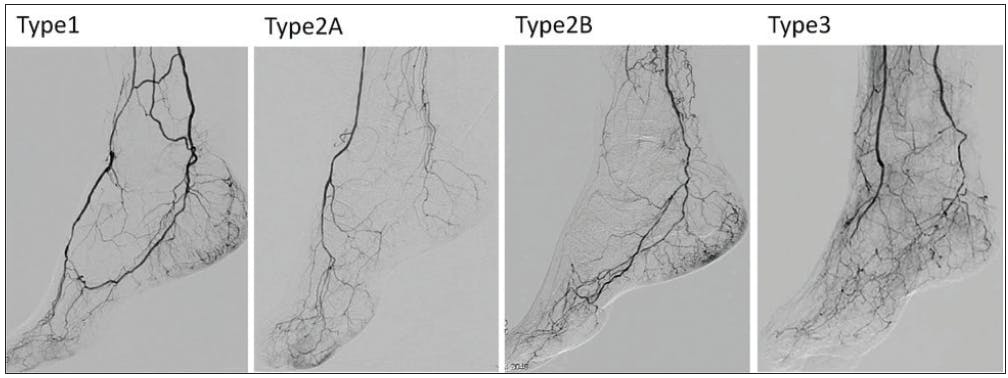
Figure 1. Kawarada pedal arch classification. Type 1: Both the dorsalis pedis and plantar arteries are patent. Type 2A: Only the dorsalis pedis artery is patent. Type 2B: Only the plantar artery is patent. Type 3: Both the dorsalis pedis and plantar arteries are occluded. Adapted with permission from Kawarada O, Fujihara M, Higashimori A, et al. Predictors of adverse clinical outcomes after successful infrapopliteal intervention. Catheter Cardiovasc Interv. 2012;80:861-871. doi: 10.1002/ccd.24370
In 2017, results from the multicenter RENDEZVOUS registry demonstrated that the speed and extent of wound healing were improved after endovascular PAR.17 A total of 257 CLI patients with de novo infrapopliteal and pedal artery disease from five experienced Japanese cardiovascular centers were divided into two groups: pedal artery angioplasty (PAA) (n = 140) or no PAA (n = 117). In the PAA group, the rate of wound healing was higher (57.5% vs 37.3%; P = .003) and the time to wound healing shorter (211 vs 365 days; P = .008). In addition, a subset analysis of this study demonstrated that PAR improved the wound healing rate of CLI patients at 12 months regardless of pedal artery disease severity compared to the no PAR group.18
Two studies further reinforced the importance of the pedal arch on wound healing, limb salvage, minor amputation–free survival, and overall survival in diabetic CLI patients.
Troisi et al retrospectively studied 137 patients with nonhealing foot ulcers who underwent infrainguinal endovascular treatment. Patients were divided into three groups based on pedal arch status at the time of angiography: 42 (30.7%) with complete pedal arch (CPA), 60 (43.8%) with incomplete pedal arch (IPA), and 35 (25.5%) with an absent pedal arch (APA). The CPA group had higher rates of wound healing at 3 months compared with IPA and APA groups (50% vs 28.3% vs 20%, respectively; P = .01). At 1 year, limb salvage rates (100% vs 93.8% vs 70.1%) and overall survival (90% vs 80.8% vs 62.7%) were both significantly higher in patients with CPA compared with IPA and APA status, respectively (P < . 001). The 1-year minor amputation–free rates were also higher in the CPA cohort (84.1% vs 82.4% vs 48.9%; P = .001).19
Ismail et al assessed 60 consecutive diabetic CLI patients who were divided into three groups based on pedal arch status. Fifteen (25%) patients had CPA, 26 (43.3%) had IPA, and 19 (31.7%) had APA. Limb salvage rates were significantly improved in patients with CPA (100%) compared to IPA or APA patients (88.5% and 68.4% respectively; P = .01). Healing time was also quicker in the CPA group (3.4 vs 4 vs 6.1 months; P = .02).20
In 2019, Huizing et al published a systematic review and meta-analysis of PAA in CLI patients that evaluated the safety and effectiveness of PAR and assessed whether additional PAR after tibial artery intervention would improve clinical outcomes.21 This review included 10 articles, 478 patients, and 524 legs treated with PAR. The pooled 12-month limb salvage and amputation-free survival rates were 92% and 78%, respectively. No statistically significant difference was seen when tibial plus pedal artery intervention was compared with tibial artery revascularization alone. However, wound healing rates were better in patients who had both tibial and pedal artery disease treated successfully.
More recently, Jung et al performed a retrospective analysis of PAR in 141 CLI patients and demonstrated higher wound healing rates (76% vs 67%; P = .031) and greater freedom from major amputation (96.3% vs 84.2%; P = .009) at 1 year in patients who underwent successful PAR compared to those who did not.22 Major adverse limb event, freedom from reintervention, and overall survival did not differ significantly between the two groups.
PAR IN PRACTICE
Although newer data are showing the positive impact of PAR, there has been a lack of widespread adoption due to the lack of randomized controlled trials (RCTs), the lack of societal guidelines of when to intervene, and discrepancies in operator skills.
More data, including RCT data, can help confirm if pedal artery interventions are appropriate and lead to better outcomes. This, in turn, would help determine society guidelines of when to perform PAR. At present, non-RCT data and expert opinion have helped to support common scenarios in which PAR may be beneficial. These include CLI patients with tissue loss (ie, Rutherford class 5 and 6) (Figure 2 and Figure 3), as well as postsurgical ischemic wounds (including forefoot amputations) because surgery can separate the anterior and posterior circulations of the foot (Figure 4). In these cases, direct inline flow based on the concept of angiosome and angiographosome revascularization can optimize blood flow to the ischemic wound or surgical flap.23-29 PAR should also be considered for patients in whom optimal healing does not occur after successful tibial intervention when there is coexisting pedal artery disease and insufficient flow to the ischemic territory. Patients who are nonambulatory, wheelchair bound, or have no hope for functional recovery of their limb despite revascularization should not undergo pedal artery interventions.
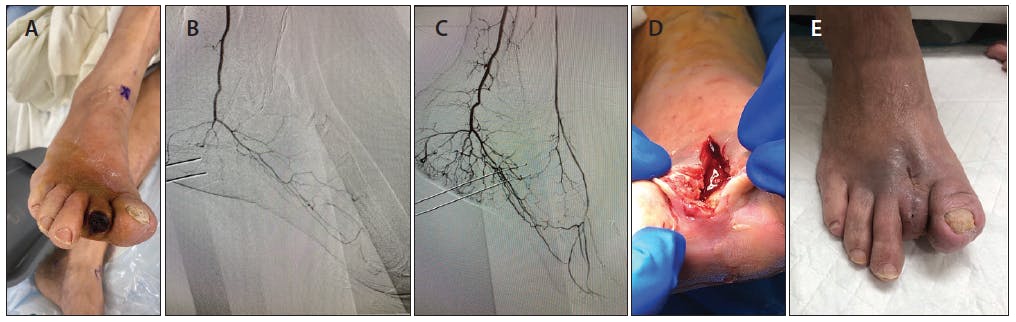
Figure 2. Patient after second toe resection for a nonhealing ulcer and associated osteomyelitis with development of gangrene at the operative site (A). The preintervention angiogram showed incomplete pedal loop and suboptimal digital flow (B). After successful PAR (C), robust intraoperative bleeding was seen during surgery (D) with subsequent complete healing (E).
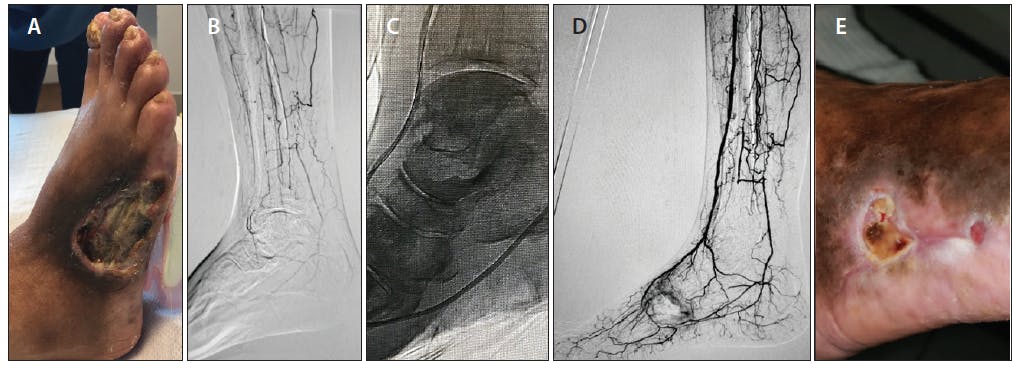
Figure 3. Large area of nonhealing ulceration in the foot (A). The preintervention angiogram showed severe tibial and pedal artery disease (B). After tibial intervention and PAR (C), final angiography showed inline flow in the anterior tibial and dorsalis pedis arteries, a patent pedal plantar loop, robust filling of the posterior tibial artery via collaterals, and an angiographic wound blush (D) that resulted in significant healing (E).
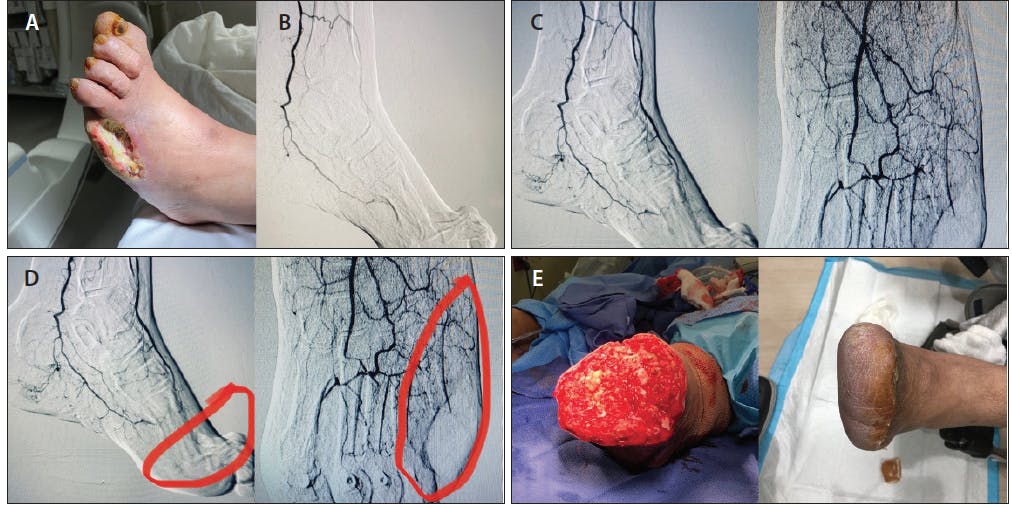
Figure 4. A diabetic patient with wound dehiscence at left fifth toe amputation site (A). The preintervention angiogram showed no dorsalis pedis artery and poor filling of the pedal plantar loop (B). Despite successful PAR with an intact pedal plantar loop (C), there was no healing at the amputation site due to diabetic microcirculation disruption (red circles) (D). However, the successful PAR did allow healing of a transmetatarsal amputation (E).
Although PAR has been part of clinical practice at experienced vascular centers for years, discrepancies in operator skills have also limited its widespread use, even in cases where it may be appropriate and beneficial. Those physicians who are highly experienced in endovascular tibial artery interventions and devices are the best equipped to learn and master PAR given the use of a similar tool kit for both territories. In addition, as endovascular techniques and skills continue to develop and are heavily incorporated into vascular training programs, more physicians will be comfortable and skilled in PAR in the coming years.
CONCLUSION
Recent studies continue to show the promise of PAR, but several challenges still exist, including clear indications, the extent of pedal arch reconstruction needed for success, and the feasibility and efficacy of newer dedicated balloons and devices. Despite this, PAR can be beneficial for CLI patients and must be considered in certain clinical scenarios.
1. Norgren L, Hiatt WR, Dormandy JA, et al. Inter-society consensus for the management of peripheral arterial disease (TASC II). J Vasc Surg. 2007;45:S5-S67. doi: 10.1016/j.jvs.2006.12.037
2. Spiliopoulos S, Katsanos K, Karnabatidis D, et al. Cryoplasty versus conventional balloon angioplasty of the femoropopliteal artery in diabetic patients: long-term results from a prospective randomized single-center controlled trial. Cardiovasc Intervent Radiol. 2010;33:929-938. doi: 10.1007/s00270-010-9915-x
3. Graziani L, Silvestro A, Bertone V, et al. Vascular involvement in diabetic subjects with ischemic foot ulcer: a new morphologic categorization of disease severity. Eur J Vasc EndoVasc Surg. 2007;33:453-460. doi: 10.1016/j.ejvs.2006.11.022
4. Chung J. Endovascular devices and revascularization techniques for limb-threatening ischemia in individuals with diabetes. J Diabetes Sci Technol. 2017;11:904-913. doi: 10.1177/1932296817702169
5. Kawarada O, Fujihara M, Higashimori A, et al. Predictors of adverse clinical outcomes after successful infrapopliteal intervention. Catheter Cardiovasc Interv. 2012;80:861-871. doi: 10.1002/ccd.24370
6. Shiraki T, Iida O, Takahara M, et al. Predictors of delayed wound healing after endovascular therapy of isolated infrapopliteal lesions underlying critical limb ischemia in patients with high prevalence of diabetes mellitus and hemodialysis. Eur J Vasc Endovasc Surg. 2015;49:565-573. doi: 10.1016/j.ejvs.2015.01.017
7. Romiti M, Albers M, Brochado-Neto FC, et al. Meta-analysis of infrapopliteal angioplasty for chronic critical limb ischemia. J Vasc Surg. 2008;47:975-981. doi: 10.1016/j.jvs.2008.01.005
8. Iida O, Soga Y, Hirano K, et al. Midterm outcomes and risk stratification after endovascular therapy for patients with critical limb ischaemia due to isolated below-the-knee lesions. Eur J Vasc Endovasc Surg. 2012;43:313-321. doi: 10.1016/j.ejvs.2011.11.025
9. Kobayashi N, Hirano K, Nakano M, et al. Predictors of non-healing in patients with critical limb ischemia and tissue loss following successful endovascular therapy. Catheter Cardiovasc Interv. 2015;85:850-858. doi: 10.1002/ccd.25625
10. Manzi M, Fusaro M, Ceccacci T, et al. Clinical results of below-the knee intervention using pedal-plantar loop technique for the revascularization of foot arteries. J Cardiovasc Surg (Torino). 2009;50:331-337.
11. Bolia A. Subintimal angioplasty in lower limb ischaemia. J Cardiovasc Surg (Torino). 2005;46:385-394.
12. Montero-Baker M, Schmidt A, Bräunlich S, et al. Retrograde approach for complex popliteal and tibioperoneal occlusions. J Endovasc Ther. 2008;15:594-604. doi: 10.1583/08-2440.1
13. Spinosa DJ, Harthun NL, Bissonette EA, et al. Subintimal arterial flossing with antegrade-retrograde intervention (SAFARI) for subintimal recanalization to treat chronic critical limb ischemia. J Vasc Interv Radiol. 2005;16:37-44. doi: 10.1097/01.RVI.0000141336.53745.4A
14. Gandini R, Pipitone V, Stefanini M, et al. The “Safari” technique to perform difficult subintimal infragenicular vessels. Cardiovasc Intervent Radiol. 2007;30:469-473. doi: 10.1007/s00270-006-0099-3
15. Graziani L, Silvestro A, Monge L, et al. Transluminal angioplasty of peroneal artery branches in diabetics: initial technical experience. Cardiovasc Intervent Radiol. 2008;31:49-55. doi: 10.1007/s00270-007-9214-3
16. Fusaro M, Dalla Paola L, Brigato C, et al. Plantar to dorsalis pedis artery subintimal angioplasty in a patient with critical foot ischemia: a novel technique in the armamentarium of the peripheral interventionist. J Cardiovasc Med (Hagerstown). 2007;8:977-980. doi: 10.2459/JCM.0b013e3280126219
17. Nakama T, Watanabe N, Haraguchi T, et al. Clinical outcomes of pedal artery angioplasty for patients with ischemic wounds results from the multicenter RENDEZVOUS registry. JACC Cardiovascu Interv. 2017;10:79-90. doi: 10.1016/j.jcin.2016.10.025
18. Tsubakimoto Y, Nakama T, Kamoi D, et al. Outcomes of pedal artery angioplasty are independent of the severity of infra-malleolar disease: a subanalysis of the multicenter RENDEZVOUS registry. J Endovasc Ther. 2020;27:186-193. doi: 10.1177/1526602820901838
19. Troisi N, Turini F, Chisci E, et al. Impact of pedal arch patency on tissue loss and time to healing in diabetic patients with foot wounds undergoing infrainguinal endovascular revascularization. Korean J Radiol. 2018;19:47-53. doi: 10.3348/kjr.2018.19.1.47
20. Ismail OA, Ahmed AA. Impact of pedal arch revascularization on clinical outcomes of diabetic patients with critical limb ischemia. Egyptian J Surg. 2020;39:344-351. doi: 10.4103/ejs.ejs_213_19
21. Huizing E, Schreve MA, de Vries JPM, et al. Below-the-ankle angioplasty in patients with critical limb ischemia: a systematic review and meta-analysis. J Vasc Interv Radiol. 2019;30:1361-1368. doi: 10.1016/j.jvir.2019.05.001
22. Jung HW, Ko YG, Hong SJ, et al. Editor’s choice–impact of endovascular pedal artery revascularisation on wound healing in patients with critical limb ischaemia. Eur J Vasc Endovasc Surg. 2019;58:854-863. doi: 10.1016/j.ejvs.2019.07.034
23. Attinger CE, Evans KK, Bulan E, et al. Angiosomes of the foot and ankle and clinical implications for limb salvage: reconstruction, incisions, and revascularization. Plast Reconstr Surg. 2006;117(7 suppl):261S–293S. doi: 10.1097/01.prs.0000222582.84385.54
24. Neville RF, Attinger CE, Bulan EJ, et al. Revascularization of a specific angiosome for limb salvage: does the target artery matter? Ann Vasc Surg. 2009;23:367-373. doi: 10.1016/j.avsg.2008.08.022
25. Iida O, Nanto S, Uematsu M, et al. Importance of the angiosome concept for endovascular therapy in patients with critical limb ischemia. Catheter Cardiovasc Interv. 2010;75:830-836. doi: 10.1002/ccd.22319
26. Alexandrescu V, Hubermont G. The challenging topic of diabetic foot revascularization: does the angiosome-guided angioplasty may improve outcome. J Cardiovasc Surg (Torino). 2012;53:3-12.
27. Alexandrescu V, Söderström M, Venermo M. Angiosome theory: fact or fiction? Scand J Surg. 2012;101:125-131. doi: 10.1177/145749691210100209
28. Varela C, Acín F, de Haro J, et al. The role of foot collateral vessels on ulcer healing and limb salvage after successful endovascular and surgical distal procedures according to an angiosome model. Vasc Endovascular Surg. 2010;44:654-660. doi: 10.1177/1538574410376601
29. Azuma N, Uchida H, Kokubo T, et al. Factors influencing wound healing of critical ischaemic foot after bypass surgery: is the angiosome important in selecting bypass target artery? Eur J Vasc Endovasc Surg. 2012;43:322-328. doi: 10.1016/j.ejvs.2011.12.001
Advertisement
Advertisement