Advertisement
Advertisement
May 2021
Sponsored by Boston Scientific Corporation
The Changing Landscape of Medical Education: Making Online Learning Personal and Effective
Breaking the mold to provide customized curricula on demand to improve patient care.
As a result of the COVID-19 pandemic, physicians and trainees have been forced to shift how they learn, how they participate in educational opportunities, and how they engage with peers. Prior to the onset of the COVID-19 pandemic, live conferences and symposia provided the majority of the educational opportunities needed for clinicians to discuss key topics and participate in peer-to-peer learning. Although the pandemic has halted virtually all substantive in-person learning opportunities for trainees and professionals, the need remains for training on new products, procedures, and techniques and evolutions in the field of vascular medicine and intervention. Beyond content needs, many professionals are seeking new ways of engaging with peers and hearing from thought leaders.
Online education has long been of interest to those in the medical education research space, particularly as studies in other disciplines have shown that it is a highly effective modality for adult learners; these individuals are more likely to pursue additional training opportunities if they are available asynchronously (on demand), are easy to navigate, and are accessible without travel.1 Although the shift to online learning has been readily adopted in other fields of study, including other areas of the biological sciences, medicine has been a late adopter of the online learning environment (Figure 1). Pre-pandemic, various biomedical companies were starting to develop platforms to meet medical education needs to better engage constituents.
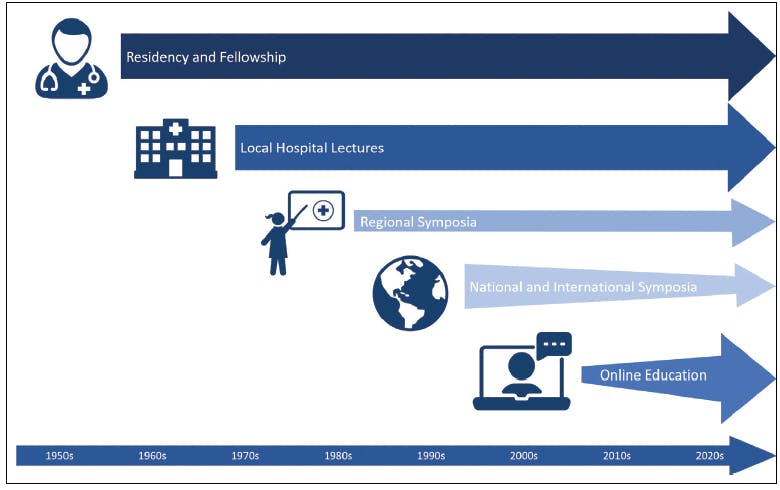
Figure 1. Evolution of medical education.
In our current world, physicians by necessity are developing new learning habits and searching for new resources to supplement their learning. As medicine is a field that has long relied on in-person education, a shift to online learning is challenging even without the backdrop of a pandemic. Therefore, acclimating to this new modality has been particularly difficult for some health care professionals as they balance the demands of their work with opportunities for independent learning.2 Many who were cautious or hesitant to teach online have been urged to adopt online learning as a viable educational platform, as is evidenced by guidance on how to adapt to web-based education that has been recently released by professional societies.3,4
While the opportunity for in-person learning will eventually return in some manner, web-based learning is likely here to stay. To that end, the early establishment of strong online learning platforms is necessary; such platforms need to be able to deliver trusted information to the health care provider on demand in a convenient, streamlined, and customizable manner while providing opportunity for interaction, either live or asynchronously.
REACHING HEALTH CARE PROVIDERS AT ALL LEVELS
Although there has been a dramatic increase in the availability of online medical education programming over the past several years, many platforms are hampered by similar limitations. One key limitation is in the prescriptive nature of many curricula offered by industry, which provide little flexibility in tailoring to the provider’s interests and educational level. Such offerings are often limited in scope to procedures utilizing the sponsor company’s products and do not include the “basics” that may be needed for earlier career providers, as well as new concepts emerging in the field for experienced clinicians to contextualize use of these products and procedures (such as disease states, techniques, and best practices).
To help support medical education efforts now and into the future, Boston Scientific Corporation has launched the fully digital EDUCARE educational platform as a resource to those practicing vascular medicine and intervention (Figure 2). This platform aims to provide education to interventional cardiologists, interventional radiologists, vascular surgeons, and vascular medicine specialists at all levels, from trainee to seasoned clinician and allied health professional. The goal is to provide easily understandable resources to the health care provider at an appropriate level with just a few clicks. Regardless of where an individual is in their career path, the resources provided in EDUCARE will keep them up to date on the latest advances in peripheral interventions.
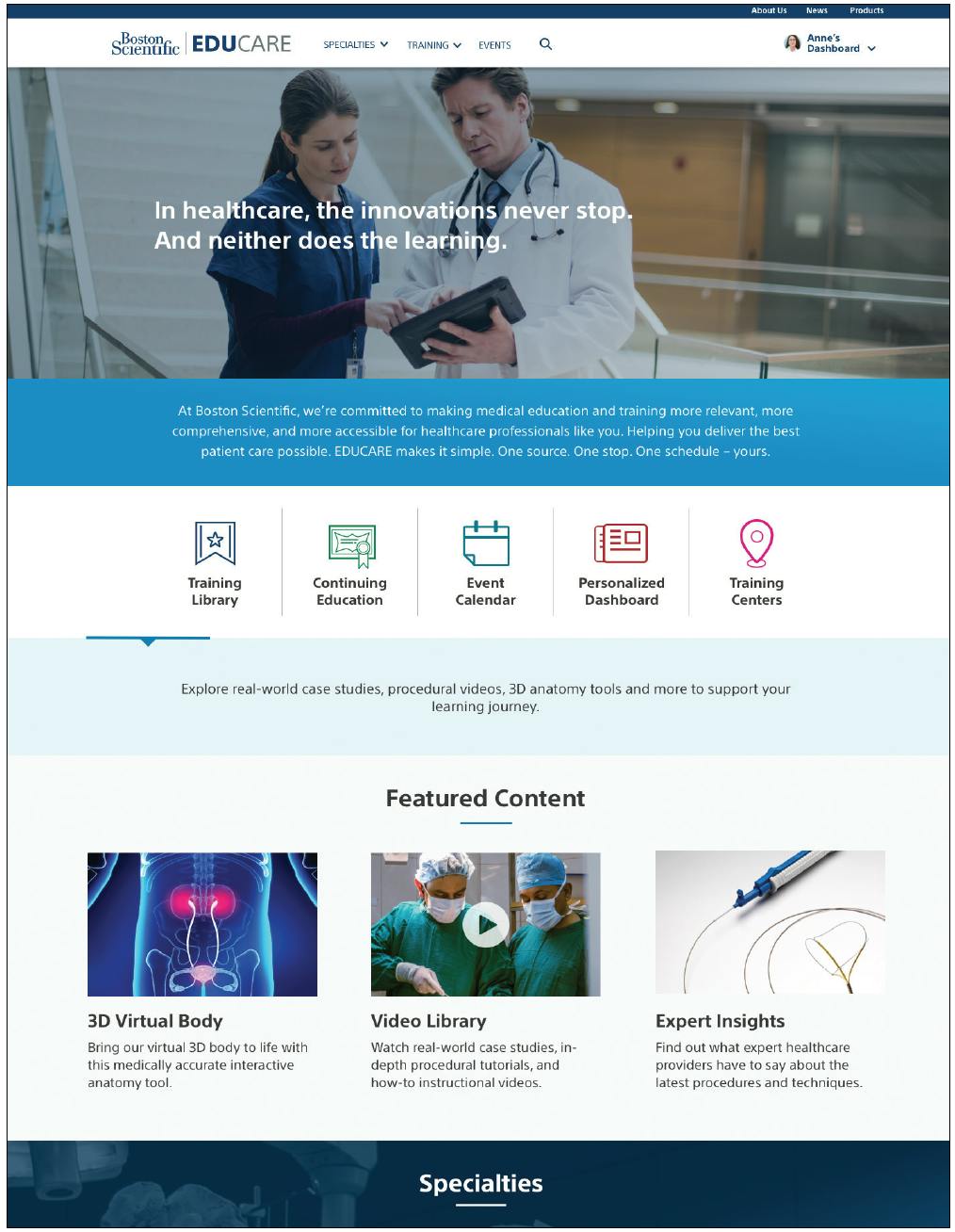
Figure 2. The EDUCARE platform.
Health care professionals can create highly personalized curricula to support their personal and professional development goals by selecting a topic of interest, specialty, procedure, or content type. After completing a few initial questions, users are presented with a personalized, secure EDUCARE dashboard containing their tailored course and resource recommendations. Content includes a variety of different forms of media, including videos, PDFs, and interactive learning exercises. All of the content is integrated into a learning management system, which helps providers identify and navigate to relevant content as they develop their curriculum, as well as manage learning tasks. As physicians complete modules and activities, the learning management system’s feedback loop helps to suggest other pieces that may be relevant.
Offerings included may consist of disease state education, procedures, and “learning journeys.” These “learning journeys” will utilize a form of case-based learning and include a series of pre-selected modules aimed at teaching to a particular clinical condition or case. This type of offering has been shown to be particularly effective in increasing self-motivation, which is critical to ensuring success with online learning.5,6 That is, adult learners are more likely to engage and commit to learning if the online activities are carefully designed to improve perceptions of task value, particularly for professionals.
A current challenge in medical education is delivering peer-to-peer education in the absence of traditional in-person conferences. To that end, content developed for and delivered through EDUCARE is created in partnership with respected faculty who are considered thought leaders; this allows health care providers to gain knowledge directly from leaders in peripheral interventions, much as they would have in a conference setting. The diversity of the faculty involved in the development of the platform has allowed for great breadth and depth of sessions, from introductory courses for residents and fellows to master courses for those who are well into their career, including allied health professionals.
BEYOND COURSEWORK: ACTIONABLE, EVOLVING CONTENT
Another challenge facing online medical education is keeping content fresh, relevant, and up to date, especially given the sheer speed with which innovation occurs in today’s world. To ensure content accuracy, some online platforms often focus on evergreen content, particularly related to their products. Although this ensures that incorrect information is not delivered, it limits the ability of clinicians to use these platforms to stay up to date on the literature, technology, and data in their respective fields. Additionally, most information available through company online learning platforms is not easily searchable, requiring the physician to wade through potentially irrelevant learning modules and courses in order to find the desired information.
To complement the more traditional online learning modules, EDUCARE features a constantly updated, highly searchable library of physician-focused learning resources and information. Additionally, much of this content is highly interactive. The goal of investing in this resource is to enable clinicians to have access to one central location for the information that they need to improve their clinical knowledge and procedural skills and ultimately, their patient outcomes. The library includes disease state learnings, clinical data summaries, live case recordings, key journal articles and case studies, recorded webinars, and recorded roundtable discussions with thought leaders. Additionally, the library includes an actively maintained calendar of upcoming events and a directory of local training center locations and course opportunities.
An additional strength of EDUCARE lies in the fact that every division within Boston Scientific Corporation will house their information and educational offerings on the EDUCARE platform. Health care professionals with cross-specialty interests will be able to access content from over 19 different specialties, all accessible through the same URL with the same login information.
The EDUCARE library is especially valuable for those on the front lines of the COVID-19 pandemic, for whom training is necessary to provide optimal patient care but may only have time to learn between patients or when home with some free time. The library also allows for evolution of the courses available as previously described, allowing clinicians not only to learn on their own time but also to personalize how broad and deep their learning is—truly representing the next generation of self-directed learning.
THE FUTURE OF PERIPHERAL INTERVENTION EDUCATION
Although some content, such as disease state and anatomy, do not change, medicine and medical education will continue to evolve. To that end, the EDUCARE team is continually working with faculty and thought leaders to ensure that the content delivered through the platform is on the leading edge of vascular clinical science and practice. Care for patients with critical limb ischemia (CLI), for example, is ever-evolving; education on best practices and techniques for CLI are necessary for providers at all career stages. Where possible, the EDUCARE faculty are now offering synchronous (live) courses on these topics, all of which are recorded and subsequently available through the EDUCARE library. Notably, a “Basics of CLI” course for early career professionals is now available, and a “Master’s Course in CLI” will be offered in July 2021 for established practitioners. As with all EDUCARE content, the CLI offerings are being developed in conjunction with thought leaders in the field, such as vascular surgeon Dr. Steve Henao, MD, of the Vascular and Vein Institute of Siouxland.
As the platform continues to grow, the ultimate goal is to create an objective, centralized resource for both synchronous and asynchronous (live and on demand) medical education—getting the high-quality, current content to the physician at the right time and in the right way.
Acknowledgments: We thank Daniel Janse (Boston Scientific Corporation) for leadership with the development and maintenance of EDUCARE and Alexandra Greenberg-Worisek, PhD, MPH (Boston Scientific Corporation), for providing medical writing assistance.
1. Hashim KF, Tan FB, Rashid A. Adult learners’ intention to adopt mobile learning: a motivational perspective. Br J Educ Technol. 2015;46:381-390. doi: 10.1111/bjet.12148
2. Russell SW, Ahuja N, Patel A, et al. Peabody’s paradox: balancing patient care and medical education in a pandemic. J Grad Med Educ. 2020;12:264-268. doi: 10.4300/JGME-D-20-00251.1
3. Hilburg R, Patel N, Ambruso S, et al. Medical education during the COVID-19 pandemic: learning from a distance. Adv Chronic Kidney Dis. 2020;27:412-417. doi: 10.1053/j.ackd.2020.05.017
4. Gordon M, Patricio M, Horne L, et al. Developments in medical education in response to the COVID-19 pandemic: a rapid BEME systematic review: BEME Guide No. 63. Med Teach. 2020;42:1202-1215. doi: 10.1080/0142159X.2020.1807484
5. Lee CY. Changes in self-efficacy and task value in online learning. Distance Educ. 2015;36:59-79. doi: 10.1080/01587919.2015.1019967
6. Huang HM. Toward constructivism for adult learners in online learning environments. Br J Educ Technol. 2002;33:27-37. doi: 10.1111/1467-8535.00236

Advertisement
Advertisement